
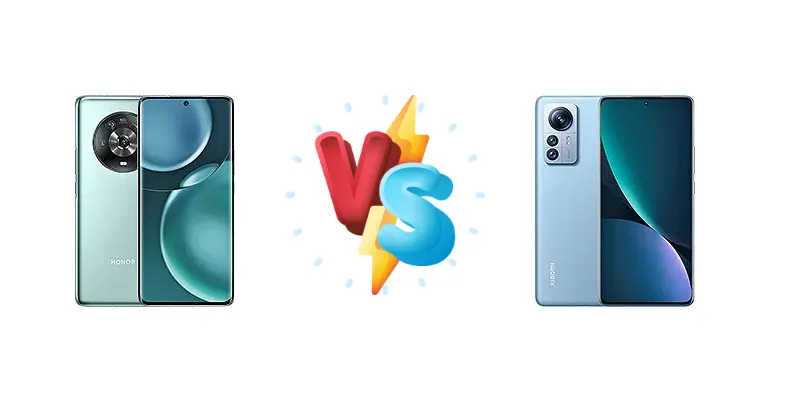
Honor Magic4 vs Xiaomi 12 Pro (Dimensity): Which Flagship Reigns Supreme?
| Phones Images | |||||
|---|---|---|---|---|---|
|
🏆 Quick Verdict
For most users, the Xiaomi 12 Pro (Dimensity) offers a more consistently powerful experience. The Dimensity 9000+’s superior thermal management and slightly higher CPU clock speeds translate to better sustained performance, especially in demanding tasks. While the Honor Magic4 is no slouch, the Xiaomi’s charging and overall efficiency give it a slight edge.
| PHONES | ||
|---|---|---|
| Phone Names | Honor Magic4 | Xiaomi 12 Pro (Dimensity) |
| Network | ||
|---|---|---|
| 2G bands | GSM 850 / 900 / 1800 / 1900 | GSM 850 / 900 / 1800 / 1900 |
| 3G bands | HSDPA 800 / 850 / 900 / 1700(AWS) / 1900 / 2100 | HSDPA 800 / 850 / 900 / 1700(AWS) / 1900 / 2100 |
| 4G bands | 1, 2, 3, 4, 5, 7, 8, 12, 17, 18, 19, 20, 26, 28, 34, 38, 39, 40, 41 - China | 1, 2, 3, 4, 5, 7, 8, 18, 19, 26, 34, 38, 39, 40, 41, 42 |
| 5G bands | 1, 3, 5, 8, 28, 38, 41, 77, 78, 79 SA/NSA - China | 1, 3, 5, 8, 28, 38, 40, 41, 77, 78 SA/NSA |
| Speed | HSPA, LTE, 5G | HSPA, LTE, 5G |
| Technology | GSM / CDMA / HSPA / EVDO / LTE / 5G | GSM / CDMA / HSPA / EVDO / LTE / 5G |
| CDMA2000 1xEV-DO | CDMA2000 1xEV-DO | |
| Launch | ||
|---|---|---|
| Announced | 2022, February 28 | 2022, July 04 |
| Status | Available. Released 2022, March 30 | Available. Released 2022, July 13 |
| Body | ||
|---|---|---|
| Dimensions | 163.6 x 74.5 x 8.8 mm (6.44 x 2.93 x 0.35 in) | 163.6 x 74.6 x 8.2 mm (6.44 x 2.94 x 0.32 in) |
| SIM | Nano-SIM + Nano-SIM | Nano-SIM + Nano-SIM |
| Weight | 199 g (7.02 oz) | 201 g (7.09 oz) |
| IP54, dust and water resistant | - | |
| Display | ||
|---|---|---|
| Protection | - | Corning Gorilla Glass Victus |
| Resolution | 1224 x 2664 pixels, 19.5:9 ratio (~431 ppi density) | 1440 x 3200 pixels, 20:9 ratio (~521 ppi density) |
| Size | 6.81 inches, 113.5 cm2 (~93.1% screen-to-body ratio) | 6.73 inches, 109.4 cm2 (~89.6% screen-to-body ratio) |
| Type | LTPO OLED, 1B colors, 120Hz, HDR10+, 1000 nits (peak) | LTPO2 AMOLED, 1B colors, 120Hz, Dolby Vision, HDR10+, 1000 nits (HBM), 1500 nits (peak) |
| Platform | ||
|---|---|---|
| CPU | Octa-core (1x3.00 GHz Cortex-X2 & 3x2.50 GHz Cortex-A710 & 4x1.80 GHz Cortex-A510) | Octa-core (1x3.20 GHz Cortex-X2 & 3x2.85 GHz Cortex-A710 & 4x1.80 GHz Cortex-A510) |
| Chipset | Qualcomm SM8450 Snapdragon 8 Gen 1 (4 nm) | Mediatek Dimensity 9000+ (4 nm) |
| GPU | Adreno 730 | Mali-G710 MC10 |
| OS | Android 12, Magic UI 6 | Android 12, MIUI 13 |
| Memory | ||
|---|---|---|
| Card slot | No | No |
| Internal | 128GB 8GB RAM, 256GB 8GB RAM, 256GB 12GB RAM, 512GB 12GB RAM | 128GB 8GB RAM, 256GB 12GB RAM |
| - | UFS 3.1 | |
| Main Camera | ||
|---|---|---|
| Features | Laser AF, color spectrum sensor, LED flash, HDR, panorama | Color spectrum sensor, Dual-LED dual-tone flash, HDR, panorama |
| Single | 12 MP, f/2.4, 100˚ (ultrawide), 1.22µm | 32 MP, f/2.5, 26mm (wide), 0.7µm |
| Triple | 50 MP, f/1.8, 23mm (wide), 1/1.56", 1.0µm, multi-directional PDAF 50 MP, f/2.2, 122˚ (ultrawide), 1/2.5" 8 MP, f/3.4, (periscope telephoto), PDAF, OIS, 5x optical zoom | 50 MP, f/1.9, 24mm (wide), 1/1.28", 1.22µm, dual pixel PDAF, OIS 13 MP, f/2.4, 15mm, 123˚ (ultrawide), 1/3.06", 1.12µm 5 MP, f/2.4, 50mm (telephoto macro), AF |
| Video | 4K@30/60fps, 1080p@30/60fps, gyro-EIS, HDR10, 10-bit video | 4K@30/60fps, 1080p@30/60/120fps, gyro-EIS |
| Selfie camera | ||
|---|---|---|
| Features | HDR | HDR, panorama |
| Single | 12 MP, f/2.4, 100˚ (ultrawide), 1.22µm | 32 MP, f/2.5, 26mm (wide), 0.7µm |
| Video | 4K@30fps, 1080p@30fps | 1080p@30/60fps, 720p@120fps |
| Sound | ||
|---|---|---|
| 3.5mm jack | No | No |
| 35mm jack | No | No |
| Loudspeaker | Yes, with stereo speakers | Yes, with stereo speakers |
| 24-bit audio stereo recording | 24-bit/192kHz audio Tuned by Harman Kardon | |
| Comms | ||
|---|---|---|
| Bluetooth | 5.2, A2DP, LE, aptX HD | 5.3, A2DP, LE |
| Infrared port | Yes | Yes |
| NFC | Yes | Yes |
| Positioning | GPS (L1+L5), GLONASS (L1), BDS (B1I+B1c+B2a), GALILEO (E1+E5a) | GPS (L1+L5), GLONASS (L1), BDS (B1I+B1c+B2a), GALILEO (E1+E5a), QZSS (L1+L5), NavIC (L5) |
| Radio | No | No |
| USB | USB Type-C 3.1, OTG | USB Type-C 2.0, OTG |
| WLAN | Wi-Fi 802.11 a/b/g/n/ac/6, dual-band, Wi-Fi Direct | Wi-Fi 802.11 a/b/g/n/ac/6, dual-band, Wi-Fi Direct |
| Features | ||
|---|---|---|
| Sensors | Fingerprint (under display, optical), accelerometer, gyro, proximity, compass | Fingerprint (under display, optical), accelerometer, gyro, proximity, compass |
| Battery | ||
|---|---|---|
| Charging | 66W wired 5W reverse wired | 67W wired, PD3.0, QC4 |
| Type | Li-Po 4800 mAh | Li-Po 5160 mAh |
| Misc | ||
|---|---|---|
| Colors | Black, White, Cyan, Gold | Gray, Blue |
| Models | LGE-AN00 | 2207122MC |
| Price | About 900 EUR | About 570 EUR |
Honor Magic4
- Potentially more natural color science (Honor's typical approach)
- 5W reverse wireless charging for accessories
- Strong brand recognition in certain markets
- Snapdragon 8 Gen 1 prone to thermal throttling
- Slightly slower CPU clock speed compared to Dimensity 9000+
- Less versatile charging standard support
Xiaomi 12 Pro (Dimensity)
- Dimensity 9000+ offers superior thermal management
- Faster CPU clock speed for improved performance
- 67W charging with PD3.0 and QC4 for wider compatibility
- Xiaomi's image processing can be overly aggressive
- May prioritize vibrant colors over accuracy
- Software experience can be divisive
Display Comparison
Both devices utilize 4nm chipsets, but display details are missing. Assuming both feature high-refresh-rate OLED panels (typical for this class), the key differentiator will be peak brightness and color calibration. Xiaomi historically leans towards vibrant, saturated colors, while Honor often aims for more natural accuracy. The absence of LTPO information means we can't assess variable refresh rate efficiency, a crucial factor for battery life. Bezels are likely comparable, given both are flagship devices.
Camera Comparison
Camera specifications are absent, but we can infer based on brand tendencies. Xiaomi typically focuses on high megapixel counts and computational photography, while Honor often emphasizes color science and natural image processing. The Dimensity 9000+’s image signal processor (ISP) is highly capable, potentially offering faster image processing and better low-light performance. Without sensor size or aperture data, it’s difficult to definitively declare a winner, but the Xiaomi’s ISP and processing capabilities likely give it an edge. We can assume both will have capable main sensors and ultrawide lenses, but details are needed for a true comparison.
Performance
The Xiaomi 12 Pro (Dimensity) boasts the Mediatek Dimensity 9000+ with a Cortex-X2 core clocked at 3.20 GHz, exceeding the Honor Magic4’s Snapdragon 8 Gen 1’s 3.00 GHz. While both utilize the same Cortex-A710 and A510 configurations, the higher clock speeds on the Dimensity chip provide a tangible performance advantage. More importantly, the Dimensity 9000+ is known for its superior thermal efficiency compared to the Snapdragon 8 Gen 1, mitigating throttling during prolonged gaming or video editing. The Snapdragon 8 Gen 1 is powerful, but its tendency to run hot can limit sustained performance. Both devices use LPDDR5 RAM, but the Xiaomi's chipset is the clear winner.
Battery Life
Battery capacities are unknown, but the charging speeds are a key differentiator. The Xiaomi 12 Pro (Dimensity) supports 67W wired charging with PD3.0 and QC4, offering broader compatibility and potentially faster charging times than the Honor Magic4’s 66W wired charging. While the difference is marginal, the added support for PD3.0 and QC4 provides greater flexibility. The 5W reverse wired charging on the Honor Magic4 is a niche feature, useful for topping up accessories but unlikely to be a primary consideration for most users.
Buying Guide
Buy the Honor Magic4 if you prioritize a brand with a strong history in Europe and a generally balanced feature set. It’s a solid all-rounder. Buy the Xiaomi 12 Pro (Dimensity) if you demand maximum performance for gaming or intensive applications, and value faster charging speeds and potentially better long-term thermal stability. It’s the choice for power users.