
Honor Magic4 vs Asus ROG Phone 5s: A Deep Dive into Flagship Performance and Gaming Prowess
| Phones Images | |||||
|---|---|---|---|---|---|
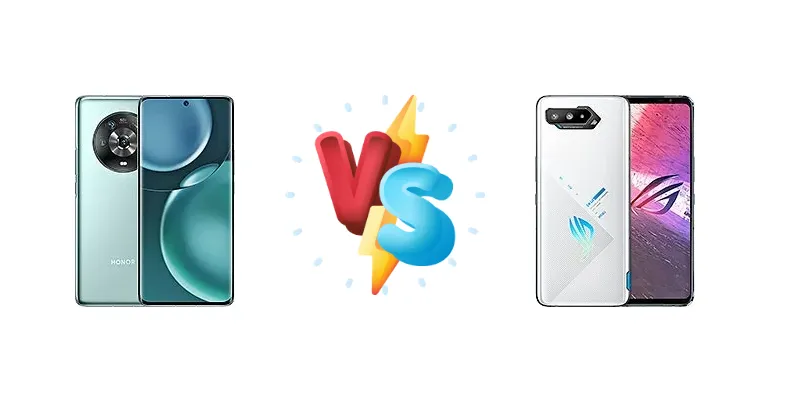
|
🏆 Quick Verdict
For the average user prioritizing a well-rounded flagship experience with a modern chipset, the Honor Magic4 emerges as the winner. Its Snapdragon 8 Gen 1 offers a performance edge, despite potential thermal concerns, and its charging is comparable. However, dedicated gamers will find the ROG Phone 5s’ optimized cooling and gaming-centric features more compelling.
| PHONES | ||
|---|---|---|
| Phone Names | Honor Magic4 | Asus ROG Phone 5s |
| Network | ||
|---|---|---|
| 2G bands | GSM 850 / 900 / 1800 / 1900 | GSM 850 / 900 / 1800 / 1900 |
| 3G bands | HSDPA 800 / 850 / 900 / 1700(AWS) / 1900 / 2100 | HSDPA 800 / 850 / 900 / 1700(AWS) / 1800 / 1900 / 2100 - Version 1 |
| 4G bands | 1, 2, 3, 4, 5, 7, 8, 12, 17, 18, 19, 20, 26, 28, 34, 38, 39, 40, 41 - China | 1, 2, 3, 4, 5, 7, 8, 12, 13, 17, 18, 19, 20, 25, 26, 28, 29, 30, 32, 34, 38, 39, 40, 41, 42, 48, 66, 71 - Version 1 |
| 5G bands | 1, 3, 5, 8, 28, 38, 41, 77, 78, 79 SA/NSA - China | 1, 2, 3, 5, 7, 8, 12, 20, 25, 28, 38, 40, 41, 66, 71, 77, 78, 79 SA/NSA - Version 1 |
| Speed | HSPA, LTE, 5G | HSPA 42.2/5.76 Mbps, LTE (7CA) Cat20 1400/150 Mbps, 5G 4 Gbps DL |
| Technology | GSM / CDMA / HSPA / EVDO / LTE / 5G | GSM / HSPA / LTE / 5G |
| CDMA2000 1xEV-DO | 2, 3, 5, 7, 12, 20, 25, 28, 38, 40, 66, 71, 77, 78, 79 SA/NSA - Version 4 | |
| Launch | ||
|---|---|---|
| Announced | 2022, February 28 | 2021, August 16 |
| Status | Available. Released 2022, March 30 | Available. Released 2021, August 26 |
| Body | ||
|---|---|---|
| Build | - | Glass front (Gorilla Glass Victus), glass back (Gorilla Glass 3), aluminum frame |
| Dimensions | 163.6 x 74.5 x 8.8 mm (6.44 x 2.93 x 0.35 in) | 172.8 x 77.3 x 9.9 mm (6.80 x 3.04 x 0.39 in) |
| SIM | Nano-SIM + Nano-SIM | Nano-SIM + Nano-SIM |
| Weight | 199 g (7.02 oz) | 238 g (8.40 oz) |
| IP54, dust and water resistant | RGB light panel (on the back) Pressure sensitive zones (Gaming triggers) | |
| Display | ||
|---|---|---|
| Protection | - | Corning Gorilla Glass Victus |
| Resolution | 1224 x 2664 pixels, 19.5:9 ratio (~431 ppi density) | 1080 x 2448 pixels (~395 ppi density) |
| Size | 6.81 inches, 113.5 cm2 (~93.1% screen-to-body ratio) | 6.78 inches, 109.5 cm2 (~82.0% screen-to-body ratio) |
| Type | LTPO OLED, 1B colors, 120Hz, HDR10+, 1000 nits (peak) | AMOLED, 1B colors, 144Hz, HDR10+, 800 nits (typ), 1200 nits (peak) |
| Platform | ||
|---|---|---|
| CPU | Octa-core (1x3.00 GHz Cortex-X2 & 3x2.50 GHz Cortex-A710 & 4x1.80 GHz Cortex-A510) | Octa-core (1x2.99 GHz Cortex-X1 & 3x2.42 GHz Cortex-A78 & 4x1.80 GHz Cortex-A55) |
| Chipset | Qualcomm SM8450 Snapdragon 8 Gen 1 (4 nm) | Qualcomm SM8350 Snapdragon 888+ 5G (5 nm) |
| GPU | Adreno 730 | Adreno 660 |
| OS | Android 12, Magic UI 6 | Android 11, upgradable to Android 13, ROG UI |
| Memory | ||
|---|---|---|
| Card slot | No | No |
| Internal | 128GB 8GB RAM, 256GB 8GB RAM, 256GB 12GB RAM, 512GB 12GB RAM | 128GB 8GB RAM, 128GB 12GB RAM, 256GB 12GB RAM, 256GB 16GB RAM, 512GB 16GB RAM, 512GB 18GB RAM |
| - | UFS 3.1 | |
| Main Camera | ||
|---|---|---|
| Features | Laser AF, color spectrum sensor, LED flash, HDR, panorama | LED flash, HDR, panorama |
| Single | 12 MP, f/2.4, 100˚ (ultrawide), 1.22µm | - |
| Triple | 50 MP, f/1.8, 23mm (wide), 1/1.56", 1.0µm, multi-directional PDAF 50 MP, f/2.2, 122˚ (ultrawide), 1/2.5" 8 MP, f/3.4, (periscope telephoto), PDAF, OIS, 5x optical zoom | 64 MP, f/1.8, 26mm (wide), 1/1.73", 0.8µm, PDAF 13 MP, f/2.4, 11mm, 125˚ (ultrawide) 5 MP (macro) |
| Video | 4K@30/60fps, 1080p@30/60fps, gyro-EIS, HDR10, 10-bit video | 8K@30fps, 4K@30/60/120fps, 1080p@30/60/120/240fps, 720p@480fps; gyro-EIS |
| Selfie camera | ||
|---|---|---|
| Features | HDR | Panorama, HDR |
| Single | 12 MP, f/2.4, 100˚ (ultrawide), 1.22µm | 24 MP, f/2.5, 27mm (wide), 0.9µm |
| Video | 4K@30fps, 1080p@30fps | 1080p@30fps |
| Sound | ||
|---|---|---|
| 3.5mm jack | No | Yes |
| 35mm jack | No | Yes |
| Loudspeaker | Yes, with stereo speakers | Yes, with stereo speakers (2 amplifiers) |
| 24-bit audio stereo recording | 24-bit/192kHz audio | |
| Comms | ||
|---|---|---|
| Bluetooth | 5.2, A2DP, LE, aptX HD | 5.2, A2DP, LE, aptX HD, aptX Adaptive |
| Infrared port | Yes | - |
| NFC | Yes | Yes |
| Positioning | GPS (L1+L5), GLONASS (L1), BDS (B1I+B1c+B2a), GALILEO (E1+E5a) | GPS (L1+L5), GLONASS (L1), BDS (B1I+B1c+B2a), GALILEO (E1+E5a), QZSS (L1+L5), NavIC (L5) |
| Radio | No | No |
| USB | USB Type-C 3.1, OTG | USB Type-C 3.1 (side), USB Type-C 2.0 (bottom), OTG, accessory connector |
| WLAN | Wi-Fi 802.11 a/b/g/n/ac/6, dual-band, Wi-Fi Direct | Wi-Fi 802.11 a/b/g/n/ac/6e, dual-band, Wi-Fi Direct |
| Features | ||
|---|---|---|
| Sensors | Fingerprint (under display, optical), accelerometer, gyro, proximity, compass | Fingerprint (under display, optical), accelerometer, gyro, proximity, compass |
| Battery | ||
|---|---|---|
| Charging | 66W wired 5W reverse wired | 65W wired, PD3.0, QC5, 70% in 30 min, 100% in 52 min 10W reverse wired |
| Type | Li-Po 4800 mAh | Li-Po 6000 mAh |
| Misc | ||
|---|---|---|
| Colors | Black, White, Cyan, Gold | Phantom Black, Storm White |
| Models | LGE-AN00 | ZS676KS |
| Price | About 900 EUR | About 1030 EUR |
Honor Magic4
- Latest Snapdragon 8 Gen 1 processor for superior performance
- Likely more advanced display technology
- Potentially superior camera system
- Potential for thermal throttling under sustained load
- May lack gaming-specific features of the ROG Phone 5s
Asus ROG Phone 5s
- Optimized for gaming with advanced cooling
- Faster charging compatibility (PD3.0, QC5)
- Larger battery capacity for extended gaming sessions
- Older Snapdragon 888+ chipset
- Less emphasis on camera performance
Display Comparison
While specific display specs beyond the chipsets aren't provided, the Honor Magic4, being a newer device, likely benefits from a more advanced panel. The ROG Phone 5s, however, is known for its high refresh rate (typically 144Hz) AMOLED display. The Snapdragon 8 Gen 1 in the Magic4 has the processing power to drive higher resolution and refresh rate panels, but thermal management will be key. The ROG Phone 5s’ display is optimized for responsiveness, crucial for gaming, while the Magic4 likely prioritizes color accuracy and brightness for multimedia consumption.
Camera Comparison
Without detailed camera specs, a direct comparison is limited. However, Honor typically emphasizes camera capabilities in its flagship devices. The Magic4 likely features a more sophisticated image processing pipeline and potentially larger sensors than the ROG Phone 5s, which prioritizes gaming features. The ROG Phone 5s camera is adequate, but not its primary selling point. The Magic4’s focus is likely on delivering high-quality photos and videos in various conditions, while the ROG Phone 5s camera serves as a functional, but secondary feature.
Performance
The core difference lies in the chipsets. The Honor Magic4’s Snapdragon 8 Gen 1 (4nm) boasts a newer CPU architecture – Cortex-X2 – compared to the ROG Phone 5s’ Snapdragon 888+ (5nm). This translates to a theoretical performance advantage for the Magic4, particularly in single-core tasks. However, the 5nm process of the 888+ is more efficient, potentially leading to better sustained performance under heavy load. The Magic4’s CPU configuration (1x3.00 GHz Cortex-X2, 3x2.50 GHz Cortex-A710, 4x1.80 GHz Cortex-A510) offers a more modern core arrangement than the ROG Phone 5s’ (1x2.99 GHz Cortex-X1, 3x2.42 GHz Cortex-A78, 4x1.80 GHz Cortex-A55). Both utilize LPDDR5 RAM, but the Magic4 likely benefits from faster speeds due to the newer platform.
Battery Life
Both phones offer fast charging – 66W for the Honor Magic4 and 65W for the Asus ROG Phone 5s. The ROG Phone 5s boasts support for PD3.0 and QC5, offering wider compatibility with chargers. While the Magic4 charges slightly faster on paper, the ROG Phone 5s’ charging profile is well-documented, reaching 70% in 30 minutes and 100% in 52 minutes. Battery capacity isn’t specified, but the ROG Phone 5s typically features a larger battery (around 5000mAh) to support its gaming focus. The 66W charging on the Magic4 will quickly replenish the battery, but the ROG Phone 5s’ larger capacity provides longer gaming sessions.
Buying Guide
Buy the Honor Magic4 if you need a versatile flagship with the latest processor for demanding tasks, a sleek design, and a balanced camera system. Buy the Asus ROG Phone 5s if you prioritize sustained gaming performance, advanced cooling solutions, customizable gaming controls, and don't mind a more utilitarian aesthetic. The ROG Phone 5s is the clear choice for competitive mobile gamers.