
Honor Magic4 Ultimate vs Oppo Find X5 Pro: Which Flagship Reigns Supreme?
| Phones Images | |||||
|---|---|---|---|---|---|
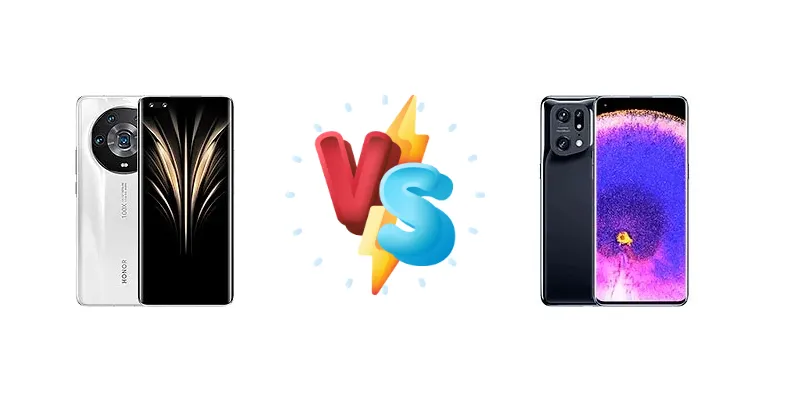
|
🏆 Quick Verdict
For users prioritizing the absolute fastest charging and a potentially more consistent performance experience, the Honor Magic4 Ultimate emerges as the winner. Its 100W wired and 50W wireless charging significantly outpace the Oppo Find X5 Pro, and the consistent Snapdragon 8 Gen 1 across all regions avoids potential chipset variability.
| PHONES | ||
|---|---|---|
| Phone Names | Honor Magic4 Ultimate | Oppo Find X5 Pro |
| Network | ||
|---|---|---|
| 2G bands | GSM 850 / 900 / 1800 / 1900 | GSM 850 / 900 / 1800 / 1900 |
| 3G bands | HSDPA 800 / 850 / 900 / 1700(AWS) / 1900 / 2100 | HSDPA 800 / 850 / 900 / 1700(AWS) / 1900 / 2100 |
| 4G bands | 1, 2, 3, 4, 5, 7, 8, 12, 17, 18, 19, 20, 26, 28, 34, 38, 39, 40, 41 | 1, 2, 3, 4, 5, 7, 8, 12, 13, 17, 18, 19, 20, 25, 26, 28, 32, 34, 38, 39, 40, 41, 42, 66 - Global |
| 5G bands | 1, 3, 5, 8, 28, 38, 41, 77, 78, 79 SA/NSA | 1, 2, 3, 5, 7, 8, 12, 13, 18, 20, 25, 26, 28, 38, 40, 41, 66, 77, 78, 79 SA/NSA - Global |
| Speed | HSPA, LTE, 5G | HSPA, LTE, 5G |
| Technology | GSM / CDMA / HSPA / EVDO / LTE / 5G | GSM / CDMA / HSPA / CDMA2000 / LTE / 5G |
| CDMA2000 1xEV-DO | 1, 2, 3, 5, 8, 20, 28, 38, 41, 66, 77, 78, 79 SA/NSA - China | |
| Launch | ||
|---|---|---|
| Announced | 2022, March 17 | 2022, February 24 |
| Status | Available. Released 2022, April 22 | Available. Released 2022, March 14 |
| Body | ||
|---|---|---|
| Build | Glass front, ceramic back, aluminum frame | Glass front (Gorilla Glass Victus), ceramic back or eco leather back, aluminum frame |
| Dimensions | 163.6 x 74.7 x 11.4 mm (6.44 x 2.94 x 0.45 in) | 163.7 x 73.9 x 8.5 or 8.8 mm |
| SIM | Nano-SIM + Nano-SIM | Nano-SIM + eSIM |
| Weight | 242 g (8.54 oz) | 218 g or 195 g (6.88 oz) |
| IP68 dust/water resistant (up to 1.5m for 30 min) | IP68 dust/water resistant (up to 1.5m for 30 min) | |
| Display | ||
|---|---|---|
| Protection | Scratch-resistant glass | Corning Gorilla Glass Victus |
| Resolution | 1312 x 2848 pixels, 19.5:9 ratio (~460 ppi density) | 1440 x 3216 pixels, 20:9 ratio (~525 ppi density) |
| Size | 6.81 inches, 113.7 cm2 (~93.0% screen-to-body ratio) | 6.7 inches, 108.4 cm2 (~89.6% screen-to-body ratio) |
| Type | LTPO OLED, 1B colors, 120Hz, HDR10+ | LTPO2 AMOLED, 1B colors, 120Hz, HDR10+, BT.2020, 500 nits (typ), 800 nits (HBM), 1300 nits (peak) |
| Platform | ||
|---|---|---|
| CPU | Octa-core (1x3.00 GHz Cortex-X2 & 3x2.50 GHz Cortex-A710 & 4x1.80 GHz Cortex-A510) | Octa-core (1x3.00 GHz Cortex-X2 & 3x2.50 GHz Cortex-A710 & 4x1.80 GHz Cortex-A510) - GlobalOcta-core (1x3.05 GHz Cortex-X2 & 3x2.85 GHz Cortex-A710 & 4x1.80 GHz Cortex-A510) - China |
| Chipset | Qualcomm SM8450 Snapdragon 8 Gen 1 (4 nm) | Qualcomm SM8450 Snapdragon 8 Gen 1 (4 nm) - GlobalMediatek Dimensity 9000 (4 nm) - China |
| GPU | Adreno 730 | Adreno 730 - GlobalMali-G710 MC10 - China |
| OS | Android 12, Magic UI 6 | Android 12, upgradable to Android 14, ColorOS 14 |
| Memory | ||
|---|---|---|
| Card slot | No | No |
| Internal | 512GB 12GB RAM | 256GB 8GB RAM, 256GB 12GB RAM, 512GB 12GB RAM |
| UFS 3.1 | UFS 3.1 | |
| Main Camera | ||
|---|---|---|
| Features | Laser AF, color spectrum sensor, LED flash, HDR, panorama | Hasselblad Color Calibration, color spectrum sensor, LED flash, HDR, panorama |
| Quad | 50 MP, f/1.6, 23mm (wide), 1/1.12", 1.4µm, PDAF 64 MP, f/2.2, 126˚ (ultrawide), 1/2.0", 0.7µm 64 MP, f/3.5, 90mm (periscope telephoto), 1/2.0", 0.7µm, PDAF, OIS, 3.5x optical zoom 50 MP, f/2.0, (wide), 1/2.5", PDAF TOF 3D (depth) | - |
| Single | 12 MP, f/2.4, 100˚ (ultrawide), 1.22µm TOF 3D, (depth/biometrics sensor) | 32 MP, f/2.4, 21mm (wide), 1/2.74", 0.8µm |
| Triple | - | 50 MP, f/1.7, 25mm (wide), 1/1.56", 1.0µm, multi-directional PDAF, OIS (3-axis sensor-shift, 2-axis lens-shift) 13 MP, f/2.4, 52mm (telephoto), 1/3.4", 2x optical zoom, PDAF 50 MP, f/2.2, 15mm, 110˚ (ultrawide), 1/1.56", 1.0µm, multi-directional PDAF |
| Video | 4K@30/60fps, 1080p@30/60fps, gyro-EIS, HDR10, 10-bit video | 4K@30/60fps, 1080p@30/60/240fps; gyro-EIS; HDR, 10‑bit video |
| Selfie camera | ||
|---|---|---|
| Features | HDR | Panorama |
| Single | 12 MP, f/2.4, 100˚ (ultrawide), 1.22µm TOF 3D, (depth/biometrics sensor) | 32 MP, f/2.4, 21mm (wide), 1/2.74", 0.8µm |
| Video | 4K@30fps, 1080p@30fps | 1080p@30fps, gyro-EIS |
| Sound | ||
|---|---|---|
| 3.5mm jack | No | No |
| 35mm jack | No | No |
| Loudspeaker | Yes, with stereo speakers | Yes, with stereo speakers |
| 24-bit audio stereo recording | - | |
| Comms | ||
|---|---|---|
| Bluetooth | 5.2, A2DP, LE, aptX HD | 5.2, A2DP, LE, aptX HD |
| Infrared port | Yes | - |
| NFC | Yes | Yes |
| Positioning | GPS (L1+L5), GLONASS (L1), BDS (B1I+B1c+B2a), GALILEO (E1+E5a) | GPS (L1), GLONASS (L1), BDS (B1I+B1c), GALILEO (E1+E5a), QZSS (L1) |
| Radio | No | No |
| USB | USB Type-C 3.1, OTG | USB Type-C 3.1, OTG |
| WLAN | Wi-Fi 802.11 a/b/g/n/ac/6, dual-band, Wi-Fi Direct | Wi-Fi 802.11 a/b/g/n/ac/6e, dual-band, Wi-Fi Direct |
| Features | ||
|---|---|---|
| Sensors | Fingerprint (under display, ultrasonic), Face ID, accelerometer, gyro, proximity, compass | Fingerprint (under display, optical), accelerometer, gyro, proximity, compass |
| - | Oppo Find X5 Pro Dimensity model has no MariSilicon X image chip, 5-axis OIS and Hasselblad’s color calibration | |
| Battery | ||
|---|---|---|
| Charging | 100W wired, 100% in 30 min 50W wireless 5W reverse wireless 5W reverse wired | 80W wired, PD, 50% in 12 min 50W wireless, 100% in 47 min 10W reverse wireless |
| Type | Li-Po 4600 mAh | Li-Po 5000 mAh |
| Misc | ||
|---|---|---|
| Colors | Ceramic Black, Ceramic White | Ceramic Black, Ceramic White, Blue (eco leather) |
| Models | LGE-AN20 | PFEM10, CPH2305, PFFM20 |
| Price | About 1150 EUR | € 449.00 / $ 430.24 / £ 1,049.00 |
| Tests | ||
|---|---|---|
| Battery life | - | Endurance rating 101h |
| Camera | - | Photo / Video |
| Display | - | Contrast ratio: Infinite (nominal) |
| Loudspeaker | - | -24.7 LUFS (Very good) |
| Performance | - | AnTuTu: 1012896 (v9) GeekBench: 3433 (v5.1) GFXBench: 44fps (ES 3.1 onscreen) |
Honor Magic4 Ultimate
- Significantly faster wired and wireless charging
- Consistent Snapdragon 8 Gen 1 across all regions
- Reverse wired charging capability
- Battery capacity not specified
- Display brightness potentially lower than Oppo
Oppo Find X5 Pro
- Brighter display (762 nits)
- Dimensity 9000 variant offers potential efficiency gains (China)
- Solid battery endurance (101h)
- Slower charging speeds compared to Honor
- Chipset variability (Snapdragon vs Dimensity)
Display Comparison
The Oppo Find X5 Pro boasts a measured peak brightness of 762 nits, offering excellent visibility in direct sunlight. While the Honor Magic4 Ultimate’s peak brightness isn’t specified, the Find X5 Pro’s figure provides a clear advantage in outdoor scenarios. Both devices likely employ LTPO technology for adaptive refresh rates, conserving battery life. The Find X5 Pro’s ‘Infinite’ contrast ratio (nominal) suggests a high-quality OLED panel, but without detailed color accuracy data, it’s difficult to definitively declare a winner beyond peak brightness.
Camera Comparison
Both devices are described as having capable Photo/Video cameras, but specific sensor details are lacking. The absence of information regarding sensor size, aperture, or OIS makes a direct comparison difficult. We can assume both utilize multi-camera systems, but without specifics, it’s impossible to assess image quality differences. The lack of detail regarding the 2MP macro cameras on either device suggests they are likely present for marketing purposes rather than significant photographic utility.
Performance
Both phones utilize the Qualcomm SM8450 Snapdragon 8 Gen 1 (4nm) in global markets, meaning CPU performance – with its 1x3.00 GHz Cortex-X2, 3x2.50 GHz Cortex-A710, and 4x1.80 GHz Cortex-A510 cores – will be largely identical. However, the Oppo Find X5 Pro offers a China-specific variant with the MediaTek Dimensity 9000 (4nm), featuring slightly higher clock speeds (1x3.05 GHz Cortex-X2, 3x2.85 GHz Cortex-A710). While the Dimensity 9000 often demonstrates strong multi-core performance, the Snapdragon 8 Gen 1 is known for its GPU prowess. Thermal management will be crucial; both chips are prone to throttling under sustained load, but the Honor’s potentially more aggressive cooling solution (not specified in the data) could provide an edge.
Battery Life
The Oppo Find X5 Pro has an endurance rating of 101 hours, indicating solid battery life. The Honor Magic4 Ultimate’s battery capacity is not specified, but its charging capabilities are a standout feature. The 100W wired charging promises a full charge in just 30 minutes, significantly faster than the Oppo’s 80W charging (50% in 12 minutes). Furthermore, the Honor supports 50W wireless charging, compared to the Oppo’s 50W, and offers 5W reverse wired charging, while the Oppo only offers 10W reverse wireless. This charging speed advantage is a major differentiator for the Honor.
Buying Guide
Buy the Honor Magic4 Ultimate if you need blazing-fast charging, consistently high performance across all regions, and are willing to potentially sacrifice some display brightness. Buy the Oppo Find X5 Pro if you prioritize a slightly brighter display, a potentially more efficient chipset (Dimensity 9000 in China), and a well-rounded camera experience with a focus on video capabilities.