
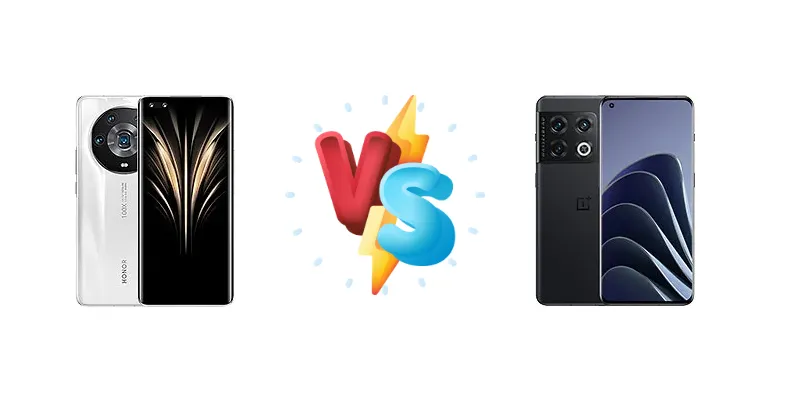
Honor Magic4 Ultimate vs OnePlus 10 Pro: Which Snapdragon 8 Gen 1 Flagship Reigns Supreme?
| Phones Images | |||||
|---|---|---|---|---|---|
|
🏆 Quick Verdict
For users prioritizing the absolute fastest charging and a potentially more versatile camera system, the Honor Magic4 Ultimate emerges as the winner. However, the OnePlus 10 Pro offers a more mature software experience and competitive battery endurance, making it a strong contender for those valuing stability and longevity.
| PHONES | ||
|---|---|---|
| Phone Names | Honor Magic4 Ultimate | OnePlus 10 Pro |
| Network | ||
|---|---|---|
| 2G bands | GSM 850 / 900 / 1800 / 1900 | GSM 850 / 900 / 1800 / 1900 |
| 3G bands | HSDPA 800 / 850 / 900 / 1700(AWS) / 1900 / 2100 | HSDPA 800 / 850 / 900 / 1700(AWS) / 1900 / 2100 |
| 4G bands | 1, 2, 3, 4, 5, 7, 8, 12, 17, 18, 19, 20, 26, 28, 34, 38, 39, 40, 41 | 1, 2, 3, 4, 5, 7, 8, 12, 13, 17, 18, 19, 20, 25, 26, 28, 30, 32, 38, 39, 40, 41, 46, 48, 66, 71 - International |
| 5G bands | 1, 3, 5, 8, 28, 38, 41, 77, 78, 79 SA/NSA | 1, 2, 3, 5, 7, 8, 20, 25, 28, 30, 38, 40, 41, 48, 66, 71, 77, 78 SA/NSA - International |
| Speed | HSPA, LTE, 5G | HSPA 42.2/5.76 Mbps, LTE (4CA) Cat18 1200/200 Mbps, 5G |
| Technology | GSM / CDMA / HSPA / EVDO / LTE / 5G | GSM / CDMA / HSPA / EVDO / LTE / 5G |
| CDMA2000 1xEV-DO | 1, 3, 5, 8, 28, 40, 41, 78, 79 SA/NSA - India | |
| Launch | ||
|---|---|---|
| Announced | 2022, March 17 | 2022, January 11 |
| Status | Available. Released 2022, April 22 | Available. Released 2022, January 13 |
| Body | ||
|---|---|---|
| Build | Glass front, ceramic back, aluminum frame | Glass front (Gorilla Glass Victus), glass back (Gorilla Glass 5), aluminum frame |
| Dimensions | 163.6 x 74.7 x 11.4 mm (6.44 x 2.94 x 0.45 in) | 163 x 73.9 x 8.6 mm (6.42 x 2.91 x 0.34 in) |
| SIM | Nano-SIM + Nano-SIM | · Nano-SIM· Nano-SIM + Nano-SIM |
| Weight | 242 g (8.54 oz) | 201 g (7.09 oz) |
| IP68 dust/water resistant (up to 1.5m for 30 min) | IP68 dust/water resistant - T-Mobile only (not for use underwater, liquid damage is not covered under warranty) | |
| Display | ||
|---|---|---|
| Protection | Scratch-resistant glass | Corning Gorilla Glass Victus |
| Resolution | 1312 x 2848 pixels, 19.5:9 ratio (~460 ppi density) | 1440 x 3216 pixels, 20:9 ratio (~525 ppi density) |
| Size | 6.81 inches, 113.7 cm2 (~93.0% screen-to-body ratio) | 6.7 inches, 108.4 cm2 (~90.0% screen-to-body ratio) |
| Type | LTPO OLED, 1B colors, 120Hz, HDR10+ | LTPO2 Fluid AMOLED, 1B colors, 120Hz, HDR10+, 500 nits (typ), 800 nits (HBM), 1300 nits (peak) |
| - | Always-on display | |
| Platform | ||
|---|---|---|
| CPU | Octa-core (1x3.00 GHz Cortex-X2 & 3x2.50 GHz Cortex-A710 & 4x1.80 GHz Cortex-A510) | Octa-core (1x3.00 GHz Cortex-X2 & 3x2.50 GHz Cortex-A710 & 4x1.80 GHz Cortex-A510) |
| Chipset | Qualcomm SM8450 Snapdragon 8 Gen 1 (4 nm) | Qualcomm SM8450 Snapdragon 8 Gen 1 (4 nm) |
| GPU | Adreno 730 | Adreno 730 |
| OS | Android 12, Magic UI 6 | Android 12, upgradable to Android 14, OxygenOS 14 (International), ColorOS (China) |
| Memory | ||
|---|---|---|
| Card slot | No | No |
| Internal | 512GB 12GB RAM | 128GB 8GB RAM, 256GB 8GB RAM, 256GB 12GB RAM, 512GB 12GB RAM |
| UFS 3.1 | UFS 3.1 | |
| Main Camera | ||
|---|---|---|
| Features | Laser AF, color spectrum sensor, LED flash, HDR, panorama | Laser AF, color spectrum sensor, Hasselblad Color Calibration, Dual-LED dual-tone flash, HDR, panorama |
| Quad | 50 MP, f/1.6, 23mm (wide), 1/1.12", 1.4µm, PDAF 64 MP, f/2.2, 126˚ (ultrawide), 1/2.0", 0.7µm 64 MP, f/3.5, 90mm (periscope telephoto), 1/2.0", 0.7µm, PDAF, OIS, 3.5x optical zoom 50 MP, f/2.0, (wide), 1/2.5", PDAF TOF 3D (depth) | - |
| Single | 12 MP, f/2.4, 100˚ (ultrawide), 1.22µm TOF 3D, (depth/biometrics sensor) | 32 MP, f/2.2, (wide), 1/2.74", 0.8µm |
| Triple | - | 48 MP, f/1.8, 23mm (wide), 1/1.43", 1.12µm, multi-directional PDAF, OIS 8 MP, f/2.4, 77mm (telephoto), 1.0µm, PDAF, OIS, 3.3x optical zoom 50 MP, f/2.2, 14mm, 150˚ (ultrawide), 1/2.76", 0.64µm |
| Video | 4K@30/60fps, 1080p@30/60fps, gyro-EIS, HDR10, 10-bit video | 8K@24fps, 4K@30/60/120fps, 1080p@30/60/240fps, Auto HDR, gyro-EIS |
| Selfie camera | ||
|---|---|---|
| Features | HDR | HDR |
| Single | 12 MP, f/2.4, 100˚ (ultrawide), 1.22µm TOF 3D, (depth/biometrics sensor) | 32 MP, f/2.2, (wide), 1/2.74", 0.8µm |
| Video | 4K@30fps, 1080p@30fps | 1080p@30fps, gyro-EIS |
| Sound | ||
|---|---|---|
| 3.5mm jack | No | No |
| 35mm jack | No | No |
| Loudspeaker | Yes, with stereo speakers | Yes, with stereo speakers |
| 24-bit audio stereo recording | 24-bit/192kHz audio | |
| Comms | ||
|---|---|---|
| Bluetooth | 5.2, A2DP, LE, aptX HD | 5.2, A2DP, LE, aptX HD |
| Infrared port | Yes | - |
| NFC | Yes | Yes |
| Positioning | GPS (L1+L5), GLONASS (L1), BDS (B1I+B1c+B2a), GALILEO (E1+E5a) | GPS (L1+L5), GLONASS (G1), BDS (B1), GALILEO (E1+E5a) |
| Radio | No | No |
| USB | USB Type-C 3.1, OTG | USB Type-C 3.1, OTG |
| WLAN | Wi-Fi 802.11 a/b/g/n/ac/6, dual-band, Wi-Fi Direct | Wi-Fi 802.11 a/b/g/n/ac/6, dual-band, Wi-Fi Direct |
| Features | ||
|---|---|---|
| Sensors | Fingerprint (under display, ultrasonic), Face ID, accelerometer, gyro, proximity, compass | Fingerprint (under display, optical), accelerometer, gyro, proximity, compass, barometer |
| Battery | ||
|---|---|---|
| Charging | 100W wired, 100% in 30 min 50W wireless 5W reverse wireless 5W reverse wired | 80W wired, PD, 100% in 32 min (International) 65W wired, PD, 58% in 15 min (North America) 50W wireless Reverse wireless |
| Type | Li-Po 4600 mAh | Li-Po 5000 mAh |
| Misc | ||
|---|---|---|
| Colors | Ceramic Black, Ceramic White | Volcanic Black, Emerald Forest, Panda White (Extreme Edition) |
| Models | LGE-AN20 | NE2210, NE2211, NE2213, NE2215, NE2217 |
| Price | About 1150 EUR | $ 264.39 / C$ 349.99 / £ 360.00 / € 399.99 |
| SAR | - | 1.16 W/kg (head) 0.70 W/kg (body) |
| Tests | ||
|---|---|---|
| Battery life | - | Endurance rating 107h |
| Camera | - | Photo / Video |
| Display | - | Contrast ratio: Infinite (nominal) |
| Loudspeaker | - | -25.2 LUFS (Very good) |
| Performance | - | AnTuTu: 886248 (v9) GeekBench: 3447 (v5.1) GFXBench: 48fps (ES 3.1 onscreen) |
Honor Magic4 Ultimate
- Significantly faster 100W wired charging
- Potentially more versatile camera system (based on brand reputation)
- 5W reverse wired charging
- Battery capacity and endurance unknown
- Limited display specifications provided
OnePlus 10 Pro
- Proven 107-hour battery endurance
- Refined OxygenOS software experience
- 780 nits peak brightness
- Slower charging speeds (especially in North America)
- Camera details are vague
Display Comparison
Both devices utilize the Snapdragon 8 Gen 1 chipset, but display characteristics differ. The OnePlus 10 Pro boasts a measured peak brightness of 780 nits, a respectable figure, but Honor doesn't provide this data. Given Honor's history with high-quality displays, it's likely comparable, potentially exceeding the OnePlus in peak luminance. Both feature infinite (nominal) contrast ratios typical of OLED panels. The absence of refresh rate data for the Honor makes direct comparison difficult, but both likely support adaptive refresh rates to balance smoothness and power consumption.
Camera Comparison
While both phones are marketed as having strong camera systems, the specifics are lacking in the provided data. Both are described as having 'Photo / Video' capabilities, which is unhelpful. The Honor Magic4 Ultimate's potential advantage lies in its brand reputation for camera innovation. Without sensor size or aperture information, it's difficult to assess image quality. The absence of detail regarding optical image stabilization (OIS) on either device is a significant omission. The lack of information on the Honor's camera system makes it difficult to assess its capabilities beyond marketing claims.
Performance
Both the Honor Magic4 Ultimate and OnePlus 10 Pro are powered by the Qualcomm SM8450 Snapdragon 8 Gen 1 (4 nm) chipset, featuring an identical CPU configuration: 1x3.00 GHz Cortex-X2, 3x2.50 GHz Cortex-A710, and 4x1.80 GHz Cortex-A510 cores. This means raw processing power will be largely equivalent. However, thermal management is where differences may emerge. The OnePlus 10 Pro's larger chassis *could* offer better heat dissipation, potentially mitigating throttling during sustained workloads. RAM specifications are not provided for the Honor, but the OnePlus 10 Pro utilizes LPDDR5 RAM, contributing to fast application loading and multitasking.
Battery Life
The OnePlus 10 Pro has an endurance rating of 107 hours, indicating solid battery life. The Honor Magic4 Ultimate's battery capacity is not specified, making a direct comparison challenging. However, the Honor boasts significantly faster charging: 100W wired (30 min to 100%) and 50W wireless, compared to the OnePlus 10 Pro's 80W wired (32 min, International) / 65W (58% in 15 min, North America) and 50W wireless. This charging speed difference is substantial. The Honor also offers 5W reverse wired and wireless charging, a feature also present on the OnePlus 10 Pro, albeit without specified wattage. The faster charging of the Honor could offset a potentially smaller battery capacity.
Buying Guide
Buy the Honor Magic4 Ultimate if you need blazing-fast 100W wired and 50W wireless charging, and value a camera system geared towards capturing detail in diverse scenarios. Buy the OnePlus 10 Pro if you prefer a refined software experience with OxygenOS, prioritize consistent battery life, and appreciate a slightly more conservative, yet polished, design aesthetic.