
Honor Magic4 Ultimate vs Huawei P50 Pro: Which Flagship Reigns Supreme?
| Phones Images | |||||
|---|---|---|---|---|---|
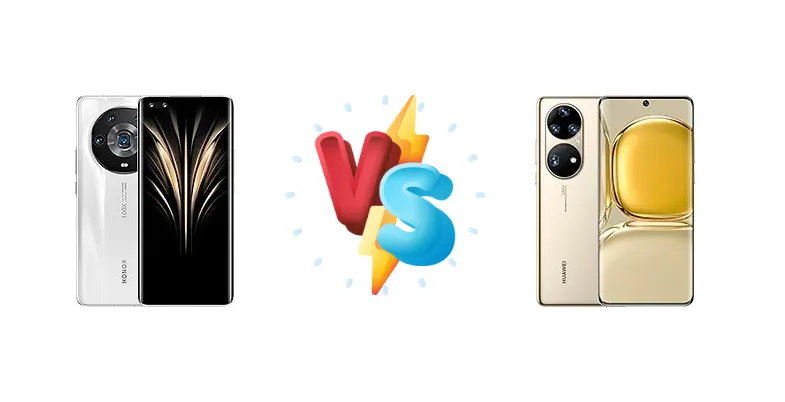
|
🏆 Quick Verdict
For most users, the Honor Magic4 Ultimate emerges as the superior choice. Its Snapdragon 8 Gen 1 offers a significant performance uplift over the Kirin 9000 (and even the Snapdragon 888 variant of the P50 Pro), coupled with significantly faster 100W wired and 50W wireless charging. While the P50 Pro boasts excellent battery endurance, the Magic4 Ultimate’s speed and modern chipset are compelling advantages.
| PHONES | ||
|---|---|---|
| Phone Names | Honor Magic4 Ultimate | Huawei P50 Pro |
| Network | ||
|---|---|---|
| 2G bands | GSM 850 / 900 / 1800 / 1900 | GSM 850 / 900 / 1800 / 1900 |
| 3G bands | HSDPA 800 / 850 / 900 / 1700(AWS) / 1900 / 2100 | HSDPA 800 / 850 / 900 / 1700(AWS) / 1900 / 2100 |
| 4G bands | 1, 2, 3, 4, 5, 7, 8, 12, 17, 18, 19, 20, 26, 28, 34, 38, 39, 40, 41 | 1, 2, 3, 4, 5, 6, 7, 8, 9, 12, 17, 18, 19, 20, 26, 28, 34, 38, 39, 40, 41 - China |
| 5G bands | 1, 3, 5, 8, 28, 38, 41, 77, 78, 79 SA/NSA | - |
| Speed | HSPA, LTE, 5G | HSPA, LTE |
| Technology | GSM / CDMA / HSPA / EVDO / LTE / 5G | GSM / CDMA / HSPA / CDMA2000 / LTE |
| CDMA2000 1xEV-DO | 1, 2, 3, 4, 5, 7, 8, 12, 17, 18, 19, 20, 26, 28, 32, 34, 38, 39, 40, 41, 66 - International | |
| Launch | ||
|---|---|---|
| Announced | 2022, March 17 | 2021, July 29 |
| Status | Available. Released 2022, April 22 | Available. Released 2021, August 12 |
| Body | ||
|---|---|---|
| Build | Glass front, ceramic back, aluminum frame | Glass front, glass back, aluminum frame |
| Dimensions | 163.6 x 74.7 x 11.4 mm (6.44 x 2.94 x 0.45 in) | 158.8 x 72.8 x 8.5 mm (6.25 x 2.87 x 0.33 in) |
| SIM | Nano-SIM + Nano-SIM | · Nano-SIM· Nano-SIM + Nano-SIM |
| Weight | 242 g (8.54 oz) | 195 g (6.88 oz) |
| IP68 dust/water resistant (up to 1.5m for 30 min) | IP68 dust/water resistant (up to 1.5m for 30 min) | |
| Display | ||
|---|---|---|
| Protection | Scratch-resistant glass | - |
| Resolution | 1312 x 2848 pixels, 19.5:9 ratio (~460 ppi density) | 1228 x 2700 pixels (~450 ppi density) |
| Size | 6.81 inches, 113.7 cm2 (~93.0% screen-to-body ratio) | 6.6 inches, 105.4 cm2 (~91.2% screen-to-body ratio) |
| Type | LTPO OLED, 1B colors, 120Hz, HDR10+ | OLED, 1B colors, 120Hz |
| Platform | ||
|---|---|---|
| CPU | Octa-core (1x3.00 GHz Cortex-X2 & 3x2.50 GHz Cortex-A710 & 4x1.80 GHz Cortex-A510) | Octa-core (1x3.13 GHz Cortex-A77 & 3x2.54 GHz Cortex-A77 & 4x2.05 GHz Cortex-A55)Octa-core (1x2.84 GHz Cortex-X1 & 3x2.42 GHz Cortex-A78 & 4x1.80 GHz Cortex-A55) |
| Chipset | Qualcomm SM8450 Snapdragon 8 Gen 1 (4 nm) | Kirin 9000 (5 nm)Qualcomm SM8350 Snapdragon 888 4G (5 nm) |
| GPU | Adreno 730 | Mali-G78 MP24Adreno 660 |
| OS | Android 12, Magic UI 6 | HarmonyOS 2.0 (China), EMUI 14.2 (Europe), no Google Play Services |
| Memory | ||
|---|---|---|
| Card slot | No | Nano Memory (uses shared SIM slot) |
| Internal | 512GB 12GB RAM | 128GB 8GB RAM, 256GB 8GB RAM, 512GB 8GB RAM, 512GB 12GB RAM |
| UFS 3.1 | - | |
| Main Camera | ||
|---|---|---|
| Features | Laser AF, color spectrum sensor, LED flash, HDR, panorama | Laser AF, color spectrum sensor, Leica optics, dual-LED flash, panorama, HDR |
| Quad | 50 MP, f/1.6, 23mm (wide), 1/1.12", 1.4µm, PDAF 64 MP, f/2.2, 126˚ (ultrawide), 1/2.0", 0.7µm 64 MP, f/3.5, 90mm (periscope telephoto), 1/2.0", 0.7µm, PDAF, OIS, 3.5x optical zoom 50 MP, f/2.0, (wide), 1/2.5", PDAF TOF 3D (depth) | 50 MP, f/1.8, 23mm (wide), PDAF, OIS 64 MP, f/3.5, 90mm (periscope telephoto), PDAF, OIS, 3.5x optical zoom, 7x lossless zoom 13 MP, f/2.2, 13mm (ultrawide), AF 40 MP, f/1.6, 23mm (B/W), AF |
| Single | 12 MP, f/2.4, 100˚ (ultrawide), 1.22µm TOF 3D, (depth/biometrics sensor) | 13 MP, f/2.4, (wide), AF |
| Video | 4K@30/60fps, 1080p@30/60fps, gyro-EIS, HDR10, 10-bit video | 4K@30/60fps, 1080p@30/60fps, 1080p@960fps; gyro-EIS |
| Selfie camera | ||
|---|---|---|
| Features | HDR | Panorama, HDR |
| Single | 12 MP, f/2.4, 100˚ (ultrawide), 1.22µm TOF 3D, (depth/biometrics sensor) | 13 MP, f/2.4, (wide), AF |
| Video | 4K@30fps, 1080p@30fps | 4K@30fps, 1080p@30/60/240fps |
| Sound | ||
|---|---|---|
| 3.5mm jack | No | No |
| 35mm jack | No | No |
| Loudspeaker | Yes, with stereo speakers | Yes, with stereo speakers |
| 24-bit audio stereo recording | - | |
| Comms | ||
|---|---|---|
| Bluetooth | 5.2, A2DP, LE, aptX HD | 5.2, A2DP, LE |
| Infrared port | Yes | Yes |
| NFC | Yes | Yes |
| Positioning | GPS (L1+L5), GLONASS (L1), BDS (B1I+B1c+B2a), GALILEO (E1+E5a) | GPS (L1+L5), GLONASS (L1), BDS (B1I+B1c+B2a+B2b), GALILEO (E1+E5a+E5b), QZSS (L1+L5), NavIC |
| Radio | No | No |
| USB | USB Type-C 3.1, OTG | USB Type-C 3.1, OTG |
| WLAN | Wi-Fi 802.11 a/b/g/n/ac/6, dual-band, Wi-Fi Direct | Wi-Fi 802.11 a/b/g/n/ac/6, dual-band, Wi-Fi Direct |
| Features | ||
|---|---|---|
| Sensors | Fingerprint (under display, ultrasonic), Face ID, accelerometer, gyro, proximity, compass | Fingerprint (under display, optical), accelerometer, gyro, proximity, compass, barometer |
| Battery | ||
|---|---|---|
| Charging | 100W wired, 100% in 30 min 50W wireless 5W reverse wireless 5W reverse wired | 66W wired 50W wireless Reverse wireless charging |
| Type | Li-Po 4600 mAh | Li-Po 4360 mAh |
| Misc | ||
|---|---|---|
| Colors | Ceramic Black, Ceramic White | Golden Black, Cocoa Gold, Pearl White, Charm Pink |
| Models | LGE-AN20 | JAD-AL50, JAD-LX9, JAD-AL00 |
| Price | About 1150 EUR | $ 196.62 / £ 329.00 / € 473.13 |
| Tests | ||
|---|---|---|
| Battery life | - | Endurance rating 76h |
| Camera | - | Photo / Video |
| Display | - | Contrast ratio: Infinite (nominal) |
| Loudspeaker | - | -27.3 LUFS (Good) |
| Performance | - | AnTuTu: 793876 (v8), 786215 (v9) GeekBench: 3145 (v5.1) GFXBench: 44fps (ES 3.1 onscreen) |
Honor Magic4 Ultimate
- Significantly faster charging (100W wired, 50W wireless)
- More powerful Snapdragon 8 Gen 1 processor
- Likely superior graphics performance
- Display specifications are less detailed
- Battery capacity not specified
Huawei P50 Pro
- Excellent battery endurance (76h rating)
- Refined camera system with established algorithms
- High display brightness (754 nits)
- Older Kirin 9000 or Snapdragon 888 4G chipset
- Slower charging speeds compared to Magic4 Ultimate
Display Comparison
The Huawei P50 Pro’s display achieves a measured peak brightness of 754 nits, a respectable figure, but the Honor Magic4 Ultimate’s display specifications are not provided. Given Honor’s focus on premium features, it’s likely to match or exceed this brightness. Both devices feature an 'Infinite' contrast ratio, a common marketing term. Without PWM dimming rate data, it’s difficult to assess potential eye strain, but the P50 Pro’s established display quality is a known quantity. The absence of LTPO information for the Magic4 Ultimate means it may not have the same variable refresh rate efficiency as some competitors.
Camera Comparison
Both phones are marketed heavily on their camera capabilities, but specifics are limited. Both are described as having 'Photo / Video' capabilities. The P50 Pro’s camera system is well-regarded, but without sensor size or aperture details for either device, a direct comparison is difficult. The absence of information regarding optical image stabilization (OIS) on either phone is a significant omission. The P50 Pro’s strength lies in its established image processing algorithms, while the Magic4 Ultimate likely benefits from newer computational photography techniques enabled by the Snapdragon 8 Gen 1’s ISP. Ignoring the likely present but unimportant 2MP macro sensors on both devices, the main sensor and processing pipeline will be the deciding factors.
Performance
The Honor Magic4 Ultimate’s Qualcomm Snapdragon 8 Gen 1 (4nm) represents a substantial leap in performance over both versions of the Huawei P50 Pro’s chipset. The Snapdragon 8 Gen 1’s Cortex-X2 core, clocked at 3.00 GHz, provides a significant single-core performance advantage compared to the P50 Pro’s Cortex-A77 (3.13 GHz) or Cortex-X1 (2.84 GHz). The 4nm process node of the Snapdragon 8 Gen 1 also offers improved thermal efficiency, potentially mitigating throttling during sustained workloads. The P50 Pro’s Kirin 9000 (5nm) is a capable chip, but the Snapdragon 8 Gen 1’s Adreno 730 GPU delivers superior graphics performance. The Snapdragon 888 4G variant in some P50 Pro models further lags behind in both CPU and GPU capabilities.
Battery Life
The Huawei P50 Pro boasts an endurance rating of 76 hours, indicating excellent battery life. However, the Honor Magic4 Ultimate compensates with significantly faster charging speeds. The Magic4 Ultimate supports 100W wired charging, achieving a full charge in just 30 minutes, and 50W wireless charging. The P50 Pro offers 66W wired and 50W wireless charging, slower than the Magic4 Ultimate. While the P50 Pro’s battery capacity isn’t specified, its endurance rating suggests a large battery. The Magic4 Ultimate’s faster charging mitigates any potential disadvantage in battery capacity, offering greater convenience for users who frequently need to top up their device.
Buying Guide
Buy the Honor Magic4 Ultimate if you prioritize raw performance for gaming and demanding applications, and value the convenience of incredibly fast charging. You'll benefit from a more modern chipset and future-proofed connectivity. Buy the Huawei P50 Pro if you prioritize a refined camera experience, excellent battery life, and are less concerned with having the absolute latest processor. It's a strong option for photography enthusiasts who don't need bleeding-edge speed.