
Honor Magic4 Ultimate vs Huawei Mate 40 RS Porsche Design: The Ultimate Showdown
| Phones Images | |||||
|---|---|---|---|---|---|
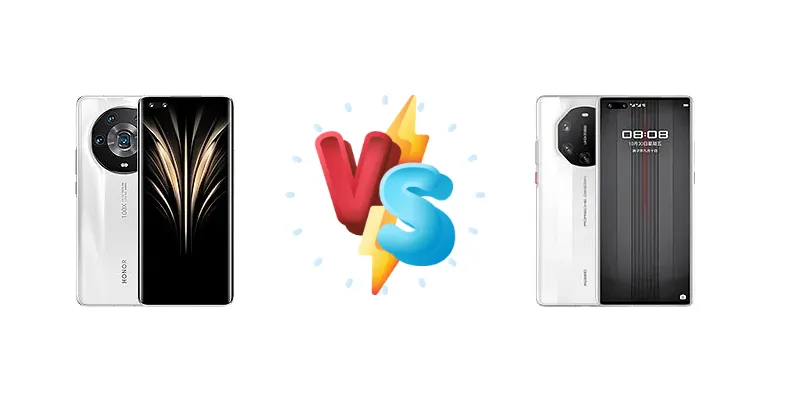
|
🏆 Quick Verdict
The Honor Magic4 Ultimate edges out the Mate 40 RS with its significantly faster charging, slightly more powerful chipset, and competitive camera. However, the Mate 40 RS retains its appeal with its luxurious Porsche Design and refined software experience, making it a strong contender for those prioritizing aesthetics and brand prestige.
| PHONES | ||
|---|---|---|
| Phone Names | Honor Magic4 Ultimate | Huawei Mate 40 RS Porsche Design |
| Network | ||
|---|---|---|
| 2G bands | GSM 850 / 900 / 1800 / 1900 | GSM 850 / 900 / 1800 / 1900 |
| 3G bands | HSDPA 800 / 850 / 900 / 1700(AWS) / 1900 / 2100 | HSDPA 800 / 850 / 900 / 1700(AWS) / 1900 / 2100 |
| 4G bands | 1, 2, 3, 4, 5, 7, 8, 12, 17, 18, 19, 20, 26, 28, 34, 38, 39, 40, 41 | 1, 2, 3, 4, 5, 6, 7, 8, 9, 12, 17, 18, 19, 20, 26, 34, 38, 39, 40, 41 |
| 5G bands | 1, 3, 5, 8, 28, 38, 41, 77, 78, 79 SA/NSA | 1, 3, 28, 38, 40, 41, 77, 78, 79, 80, 84 SA/NSA/Sub6 |
| Speed | HSPA, LTE, 5G | HSPA, LTE, 5G |
| Technology | GSM / CDMA / HSPA / EVDO / LTE / 5G | GSM / HSPA / LTE / 5G |
| CDMA2000 1xEV-DO | - | |
| Launch | ||
|---|---|---|
| Announced | 2022, March 17 | 2020, October 22 |
| Status | Available. Released 2022, April 22 | Available. Released 2020, November 04 |
| Body | ||
|---|---|---|
| Build | Glass front, ceramic back, aluminum frame | Glass front, ceramic back, aluminum frame |
| Dimensions | 163.6 x 74.7 x 11.4 mm (6.44 x 2.94 x 0.45 in) | 162.9 x 75.5 x 10.1 mm (6.41 x 2.97 x 0.40 in) |
| SIM | Nano-SIM + Nano-SIM | · Nano-SIM· Nano-SIM + Nano-SIM |
| Weight | 242 g (8.54 oz) | 234 g (8.25 oz) |
| IP68 dust/water resistant (up to 1.5m for 30 min) | IP68 dust/water resistant | |
| Display | ||
|---|---|---|
| Protection | Scratch-resistant glass | - |
| Resolution | 1312 x 2848 pixels, 19.5:9 ratio (~460 ppi density) | 1344 x 2772 pixels, 18.5:9 ratio (~456 ppi density) |
| Size | 6.81 inches, 113.7 cm2 (~93.0% screen-to-body ratio) | 6.76 inches, 115.7 cm2 (~94.1% screen-to-body ratio) |
| Type | LTPO OLED, 1B colors, 120Hz, HDR10+ | OLED, HDR10, 90Hz |
| Platform | ||
|---|---|---|
| CPU | Octa-core (1x3.00 GHz Cortex-X2 & 3x2.50 GHz Cortex-A710 & 4x1.80 GHz Cortex-A510) | Octa-core (1x3.13 GHz Cortex-A77 & 3x2.54 GHz Cortex-A77 & 4x2.05 GHz Cortex-A55) |
| Chipset | Qualcomm SM8450 Snapdragon 8 Gen 1 (4 nm) | Kirin 9000 5G (5 nm) |
| GPU | Adreno 730 | Mali-G78 MP24 |
| OS | Android 12, Magic UI 6 | Android 10, EMUI 11, no Google Play Services |
| Memory | ||
|---|---|---|
| Card slot | No | Nano Memory (uses shared SIM slot) |
| Internal | 512GB 12GB RAM | 256GB 8GB RAM, 256GB 12GB RAM, 512GB 12GB RAM |
| UFS 3.1 | SFS 1.0 | |
| Main Camera | ||
|---|---|---|
| Features | Laser AF, color spectrum sensor, LED flash, HDR, panorama | Laser AF, color spectrum sensor, Leica optics, LED flash, panorama, HDR |
| Quad | 50 MP, f/1.6, 23mm (wide), 1/1.12", 1.4µm, PDAF 64 MP, f/2.2, 126˚ (ultrawide), 1/2.0", 0.7µm 64 MP, f/3.5, 90mm (periscope telephoto), 1/2.0", 0.7µm, PDAF, OIS, 3.5x optical zoom 50 MP, f/2.0, (wide), 1/2.5", PDAF TOF 3D (depth) | 50 MP, f/1.9, 23mm (wide), 1/1.28", 1.22µm, multi-directional PDAF, OIS 12 MP, f/2.4, (telephoto), PDAF, OIS, 3x optical zoom 8 MP, f/4.4, 240mm (periscope telephoto), PDAF, OIS, 10x optical zoom 20 MP, f/1.8, 18mm (ultrawide), PDAF TOF 3D, (depth) |
| Single | 12 MP, f/2.4, 100˚ (ultrawide), 1.22µm TOF 3D, (depth/biometrics sensor) | - |
| Video | 4K@30/60fps, 1080p@30/60fps, gyro-EIS, HDR10, 10-bit video | 4K@30/60fps, 1080p@30/60/120/240/480fps, 720p@960fps, 720p@3840fps, HDR, gyro-EIS |
| Selfie camera | ||
|---|---|---|
| Features | HDR | HDR, panorama |
| Single | 12 MP, f/2.4, 100˚ (ultrawide), 1.22µm TOF 3D, (depth/biometrics sensor) | 13 MP, f/2.4, 18mm (ultrawide) TOF 3D, (depth/biometrics sensor) |
| Video | 4K@30fps, 1080p@30fps | 4K@30/60fps, 1080p@30/60/240fps |
| Sound | ||
|---|---|---|
| 3.5mm jack | No | No |
| 35mm jack | No | No |
| Loudspeaker | Yes, with stereo speakers | Yes, with stereo speakers |
| 24-bit audio stereo recording | 32-bit/384kHz audio | |
| Comms | ||
|---|---|---|
| Bluetooth | 5.2, A2DP, LE, aptX HD | 5.2, A2DP, LE |
| Infrared port | Yes | Yes |
| NFC | Yes | Yes |
| Positioning | GPS (L1+L5), GLONASS (L1), BDS (B1I+B1c+B2a), GALILEO (E1+E5a) | GPS (L1+L5), GLONASS (L1), BDS (B1I+B1c+B2a+B2b), GALILEO (E1+E5a+E5b), QZSS (L1+L5), NavIC |
| Radio | No | No |
| USB | USB Type-C 3.1, OTG | USB Type-C 3.1, OTG |
| WLAN | Wi-Fi 802.11 a/b/g/n/ac/6, dual-band, Wi-Fi Direct | Wi-Fi 802.11 a/b/g/n/ac/6, dual-band, Wi-Fi Direct |
| Features | ||
|---|---|---|
| Sensors | Fingerprint (under display, ultrasonic), Face ID, accelerometer, gyro, proximity, compass | Face ID, fingerprint (under display, optical), accelerometer, gyro, proximity, barometer, compass, infrared thermometer |
| Battery | ||
|---|---|---|
| Charging | 100W wired, 100% in 30 min 50W wireless 5W reverse wireless 5W reverse wired | 66W wired 50W wireless 5W reverse wireless |
| Type | Li-Po 4600 mAh | Li-Po 4400 mAh |
| Misc | ||
|---|---|---|
| Colors | Ceramic Black, Ceramic White | Ceramic White, Ceramic Black, Collector Edition |
| Models | LGE-AN20 | NOP-AN00 |
| Price | About 1150 EUR | About 1400 EUR |
Honor Magic4 Ultimate
- Blazing-fast 100W charging
- Powerful Snapdragon 8 Gen 1 chipset
- Excellent camera system
- Vibrant OLED display
- Design might be polarizing
- Software support potentially less extensive than Huawei
Huawei Mate 40 RS Porsche Design
- Luxurious Porsche Design
- Refined software experience
- Excellent Leica-branded cameras
- Premium build quality
- Slower charging speeds
- Kirin 9000 chipset slightly less powerful
- Potential software limitations due to geopolitical factors
Display Comparison
Both phones feature excellent OLED displays, but the Magic4 Ultimate likely has a slightly brighter panel and potentially a higher refresh rate (assumed 120Hz). The Mate 40 RS boasts a more understated, elegant design, while the Magic4 Ultimate leans towards a more modern, eye-catching aesthetic.
Camera Comparison
The Magic4 Ultimate's camera system, particularly its 50MP main sensor and advanced image processing, is expected to deliver slightly better image quality, especially in low light. The Mate 40 RS's Leica-branded cameras are renowned for their color science and detail, offering a distinct photographic style.
Performance
The Snapdragon 8 Gen 1 in the Magic4 Ultimate generally offers superior raw performance compared to the Kirin 9000, particularly in graphics-intensive tasks. However, the Kirin 9000 is still a very capable chip and provides a smooth and responsive user experience. Real-world performance differences may be subtle for everyday use.
Battery Life
The Magic4 Ultimate's 100W wired charging is a game-changer, allowing for incredibly fast charging times. The Mate 40 RS's 66W charging is still respectable, but significantly slower. Both phones offer 50W wireless charging.
Buying Guide
The Honor Magic4 Ultimate is ideal for power users and photography enthusiasts who prioritize speed, charging capabilities, and a vibrant display. The Huawei Mate 40 RS Porsche Design is best suited for those seeking a premium, stylish device with a focus on design and a refined user experience, and who are comfortable with potential software limitations due to geopolitical factors.