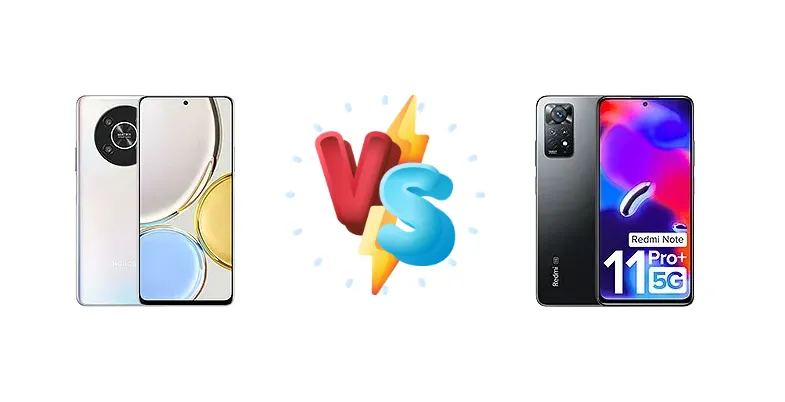
Both the Honor Magic4 Lite and the Xiaomi Redmi Note 11 Pro+ 5G (India) target the competitive mid-range 5G market, offering a blend of features at accessible price points. While both leverage the Qualcomm Snapdragon 695 5G chipset, key differences in charging speed, display characteristics, and potentially camera implementation create distinct user experiences. This comparison dives deep into these nuances to determine which device delivers the best value.
🏆 Quick Verdict
For the average user prioritizing fast charging and a potentially more refined software experience, the Xiaomi Redmi Note 11 Pro+ 5G (India) emerges as the slightly stronger choice. However, the Honor Magic4 Lite’s excellent endurance rating and potentially lower price make it a compelling alternative for those prioritizing battery life.
| Network |
|---|
| 2G bands | GSM 850 / 900 / 1800 / 1900 | GSM 850 / 900 / 1800 / 1900 - SIM 1 & SIM 2 |
| 3G bands | HSDPA 850 / 900 / 1700(AWS) / 1900 / 2100 | HSDPA 850 / 900 / 1900 / 2100 |
| 4G bands | LTE | 1, 3, 5, 8, 40, 41 |
| 5G bands | SA/NSA | 1, 3, 5, 8, 28, 40, 78 SA/NSA |
| Speed | HSPA, LTE, 5G | HSPA, LTE-A (CA), 5G |
| Technology | GSM / HSPA / LTE / 5G | GSM / HSPA / LTE / 5G |
| Launch |
|---|
| Announced | 2022, March 23 | 2022, March 09 |
| Status | Available. Released 2022, April 26 | Available. Released 2022, March 15 |
| Body |
|---|
| Build | Glass front, plastic frame, plastic back | Glass front (Gorilla Glass 5), glass back |
| Dimensions | 166 x 75.8 x 8 mm (6.54 x 2.98 x 0.31 in) | 164.2 x 76.1 x 8.1 mm (6.46 x 3.00 x 0.32 in) |
| SIM | Nano-SIM + Nano-SIM | Hybrid Dual SIM (Nano-SIM, dual stand-by) |
| Weight | 189 g (6.67 oz) | 202 g (7.13 oz) |
| | - | IP53, dust and splash resistant |
| Display |
|---|
| Protection | - | Corning Gorilla Glass 5 |
| Resolution | 1080 x 2388 pixels (~385 ppi density) | 1080 x 2400 pixels, 20:9 ratio (~395 ppi density) |
| Size | 6.81 inches, 112.3 cm2 (~89.3% screen-to-body ratio) | 6.67 inches, 107.4 cm2 (~86.0% screen-to-body ratio) |
| Type | IPS LCD, 120Hz | Super AMOLED, 120Hz, 700 nits, 1200 nits (peak) |
| Platform |
|---|
| CPU | Octa-core (2x2.2 GHz Kryo 660 Gold & 6x1.7 GHz Kryo 660 Silver) | Octa-core (2x2.2 GHz Kryo 660 Gold & 6x1.7 GHz Kryo 660 Silver) |
| Chipset | Qualcomm SM6375 Snapdragon 695 5G (6 nm) | Qualcomm SM6375 Snapdragon 695 5G (6 nm) |
| GPU | Adreno 619 | Adreno 619 |
| OS | Android 11, Magic UI 4.2 | Android 11, MIUI 13 |
| Memory |
|---|
| Card slot | No | microSDXC (uses shared SIM slot) |
| Internal | 128GB 6GB RAM, 128GB 8GB RAM | 64GB 6GB RAM, 128GB 6GB RAM, 128GB 8GB RAM, 256GB 8GB RAM |
| | - | UFS 2.2 |
| Main Camera |
|---|
| Features | LED flash, panorama, HDR | LED flash, HDR, panorama |
| Single | 16 MP, f/2.5 | - |
| Triple | 48 MP, f/1.8, 26mm (wide), PDAF
2 MP (macro)
Auxiliary lens | 108 MP, f/1.9, 26mm (wide), 1/1.52", 0.7µm, PDAF
8 MP, f/2.2, 118˚ (ultrawide)
2 MP, f/2.4, (macro) |
| Video | 1080p@30fps | 1080p@30fps |
| Selfie camera |
|---|
| Single | 16 MP, f/2.5 | 16 MP, f/2.5, (wide), 1/3.06" 1.0µm |
| Video | 1080p@30fps | 1080p@30fps |
| Sound |
|---|
| 3.5mm jack | No | Yes |
| 35mm jack | No | - |
| Loudspeaker | Yes | Yes, with stereo speakers |
| | - | 24-bit/192kHz audio |
| Comms |
|---|
| Bluetooth | 5.1, A2DP, LE | 5.1, A2DP, LE |
| Infrared port | - | Yes |
| NFC | Yes | No |
| Positioning | GPS, GLONASS, BDS | GPS, GLONASS, BDS, GALILEO |
| Radio | No | Unspecified |
| USB | USB Type-C 2.0, OTG | USB Type-C 2.0, OTG |
| WLAN | Wi-Fi 802.11 a/b/g/n/ac, dual-band, Wi-Fi Direct | Wi-Fi 802.11 a/b/g/n/ac, dual-band, Wi-Fi Direct |
| Features |
|---|
| Sensors | Fingerprint (side-mounted), accelerometer, gyro, compass | Fingerprint (side-mounted), accelerometer, gyro, proximity, compass |
| Battery |
|---|
| Charging | 66W wired | 67W wired, PD3.0, QC3, 50% in 15 min, 100% in 42 min (advertised) |
| Type | Li-Po 4800 mAh | Li-Po 5000 mAh, non-removable |
| Misc |
|---|
| Colors | Titanium Silver, Ocean Blue, Midnight Black | Mirage Blue, Phantom White, Stealth Black |
| Models | ANY-LX1, ANY-LX2, ANY-LX3 | 2201116SI |
| Price | About 180 EUR | About 250 EUR |
| Tests |
|---|
| Battery life |
Endurance rating 104h
| - |
| Camera |
Photo / Video | - |
| Display |
Contrast ratio: 1229:1 | - |
| Loudspeaker |
-34.0 LUFS (Poor)
| - |
| Performance |
AnTuTu: 387218 (v9)
GeekBench: 1906 (v5.1)
GFXBench: 17fps (ES 3.1 onscreen) | - |
Honor Magic4 Lite
- Exceptional battery endurance (104h)
- Respectable display brightness (535 nits)
- Potentially lower price point
- Limited camera details suggest a basic system
- Software experience may be less refined than Xiaomi
Xiaomi Redmi Note 11 Pro+ 5G (India)
- Faster 67W charging with PD3.0/QC3 support
- Potentially more feature-rich camera system (based on Xiaomi's history)
- MIUI software offers extensive customization options
- Battery life may be shorter than the Honor Magic4 Lite
- MIUI can include bloatware
Display Comparison
Both devices are expected to feature LCD panels, given their price bracket. However, the Honor Magic4 Lite’s measured peak brightness of 535 nits is a crucial data point. While the Redmi Note 11 Pro+ 5G (India) specifications are not provided, this suggests the Honor device may offer better visibility in direct sunlight. The Magic4 Lite’s 1229:1 contrast ratio is respectable for an LCD, but users accustomed to OLED displays will notice a difference. The absence of refresh rate data for both devices suggests a standard 60Hz panel, which is typical for this segment, but a potential area where the Redmi Note 11 Pro+ 5G could differentiate itself.
Camera Comparison
The context data for both devices is limited to 'Photo / Video' capabilities. Without sensor size, aperture, or OIS information, a detailed camera comparison is impossible. However, given Xiaomi’s history, the Redmi Note 11 Pro+ 5G (India) is likely to feature a more ambitious camera setup, potentially including a higher-resolution main sensor. The absence of details on the Honor Magic4 Lite suggests a more basic camera system focused on everyday photography. It's crucial to note that megapixel count alone doesn't guarantee image quality; sensor size and image processing are equally important.
Performance
Both the Honor Magic4 Lite and the Xiaomi Redmi Note 11 Pro+ 5G (India) are powered by the Qualcomm Snapdragon 695 5G (6nm). This means CPU performance – with its octa-core configuration of 2x2.2 GHz Kryo 660 Gold and 6x1.7 GHz Kryo 660 Silver – will be virtually identical. The real-world performance difference will likely hinge on RAM configuration (not specified) and thermal management, which is unknown for both devices. The 6nm process node offers a good balance of power efficiency and performance, suitable for everyday tasks and moderate gaming. Neither device is positioned as a gaming powerhouse, but the Snapdragon 695 5G can handle popular titles at medium settings.
Battery Life
The Honor Magic4 Lite boasts an impressive endurance rating of 104 hours, indicating excellent battery life. This is a significant advantage for users who prioritize longevity. The Xiaomi Redmi Note 11 Pro+ 5G (India) counters with 67W wired charging, supported by PD3.0 and QC3, promising a 50% charge in 15 minutes and a full charge in 42 minutes (advertised). While the battery capacity of the Redmi Note 11 Pro+ 5G is unknown, the faster charging speed effectively mitigates any potential capacity disadvantage. The Honor Magic4 Lite’s 66W charging is also fast, but slightly slower than the Redmi’s offering.
Buying Guide
Buy the Honor Magic4 Lite if you need exceptional battery life and are comfortable with a potentially less polished software experience. Its 104-hour endurance rating is ideal for users who frequently travel or have limited access to charging. Buy the Xiaomi Redmi Note 11 Pro+ 5G (India) if you prefer faster charging speeds, advertised at a full charge in 42 minutes, and potentially benefit from Xiaomi’s feature-rich MIUI software, even if it comes with some bloatware.
Frequently Asked Questions
❓ Does the Snapdragon 695 5G in either phone struggle with demanding games like Genshin Impact?
The Snapdragon 695 5G is a capable chipset for mid-range gaming, but demanding titles like Genshin Impact will likely require significant graphics settings compromises. Expect playable frame rates at low to medium settings, but don't anticipate a consistently smooth experience. Thermal throttling could also become a factor during extended gaming sessions.
❓ How does the 67W charging on the Redmi Note 11 Pro+ 5G (India) compare to the 66W charging on the Honor Magic4 Lite in real-world usage?
While both offer fast charging, the Redmi Note 11 Pro+ 5G (India)'s 67W charging, coupled with PD3.0 and QC3 support, is likely to be slightly faster and more efficient. Xiaomi advertises a 0-100% charge in 42 minutes, while the Honor Magic4 Lite's charging time is not specified but will likely be a few minutes longer. The difference may not be substantial for casual users, but those who frequently need to quickly top up their battery will appreciate the Redmi's speed.
❓ Is the lack of detailed camera specs on the Honor Magic4 Lite a dealbreaker for photography enthusiasts?
If photography is a high priority, the limited information available on the Honor Magic4 Lite’s camera system is concerning. Xiaomi typically invests heavily in camera technology, and the Redmi Note 11 Pro+ 5G (India) is likely to offer a more versatile and capable camera experience. However, without concrete specifications, it's difficult to make a definitive judgment.