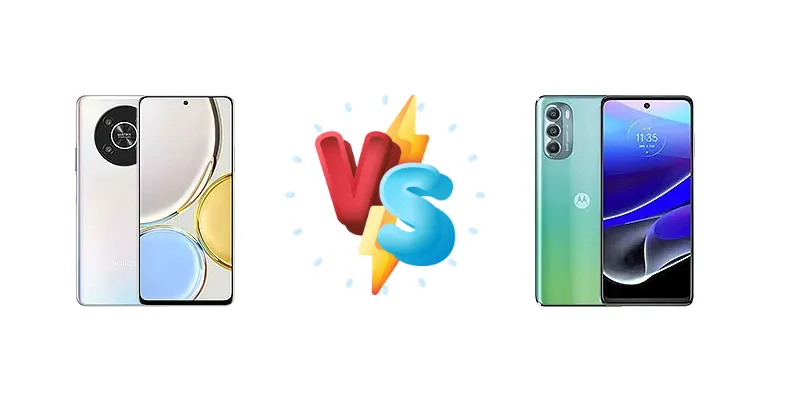
Both the Honor Magic4 Lite and the Motorola Moto G Stylus 5G (2022) target the competitive mid-range 5G market, but they prioritize different features. The Honor focuses on rapid charging and a brighter display, while the Motorola integrates a stylus and emphasizes longer battery endurance. This comparison dissects their strengths and weaknesses to determine which device best suits your needs.
🏆 Quick Verdict
For the average user prioritizing convenience, the Honor Magic4 Lite is the better choice. Its 66W charging significantly reduces downtime, offsetting the slightly lower endurance rating compared to the Motorola. However, if stylus functionality is essential, the Moto G Stylus 5G remains a compelling option.
| Network |
|---|
| 2G bands | GSM 850 / 900 / 1800 / 1900 | GSM 850 / 900 / 1800 / 1900 |
| 3G bands | HSDPA 850 / 900 / 1700(AWS) / 1900 / 2100 | HSDPA 850 / 900 / 1700(AWS) / 1900 / 2100 |
| 4G bands | LTE | 1, 2, 3, 4, 5, 7, 8, 12, 13, 17, 18, 19, 20, 25, 26, 28, 29, 30, 38, 39, 40, 41, 48, 66, 71 - USA |
| 5G bands | SA/NSA | 1, 2, 5, 12, 14, 24, 26, 29, 30, 41, 48, 66, 70, 71, 77, 78 SA/NSA - USA |
| Speed | HSPA, LTE, 5G | HSPA, LTE, 5G |
| Technology | GSM / HSPA / LTE / 5G | GSM / HSPA / LTE / 5G |
| Launch |
|---|
| Announced | 2022, March 23 | 2022, April 22 |
| Status | Available. Released 2022, April 26 | Available. Released 2022, April 27 |
| Body |
|---|
| Build | Glass front, plastic frame, plastic back | Glass front, plastic frame, plastic back |
| Dimensions | 166 x 75.8 x 8 mm (6.54 x 2.98 x 0.31 in) | 168.9 x 75.8 x 9.3 mm (6.65 x 2.98 x 0.37 in) |
| SIM | Nano-SIM + Nano-SIM | Nano-SIM |
| Weight | 189 g (6.67 oz) | 215 g (7.58 oz) |
| | - | Stylus
Water-repellent design |
| Display |
|---|
| Resolution | 1080 x 2388 pixels (~385 ppi density) | 1080 x 2460 pixels (~395 ppi density) |
| Size | 6.81 inches, 112.3 cm2 (~89.3% screen-to-body ratio) | 6.8 inches, 109.8 cm2 (~85.8% screen-to-body ratio) |
| Type | IPS LCD, 120Hz | IPS LCD, 120Hz |
| Platform |
|---|
| CPU | Octa-core (2x2.2 GHz Kryo 660 Gold & 6x1.7 GHz Kryo 660 Silver) | Octa-core (2x2.2 GHz Kryo 660 Gold & 6x1.7 GHz Kryo 660 Silver) |
| Chipset | Qualcomm SM6375 Snapdragon 695 5G (6 nm) | Qualcomm SM6375 Snapdragon 695 5G (6 nm) |
| GPU | Adreno 619 | Adreno 619 |
| OS | Android 11, Magic UI 4.2 | Android 12, planned upgrade to Android 13 |
| Memory |
|---|
| Card slot | No | microSDXC (dedicated slot) |
| Internal | 128GB 6GB RAM, 128GB 8GB RAM | 128GB 4GB RAM, 128GB 6GB RAM, 128GB 8GB RAM, 256GB 8GB RAM |
| Main Camera |
|---|
| Features | LED flash, panorama, HDR | LED flash, HDR, panorama |
| Single | 16 MP, f/2.5 | - |
| Triple | 48 MP, f/1.8, 26mm (wide), PDAF
2 MP (macro)
Auxiliary lens | 50 MP, f/1.9, 26mm (wide), 0.64µm, PDAF, OIS
8 MP, f/2.2, 118˚ (ultrawide), 1/4.0, 1.12µm
Auxiliary lens |
| Video | 1080p@30fps | 1080p@30/60fps; gyro-EIS |
| Selfie camera |
|---|
| Features | - | HDR |
| Single | 16 MP, f/2.5 | 16 MP, f/2.2, (wide), 1/3.06", 1.0µm |
| Video | 1080p@30fps | 1080p@30fps |
| Sound |
|---|
| 3.5mm jack | No | Yes |
| 35mm jack | No | Yes |
| Loudspeaker | Yes | Yes |
| Comms |
|---|
| Bluetooth | 5.1, A2DP, LE | 5.1, A2DP, LE |
| NFC | Yes | Yes |
| Positioning | GPS, GLONASS, BDS | GPS, GLONASS, BDS, GALILEO |
| Radio | No | FM radio |
| USB | USB Type-C 2.0, OTG | USB Type-C 2.0 |
| WLAN | Wi-Fi 802.11 a/b/g/n/ac, dual-band, Wi-Fi Direct | Wi-Fi 802.11 a/b/g/n/ac, dual-band, Wi-Fi Direct |
| Features |
|---|
| Sensors | Fingerprint (side-mounted), accelerometer, gyro, compass | Fingerprint (side-mounted), accelerometer, gyro, proximity |
| Battery |
|---|
| Charging | 66W wired | 10W wired, QC3 |
| Type | Li-Po 4800 mAh | Li-Po 5000 mAh |
| Misc |
|---|
| Colors | Titanium Silver, Ocean Blue, Midnight Black | Steel Blue, Seafoam Green |
| Models | ANY-LX1, ANY-LX2, ANY-LX3 | XT2215, XT2215-1, XT2215-2, XT2215-3, XT2215-4 |
| Price | About 180 EUR | $ 66.60 |
| Tests |
|---|
| Battery life |
Endurance rating 104h
| - |
| Camera |
Photo / Video | - |
| Display |
Contrast ratio: 1229:1 | - |
| Loudspeaker |
-34.0 LUFS (Poor)
| - |
| Performance |
AnTuTu: 387218 (v9)
GeekBench: 1906 (v5.1)
GFXBench: 17fps (ES 3.1 onscreen) | - |
Honor Magic4 Lite
- Significantly faster 66W charging
- Brighter and higher contrast display
- Potentially better outdoor visibility
- Endurance rating slightly lower than expected
- Camera specs lack detail
Motorola Moto G Stylus 5G (2022)
- Integrated stylus for note-taking and navigation
- Potentially longer battery endurance (unconfirmed)
- Familiar Motorola software experience
- Slow 10W charging
- Display likely inferior to Honor in brightness and contrast
- Camera specs lack detail
Display Comparison
The Honor Magic4 Lite boasts a measured peak brightness of 535 nits and a 1229:1 contrast ratio. While the Moto G Stylus 5G’s display specifications aren’t provided, Motorola typically utilizes IPS LCD panels in this price bracket, which generally offer lower contrast ratios and peak brightness than the Honor’s panel. This means the Magic4 Lite will likely deliver a more vibrant and readable experience, particularly in direct sunlight. The contrast ratio on the Honor suggests deeper blacks and more vivid colors, enhancing media consumption.
Camera Comparison
Both phones list 'Photo / Video' capabilities, but lack specific details regarding sensor size, aperture, or optical image stabilization (OIS). Without this information, a direct comparison is difficult. However, the market segment suggests both will rely on primary sensors around the 50MP mark. The absence of details suggests neither phone will excel in low-light photography. The usefulness of any additional cameras (likely including a 2MP macro) is questionable, offering limited practical benefit over the main sensor.
Performance
Both devices are powered by the Qualcomm Snapdragon 695 5G (6nm), featuring an octa-core CPU configuration with 2x2.2 GHz Kryo 660 Gold and 6x1.7 GHz Kryo 660 Silver cores. Performance will be virtually identical for everyday tasks and moderate gaming. The 6nm process node ensures reasonable thermal efficiency, but sustained heavy workloads could lead to throttling on both devices. The lack of information regarding RAM type and speed (LPDDR4x vs LPDDR5) prevents a deeper analysis of multitasking capabilities, but we can assume they are similarly equipped given the price point.
Battery Life
The Honor Magic4 Lite achieves an endurance rating of 104 hours, while the Moto G Stylus 5G (2022) is not provided with an endurance rating. However, the Motorola’s 10W charging with QC3 support is significantly slower than the Honor’s 66W wired charging. This means the Magic4 Lite can replenish its battery much faster, potentially mitigating the impact of a slightly lower overall capacity. A full charge on the Honor will take considerably less time, offering greater convenience for users who frequently need to top up their battery.
Buying Guide
Buy the Honor Magic4 Lite if you need a phone that can quickly top up its battery, offering minimal disruption to your day. Its brighter display is also beneficial for outdoor use. Buy the Motorola Moto G Stylus 5G (2022) if you frequently take notes, sketch, or navigate with precision, and value the integrated stylus functionality alongside a longer-lasting battery, even if charging is slower.
Frequently Asked Questions
❓ Does the Snapdragon 695 in either phone struggle with demanding games like Genshin Impact?
The Snapdragon 695 is a capable chip for casual gaming, but demanding titles like Genshin Impact will require significant graphical settings reductions to achieve playable frame rates on both the Honor Magic4 Lite and the Moto G Stylus 5G. Expect to play at low to medium settings for a smoother experience.
❓ Is the stylus on the Moto G Stylus 5G compatible with all apps, or are there limitations?
The Moto G Stylus 5G's stylus is compatible with most note-taking and drawing applications, as well as Motorola's own software features. However, compatibility with third-party apps can vary. Some apps may not fully utilize the stylus's pressure sensitivity or advanced features.
❓ How long does it realistically take to fully charge the Honor Magic4 Lite with the 66W charger?
Honor claims the 66W charger can take the Magic4 Lite from 0% to 100% in approximately 43 minutes, based on internal testing. Real-world charging times may vary slightly depending on usage and ambient temperature.