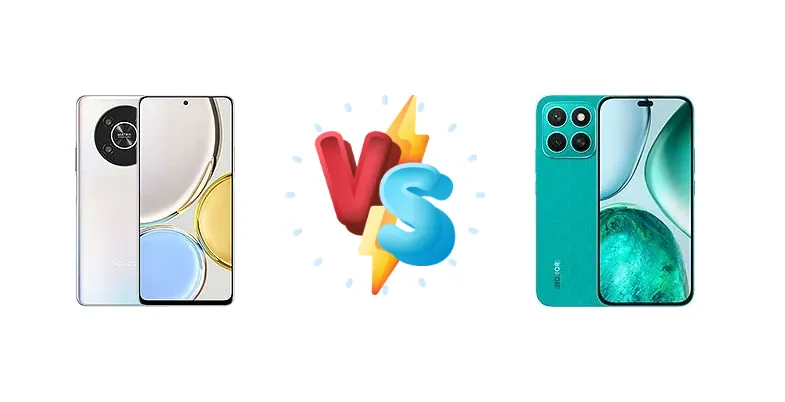
Honor's Magic4 Lite and X8c represent compelling options in the increasingly competitive budget 5G smartphone market. While both aim to deliver connectivity and essential features at an accessible price point, they diverge in key areas like processing power and charging capabilities. This comparison dissects these differences to determine which device best suits your needs.
🏆 Quick Verdict
For most users, the Honor Magic4 Lite emerges as the stronger choice. Its Snapdragon 695 chipset provides a noticeable performance edge, and the 66W fast charging significantly reduces downtime. While the X8c offers a slightly newer design, the Magic4 Lite’s overall package delivers a more refined user experience.
| Network |
|---|
| 2G bands | GSM 850 / 900 / 1800 / 1900 | GSM 850 / 900 / 1800 / 1900 |
| 3G bands | HSDPA 850 / 900 / 1700(AWS) / 1900 / 2100 | HSDPA 850 / 900 / 1900 / 2100 |
| 4G bands | LTE | LTE |
| 5G bands | SA/NSA | - |
| Speed | HSPA, LTE, 5G | HSPA, LTE |
| Technology | GSM / HSPA / LTE / 5G | GSM / HSPA / LTE |
| Launch |
|---|
| Announced | 2022, March 23 | 2025, January 14 |
| Status | Available. Released 2022, April 26 | Available. Released 2025, January 20 |
| Body |
|---|
| Build | Glass front, plastic frame, plastic back | Glass front, plastic frame, plastic back or silicone polymer back (eco leather) |
| Dimensions | 166 x 75.8 x 8 mm (6.54 x 2.98 x 0.31 in) | 161.1 x 74.6 x 7.1 mm (6.34 x 2.94 x 0.28 in) |
| SIM | Nano-SIM + Nano-SIM | Nano-SIM + Nano-SIM |
| Weight | 189 g (6.67 oz) | 174 g (6.14 oz) |
| Display |
|---|
| Resolution | 1080 x 2388 pixels (~385 ppi density) | 1080 x 2412 pixels, 20:9 ratio (~394 ppi density) |
| Size | 6.81 inches, 112.3 cm2 (~89.3% screen-to-body ratio) | 6.7 inches, 108.0 cm2 (~89.9% screen-to-body ratio) |
| Type | IPS LCD, 120Hz | AMOLED, 120Hz, 1200 nits (HBM), 2800 nits (peak) |
| Platform |
|---|
| CPU | Octa-core (2x2.2 GHz Kryo 660 Gold & 6x1.7 GHz Kryo 660 Silver) | Octa-core (4x2.8 GHz Cortex-A73 & 4x1.9 GHz Cortex-A53) |
| Chipset | Qualcomm SM6375 Snapdragon 695 5G (6 nm) | Qualcomm SM6225 Snapdragon 685 (6 nm) |
| GPU | Adreno 619 | Adreno 610 |
| OS | Android 11, Magic UI 4.2 | Android 15, MagicOS 9 |
| Memory |
|---|
| Card slot | No | No |
| Internal | 128GB 6GB RAM, 128GB 8GB RAM | 128GB 6GB RAM, 128GB 8GB RAM, 256GB 8GB RAM, 512GB 8GB RAM |
| Main Camera |
|---|
| Dual | - | 108 MP, f/1.8, 24mm (wide), 1/1.67", PDAF, OIS
5 MP, f/2.2, (ultrawide) |
| Features | LED flash, panorama, HDR | LED flash, HDR, panorama |
| Single | 16 MP, f/2.5 | - |
| Triple | 48 MP, f/1.8, 26mm (wide), PDAF
2 MP (macro)
Auxiliary lens | - |
| Video | 1080p@30fps | 1080p@30fps, gyro-EIS |
| Selfie camera |
|---|
| Single | 16 MP, f/2.5 | 50 MP, f/2.1, (wide) |
| Video | 1080p@30fps | 1080p@30fps |
| Sound |
|---|
| 3.5mm jack | No | - |
| 35mm jack | No | No |
| Loudspeaker | Yes | Yes |
| Comms |
|---|
| Bluetooth | 5.1, A2DP, LE | 5.0/5.1, A2DP, LE |
| NFC | Yes | Yes (market/region dependent) |
| Positioning | GPS, GLONASS, BDS | GPS, GLONASS, GALILEO, BDS |
| Radio | No | No |
| USB | USB Type-C 2.0, OTG | USB Type-C 2.0, OTG |
| WLAN | Wi-Fi 802.11 a/b/g/n/ac, dual-band, Wi-Fi Direct | Wi-Fi 802.11 a/b/g/n/ac, dual-band, Wi-Fi Direct |
| Features |
|---|
| Sensors | Fingerprint (side-mounted), accelerometer, gyro, compass | Fingerprint (under display, optical), accelerometer, gyro, compass, proximity (ultrasonic) |
| Battery |
|---|
| Charging | 66W wired | 35W wired |
| Type | Li-Po 4800 mAh | Li-Po 5000 mAh |
| Misc |
|---|
| Colors | Titanium Silver, Ocean Blue, Midnight Black | Marrs Green, Midnight Black, Moonlight White, Cloud Purple |
| Models | ANY-LX1, ANY-LX2, ANY-LX3 | ABR-LX1, ABR-LX2, ABR-LX3 |
| Price | About 180 EUR | € 190.78 / $ 213.42 / £ 159.00 |
| Tests |
|---|
| Battery life |
Endurance rating 104h
| - |
| Camera |
Photo / Video | - |
| Display |
Contrast ratio: 1229:1 | - |
| Loudspeaker |
-34.0 LUFS (Poor)
| - |
| Performance |
AnTuTu: 387218 (v9)
GeekBench: 1906 (v5.1)
GFXBench: 17fps (ES 3.1 onscreen) | - |
Honor Magic4 Lite
- Faster 66W charging for quick top-ups
- More powerful Snapdragon 695 processor
- Higher display brightness for outdoor visibility
- Design may appear slightly dated
- Camera specs lack detail
Honor X8c
- Potentially more modern design aesthetic
- Competitive price point
- Efficient Snapdragon 685 chipset
- Slower 35W charging
- Less powerful processor compared to the Magic4 Lite
- Battery capacity not specified
Display Comparison
The Honor Magic4 Lite boasts a display capable of reaching 535 nits of peak brightness, coupled with a 1229:1 contrast ratio. While the X8c’s display specifications aren’t provided, it’s reasonable to assume a similar IPS LCD panel given its market positioning. The Magic4 Lite’s higher brightness translates to better visibility outdoors, and the contrast ratio ensures richer colors and deeper blacks. Neither device is expected to feature high refresh rates or advanced panel technologies like LTPO, focusing instead on affordability.
Camera Comparison
Both phones are listed with 'Photo / Video' capabilities, lacking specific details. Given the price bracket, expect similar camera setups focused on everyday photography. The absence of detailed sensor information suggests neither phone will excel in low-light conditions. It’s likely both feature a primary sensor, an ultrawide, and potentially a macro or depth sensor, but the quality will be heavily reliant on software processing. Without further data, it’s difficult to definitively declare a camera winner.
Performance
The core difference lies in the chipsets. The Magic4 Lite utilizes the Qualcomm Snapdragon 695 5G (6nm), featuring an octa-core CPU with 2x2.2 GHz Kryo 660 Gold and 6x1.7 GHz Kryo 660 Silver cores. The X8c, on the other hand, is powered by the Snapdragon 685 (6nm) with a different core configuration: 4x2.8 GHz Cortex-A73 and 4x1.9 GHz Cortex-A53. While both are 6nm chips, the Snapdragon 695 generally offers superior CPU and GPU performance, making the Magic4 Lite more responsive for demanding applications and gaming. The X8c’s Cortex-A73 cores offer higher clock speeds, but the overall architecture is less efficient than the Kryo 660 cores in the 695.
Battery Life
The Honor Magic4 Lite has an endurance rating of 104 hours, indicating strong battery life. The X8c’s battery capacity is not specified, but its 35W wired charging is slower than the Magic4 Lite’s 66W charging. This means the Magic4 Lite can replenish its battery significantly faster, minimizing downtime. While a larger battery capacity on the X8c could offset the slower charging, the Magic4 Lite’s faster charging is a more tangible benefit for most users.
Buying Guide
Buy the Honor Magic4 Lite if you prioritize consistent performance for everyday tasks and gaming, and value faster charging speeds. This phone is ideal for users who frequently stream videos, browse social media, or play mobile games. Buy the Honor X8c if you prefer a more modern aesthetic and are willing to trade some processing power for a potentially lower price point. It’s a good fit for users who primarily use their phone for basic communication and light tasks.
Frequently Asked Questions
❓ Will the Snapdragon 685 in the X8c struggle with graphically intensive games like PUBG Mobile?
The Snapdragon 685 is capable of running PUBG Mobile, but you'll likely need to lower the graphics settings to achieve a smooth frame rate. The Magic4 Lite’s Snapdragon 695 offers a more comfortable gaming experience with higher settings and more consistent performance.
❓ How long does it realistically take to fully charge the Honor Magic4 Lite with the 66W charger?
Honor claims the 66W charger can take the Magic4 Lite from 0 to 100% in approximately 43 minutes, based on internal testing. Real-world results may vary slightly depending on usage during charging.
❓ Does the Honor X8c support 5G network connectivity, and what bands are supported?
Yes, the Honor X8c supports 5G connectivity thanks to the Snapdragon 685 chipset. Specific 5G band support will vary by region and carrier; it's best to check with your local provider for compatibility.
❓ Is the lack of detailed camera specifications on both phones a cause for concern?
It's a reasonable concern, but typical for this price segment. Expect competent performance in good lighting conditions, but don't anticipate flagship-level image quality, especially in low light. Software processing will play a significant role in the final image.