
Honor Magic4 Lite vs Google Pixel 6a: Which Mid-Range Phone Reigns Supreme?
| Phones Images | |||||
|---|---|---|---|---|---|
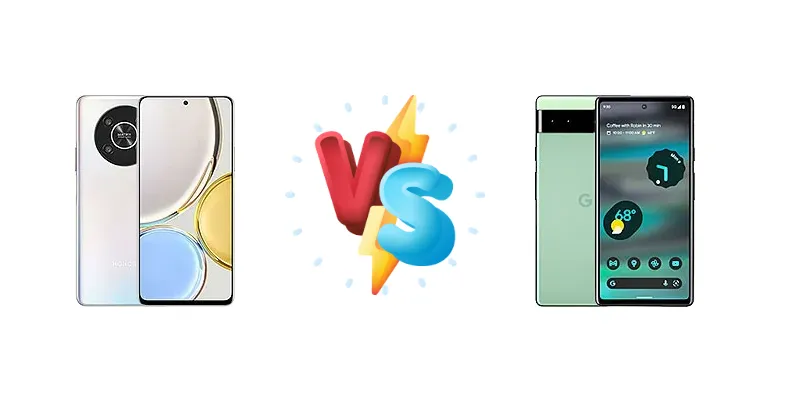
|
🏆 Quick Verdict
For the average user prioritizing a smooth, intelligent camera experience and guaranteed software updates, the Google Pixel 6a is the better choice. However, the Honor Magic4 Lite excels in battery endurance and charging speed, making it ideal for users who demand all-day power and quick top-ups.
| PHONES | ||
|---|---|---|
| Phone Names | Honor Magic4 Lite | Google Pixel 6a |
| Network | ||
|---|---|---|
| 2G bands | GSM 850 / 900 / 1800 / 1900 | GSM 850 / 900 / 1800 / 1900 |
| 3G bands | HSDPA 850 / 900 / 1700(AWS) / 1900 / 2100 | HSDPA 800 / 850 / 900 / 1700(AWS) / 1900 / 2100 |
| 4G bands | LTE | 1, 2, 3, 4, 5, 7, 8, 12, 13, 14, 17, 18, 19, 20, 25, 26, 28, 29, 30, 38, 39, 40, 41, 42, 48, 66, 71 - GX7AS, GB62Z (USA/Canada) |
| 5G bands | SA/NSA | 1, 2, 3, 5, 7, 8, 12, 20, 25, 28, 30, 38, 40, 41, 48, 66, 71, 77, 78 SA/NSA/Sub6 - GX7AS (USA/Canada) |
| Speed | HSPA, LTE, 5G | HSPA, LTE, 5G |
| Technology | GSM / HSPA / LTE / 5G | GSM / HSPA / LTE / 5G |
| - | 1, 2, 3, 5, 7, 8, 12, 20, 25, 28, 30, 40, 48, 66, 71, 77, 78 SA/NSA/Sub6 - G1AZG (International) | |
| Launch | ||
|---|---|---|
| Announced | 2022, March 23 | 2022, May 11 |
| Status | Available. Released 2022, April 26 | Available. Released 2022, July 21 |
| Body | ||
|---|---|---|
| Build | Glass front, plastic frame, plastic back | Glass front (Gorilla Glass 3), aluminum frame, plastic back |
| Dimensions | 166 x 75.8 x 8 mm (6.54 x 2.98 x 0.31 in) | 152.2 x 71.8 x 8.9 mm (5.99 x 2.83 x 0.35 in) |
| SIM | Nano-SIM + Nano-SIM | Nano-SIM + eSIM |
| Weight | 189 g (6.67 oz) | 178 g (6.28 oz) |
| - | IP67 dust/water resistant (up to 1m for 30 min) | |
| Display | ||
|---|---|---|
| Protection | - | Corning Gorilla Glass 3 |
| Resolution | 1080 x 2388 pixels (~385 ppi density) | 1080 x 2400 pixels, 20:9 ratio (~429 ppi density) |
| Size | 6.81 inches, 112.3 cm2 (~89.3% screen-to-body ratio) | 6.1 inches, 90.7 cm2 (~83.0% screen-to-body ratio) |
| Type | IPS LCD, 120Hz | OLED, HDR |
| - | Always-on display | |
| Platform | ||
|---|---|---|
| CPU | Octa-core (2x2.2 GHz Kryo 660 Gold & 6x1.7 GHz Kryo 660 Silver) | Octa-core (2x2.80 GHz Cortex-X1 & 2x2.25 GHz Cortex-A76 & 4x1.80 GHz Cortex-A55) |
| Chipset | Qualcomm SM6375 Snapdragon 695 5G (6 nm) | Google Tensor (5 nm) |
| GPU | Adreno 619 | Mali-G78 MP20 |
| OS | Android 11, Magic UI 4.2 | Android 12, upgradable to Android 15, up to 5 major Android upgrades |
| Memory | ||
|---|---|---|
| Card slot | No | No |
| Internal | 128GB 6GB RAM, 128GB 8GB RAM | 128GB 6GB RAM |
| - | UFS 3.1 | |
| Main Camera | ||
|---|---|---|
| Dual | - | 12.2 MP, f/1.7, 27mm, (wide), 1/2.55", 1.4µm, dual pixel PDAF, OIS 12 MP, f/2.2, 17mm, 114˚ (ultrawide), 1.25µm |
| Features | LED flash, panorama, HDR | Dual-LED flash, Pixel Shift, Auto-HDR, panorama |
| Single | 16 MP, f/2.5 | 8 MP, f/2.0, 24mm (wide), 1.12µm |
| Triple | 48 MP, f/1.8, 26mm (wide), PDAF 2 MP (macro) Auxiliary lens | - |
| Video | 1080p@30fps | 4K@30/60fps, 1080p@30/60/120/240fps; gyro-EIS, OIS |
| Selfie camera | ||
|---|---|---|
| Features | - | HDR, panorama |
| Single | 16 MP, f/2.5 | 8 MP, f/2.0, 24mm (wide), 1.12µm |
| Video | 1080p@30fps | 1080p@30fps |
| Sound | ||
|---|---|---|
| 3.5mm jack | No | No |
| 35mm jack | No | No |
| Loudspeaker | Yes | Yes, with stereo speakers |
| Comms | ||
|---|---|---|
| Bluetooth | 5.1, A2DP, LE | 5.2, A2DP, LE |
| NFC | Yes | Yes |
| Positioning | GPS, GLONASS, BDS | GPS, GLONASS, GALILEO, QZSS |
| Radio | No | No |
| USB | USB Type-C 2.0, OTG | USB Type-C 3.1 |
| WLAN | Wi-Fi 802.11 a/b/g/n/ac, dual-band, Wi-Fi Direct | Wi-Fi 802.11 a/b/g/n/ac/6e, dual-band, Wi-Fi Direct |
| Features | ||
|---|---|---|
| Sensors | Fingerprint (side-mounted), accelerometer, gyro, compass | Fingerprint (under display, optical), accelerometer, gyro, proximity, compass, barometer |
| Battery | ||
|---|---|---|
| Charging | 66W wired | 18W wired, PD3.0 |
| Type | Li-Po 4800 mAh | Li-Po 4410 mAh |
| Misc | ||
|---|---|---|
| Colors | Titanium Silver, Ocean Blue, Midnight Black | Chalk, Charcoal, Sage |
| Models | ANY-LX1, ANY-LX2, ANY-LX3 | GX7AS, GB62Z, G1AZG, GB17L |
| Price | About 180 EUR | $ 138.99 / C$ 228.74 / ₹ 23,999 |
| Tests | ||
|---|---|---|
| Battery life | Endurance rating 104h | Endurance rating 94h |
| Camera | Photo / Video | - |
| Display | Contrast ratio: 1229:1 | Contrast ratio: Infinite (nominal) |
| Loudspeaker | -34.0 LUFS (Poor) | - |
| Performance | AnTuTu: 387218 (v9) GeekBench: 1906 (v5.1) GFXBench: 17fps (ES 3.1 onscreen) | - |
Honor Magic4 Lite
- Exceptional 104-hour battery endurance
- Ultra-fast 66W wired charging
- Competitive price point
- Less powerful Snapdragon 695 chipset
- Inferior camera image processing compared to Pixel 6a
- Less frequent software updates
Google Pixel 6a
- Powerful Google Tensor chip for smooth performance
- Superior camera quality and computational photography
- Guaranteed software updates and clean Android experience
- Shorter 94-hour battery endurance
- Slower 18W wired charging
- Higher price compared to Honor Magic4 Lite
Display Comparison
The Pixel 6a boasts a significantly brighter display, reaching 876 nits compared to the Magic4 Lite’s 535 nits. This translates to better visibility outdoors under direct sunlight. While the Magic4 Lite offers a 1229:1 contrast ratio, the Pixel 6a’s ‘Infinite’ contrast ratio (typical of OLED panels) delivers deeper blacks and more vibrant colors. The Pixel 6a’s OLED panel also likely benefits from a higher PWM dimming rate, potentially reducing eye strain for sensitive users, a specification not provided for the Magic4 Lite. The lack of high refresh rate on either device is a common trade-off in this price bracket.
Camera Comparison
Both phones offer capable camera systems, but approach image capture differently. The Pixel 6a leverages Google’s computational photography prowess, powered by the Tensor chip, to deliver consistently excellent photos, particularly in challenging lighting conditions. While specific sensor details are missing for the Magic4 Lite, the Pixel 6a’s image processing excels in dynamic range and detail preservation. The Pixel 6a’s software features, like Night Sight and Portrait Mode, are industry-leading. The Magic4 Lite’s camera is described as capable of Photo/Video, but lacks the software sophistication of the Pixel 6a. The absence of OIS information for the Magic4 Lite suggests it may struggle with low-light video stabilization.
Performance
The Google Pixel 6a’s Google Tensor chip, fabricated on a 5nm process, represents a substantial leap in performance over the Honor Magic4 Lite’s Snapdragon 695 (6nm). The Tensor’s octa-core configuration, featuring Cortex-X1 and Cortex-A76 cores, delivers significantly faster processing speeds (2.80 GHz vs 2.2 GHz peak) and improved AI capabilities. While the Snapdragon 695 is adequate for everyday tasks, the Tensor excels in demanding applications like video editing and gaming. The Pixel 6a’s Tensor chip also enables features like Magic Eraser and Real Tone, unavailable on the Magic4 Lite. The 6nm Snapdragon 695 will be more efficient than older 7nm or 8nm chips, but cannot match the 5nm Tensor.
Battery Life
The Honor Magic4 Lite boasts an impressive endurance rating of 104 hours, exceeding the Pixel 6a’s 94 hours. This suggests the Magic4 Lite will last longer on a single charge under typical usage. However, the Pixel 6a’s Tensor chip is more power-efficient under heavy load. The Magic4 Lite’s 66W wired charging is a significant advantage, allowing for a full charge in under 40 minutes, while the Pixel 6a’s 18W charging takes considerably longer. The faster charging of the Magic4 Lite mitigates the slightly smaller battery capacity, making it a strong contender for users who prioritize quick top-ups.
Buying Guide
Buy the Honor Magic4 Lite if you need exceptional battery life and incredibly fast 66W charging, and are comfortable with a less refined software experience. This phone is perfect for users who prioritize longevity and don't rely heavily on advanced computational photography. Buy the Google Pixel 6a if you prefer a clean Android experience, superior image processing capabilities powered by the Tensor chip, and guaranteed software updates, even if it means sacrificing some battery endurance and charging speed.