
Honor Magic3 vs Xiaomi Mi 11 Ultra: Which Snapdragon 888 Flagship Reigns Supreme?
| Phones Images | |||||
|---|---|---|---|---|---|
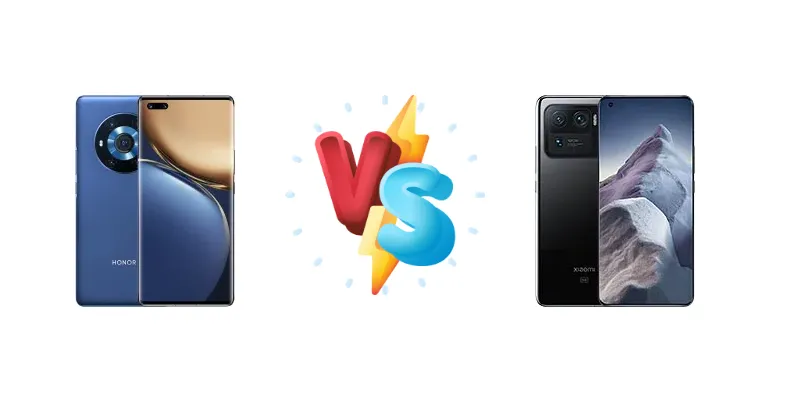
|
🏆 Quick Verdict
For the average user prioritizing all-around performance and exceptional charging versatility, the Xiaomi Mi 11 Ultra emerges as the winner. Its 67W wired *and* wireless charging, coupled with a measured 943 nits peak brightness, provide a more complete and convenient experience than the Honor Magic3.
| PHONES | ||
|---|---|---|
| Phone Names | Honor Magic3 | Xiaomi Mi 11 Ultra |
| Network | ||
|---|---|---|
| 2G bands | GSM 850 / 900 / 1800 / 1900 | GSM 850 / 900 / 1800 / 1900 |
| 3G bands | HSDPA 800 / 850 / 900 / 1700(AWS) / 1900 / 2100 | HSDPA 850 / 900 / 1700(AWS) / 1900 / 2100 |
| 4G bands | 1, 2, 3, 4, 5, 7, 8, 12, 17, 18, 19, 20, 26, 28, 34, 38, 39, 40, 41 | 1, 2, 3, 4, 5, 7, 8, 12, 17, 20, 28, 32, 38, 40, 41, 42, 66 - International |
| 5G bands | 1, 3, 5, 8, 28, 38, 41, 77, 78, 79 SA/NSA | 1, 3, 5, 7, 8, 20, 28, 38, 40, 41, 77, 78, 79 SA/NSA - International |
| Speed | HSPA, LTE, 5G | HSPA, LTE, 5G |
| Technology | GSM / CDMA / HSPA / EVDO / LTE / 5G | GSM / CDMA / HSPA / EVDO / LTE / 5G |
| CDMA2000 1xEV-DO | 1, 3, 28, 41, 77, 78, 79 SA/NSA - China | |
| Launch | ||
|---|---|---|
| Announced | 2021, August 12 | 2021, March 29 |
| Status | Available. Released 2021, August 20 | Available. Released 2021, April 02 |
| Body | ||
|---|---|---|
| Build | Glass front, glass back or vegan leather back, aluminum frame | Glass front (Gorilla Glass Victus), ceramic back, aluminum frame |
| Dimensions | 162.8 x 74.9 x 8.99 mm (Glass) / 9.5 mm (Vegan Leather) | 164.3 x 74.6 x 8.4 mm (6.47 x 2.94 x 0.33 in) |
| SIM | Nano-SIM + Nano-SIM | Nano-SIM + Nano-SIM |
| Weight | 203 g (Glass) / 202 g (Vegan Leather) (7.16 oz) | 234 g (8.25 oz) |
| IP54, dust and water resistant | IP68 dust/water resistant (up to 1.5m for 30 min) | |
| Display | ||
|---|---|---|
| Protection | - | Corning Gorilla Glass Victus |
| Resolution | 1344 x 2772 pixels, 18.5:9 ratio (~456 ppi density) | 1440 x 3200 pixels, 20:9 ratio (~515 ppi density) |
| Size | 6.76 inches, 115.7 cm2 (~94.9% screen-to-body ratio) | 6.81 inches, 112.0 cm2 (~91.4% screen-to-body ratio) |
| Type | OLED, 1B colors, 120Hz, HDR10+ | AMOLED, 1B colors, 120Hz, HDR10+, Dolby Vision, 900 nits (HBM), 1700 nits (peak) |
| Platform | ||
|---|---|---|
| CPU | Octa-core (1x2.84 GHz Cortex-X1 & 3x2.42 GHz Cortex-A78 & 4x1.80 GHz Cortex-A55 | Octa-core (1x2.84 GHz Cortex-X1 & 3x2.42 GHz Cortex-A78 & 4x1.80 GHz Cortex-A55) |
| Chipset | Qualcomm SM8350 Snapdragon 888 5G (5 nm) | Qualcomm SM8350 Snapdragon 888 5G (5 nm) |
| GPU | Adreno 660 | Adreno 660 |
| OS | Android 11, Magic UI 5 | Android 11, upgradable to Android 13, MIUI 14 |
| Memory | ||
|---|---|---|
| Card slot | No | No |
| Internal | 128GB 8GB RAM, 256GB 8GB RAM | 256GB 8GB RAM, 256GB 12GB RAM, 512GB 12GB RAM |
| - | UFS 3.1 | |
| Main Camera | ||
|---|---|---|
| Features | LED flash, HDR, panorama | Laser AF, color spectrum sensor, Dual-LED flash, HDR, panorama, 1.1” AMOLED selfie display |
| Single | 13 MP, f/2.4, 100˚ (ultrawide) | 20 MP, f/2.2, 27mm (wide), 1/3.4", 0.8µm |
| Triple | 50 MP, f/1.9, 23mm (wide), 1/1.56", 1.0µm, multi-directional PDAF 64 MP, f/1.8, (monochrome) 13 MP, f/2.2, 120˚ (ultrawide) | 50 MP, f/2.0, 24mm (wide), 1/1.12", 1.4µm, dual pixel PDAF, OIS 48 MP, f/4.1, 120mm (periscope telephoto), 1/2.0", 0.8µm, PDAF, OIS, 5x optical zoom 48 MP, f/2.2, 12mm, 128˚ (ultrawide), 1/2.0", 0.8µm, PDAF |
| Video | 4K@30/60fps, 1080p@30/60fps, gyro-EIS | 8K@24fps, 4K@30/60fps, 1080p@30/60/120/240/960/1920fps, gyro-EIS, HDR10+ rec. |
| Selfie camera | ||
|---|---|---|
| Features | HDR | HDR, panorama |
| Single | 13 MP, f/2.4, 100˚ (ultrawide) | 20 MP, f/2.2, 27mm (wide), 1/3.4", 0.8µm |
| Video | 1080p@30fps | 1080p@30/60fps, 720p@120fps, gyro-EIS |
| Sound | ||
|---|---|---|
| 3.5mm jack | No | No |
| 35mm jack | No | No |
| Loudspeaker | Yes, with stereo speakers | Yes, with stereo speakers |
| - | 24-bit/192kHz audio Tuned by Harman Kardon | |
| Comms | ||
|---|---|---|
| Bluetooth | 5.2, A2DP, LE, aptX HD | 5.2, A2DP, LE, aptX HD, aptX Adaptive |
| Infrared port | - | Yes |
| NFC | Yes | Yes |
| Positioning | GPS (L1+L5), GLONASS (L1), BDS (B1I+B1c+B2a) | GPS (L1+L5), GLONASS (L1), BDS (B1I+B1c+B2a), GALILEO (E1+E5a), QZSS (L1+L5), NavIC (L5) |
| Radio | No | No |
| USB | USB Type-C 3.1, OTG | USB Type-C 2.0, OTG |
| WLAN | Wi-Fi 802.11 a/b/g/n/ac/6, dual-band, Wi-Fi Direct | Wi-Fi 802.11 a/b/g/n/ac/6e, dual-band, Wi-Fi Direct, DLNA |
| Features | ||
|---|---|---|
| Sensors | Fingerprint (under display, optical), accelerometer, gyro, proximity, compass | Fingerprint (under display, optical), accelerometer, gyro, compass |
| - | Virtual proximity sensing | |
| Battery | ||
|---|---|---|
| Charging | 66W wired 5W reverse wired | 67W wired, PD3.0, QC4, 100% in 36 min 67W wireless, 100% in 39 min 10W reverse wireless |
| Type | Li-Po 4600 mAh | Li-Po 5000 mAh |
| Misc | ||
|---|---|---|
| Colors | Golden Hour (Vegan Leather), Blue Hour (Vegan Leather), Black, White | Ceramic White (Cosmic White), Ceramic Black (Cosmic Black) |
| Models | ELZ-AN00 | M2102K1G, M2102K1C |
| Price | About 670 EUR | About 1500 EUR |
| SAR | - | 1.08 W/kg (head) 0.81 W/kg (body) |
| SAR EU | - | 0.55 W/kg (head) 0.99 W/kg (body) |
| Tests | ||
|---|---|---|
| Battery life | - | Endurance rating 95h |
| Camera | - | Photo / Video |
| Display | - | Contrast ratio: Infinite (nominal) |
| Loudspeaker | - | -24.3 LUFS (Very good) |
| Performance | - | AnTuTu: 688720 (v8) GeekBench: 3191 (v5.1) GFXBench: 33fps (ES 3.1 onscreen) |
Honor Magic3
- Potentially cleaner software experience (Honor's history)
- 66W wired charging is still fast
- Competitive Snapdragon 888 performance
- Slower and less versatile charging options
- Display brightness likely lower than Mi 11 Ultra
- Camera details are unknown, potentially less advanced
Xiaomi Mi 11 Ultra
- 67W wired and wireless charging with fast charging times
- 943 nits peak display brightness for excellent outdoor visibility
- Likely more advanced camera system based on Xiaomi's track record
- Potential for software bloat (Xiaomi's history)
- Snapdragon 888 can run hot under sustained load
- Larger size and weight compared to some competitors
Display Comparison
Both devices utilize OLED panels, but the Xiaomi Mi 11 Ultra boasts a significantly higher measured peak brightness of 943 nits compared to an unspecified value for the Honor Magic3. This translates to superior visibility outdoors. While both likely employ high refresh rates (a common feature in this segment), the Mi 11 Ultra’s infinite (nominal) contrast ratio suggests a more immersive viewing experience. The absence of LTPO information for either device means we can’t assess dynamic refresh rate efficiency, but the brightness advantage clearly favors the Xiaomi.
Camera Comparison
Both phones are described as having 'Photo / Video' capabilities, but lack specific sensor details. The absence of information regarding sensor size, aperture, or optical image stabilization (OIS) makes a direct comparison impossible. However, Xiaomi’s flagship devices typically prioritize camera innovation, suggesting a more refined image processing pipeline and potentially more versatile shooting modes. The lack of detail regarding the Honor Magic3’s camera system implies a more conservative approach. We can assume both will offer competitive performance, but Xiaomi likely holds an edge.
Performance
Both the Honor Magic3 and Xiaomi Mi 11 Ultra are powered by the Qualcomm SM8350 Snapdragon 888 5G (5 nm) chipset, featuring an octa-core CPU configuration identical in clock speeds (1x2.84 GHz Cortex-X1, 3x2.42 GHz Cortex-A78, and 4x1.80 GHz Cortex-A55). Therefore, raw processing power will be nearly indistinguishable. The key differentiator will likely be thermal management. While neither device’s cooling solution is detailed in the provided data, Xiaomi’s history suggests a more robust approach to preventing throttling under sustained load. RAM configurations are not specified, but both would likely utilize LPDDR5 for fast memory access.
Battery Life
The Xiaomi Mi 11 Ultra claims an endurance rating of 95 hours, suggesting excellent battery life. While the Honor Magic3’s battery life is not specified, the Mi 11 Ultra’s 67W wired charging (100% in 36 minutes) and 67W wireless charging (100% in 39 minutes) are significantly more versatile than the Honor Magic3’s 66W wired and 5W reverse wired charging. The inclusion of PD3.0 and QC4 support on the Mi 11 Ultra further enhances its charging compatibility. The 10W reverse wireless charging on the Mi 11 Ultra is also more practical than the Magic3’s 5W offering.
Buying Guide
Buy the Honor Magic3 if you prioritize a slightly more streamlined software experience and are comfortable with a less aggressive charging profile. Buy the Xiaomi Mi 11 Ultra if you demand the fastest possible charging – both wired and wireless – and value a brighter, more visible display in direct sunlight. The Mi 11 Ultra also caters to users who appreciate a more feature-rich camera system, even if the core sensor technology is similar.