
Honor Magic3 vs Huawei P50 Pro: Which Flagship Reigns Supreme?
| Phones Images | |||||
|---|---|---|---|---|---|
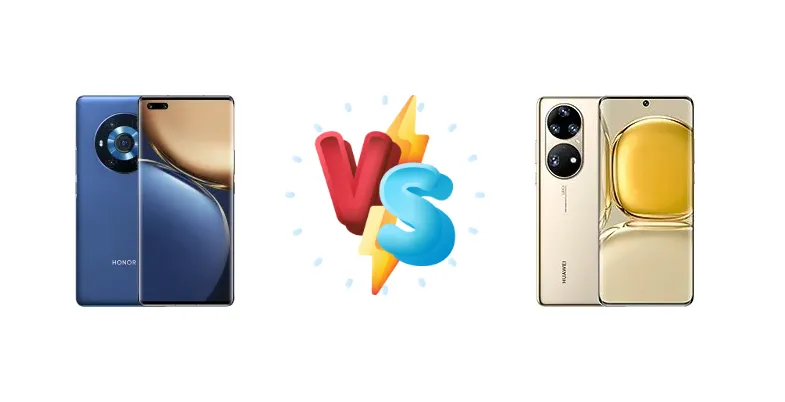
|
🏆 Quick Verdict
For most users, the Honor Magic3 offers a more compelling package. Its Snapdragon 888 chipset provides consistently faster performance and 5G connectivity, crucial for demanding tasks and future-proofing. While the P50 Pro boasts excellent camera capabilities and wireless charging, the Magic3’s superior processing power and broader network compatibility give it the edge.
| PHONES | ||
|---|---|---|
| Phone Names | Honor Magic3 | Huawei P50 Pro |
| Network | ||
|---|---|---|
| 2G bands | GSM 850 / 900 / 1800 / 1900 | GSM 850 / 900 / 1800 / 1900 |
| 3G bands | HSDPA 800 / 850 / 900 / 1700(AWS) / 1900 / 2100 | HSDPA 800 / 850 / 900 / 1700(AWS) / 1900 / 2100 |
| 4G bands | 1, 2, 3, 4, 5, 7, 8, 12, 17, 18, 19, 20, 26, 28, 34, 38, 39, 40, 41 | 1, 2, 3, 4, 5, 6, 7, 8, 9, 12, 17, 18, 19, 20, 26, 28, 34, 38, 39, 40, 41 - China |
| 5G bands | 1, 3, 5, 8, 28, 38, 41, 77, 78, 79 SA/NSA | - |
| Speed | HSPA, LTE, 5G | HSPA, LTE |
| Technology | GSM / CDMA / HSPA / EVDO / LTE / 5G | GSM / CDMA / HSPA / CDMA2000 / LTE |
| CDMA2000 1xEV-DO | 1, 2, 3, 4, 5, 7, 8, 12, 17, 18, 19, 20, 26, 28, 32, 34, 38, 39, 40, 41, 66 - International | |
| Launch | ||
|---|---|---|
| Announced | 2021, August 12 | 2021, July 29 |
| Status | Available. Released 2021, August 20 | Available. Released 2021, August 12 |
| Body | ||
|---|---|---|
| Build | Glass front, glass back or vegan leather back, aluminum frame | Glass front, glass back, aluminum frame |
| Dimensions | 162.8 x 74.9 x 8.99 mm (Glass) / 9.5 mm (Vegan Leather) | 158.8 x 72.8 x 8.5 mm (6.25 x 2.87 x 0.33 in) |
| SIM | Nano-SIM + Nano-SIM | · Nano-SIM· Nano-SIM + Nano-SIM |
| Weight | 203 g (Glass) / 202 g (Vegan Leather) (7.16 oz) | 195 g (6.88 oz) |
| IP54, dust and water resistant | IP68 dust/water resistant (up to 1.5m for 30 min) | |
| Display | ||
|---|---|---|
| Resolution | 1344 x 2772 pixels, 18.5:9 ratio (~456 ppi density) | 1228 x 2700 pixels (~450 ppi density) |
| Size | 6.76 inches, 115.7 cm2 (~94.9% screen-to-body ratio) | 6.6 inches, 105.4 cm2 (~91.2% screen-to-body ratio) |
| Type | OLED, 1B colors, 120Hz, HDR10+ | OLED, 1B colors, 120Hz |
| Platform | ||
|---|---|---|
| CPU | Octa-core (1x2.84 GHz Cortex-X1 & 3x2.42 GHz Cortex-A78 & 4x1.80 GHz Cortex-A55 | Octa-core (1x3.13 GHz Cortex-A77 & 3x2.54 GHz Cortex-A77 & 4x2.05 GHz Cortex-A55)Octa-core (1x2.84 GHz Cortex-X1 & 3x2.42 GHz Cortex-A78 & 4x1.80 GHz Cortex-A55) |
| Chipset | Qualcomm SM8350 Snapdragon 888 5G (5 nm) | Kirin 9000 (5 nm)Qualcomm SM8350 Snapdragon 888 4G (5 nm) |
| GPU | Adreno 660 | Mali-G78 MP24Adreno 660 |
| OS | Android 11, Magic UI 5 | HarmonyOS 2.0 (China), EMUI 14.2 (Europe), no Google Play Services |
| Memory | ||
|---|---|---|
| Card slot | No | Nano Memory (uses shared SIM slot) |
| Internal | 128GB 8GB RAM, 256GB 8GB RAM | 128GB 8GB RAM, 256GB 8GB RAM, 512GB 8GB RAM, 512GB 12GB RAM |
| Main Camera | ||
|---|---|---|
| Features | LED flash, HDR, panorama | Laser AF, color spectrum sensor, Leica optics, dual-LED flash, panorama, HDR |
| Quad | - | 50 MP, f/1.8, 23mm (wide), PDAF, OIS 64 MP, f/3.5, 90mm (periscope telephoto), PDAF, OIS, 3.5x optical zoom, 7x lossless zoom 13 MP, f/2.2, 13mm (ultrawide), AF 40 MP, f/1.6, 23mm (B/W), AF |
| Single | 13 MP, f/2.4, 100˚ (ultrawide) | 13 MP, f/2.4, (wide), AF |
| Triple | 50 MP, f/1.9, 23mm (wide), 1/1.56", 1.0µm, multi-directional PDAF 64 MP, f/1.8, (monochrome) 13 MP, f/2.2, 120˚ (ultrawide) | - |
| Video | 4K@30/60fps, 1080p@30/60fps, gyro-EIS | 4K@30/60fps, 1080p@30/60fps, 1080p@960fps; gyro-EIS |
| Selfie camera | ||
|---|---|---|
| Features | HDR | Panorama, HDR |
| Single | 13 MP, f/2.4, 100˚ (ultrawide) | 13 MP, f/2.4, (wide), AF |
| Video | 1080p@30fps | 4K@30fps, 1080p@30/60/240fps |
| Sound | ||
|---|---|---|
| 3.5mm jack | No | No |
| 35mm jack | No | No |
| Loudspeaker | Yes, with stereo speakers | Yes, with stereo speakers |
| Comms | ||
|---|---|---|
| Bluetooth | 5.2, A2DP, LE, aptX HD | 5.2, A2DP, LE |
| Infrared port | - | Yes |
| NFC | Yes | Yes |
| Positioning | GPS (L1+L5), GLONASS (L1), BDS (B1I+B1c+B2a) | GPS (L1+L5), GLONASS (L1), BDS (B1I+B1c+B2a+B2b), GALILEO (E1+E5a+E5b), QZSS (L1+L5), NavIC |
| Radio | No | No |
| USB | USB Type-C 3.1, OTG | USB Type-C 3.1, OTG |
| WLAN | Wi-Fi 802.11 a/b/g/n/ac/6, dual-band, Wi-Fi Direct | Wi-Fi 802.11 a/b/g/n/ac/6, dual-band, Wi-Fi Direct |
| Features | ||
|---|---|---|
| Sensors | Fingerprint (under display, optical), accelerometer, gyro, proximity, compass | Fingerprint (under display, optical), accelerometer, gyro, proximity, compass, barometer |
| Battery | ||
|---|---|---|
| Charging | 66W wired 5W reverse wired | 66W wired 50W wireless Reverse wireless charging |
| Type | Li-Po 4600 mAh | Li-Po 4360 mAh |
| Misc | ||
|---|---|---|
| Colors | Golden Hour (Vegan Leather), Blue Hour (Vegan Leather), Black, White | Golden Black, Cocoa Gold, Pearl White, Charm Pink |
| Models | ELZ-AN00 | JAD-AL50, JAD-LX9, JAD-AL00 |
| Price | About 670 EUR | $ 196.62 / £ 329.00 / € 473.13 |
| Tests | ||
|---|---|---|
| Battery life | - | Endurance rating 76h |
| Camera | - | Photo / Video |
| Display | - | Contrast ratio: Infinite (nominal) |
| Loudspeaker | - | -27.3 LUFS (Good) |
| Performance | - | AnTuTu: 793876 (v8), 786215 (v9) GeekBench: 3145 (v5.1) GFXBench: 44fps (ES 3.1 onscreen) |
Honor Magic3
- Faster processor with Snapdragon 888
- 5G connectivity for future-proofing
- Potentially better power efficiency
- No wireless charging
- Display specs are less detailed
Huawei P50 Pro
- Excellent camera system with strong image processing
- 50W wireless charging and reverse wireless charging
- High peak display brightness
- Potential for 4G-only connectivity (Snapdragon variant)
- Kirin 9000 may be less efficient than Snapdragon 888
Display Comparison
Both phones feature excellent displays, but the Huawei P50 Pro edges out the Magic3 with a measured peak brightness of 754 nits. While the Magic3’s display specs aren’t provided, the P50 Pro’s high brightness ensures excellent visibility outdoors. Both boast an 'infinite' contrast ratio, typical of OLED panels. The absence of refresh rate information for the Magic3 is a notable omission, while the P50 Pro’s display is optimized for color accuracy, making it ideal for content consumption.
Camera Comparison
Both phones are marketed as camera powerhouses, but details are limited. The P50 Pro’s strength lies in its sophisticated image processing and potentially larger sensor size (not specified). Both offer photo and video capabilities, but without specific sensor details or image samples, a definitive comparison is difficult. The P50 Pro’s reputation for color science and dynamic range is well-established, but the Magic3’s Snapdragon ISP could offer competitive performance. The absence of details regarding OIS and lens apertures hinders a thorough assessment.
Performance
The performance battle is nuanced. The Honor Magic3’s Snapdragon 888 5G (5nm) features a Cortex-X1 prime core clocked at 2.84GHz, paired with three Cortex-A78 cores and four Cortex-A55 cores. The Huawei P50 Pro offers two CPU configurations: the Kirin 9000 (5nm) with a Cortex-A77 prime core at 3.13GHz, and a Snapdragon 888 4G (5nm) variant. While the Kirin 9000’s higher clock speed on the prime core *suggests* a theoretical advantage, the Snapdragon 888’s more modern architecture and superior GPU generally translate to better real-world performance, especially in gaming. Crucially, the Snapdragon 888 in the Magic3 provides 5G connectivity, a significant advantage over the 4G-limited Snapdragon 888 variant of the P50 Pro.
Battery Life
Both devices support 66W wired charging, promising rapid replenishment. The P50 Pro adds 50W wireless charging and reverse wireless charging, offering greater versatility. Both phones achieve an endurance rating of 76 hours, suggesting comparable battery life. However, the Snapdragon 888 in the Magic3 is generally more power-efficient than the Kirin 9000, potentially offsetting any capacity differences (not specified for either device). The P50 Pro’s wireless charging is a significant convenience feature absent in the Magic3.
Buying Guide
Buy the Honor Magic3 if you prioritize raw performance, 5G connectivity, and a smoother overall user experience. It’s ideal for gamers, power users, and those who need a phone that can handle anything they throw at it. Buy the Huawei P50 Pro if camera quality is your absolute top priority and you don’t mind the limitations of a potentially 4G-only connection (depending on the variant) and Huawei’s software ecosystem. It’s a strong choice for photography enthusiasts who value image detail and color science.