
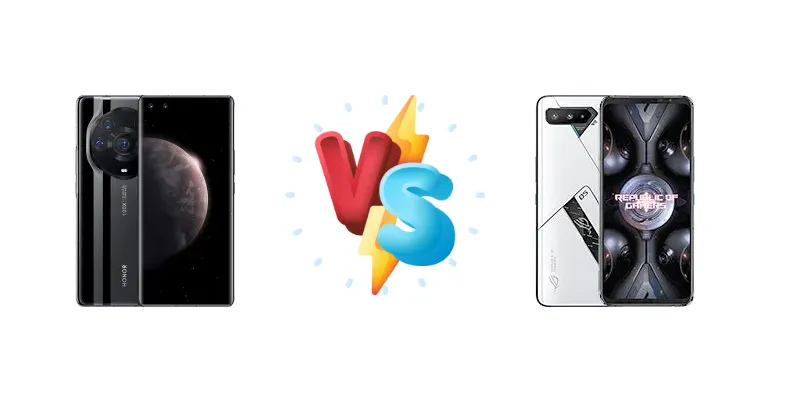
Honor Magic3 Pro+ vs Asus ROG Phone 5 Ultimate: A Deep Dive Comparison
| Phones Images | |||||
|---|---|---|---|---|---|
|
🏆 Quick Verdict
For the average user prioritizing a well-rounded flagship with incredibly fast wireless charging, the Honor Magic3 Pro+ is the better choice. However, dedicated mobile gamers will find the Asus ROG Phone 5 Ultimate’s specialized features and cooling system provide a superior gaming experience, despite slightly slower charging.
| PHONES | ||
|---|---|---|
| Phone Names | Honor Magic3 Pro+ | Asus ROG Phone 5 Ultimate |
| Network | ||
|---|---|---|
| 2G bands | GSM 850 / 900 / 1800 / 1900 | GSM 850 / 900 / 1800 / 1900 |
| 3G bands | HSDPA 800 / 850 / 900 / 1700(AWS) / 1900 / 2100 | HSDPA 800 / 850 / 900 / 1700(AWS) / 1800 / 1900 / 2100 |
| 4G bands | 1, 2, 3, 4, 5, 7, 8, 12, 17, 18, 19, 20, 26, 28, 34, 38, 39, 40, 41 | 1, 2, 3, 4, 5, 7, 8, 12, 13, 17, 18, 19, 20, 25, 26, 28, 29, 30, 32, 34, 38, 39, 40, 41, 42, 48, 66, 71 |
| 5G bands | 1, 3, 5, 8, 28, 38, 41, 77, 78, 79 SA/NSA | 1, 2, 3, 5, 7, 8, 12, 20, 25, 28, 38, 40, 41, 66, 71, 77, 78, 79 SA/NSA |
| Speed | HSPA, LTE, 5G | HSPA 42.2/5.76 Mbps, LTE (7CA) Cat20 1400/150 Mbps, 5G 4 Gbps DL |
| Technology | GSM / CDMA / HSPA / EVDO / LTE / 5G | GSM / HSPA / LTE / 5G |
| Launch | ||
|---|---|---|
| Announced | 2021, August 12 | 2021, March 10 |
| Status | Available. Released 2021, September 19 | Available. Released 2021, June 07 |
| Body | ||
|---|---|---|
| Build | Glass front, ceramic back, aluminum frame | Glass front (Gorilla Glass Victus), glass back (Gorilla Glass 3), aluminum frame |
| Dimensions | 162.8 x 74.9 x 9.9 mm (6.41 x 2.95 x 0.39 in) | 172.8 x 77.3 x 10.3 mm (6.80 x 3.04 x 0.41 in) |
| SIM | Nano-SIM + Nano-SIM | Nano-SIM + Nano-SIM |
| Weight | 236 g (8.32 oz) | 238 g (8.40 oz) |
| - | Pressure sensitive zones (Gaming triggers) Touch sensor; ROG Vision monochrome PMOLED display (on the back) | |
| Display | ||
|---|---|---|
| Protection | - | Corning Gorilla Glass Victus |
| Resolution | 1344 x 2772 pixels, 18.5:9 ratio (~456 ppi density) | 1080 x 2448 pixels (~395 ppi density) |
| Size | 6.76 inches, 115.7 cm2 (~94.9% screen-to-body ratio) | 6.78 inches, 109.5 cm2 (~82.0% screen-to-body ratio) |
| Type | OLED, 1B colors, 120Hz, HDR10+ | AMOLED, 1B colors, 144Hz, HDR10+, 800 nits (typ), 1200 nits (peak) |
| Platform | ||
|---|---|---|
| CPU | Octa-core (1x2.99 GHz Cortex-X1 & 3x2.42 GHz Cortex-A78 & 4x1.80 GHz Cortex-A55) | Octa-core (1x2.84 GHz Cortex-X1 & 3x2.42 GHz Cortex-A78 & 4x1.80 GHz Cortex-A55) |
| Chipset | Qualcomm SM8350 Snapdragon 888+ 5G (5 nm) | Qualcomm SM8350 Snapdragon 888 5G (5 nm) |
| GPU | Adreno 660 | Adreno 660 |
| OS | Android 11, Magic UI 5 | Android 11, upgradable to Android 13, ROG UI |
| Memory | ||
|---|---|---|
| Card slot | No | No |
| Internal | 512GB 12GB RAM | 512GB 18GB RAM |
| - | UFS 3.1 | |
| Main Camera | ||
|---|---|---|
| Features | Color spectrum sensor, LED flash, HDR, panorama | LED flash, HDR, panorama |
| Quad | 50 MP, f/1.9, 23mm (wide), 1/1.28", 1.22µm, multi-directional PDAF, OIS 64 MP, f/3.5, 90mm (telephoto), 1/2.0", 0.7µm, PDAF, OIS, 3.5x optical zoom, 10x hybrid zoom 64 MP, f/1.8, (monochrome) 64 MP, f/2.4, 11mm 126˚ (ultrawide), 1/2.0", 0.7µm, PDAF TOF 3D (depth) | - |
| Triple | - | 64 MP, f/1.8, 26mm (wide), 1/1.73", 0.8µm, PDAF 13 MP, f/2.4, 11mm, 125˚ (ultrawide) 5 MP (macro) |
| Video | 4K@30/60fps, 1080p@30/60fps, gyro-EIS | 8K@30fps, 4K@30/60/120fps, 1080p@30/60/120/240fps, 720p@480fps; gyro-EIS |
| Selfie camera | ||
|---|---|---|
| Features | HDR | Panorama, HDR |
| Single | 13 MP, f/2.4, 100˚ (ultrawide) TOF 3D, (depth/biometrics sensor) | 24 MP, f/2.5, 27mm (wide), 0.9µm |
| Video | 1080p@30fps | 1080p@30fps |
| Sound | ||
|---|---|---|
| 3.5mm jack | - | Yes |
| 35mm jack | No | Yes |
| Loudspeaker | Yes, with stereo speakers | Yes, with DTS:X stereo speakers (2 dedicated amplifiers) |
| - | 24-bit/192kHz audio | |
| Comms | ||
|---|---|---|
| Bluetooth | 5.2, A2DP, LE, aptX HD | 5.2, A2DP, LE, aptX HD, aptX Adaptive |
| NFC | Yes | Yes |
| Positioning | GPS (L1+L5), GLONASS (L1), BDS (B1I+B1c+B2a) | GPS (L1+L5), GLONASS (L1), BDS (B1I+B1c+B2a), GALILEO (E1+E5a), QZSS (L1+L5), NavIC (L5) |
| Radio | No | No |
| USB | USB Type-C 3.1, OTG | USB Type-C 3.1 (side), USB Type-C 2.0 (bottom), OTG, accessory connector |
| WLAN | Wi-Fi 802.11 a/b/g/n/ac/6, dual-band, Wi-Fi Direct | Wi-Fi 802.11 a/b/g/n/ac/6e, dual-band, Wi-Fi Direct |
| Features | ||
|---|---|---|
| Sensors | Fingerprint (under display, optical), Face ID, accelerometer, gyro, proximity, compass | Fingerprint (under display, optical), accelerometer, gyro, proximity, compass |
| Battery | ||
|---|---|---|
| Charging | 66W wired 66W wireless 5W reverse wireless 5W reverse wired | 65W wired, PD3.0, QC5, 70% in 30 min, 100% in 52 min 10W reverse wired |
| Type | Li-Po 4600 mAh | Li-Po 6000 mAh |
| Misc | ||
|---|---|---|
| Colors | Ceramic Black, Ceramic White | Matte White |
| Models | ELZ-AN20 | ZS673KS, ZS673KS-1B063IN, I005DC |
| Price | About 1070 EUR | About 1300 EUR |
Honor Magic3 Pro+
- Incredibly fast 66W wireless charging
- Potentially superior camera system
- Slightly faster CPU clock speed
- Likely less effective thermal management for sustained gaming
- Reverse charging options are limited to 5W
Asus ROG Phone 5 Ultimate
- Superior cooling system for sustained gaming performance
- Optimized for mobile gaming with customizable controls
- Faster wired charging (0-100% in 52 minutes)
- Significantly slower wireless charging (10W)
- Camera likely secondary to gaming features
Display Comparison
Both devices utilize 5nm Snapdragon 888-series chipsets, but their display philosophies diverge. While specific display specs (resolution, refresh rate) aren't provided, the ROG Phone 5 Ultimate’s gaming focus likely prioritizes a high refresh rate for smoother visuals. The Magic3 Pro+ may lean towards color accuracy and brightness for general use. The absence of LTPO information suggests neither device dynamically adjusts refresh rates for power saving, a feature becoming increasingly common in flagship devices.
Camera Comparison
Without detailed camera specs, a direct comparison is limited. However, Honor historically emphasizes camera quality, suggesting the Magic3 Pro+ likely boasts a more sophisticated camera system with advanced image processing. The ROG Phone 5 Ultimate’s camera is likely competent but secondary to its gaming features. The absence of information on sensor sizes and apertures makes a definitive judgment impossible, but the Magic3 Pro+ is expected to offer a more versatile and higher-quality photographic experience.
Performance
The Honor Magic3 Pro+ features the Snapdragon 888+ 5G, clocked slightly higher at 2.99 GHz on its Cortex-X1 core compared to the ROG Phone 5 Ultimate’s 2.84 GHz. This clock speed difference, while seemingly small, can translate to a marginal performance advantage in CPU-intensive tasks. Both phones utilize the same Cortex-A78 and A55 cores, meaning multi-core performance will be similar. However, the ROG Phone 5 Ultimate’s advanced cooling system is crucial; the Snapdragon 888 is known to throttle under sustained load, and Asus’s design mitigates this better than Honor’s likely more conventional thermal solution. Both utilize LPDDR5 RAM, but the speed isn't specified, impacting overall system responsiveness.
Battery Life
The Honor Magic3 Pro+ boasts a significant charging advantage with 66W wired and 66W wireless charging, alongside 5W reverse wireless and wired charging. The ROG Phone 5 Ultimate offers 65W wired charging (with PD3.0 and QC5 support, achieving 70% in 30 minutes and 100% in 52 minutes) and only 10W reverse wired charging. This means the Magic3 Pro+ can top up much faster, especially wirelessly. While battery capacity isn't specified, the faster wireless charging of the Honor is a major differentiator for users who frequently utilize this feature.
Buying Guide
Buy the Honor Magic3 Pro+ if you need a premium all-rounder with exceptional camera capabilities, blazing-fast 66W wireless charging, and a more refined software experience. Buy the Asus ROG Phone 5 Ultimate if you prioritize raw gaming performance, customizable gaming controls, and a robust cooling system designed for extended gaming sessions, even if it means sacrificing wireless charging speed.