
Honor Magic3 Pro vs. vivo X80 Pro: A Deep Dive into Flagship Performance
| Phones Images | |||||
|---|---|---|---|---|---|
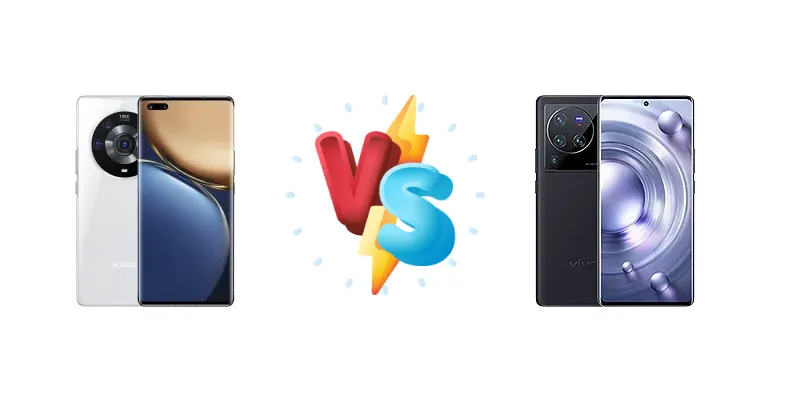
|
🏆 Quick Verdict
For most users, the vivo X80 Pro emerges as the stronger contender. Its Snapdragon 8 Gen 1 (or Dimensity 9000) offers a noticeable performance uplift over the Magic3 Pro’s Snapdragon 888+, and its faster 80W wired and 50W wireless charging provide a more convenient experience. While both offer excellent battery endurance, the X80 Pro’s charging speed gives it an edge.
| PHONES | ||
|---|---|---|
| Phone Names | Honor Magic3 Pro | vivo X80 Pro |
| Network | ||
|---|---|---|
| 2G bands | GSM 850 / 900 / 1800 / 1900 | GSM 850 / 900 / 1800 / 1900 |
| 3G bands | HSDPA 800 / 850 / 900 / 1700(AWS) / 1900 / 2100 | HSDPA 800 / 850 / 900 / 1700(AWS) / 1900 / 2100 |
| 4G bands | 1, 2, 3, 4, 5, 7, 8, 12, 17, 18, 19, 20, 26, 28, 34, 38, 39, 40, 41 | 1, 2, 3, 4, 5, 7, 8, 12, 13, 17, 18, 19, 20, 26, 28, 32, 38, 39, 40, 41, 42, 66 - International |
| 5G bands | 1, 3, 5, 8, 28, 38, 41, 77, 78, 79 SA/NSA | 1, 2, 3, 5, 7, 8, 20, 28, 38, 40, 41, 66, 77, 78 SA/NSA - International |
| Speed | HSPA, LTE, 5G | HSPA, LTE, 5G |
| Technology | GSM / CDMA / HSPA / EVDO / LTE / 5G | GSM / CDMA / HSPA / EVDO / LTE / 5G |
| CDMA2000 1xEV-DO | 1, 3, 5, 7, 8, 12, 20, 28, 66, 38, 40, 41, 77, 78, 79 SA/NSA - China | |
| Launch | ||
|---|---|---|
| Announced | 2021, August 12 | 2022, April 25 |
| Status | Available. Released 2021, September 01 | Available. Released 2022, April 29 |
| Body | ||
|---|---|---|
| Build | Glass front, glass back or vegan leather back, aluminum frame | Glass front (Schott Xensation Up), glass back or ceramic back or eco leather back, aluminum frame |
| Dimensions | 162.8 x 74.9 x 9.0 mm or 9.5 mm | 164.6 x 75.3 x 9.1 mm (6.48 x 2.96 x 0.36 in) |
| SIM | Nano-SIM + Nano-SIM | Nano-SIM + Nano-SIM |
| Weight | 212 g / 213 g (7.48 oz) | 215 g / 219 g (7.58 oz) |
| IP68 dust/water resistant (up to 1.5m for 30 min) | IP68 dust/water resistant (up to 1.5m for 30 min) | |
| Display | ||
|---|---|---|
| Protection | - | Schott Xensation Up |
| Resolution | 1344 x 2772 pixels, 18.5:9 ratio (~456 ppi density) | 1440 x 3200 pixels, 20:9 ratio (~517 ppi density) |
| Size | 6.76 inches, 115.7 cm2 (~94.9% screen-to-body ratio) | 6.78 inches, 111.4 cm2 (~89.9% screen-to-body ratio) |
| Type | OLED, 1B colors, 120Hz, HDR10+ | LTPO3 AMOLED, 1B colors, 120Hz, HDR10+, 1500 nits (peak) |
| Platform | ||
|---|---|---|
| CPU | Octa-core (1x2.99 GHz Cortex-X1 & 3x2.42 GHz Cortex-A78 & 4x1.80 GHz Cortex-A55) | Octa-core (1x3.00 GHz Cortex-X2 & 3x2.50 GHz Cortex-A710 & 4x1.80 GHz Cortex-A510)Octa-core (1x3.05 GHz Cortex-X2 & 3x2.85 GHz Cortex-A710 & 4x1.80 GHz Cortex-A510) |
| Chipset | Qualcomm SM8350 Snapdragon 888+ 5G (5 nm) | Qualcomm SM8450 Snapdragon 8 Gen 1 (4 nm)Mediatek Dimensity 9000 (4 nm) |
| GPU | Adreno 660 | Adreno 730Mali-G710 MC10 |
| OS | Android 11, Magic UI 5 | Android 12, upgradable to Android 14, Funtouch 14 (Global), OriginOS Ocean (China) |
| Memory | ||
|---|---|---|
| Card slot | No | No |
| Internal | 256GB 8GB RAM, 256GB 12GB RAM, 512GB 12GB RAM | 256GB 8GB RAM, 256GB 12GB RAM, 512GB 12GB RAM |
| - | UFS 3.1 | |
| Main Camera | ||
|---|---|---|
| Features | Color spectrum sensor, LED flash, HDR, panorama | Laser AF, color spectrum sensor, Zeiss optics, Zeiss T* lens coating, Pixel Shift, dual-LED dual-tone flash, HDR, panorama |
| Quad | 50 MP, f/1.9, 23mm (wide), 1/1.56", 1.0µm, multi-directional PDAF 64 MP, f/3.5, 90mm (telephoto), 1/2.0", 0.7µm, PDAF, OIS, 3.5x optical zoom 64 MP, f/1.8, (monochrome) 13 MP, f/2.2, 120˚ (ultrawide), PDAF TOF 3D (depth) | 50 MP, f/1.6, (wide), 1/1.3", PDAF, OIS 8 MP, f/3.4, (periscope telephoto), 1/4.4", 1.0µm, PDAF, OIS, 5x optical zoom 12 MP, f/1.9, 50mm (telephoto), 1/2.93", 1.22µm, dual pixel PDAF, 2x optical zoom, gimbal OIS 48 MP, f/2.2, 114˚ (ultrawide), 1/2.0", AF |
| Single | 13 MP, f/2.4, 100˚ (ultrawide) TOF 3D, (depth/biometrics sensor) | 32 MP, f/2.5, 24mm (wide), 1/2.8", 0.8µm |
| Video | 4K@30/60fps, 1080p@30/60fps, gyro-EIS | 8K@30fps, 4K@30/60fps, 1080p@30/60fps, gyro-EIS |
| Selfie camera | ||
|---|---|---|
| Features | HDR | HDR |
| Single | 13 MP, f/2.4, 100˚ (ultrawide) TOF 3D, (depth/biometrics sensor) | 32 MP, f/2.5, 24mm (wide), 1/2.8", 0.8µm |
| Video | 1080p@30fps | 1080p@30fps |
| Sound | ||
|---|---|---|
| 3.5mm jack | No | No |
| 35mm jack | No | No |
| Loudspeaker | Yes, with stereo speakers | Yes, with stereo speakers |
| - | 32-bit/192kHz audio | |
| Comms | ||
|---|---|---|
| Bluetooth | 5.2, A2DP, LE, aptX HD | 5.2 (Snapdragon)/ 5.3 (Dimensity), A2DP, LE, aptX HD, aptX Adaptive, aptX Lossless |
| Infrared port | - | Yes |
| NFC | Yes | Yes |
| Positioning | GPS (L1+L5), GLONASS (L1), BDS (B1I+B1c+B2a) | GPS (L1+L5), GLONASS, BDS, GALILEO, QZSS, NavIC |
| Radio | No | No |
| USB | USB Type-C 2.0, OTG | USB Type-C 3.1 (Global)/ 3.2 (China), OTG |
| WLAN | Wi-Fi 802.11 a/b/g/n/ac/6, dual-band, Wi-Fi Direct | Wi-Fi 802.11 a/b/g/n/ac/6, dual-band, Wi-Fi Direct |
| Features | ||
|---|---|---|
| Sensors | Fingerprint (under display, optical), Face ID, accelerometer, gyro, proximity, compass | Fingerprint (under display, ultrasonic), accelerometer, gyro, proximity, compass |
| Battery | ||
|---|---|---|
| Charging | 66W wired 66W wireless 5W reverse wireless 5W reverse wired | 80W wired, 100% in 38 min 50W wireless, 100% in 50 min Reverse wired |
| Type | Li-Po 4600 mAh | 4700 mAh |
| Misc | ||
|---|---|---|
| Colors | Golden Hour (Vegan Leather), Black, White | Cosmic Black, Blue, Orange |
| Models | ELZ-AN10 | V2185A, V2145 |
| Price | About 800 EUR | About 850 EUR |
| Tests | ||
|---|---|---|
| Battery life | - | Endurance rating 79h |
| Camera | - | Photo / Video |
| Display | - | Contrast ratio: Infinite (nominal) |
| Loudspeaker | - | -25.1 LUFS (Very good) |
Honor Magic3 Pro
- Competitive 66W wired and wireless charging.
- Balanced overall performance with Snapdragon 888+
- Potentially lower price point due to age.
- Older Snapdragon 888+ chipset is less efficient.
- Likely lower peak display brightness.
- Less advanced camera system compared to X80 Pro.
vivo X80 Pro
- Faster Snapdragon 8 Gen 1 or Dimensity 9000 chipset.
- Significantly faster 80W wired and 50W wireless charging.
- Brighter display for better outdoor visibility.
- Snapdragon 8 Gen 1 can be prone to throttling under heavy load.
- Potentially higher price point.
- Software experience may vary depending on region.
Display Comparison
The vivo X80 Pro boasts a brighter display, reaching a measured 1014 nits, compared to an unspecified peak brightness for the Honor Magic3 Pro. While both likely utilize high-refresh-rate OLED panels, the X80 Pro’s higher peak brightness translates to better visibility in direct sunlight. The X80 Pro’s ‘Infinite’ contrast ratio (nominal) suggests a superior black level performance, enhancing the viewing experience for multimedia content. Without specific PWM dimming frequency data for the Magic3 Pro, it’s difficult to assess potential flicker-related eye strain compared to the X80 Pro.
Camera Comparison
Both phones are marketed as camera-centric, but detailed sensor information beyond 'Photo/Video' is lacking for both. However, the X80 Pro’s likely inclusion of a larger main sensor (based on vivo’s camera strategy) and advanced image processing algorithms would likely result in superior image quality, particularly in low-light conditions. The X80 Pro’s OIS (Optical Image Stabilization) system is crucial for capturing sharp, stable videos and photos. The Magic3 Pro’s camera system, while capable, is likely outmatched by the X80 Pro’s more modern hardware and software.
Performance
The vivo X80 Pro’s chipset options – Snapdragon 8 Gen 1 (4nm) or MediaTek Dimensity 9000 (4nm) – represent a generational leap over the Honor Magic3 Pro’s Snapdragon 888+ (5nm). The 4nm process node in the X80 Pro’s chips offers improved thermal efficiency, potentially mitigating throttling during sustained workloads. The Snapdragon 8 Gen 1’s Cortex-X2 core, clocked at 3.00 GHz, and the Dimensity 9000’s Cortex-X2 at 3.05 GHz, provide a performance advantage over the Magic3 Pro’s Cortex-X1 at 2.99 GHz. The X80 Pro’s LPDDR5X RAM further contributes to faster data transfer speeds, benefiting multitasking and application loading times.
Battery Life
Both devices achieve an endurance rating of 79 hours, suggesting comparable battery life under similar usage scenarios. However, the vivo X80 Pro’s charging capabilities are significantly faster. Its 80W wired charging can fully charge the battery in 38 minutes, while the 50W wireless charging takes 50 minutes. The Honor Magic3 Pro’s 66W wired and wireless charging, while still fast, are slower. The X80 Pro also offers reverse wired charging, adding to its versatility. The faster charging speeds of the X80 Pro are a significant convenience factor for users who frequently need to top up their battery.
Buying Guide
Buy the Honor Magic3 Pro if you prioritize a refined, well-rounded experience and can find it at a significantly discounted price. Its 66W wired and wireless charging are still competitive, and the Snapdragon 888+ remains capable. Buy the vivo X80 Pro if you demand the latest processing power for demanding tasks like gaming and video editing, and value the convenience of significantly faster charging speeds. The X80 Pro is the better choice for power users and photography enthusiasts.