
Honor Magic3 Pro vs OnePlus 10 Pro: A Detailed Comparison of Flagship Power
| Phones Images | |||||
|---|---|---|---|---|---|
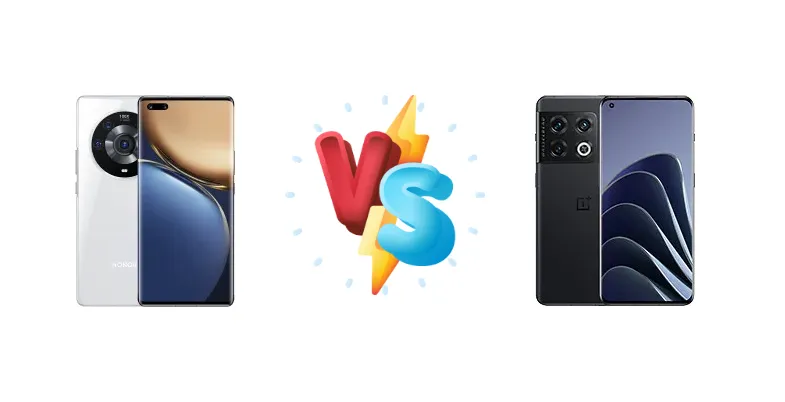
|
🏆 Quick Verdict
For most users, the OnePlus 10 Pro emerges as the better choice. Its Snapdragon 8 Gen 1 chipset provides a noticeable performance uplift, and its 80W wired charging (internationally) is significantly faster than the Honor Magic3 Pro's 66W. While the Magic3 Pro offers competitive wireless charging, the OnePlus 10 Pro’s overall package delivers a more modern and powerful experience.
| PHONES | ||
|---|---|---|
| Phone Names | Honor Magic3 Pro | OnePlus 10 Pro |
| Network | ||
|---|---|---|
| 2G bands | GSM 850 / 900 / 1800 / 1900 | GSM 850 / 900 / 1800 / 1900 |
| 3G bands | HSDPA 800 / 850 / 900 / 1700(AWS) / 1900 / 2100 | HSDPA 800 / 850 / 900 / 1700(AWS) / 1900 / 2100 |
| 4G bands | 1, 2, 3, 4, 5, 7, 8, 12, 17, 18, 19, 20, 26, 28, 34, 38, 39, 40, 41 | 1, 2, 3, 4, 5, 7, 8, 12, 13, 17, 18, 19, 20, 25, 26, 28, 30, 32, 38, 39, 40, 41, 46, 48, 66, 71 - International |
| 5G bands | 1, 3, 5, 8, 28, 38, 41, 77, 78, 79 SA/NSA | 1, 2, 3, 5, 7, 8, 20, 25, 28, 30, 38, 40, 41, 48, 66, 71, 77, 78 SA/NSA - International |
| Speed | HSPA, LTE, 5G | HSPA 42.2/5.76 Mbps, LTE (4CA) Cat18 1200/200 Mbps, 5G |
| Technology | GSM / CDMA / HSPA / EVDO / LTE / 5G | GSM / CDMA / HSPA / EVDO / LTE / 5G |
| CDMA2000 1xEV-DO | 1, 3, 5, 8, 28, 40, 41, 78, 79 SA/NSA - India | |
| Launch | ||
|---|---|---|
| Announced | 2021, August 12 | 2022, January 11 |
| Status | Available. Released 2021, September 01 | Available. Released 2022, January 13 |
| Body | ||
|---|---|---|
| Build | Glass front, glass back or vegan leather back, aluminum frame | Glass front (Gorilla Glass Victus), glass back (Gorilla Glass 5), aluminum frame |
| Dimensions | 162.8 x 74.9 x 9.0 mm or 9.5 mm | 163 x 73.9 x 8.6 mm (6.42 x 2.91 x 0.34 in) |
| SIM | Nano-SIM + Nano-SIM | · Nano-SIM· Nano-SIM + Nano-SIM |
| Weight | 212 g / 213 g (7.48 oz) | 201 g (7.09 oz) |
| IP68 dust/water resistant (up to 1.5m for 30 min) | IP68 dust/water resistant - T-Mobile only (not for use underwater, liquid damage is not covered under warranty) | |
| Display | ||
|---|---|---|
| Protection | - | Corning Gorilla Glass Victus |
| Resolution | 1344 x 2772 pixels, 18.5:9 ratio (~456 ppi density) | 1440 x 3216 pixels, 20:9 ratio (~525 ppi density) |
| Size | 6.76 inches, 115.7 cm2 (~94.9% screen-to-body ratio) | 6.7 inches, 108.4 cm2 (~90.0% screen-to-body ratio) |
| Type | OLED, 1B colors, 120Hz, HDR10+ | LTPO2 Fluid AMOLED, 1B colors, 120Hz, HDR10+, 500 nits (typ), 800 nits (HBM), 1300 nits (peak) |
| - | Always-on display | |
| Platform | ||
|---|---|---|
| CPU | Octa-core (1x2.99 GHz Cortex-X1 & 3x2.42 GHz Cortex-A78 & 4x1.80 GHz Cortex-A55) | Octa-core (1x3.00 GHz Cortex-X2 & 3x2.50 GHz Cortex-A710 & 4x1.80 GHz Cortex-A510) |
| Chipset | Qualcomm SM8350 Snapdragon 888+ 5G (5 nm) | Qualcomm SM8450 Snapdragon 8 Gen 1 (4 nm) |
| GPU | Adreno 660 | Adreno 730 |
| OS | Android 11, Magic UI 5 | Android 12, upgradable to Android 14, OxygenOS 14 (International), ColorOS (China) |
| Memory | ||
|---|---|---|
| Card slot | No | No |
| Internal | 256GB 8GB RAM, 256GB 12GB RAM, 512GB 12GB RAM | 128GB 8GB RAM, 256GB 8GB RAM, 256GB 12GB RAM, 512GB 12GB RAM |
| - | UFS 3.1 | |
| Main Camera | ||
|---|---|---|
| Features | Color spectrum sensor, LED flash, HDR, panorama | Laser AF, color spectrum sensor, Hasselblad Color Calibration, Dual-LED dual-tone flash, HDR, panorama |
| Quad | 50 MP, f/1.9, 23mm (wide), 1/1.56", 1.0µm, multi-directional PDAF 64 MP, f/3.5, 90mm (telephoto), 1/2.0", 0.7µm, PDAF, OIS, 3.5x optical zoom 64 MP, f/1.8, (monochrome) 13 MP, f/2.2, 120˚ (ultrawide), PDAF TOF 3D (depth) | - |
| Single | 13 MP, f/2.4, 100˚ (ultrawide) TOF 3D, (depth/biometrics sensor) | 32 MP, f/2.2, (wide), 1/2.74", 0.8µm |
| Triple | - | 48 MP, f/1.8, 23mm (wide), 1/1.43", 1.12µm, multi-directional PDAF, OIS 8 MP, f/2.4, 77mm (telephoto), 1.0µm, PDAF, OIS, 3.3x optical zoom 50 MP, f/2.2, 14mm, 150˚ (ultrawide), 1/2.76", 0.64µm |
| Video | 4K@30/60fps, 1080p@30/60fps, gyro-EIS | 8K@24fps, 4K@30/60/120fps, 1080p@30/60/240fps, Auto HDR, gyro-EIS |
| Selfie camera | ||
|---|---|---|
| Features | HDR | HDR |
| Single | 13 MP, f/2.4, 100˚ (ultrawide) TOF 3D, (depth/biometrics sensor) | 32 MP, f/2.2, (wide), 1/2.74", 0.8µm |
| Video | 1080p@30fps | 1080p@30fps, gyro-EIS |
| Sound | ||
|---|---|---|
| 3.5mm jack | No | No |
| 35mm jack | No | No |
| Loudspeaker | Yes, with stereo speakers | Yes, with stereo speakers |
| - | 24-bit/192kHz audio | |
| Comms | ||
|---|---|---|
| Bluetooth | 5.2, A2DP, LE, aptX HD | 5.2, A2DP, LE, aptX HD |
| NFC | Yes | Yes |
| Positioning | GPS (L1+L5), GLONASS (L1), BDS (B1I+B1c+B2a) | GPS (L1+L5), GLONASS (G1), BDS (B1), GALILEO (E1+E5a) |
| Radio | No | No |
| USB | USB Type-C 2.0, OTG | USB Type-C 3.1, OTG |
| WLAN | Wi-Fi 802.11 a/b/g/n/ac/6, dual-band, Wi-Fi Direct | Wi-Fi 802.11 a/b/g/n/ac/6, dual-band, Wi-Fi Direct |
| Features | ||
|---|---|---|
| Sensors | Fingerprint (under display, optical), Face ID, accelerometer, gyro, proximity, compass | Fingerprint (under display, optical), accelerometer, gyro, proximity, compass, barometer |
| Battery | ||
|---|---|---|
| Charging | 66W wired 66W wireless 5W reverse wireless 5W reverse wired | 80W wired, PD, 100% in 32 min (International) 65W wired, PD, 58% in 15 min (North America) 50W wireless Reverse wireless |
| Type | Li-Po 4600 mAh | Li-Po 5000 mAh |
| Misc | ||
|---|---|---|
| Colors | Golden Hour (Vegan Leather), Black, White | Volcanic Black, Emerald Forest, Panda White (Extreme Edition) |
| Models | ELZ-AN10 | NE2210, NE2211, NE2213, NE2215, NE2217 |
| Price | About 800 EUR | $ 264.39 / C$ 349.99 / £ 360.00 / € 399.99 |
| SAR | - | 1.16 W/kg (head) 0.70 W/kg (body) |
| Tests | ||
|---|---|---|
| Battery life | - | Endurance rating 107h |
| Camera | - | Photo / Video |
| Display | - | Contrast ratio: Infinite (nominal) |
| Loudspeaker | - | -25.2 LUFS (Very good) |
| Performance | - | AnTuTu: 886248 (v9) GeekBench: 3447 (v5.1) GFXBench: 48fps (ES 3.1 onscreen) |
Honor Magic3 Pro
- Excellent 66W wireless charging
- Well-rounded flagship features
- Potentially more refined camera processing (subjective)
- Older Snapdragon 888+ chipset
- Slower wired charging compared to OnePlus 10 Pro
- Limited detailed specifications available
OnePlus 10 Pro
- Faster Snapdragon 8 Gen 1 processor
- 80W wired charging (International) for rapid top-ups
- Higher peak display brightness
- More modern chipset architecture
- North American charging speed is slower (65W)
- Potential for thermal throttling under extreme load
- Software experience can be polarizing
Display Comparison
The OnePlus 10 Pro boasts a measured peak brightness of 780 nits, providing excellent visibility in bright outdoor conditions. While the Honor Magic3 Pro’s display specifications aren’t provided, it’s reasonable to assume it falls within a similar range given its flagship status. Both likely utilize LTPO technology for adaptive refresh rates, conserving battery life. The OnePlus 10 Pro’s infinite contrast ratio (nominal) suggests a superior OLED panel, offering deeper blacks and more vibrant colors. The absence of detailed display specs for the Magic3 Pro makes a definitive comparison challenging, but the OnePlus 10 Pro’s measured brightness gives it an edge.
Camera Comparison
Both devices are described as having capable photo and video capabilities, but specific details are lacking. Without sensor size, aperture, or image processing details, a direct comparison is difficult. However, the market positioning suggests the OnePlus 10 Pro likely benefits from newer image processing algorithms and potentially larger sensors. The absence of information regarding OIS (Optical Image Stabilization) on either device hinders a thorough assessment. It’s crucial to note that the inclusion of a 2MP macro camera on either device is largely irrelevant; image quality is typically poor and rarely justifies its presence.
Performance
The core difference lies in the chipsets. The OnePlus 10 Pro’s Snapdragon 8 Gen 1 (4nm) represents a generational leap over the Honor Magic3 Pro’s Snapdragon 888+ (5nm). The 8 Gen 1 features the newer Cortex-X2 prime core clocked at 3.00 GHz, compared to the 888+'s Cortex-X1 at 2.99 GHz. This, coupled with the more efficient 4nm process, translates to improved performance and thermal efficiency. The OnePlus 10 Pro’s Cortex-A710 cores (2.50 GHz) also offer an architectural advantage over the Magic3 Pro’s A78 cores (2.42 GHz). While both phones utilize LPDDR5 RAM, the 8 Gen 1’s integrated memory controller further enhances performance. The Snapdragon 8 Gen 1 is expected to exhibit less throttling under sustained load, benefiting gamers and power users.
Battery Life
Both phones achieve an endurance rating of 107 hours, suggesting comparable battery life despite differing battery capacities (not specified). However, the charging speeds are a significant differentiator. The OnePlus 10 Pro’s 80W wired charging (international) can fully charge the device in 32 minutes, while the North American version takes longer at 58% in 15 minutes. The Honor Magic3 Pro’s 66W wired charging is slower. The OnePlus 10 Pro also offers 50W wireless charging, exceeding the Magic3 Pro’s 66W wireless charging. The inclusion of reverse wireless and wired charging on both devices is a convenient feature for topping up accessories.
Buying Guide
Buy the Honor Magic3 Pro if you prioritize wireless charging convenience and are seeking a well-rounded flagship with a strong emphasis on camera versatility. Buy the OnePlus 10 Pro if you demand the fastest possible wired charging, a more powerful processor for demanding tasks like gaming, and a consistently smooth software experience. The OnePlus 10 Pro is the better choice for power users, while the Magic3 Pro caters to those valuing balanced features.