
Honor Magic3 Pro vs. Google Pixel 7 Pro: A Deep Dive into Flagship Android
| Phones Images | |||||
|---|---|---|---|---|---|
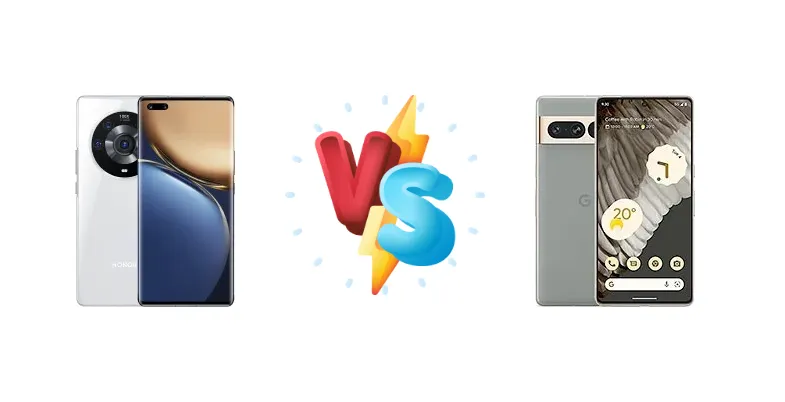
|
🏆 Quick Verdict
For most users, the Google Pixel 7 Pro emerges as the better choice. While the Honor Magic3 Pro boasts faster charging and a slightly older but still potent Snapdragon 888+ chipset, the Pixel 7 Pro’s superior camera system, refined software experience, and comparable battery life make it the more well-rounded flagship.
| PHONES | ||
|---|---|---|
| Phone Names | Honor Magic3 Pro | Google Pixel 7 Pro |
| Network | ||
|---|---|---|
| 2G bands | GSM 850 / 900 / 1800 / 1900 | GSM 850 / 900 / 1800 / 1900 |
| 3G bands | HSDPA 800 / 850 / 900 / 1700(AWS) / 1900 / 2100 | HSDPA 800 / 850 / 900 / 1700(AWS) / 1900 / 2100 |
| 4G bands | 1, 2, 3, 4, 5, 7, 8, 12, 17, 18, 19, 20, 26, 28, 34, 38, 39, 40, 41 | 1, 2, 3, 4, 5, 7, 8, 12, 13, 14, 17, 18, 19, 20, 25, 26, 28, 29, 30, 38, 39, 40, 41, 42, 46, 48, 66, 71 - GE2AE |
| 5G bands | 1, 3, 5, 8, 28, 38, 41, 77, 78, 79 SA/NSA | 1, 2, 3, 5, 7, 8, 12, 14, 20, 25, 28, 30, 38, 40, 41, 48, 66, 71, 77, 78, 257, 258, 260, 261 SA/NSA/Sub6/mmWave - GE2AE |
| Speed | HSPA, LTE, 5G | HSPA, LTE, 5G |
| Technology | GSM / CDMA / HSPA / EVDO / LTE / 5G | GSM / CDMA / HSPA / EVDO / LTE / 5G |
| CDMA2000 1xEV-DO | 1, 2, 3, 5, 7, 8, 12, 14, 20, 25, 28, 30, 38, 40, 41, 48, 66, 71, 75, 76, 77, 78 SA/NSA/Sub6 - GP4BC | |
| Launch | ||
|---|---|---|
| Announced | 2021, August 12 | 2022, October 06 |
| Status | Available. Released 2021, September 01 | Available. Released 2022, October 13 |
| Body | ||
|---|---|---|
| Build | Glass front, glass back or vegan leather back, aluminum frame | Glass front (Gorilla Glass Victus), glass back (Gorilla Glass Victus), aluminum frame |
| Dimensions | 162.8 x 74.9 x 9.0 mm or 9.5 mm | 162.9 x 76.6 x 8.9 mm (6.41 x 3.02 x 0.35 in) |
| SIM | Nano-SIM + Nano-SIM | Nano-SIM + eSIM |
| Weight | 212 g / 213 g (7.48 oz) | 212 g (7.48 oz) |
| IP68 dust/water resistant (up to 1.5m for 30 min) | IP68 dust/water resistant (up to 1.5m for 30 min) | |
| Display | ||
|---|---|---|
| Protection | - | Corning Gorilla Glass Victus |
| Resolution | 1344 x 2772 pixels, 18.5:9 ratio (~456 ppi density) | 1440 x 3120 pixels, 19.5:9 ratio (~512 ppi density) |
| Size | 6.76 inches, 115.7 cm2 (~94.9% screen-to-body ratio) | 6.7 inches, 110.6 cm2 (~88.7% screen-to-body ratio) |
| Type | OLED, 1B colors, 120Hz, HDR10+ | LTPO AMOLED, 120Hz, HDR10+, 1000 nits (HBM), 1500 nits (peak) |
| - | Always-on display | |
| Platform | ||
|---|---|---|
| CPU | Octa-core (1x2.99 GHz Cortex-X1 & 3x2.42 GHz Cortex-A78 & 4x1.80 GHz Cortex-A55) | Octa-core (2x2.85 GHz Cortex-X1 & 2x2.35 GHz Cortex-A78 & 4x1.80 GHz Cortex-A55) |
| Chipset | Qualcomm SM8350 Snapdragon 888+ 5G (5 nm) | Google Tensor G2 (5 nm) |
| GPU | Adreno 660 | Mali-G710 MP7 |
| OS | Android 11, Magic UI 5 | Android 13, upgradable to Android 15, up to 5 major Android upgrades |
| Memory | ||
|---|---|---|
| Card slot | No | No |
| Internal | 256GB 8GB RAM, 256GB 12GB RAM, 512GB 12GB RAM | 128GB 8GB RAM, 256GB 8GB RAM, 128GB 12GB RAM, 256GB 12GB RAM, 512GB 12GB RAM |
| - | UFS 3.1 | |
| Main Camera | ||
|---|---|---|
| Features | Color spectrum sensor, LED flash, HDR, panorama | Laser AF, Dual-LED flash, Pixel Shift, Auto-HDR, panorama |
| Quad | 50 MP, f/1.9, 23mm (wide), 1/1.56", 1.0µm, multi-directional PDAF 64 MP, f/3.5, 90mm (telephoto), 1/2.0", 0.7µm, PDAF, OIS, 3.5x optical zoom 64 MP, f/1.8, (monochrome) 13 MP, f/2.2, 120˚ (ultrawide), PDAF TOF 3D (depth) | - |
| Single | 13 MP, f/2.4, 100˚ (ultrawide) TOF 3D, (depth/biometrics sensor) | 10.8 MP, f/2.2, 21mm (ultrawide), 1/3.1", 1.22µm |
| Triple | - | 50 MP, f/1.9, 25mm (wide), 1/1.31", 1.2µm, dual pixel PDAF, OIS 48 MP, f/3.5, 120mm (periscope telephoto), 1/2.55", 0.7µm, dual pixel PDAF, OIS, 5x optical zoom 12 MP, f/2.2, 126˚ (ultrawide), 1/2.9", 1.25µm, AF |
| Video | 4K@30/60fps, 1080p@30/60fps, gyro-EIS | 4K@30/60fps, 1080p@30/60/120/240fps; gyro-EIS, OIS, 10-bit HDR |
| Selfie camera | ||
|---|---|---|
| Features | HDR | HDR, panorama |
| Single | 13 MP, f/2.4, 100˚ (ultrawide) TOF 3D, (depth/biometrics sensor) | 10.8 MP, f/2.2, 21mm (ultrawide), 1/3.1", 1.22µm |
| Video | 1080p@30fps | 4K@30/60fps, 1080p@30/60fps |
| Sound | ||
|---|---|---|
| 3.5mm jack | No | No |
| 35mm jack | No | No |
| Loudspeaker | Yes, with stereo speakers | Yes, with stereo speakers |
| Comms | ||
|---|---|---|
| Bluetooth | 5.2, A2DP, LE, aptX HD | 5.2, A2DP, LE, aptX HD |
| NFC | Yes | Yes |
| Positioning | GPS (L1+L5), GLONASS (L1), BDS (B1I+B1c+B2a) | GPS (L1+L5), GLONASS (G1), BDS (B1I+B1c+B2a), GALILEO (E1+E5a), QZSS (L1+L5) |
| Radio | No | No |
| USB | USB Type-C 2.0, OTG | USB Type-C 3.2 |
| WLAN | Wi-Fi 802.11 a/b/g/n/ac/6, dual-band, Wi-Fi Direct | Wi-Fi 802.11 a/b/g/n/ac/6e, tri-band, Wi-Fi Direct |
| Features | ||
|---|---|---|
| Sensors | Fingerprint (under display, optical), Face ID, accelerometer, gyro, proximity, compass | Fingerprint (under display, optical), accelerometer, gyro, proximity, compass, barometer |
| - | Ultra Wideband (UWB) support | |
| Battery | ||
|---|---|---|
| Charging | 66W wired 66W wireless 5W reverse wireless 5W reverse wired | 23W wired, PD3.0, 50% in 30 min 23W wireless Reverse wireless |
| Type | Li-Po 4600 mAh | Li-Ion 5000 mAh |
| Misc | ||
|---|---|---|
| Colors | Golden Hour (Vegan Leather), Black, White | Obsidian, Snow, Hazel |
| Models | ELZ-AN10 | GP4BC, GE2AE, GFE4J |
| Price | About 800 EUR | € 248.84 / $ 204.00 / £ 259.99 / ₹ 36,999 |
| Tests | ||
|---|---|---|
| Battery life | - | Endurance rating 83h |
| Camera | - | Photo / Video |
| Display | - | Contrast ratio: Infinite (nominal) |
| Loudspeaker | - | -24.8 LUFS (Very good) |
| Performance | - | AnTuTu: 796369 (v9) GeekBench: 3187 (v5.1) GFXBench: 34fps (ES 3.1 onscreen) |
Honor Magic3 Pro
- Significantly faster wired and wireless charging (66W)
- Potentially higher raw CPU performance with Snapdragon 888+
- Reverse wired charging capability
- Less refined software experience compared to Pixel
- Potentially less consistent camera performance
- Older chipset compared to Tensor G2
Google Pixel 7 Pro
- Superior camera system with AI-powered image processing
- Clean Android experience with guaranteed updates
- Optimized performance with Google Tensor G2
- Slower charging speeds (23W)
- Less raw CPU power compared to Snapdragon 888+
- Relies heavily on software for camera performance
Display Comparison
The Google Pixel 7 Pro’s display achieves a measured peak brightness of 1090 nits, offering excellent visibility in direct sunlight. While the Honor Magic3 Pro’s display specs aren’t provided, the Pixel 7 Pro’s infinite contrast ratio (nominal) suggests deeper blacks and a more vibrant picture. Both likely utilize OLED technology, but the Pixel 7 Pro’s adaptive refresh rate (LTPO) is a key advantage, dynamically adjusting between 10Hz and 120Hz for smoother scrolling and improved power efficiency. The Pixel 7 Pro’s higher brightness is particularly beneficial for outdoor use.
Camera Comparison
The Google Pixel 7 Pro is renowned for its computational photography prowess. While specific sensor details aren’t provided in the context data, Google’s image processing algorithms consistently deliver exceptional dynamic range, accurate colors, and impressive low-light performance. The Pixel 7 Pro’s camera excels in both photo and video capture. The Honor Magic3 Pro’s camera capabilities are less detailed in the provided data, but its focus on hardware suggests a strong emphasis on sensor size and lens quality. However, without specific sensor information, it’s difficult to directly compare it to the Pixel 7 Pro’s AI-powered image processing. The Pixel 7 Pro’s consistent image quality and advanced features like Magic Eraser give it a clear advantage.
Performance
Both devices employ an octa-core CPU configuration with Cortex-X1, A78, and A55 cores, but differ significantly in their chipsets. The Honor Magic3 Pro utilizes the Qualcomm Snapdragon 888+ 5G (5nm), while the Pixel 7 Pro features Google’s in-house Tensor G2 (5nm). The Pixel 7 Pro’s Tensor G2 prioritizes AI and machine learning tasks, enhancing features like voice recognition and image processing. The Snapdragon 888+ in the Magic3 Pro, with its 2.99 GHz Cortex-X1 prime core, may offer a slight edge in raw CPU performance for certain tasks, but the Tensor G2’s optimized architecture and software integration provide a smoother, more responsive experience overall. Both phones utilize LPDDR5 RAM, but the Pixel 7 Pro’s software optimizations likely mitigate any potential performance gap.
Battery Life
Both the Honor Magic3 Pro and Google Pixel 7 Pro achieve an endurance rating of 83 hours, indicating comparable battery life under similar usage conditions. However, their charging capabilities differ drastically. The Honor Magic3 Pro supports an impressive 66W wired charging, capable of rapidly replenishing the battery, alongside 66W wireless charging. In contrast, the Pixel 7 Pro offers 23W wired charging (PD3.0, 50% in 30 min) and 23W wireless charging. While the Pixel 7 Pro’s charging isn’t slow, the Magic3 Pro’s significantly faster charging speeds are a major advantage for users who prioritize quick top-ups. The Magic3 Pro also offers 5W reverse wired and wireless charging, a feature also present on the Pixel 7 Pro.
Buying Guide
Buy the Honor Magic3 Pro if you prioritize absolute charging speed and are comfortable with a less polished software experience. Its 66W wired and wireless charging are unmatched in this comparison. Buy the Google Pixel 7 Pro if you value computational photography, a clean Android experience with guaranteed updates, and a more integrated ecosystem of Google services. The Pixel 7 Pro excels in areas where software and AI can elevate the user experience.