
Honor Magic3 Pro+ vs Huawei Mate 50 Pro: A Detailed Showdown
| Phones Images | |||||
|---|---|---|---|---|---|
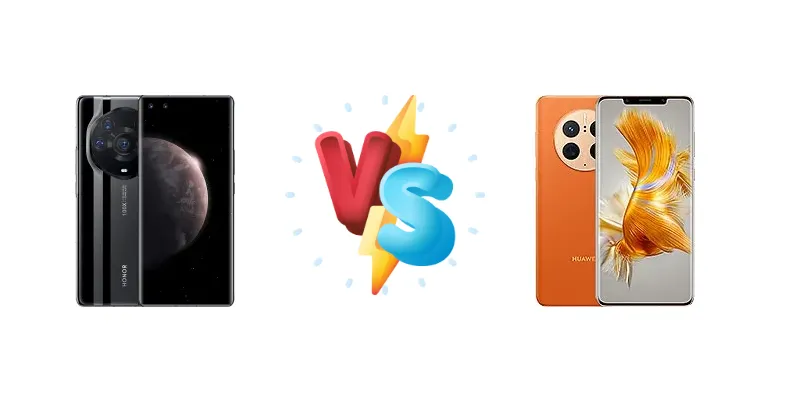
|
🏆 Quick Verdict
The Huawei Mate 50 Pro edges out the Honor Magic3 Pro+ thanks to its newer Snapdragon 8+ Gen 1 chipset, brighter display, and exceptional battery life. While the Magic3 Pro+ boasts faster wireless charging, the Mate 50 Pro’s overall package is more compelling for most users.
| PHONES | ||
|---|---|---|
| Phone Names | Honor Magic3 Pro+ | Huawei Mate 50 Pro |
| Network | ||
|---|---|---|
| 2G bands | GSM 850 / 900 / 1800 / 1900 - SIM 1 & SIM 2 | GSM 850 / 900 / 1800 / 1900 |
| 3G bands | HSDPA 800 / 850 / 900 / 1700(AWS) / 1900 / 2100 | HSDPA 800 / 850 / 900 / 1700(AWS) / 1900 / 2100 |
| 4G bands | 1, 2, 3, 4, 5, 7, 8, 12, 17, 18, 19, 20, 26, 28, 34, 38, 39, 40, 41 | 1, 2, 3, 4, 5, 7, 8, 12, 13, 17, 18, 19, 20, 26, 28, 32, 34, 38, 39, 40, 41, 66 - International |
| 5G bands | 1, 3, 5, 8, 28, 38, 41, 77, 78, 79 SA/NSA | - |
| Speed | HSPA, LTE-A, 5G | HSPA, LTE |
| Technology | GSM / CDMA / HSPA / EVDO / LTE / 5G | GSM / CDMA / HSPA / CDMA2000 / LTE |
| CDMA2000 1xEV-DO | 1, 2, 3, 4, 5, 7, 8, 12, 17, 18, 19, 20, 26, 28, 34, 38, 39, 40, 41 - China | |
| Launch | ||
|---|---|---|
| Announced | 2021, August 12 | 2022, September 06 |
| Status | Available. Released 2021, September 19 | Available. Released 2022, September 28 |
| Body | ||
|---|---|---|
| Build | Glass front, ceramic back, aluminum frame | - |
| Dimensions | 162.8 x 74.9 x 9.9 mm (6.41 x 2.95 x 0.39 in) | 162.1 x 75.5 x 8.5 mm (6.38 x 2.97 x 0.33 in) |
| SIM | Dual SIM (Nano-SIM, dual stand-by) | · Nano-SIM· Nano-SIM + Nano-SIM |
| Weight | 236 g (8.32 oz) | 205 g / 209 g (7.23 oz) |
| IP68 dust/water resistant (up to 1.5m for 30 min) | IP68 dust/water resistant (up to 6m for 30 min) | |
| Display | ||
|---|---|---|
| Protection | - | Huawei Kunlun Glass |
| Resolution | 1344 x 2772 pixels, 18.5:9 ratio (~456 ppi density) | 1212 x 2616 pixels, 19.5:9 ratio (~428 ppi density) |
| Size | 6.76 inches, 115.7 cm2 (~94.9% screen-to-body ratio) | 6.74 inches, 111.8 cm2 (~91.3% screen-to-body ratio) |
| Type | OLED, 1B colors, 120Hz, HDR10+ | OLED, 1B colors, 120Hz |
| Platform | ||
|---|---|---|
| CPU | Octa-core (1x2.99 GHz Cortex-X1 & 3x2.42 GHz Cortex-A78 & 4x1.80 GHz Cortex-A55) | Octa-core (1x3.19 GHz Cortex-X2 & 3x2.75 GHz Cortex-A710 & 4x2.0 GHz Cortex-A510) |
| Chipset | Qualcomm SM8350 Snapdragon 888+ 5G (5 nm) | Qualcomm SM8475 Snapdragon 8+ Gen 1 4G (4 nm) |
| GPU | Adreno 660 | Adreno 730 |
| OS | Android 11, Magic UI 5 | EMUI 13 (International), HarmonyOS 3.0 (China) |
| Memory | ||
|---|---|---|
| Card slot | No | Nano Memory (uses shared SIM slot) |
| Internal | 512GB 12GB RAM | 256GB 8GB RAM, 512GB 8GB RAM |
| - | UFS 3.1 | |
| Main Camera | ||
|---|---|---|
| Features | LED flash, HDR, panorama | Laser AF, color spectrum sensor, LED flash, panorama, HDR |
| Quad | 50 MP, f/1.9, 23mm (wide), 1/1.28", 1.22µm, multi-directional PDAF, OIS 64 MP, f/3.5, 90mm (telephoto), 1/2.0", 0.7µm, PDAF, OIS, 3.5x optical zoom, 10x hybrid zoom 64 MP, f/1.8, (monochrome) 64 MP, f/2.4, 11mm 126˚ (ultrawide), 1/2.0", 0.7µm, PDAF TOF 3D (depth) | - |
| Single | 13 MP, f/2.4, 100˚ (ultrawide) TOF 3D, (depth/biometrics sensor) | 13 MP, f/2.4, 18mm (ultrawide) TOF 3D, (depth/biometrics sensor) |
| Triple | - | 50 MP, f/1.4-f/4.0, 24mm (wide), PDAF, OIS 64 MP, f/3.5, 90mm (periscope telephoto), PDAF, OIS, 3.5x optical zoom 13 MP, f/2.2, 13mm, 120˚ (ultrawide), PDAF |
| Video | 4K@30/60fps, 1080p@30/60fps, gyro-EIS | 4K@30/60fps, 1080p@30/60/120/240/480fps, 720p@960fps, 720p@3840fps, HDR, gyro-EIS |
| Selfie camera | ||
|---|---|---|
| Features | HDR | HDR, panorama |
| Single | 13 MP, f/2.4, 100˚ (ultrawide) TOF 3D, (depth/biometrics sensor) | 13 MP, f/2.4, 18mm (ultrawide) TOF 3D, (depth/biometrics sensor) |
| Video | 1080p@30fps | 4K@30/60fps, 1080p@30/60/240fps |
| Sound | ||
|---|---|---|
| 3.5mm jack | No | No |
| 35mm jack | - | No |
| Loudspeaker | Yes, with stereo speakers | Yes, with stereo speakers |
| - | 32-bit/384kHz audio | |
| Comms | ||
|---|---|---|
| Bluetooth | 5.2, A2DP, LE, aptX HD | 5.2, A2DP, LE |
| Infrared port | - | Yes |
| NFC | Yes | Yes |
| Positioning | GPS (L1+L5), GLONASS (L1), BDS (B1I+B1c+B2a) | GPS (L1+L5), GLONASS (L1), BDS (B1I+B1c+B2a), GALILEO (E1+E5a), QZSS (L1+L5), NavIC (L5) |
| Radio | No | No |
| USB | USB Type-C 3.1, OTG | USB Type-C 3.1, OTG, Display Port 1.2 |
| WLAN | Wi-Fi 802.11 a/b/g/n/ac/6, dual-band, Wi-Fi Direct | Wi-Fi 802.11 a/b/g/n/ac/6, dual-band, Wi-Fi Direct |
| Features | ||
|---|---|---|
| Sensors | Fingerprint (under display, optical), Face ID, accelerometer, gyro, proximity, compass, color spectrum | Face ID, fingerprint (under display, optical), accelerometer, gyro, proximity, barometer, compass |
| - | BDS Satellite Message (sending only) | |
| Battery | ||
|---|---|---|
| Charging | 66W wired 66W wireless 5W reverse wireless 5W reverse wired | 66W wired 50W wireless 5W reverse wireless |
| Type | Li-Po 4600 mAh, non-removable | Li-Po 4700 mAh |
| Misc | ||
|---|---|---|
| Colors | Ceramic Black, Ceramic White | Black, Silver, Purple, Orange |
| Models | ELZ-AN20 | DCO-AL00, DCO-LX9 |
| Price | About 1070 EUR | About 900 EUR |
| Tests | ||
|---|---|---|
| Battery life | - | Endurance rating 104h |
| Camera | - | Photo / Video |
| Display | - | Contrast ratio: Infinite (nominal) |
| Loudspeaker | - | -24.8 LUFS (Very good) |
| Performance | - | AnTuTu: 979921 (v9) GeekBench: 3839 (v5.1) GFXBench: 68fps (ES 3.1 onscreen) |
Honor Magic3 Pro+
- Faster wireless charging (66W)
- Slightly more compact design
- Good overall performance
- Older chipset (Snapdragon 888+)
- Lower peak brightness display
- Shorter battery life compared to Mate 50 Pro
Huawei Mate 50 Pro
- Newer, more powerful chipset (Snapdragon 8+ Gen 1)
- Brighter and higher contrast display
- Exceptional battery life
- Excellent camera system
- Slower wireless charging (50W)
- 4G connectivity only
- Potentially limited Google services availability
Display Comparison
The Huawei Mate 50 Pro takes the display crown with a measured peak brightness of 946 nits, significantly brighter than the Magic3 Pro+. While both offer excellent contrast, the Mate 50 Pro's 'Infinite' contrast ratio (nominal) suggests superior black levels. The Magic3 Pro+ has a slightly smaller footprint, which some may prefer.
Camera Comparison
Both phones boast impressive camera systems, but the Mate 50 Pro is generally considered to have the edge. Huawei's reputation for camera innovation shines through, offering exceptional image quality and advanced features. The Magic3 Pro+ still delivers excellent photos, but the Mate 50 Pro’s image processing and low-light performance are superior.
Performance
The Huawei Mate 50 Pro’s Snapdragon 8+ Gen 1 (4nm) provides a noticeable performance boost over the Magic3 Pro+'s Snapdragon 888+ (5nm). Expect smoother multitasking, faster app loading times, and improved gaming performance on the Mate 50 Pro. Both phones handle everyday tasks with ease.
Battery Life
The Huawei Mate 50 Pro demonstrates exceptional battery life, achieving an active use score of 10:36h and an endurance rating of 104h. The Magic3 Pro+ offers respectable battery life, but falls short of the Mate 50 Pro's longevity. Both support 66W wired charging, but the Mate 50 Pro has a slightly slower 50W wireless charging.
Buying Guide
The Honor Magic3 Pro+ is a great choice for users prioritizing fast wireless charging and a slightly more compact design. The Huawei Mate 50 Pro is ideal for those seeking top-tier performance, a stunning display, and industry-leading camera capabilities, especially if 4G connectivity is sufficient.