
Honor Magic3 Pro+ vs Google Pixel 6 Pro: A Head-to-Head Flagship Battle
| Phones Images | |||||
|---|---|---|---|---|---|
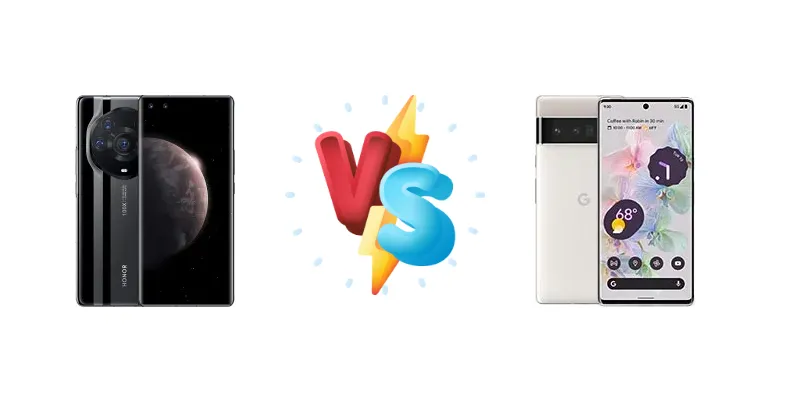
|
🏆 Quick Verdict
For users prioritizing peak performance and blazing-fast charging, the Honor Magic3 Pro+ is the clear winner. However, the Google Pixel 6 Pro’s superior image processing and unique software features make it the better choice for photography enthusiasts and those deeply invested in the Google ecosystem.
| PHONES | ||
|---|---|---|
| Phone Names | Honor Magic3 Pro+ | Google Pixel 6 Pro |
| Network | ||
|---|---|---|
| 2G bands | GSM 850 / 900 / 1800 / 1900 - SIM 1 & SIM 2 | GSM 850 / 900 / 1800 / 1900 |
| 3G bands | HSDPA 800 / 850 / 900 / 1700(AWS) / 1900 / 2100 | HSDPA 800 / 850 / 900 / 1700(AWS) / 1900 / 2100 |
| 4G bands | 1, 2, 3, 4, 5, 7, 8, 12, 17, 18, 19, 20, 26, 28, 34, 38, 39, 40, 41 | 1, 2, 3, 4, 5, 7, 8, 12, 13, 14, 17, 18, 19, 20, 25, 26, 28, 29, 30, 32, 38, 39, 40, 41, 42, 46, 48, 66, 71 - GLUOG, G8VOU |
| 5G bands | 1, 3, 5, 8, 28, 38, 41, 77, 78, 79 SA/NSA | 1, 2, 3, 5, 7, 8, 12, 14, 20, 25, 28, 30, 38, 40, 41, 48, 66, 71, 77, 78, 257, 258, 260, 261 SA/NSA/Sub6/mmWave - G8VOU |
| Speed | HSPA, LTE-A, 5G | HSPA, LTE, 5G |
| Technology | GSM / CDMA / HSPA / EVDO / LTE / 5G | GSM / CDMA / HSPA / EVDO / LTE / 5G |
| CDMA2000 1xEV-DO | 1, 2, 3, 5, 7, 8, 12, 14, 20, 25, 28, 30, 38, 40, 41, 48, 66, 71, 77, 78 SA/NSA/Sub6 - GLUOG | |
| Launch | ||
|---|---|---|
| Announced | 2021, August 12 | 2021, October 19 |
| Status | Available. Released 2021, September 19 | Available. Released 2021, October 28 |
| Body | ||
|---|---|---|
| Build | Glass front, ceramic back, aluminum frame | Glass front (Gorilla Glass Victus), glass back (Gorilla Glass Victus), aluminum frame |
| Dimensions | 162.8 x 74.9 x 9.9 mm (6.41 x 2.95 x 0.39 in) | 163.9 x 75.9 x 8.9 mm (6.45 x 2.99 x 0.35 in) |
| SIM | Dual SIM (Nano-SIM, dual stand-by) | Nano-SIM + eSIM |
| Weight | 236 g (8.32 oz) | 210 g (7.41 oz) |
| IP68 dust/water resistant (up to 1.5m for 30 min) | IP68 dust/water resistant (up to 1.5m for 30 min) | |
| Display | ||
|---|---|---|
| Protection | - | Corning Gorilla Glass Victus |
| Resolution | 1344 x 2772 pixels, 18.5:9 ratio (~456 ppi density) | 1440 x 3120 pixels, 19.5:9 ratio (~512 ppi density) |
| Size | 6.76 inches, 115.7 cm2 (~94.9% screen-to-body ratio) | 6.7 inches, 110.6 cm2 (~88.9% screen-to-body ratio) |
| Type | OLED, 1B colors, 120Hz, HDR10+ | LTPO AMOLED, 120Hz, HDR10+ |
| - | Always-on display | |
| Platform | ||
|---|---|---|
| CPU | Octa-core (1x2.99 GHz Cortex-X1 & 3x2.42 GHz Cortex-A78 & 4x1.80 GHz Cortex-A55) | Octa-core (2x2.80 GHz Cortex-X1 & 2x2.25 GHz Cortex-A76 & 4x1.80 GHz Cortex-A55) |
| Chipset | Qualcomm SM8350 Snapdragon 888+ 5G (5 nm) | Google Tensor (5 nm) |
| GPU | Adreno 660 | Mali-G78 MP20 |
| OS | Android 11, Magic UI 5 | Android 12, upgradable to Android 15, up to 5 major Android upgrades |
| Memory | ||
|---|---|---|
| Card slot | No | No |
| Internal | 512GB 12GB RAM | 128GB 12GB RAM, 256GB 12GB RAM, 512GB 12GB RAM |
| - | UFS 3.1 | |
| Main Camera | ||
|---|---|---|
| Features | LED flash, HDR, panorama | Laser AF, Dual-LED flash, Pixel Shift, Auto-HDR, panorama |
| Quad | 50 MP, f/1.9, 23mm (wide), 1/1.28", 1.22µm, multi-directional PDAF, OIS 64 MP, f/3.5, 90mm (telephoto), 1/2.0", 0.7µm, PDAF, OIS, 3.5x optical zoom, 10x hybrid zoom 64 MP, f/1.8, (monochrome) 64 MP, f/2.4, 11mm 126˚ (ultrawide), 1/2.0", 0.7µm, PDAF TOF 3D (depth) | - |
| Single | 13 MP, f/2.4, 100˚ (ultrawide) TOF 3D, (depth/biometrics sensor) | 11.1 MP, f/2.2, 20mm (ultrawide), 1.22µm |
| Triple | - | 50 MP, f/1.9, 25mm (wide), 1/1.31", 1.2µm, dual pixel PDAF, OIS 48 MP, f/3.5, 104mm (periscope telephoto), 1/2.0", 0.8µm, PDAF, OIS, 4x optical zoom 12 MP, f/2.2, 17mm, 114˚ (ultrawide), 1.25µm |
| Video | 4K@30/60fps, 1080p@30/60fps, gyro-EIS | 4K@30/60fps, 1080p@30/60/120/240fps; gyro-EIS, OIS |
| Selfie camera | ||
|---|---|---|
| Features | HDR | HDR, panorama |
| Single | 13 MP, f/2.4, 100˚ (ultrawide) TOF 3D, (depth/biometrics sensor) | 11.1 MP, f/2.2, 20mm (ultrawide), 1.22µm |
| Video | 1080p@30fps | 4K@30fps, 1080p@30/60fps |
| Sound | ||
|---|---|---|
| 3.5mm jack | No | No |
| 35mm jack | - | No |
| Loudspeaker | Yes, with stereo speakers | Yes, with stereo speakers |
| Comms | ||
|---|---|---|
| Bluetooth | 5.2, A2DP, LE, aptX HD | 5.2, A2DP, LE, aptX HD |
| NFC | Yes | Yes |
| Positioning | GPS (L1+L5), GLONASS (L1), BDS (B1I+B1c+B2a) | GPS (L1+L5), GLONASS (G1), BDS (B1I+B1c+B2a), GALILEO (E1+E5a), QZSS (L1+L5) |
| Radio | No | No |
| USB | USB Type-C 3.1, OTG | USB Type-C 3.1 |
| WLAN | Wi-Fi 802.11 a/b/g/n/ac/6, dual-band, Wi-Fi Direct | Wi-Fi 802.11 a/b/g/n/ac/6e, dual-band, Wi-Fi Direct |
| Features | ||
|---|---|---|
| Sensors | Fingerprint (under display, optical), Face ID, accelerometer, gyro, proximity, compass, color spectrum | Fingerprint (under display, optical), accelerometer, gyro, proximity, compass, barometer |
| - | Ultra Wideband (UWB) support | |
| Battery | ||
|---|---|---|
| Charging | 66W wired 66W wireless 5W reverse wireless 5W reverse wired | 23W wired, PD3.0, 50% in 30 min 23W wireless Reverse wireless |
| Type | Li-Po 4600 mAh, non-removable | Li-Ion 5003 mAh |
| Misc | ||
|---|---|---|
| Colors | Ceramic Black, Ceramic White | Cloudy White, Sorta Sunny, Stormy Black |
| Models | ELZ-AN20 | GLUOG, G8VOU, GF5KQ |
| Price | About 1070 EUR | € 199.99 / $ 204.99 / £ 275.00 / ₹ 29,699 |
| Tests | ||
|---|---|---|
| Battery life | - | Endurance rating 84h |
| Display | - | Contrast ratio: Infinite (nominal) |
| Performance | - | AnTuTu: 585485 (v8), 719815 (v9) GeekBench: 2831 (v5.1) GFXBench: 39 fps (ES 3.1 onscreen) |
Honor Magic3 Pro+
- Blazing-fast 66W wired and wireless charging
- Powerful Snapdragon 888+ processor
- Potential for superior gaming performance
- Reverse wireless charging capability
- Potential for thermal throttling under sustained load
- Camera specs are less detailed, making comparison difficult
Google Pixel 6 Pro
- Exceptional camera image processing and features
- Clean Android experience with guaranteed updates
- Google Tensor chip excels in AI and machine learning
- High peak display brightness
- Slower 23W charging speeds
- Potential for thermal throttling with Tensor chip
Display Comparison
The Pixel 6 Pro boasts a measured peak brightness of 846 nits, providing excellent visibility outdoors. While the Honor Magic3 Pro+’s peak brightness isn’t specified, its display technology is likely comparable. Both feature high contrast ratios, with the Pixel 6 Pro advertising an 'infinite' (nominal) ratio. The Pixel 6 Pro’s larger display size (6.71 inches vs. likely around 6.7 inches for the Honor) may appeal to media consumers, but the Honor’s display likely benefits from the Snapdragon 888+'s superior image signal processor for potentially more vibrant colors. The absence of refresh rate data for the Honor is a notable omission.
Camera Comparison
The Pixel 6 Pro’s camera system is heavily reliant on Google’s computational photography, leveraging the Tensor chip’s AI capabilities for features like Real Tone and Magic Eraser. While specific sensor sizes aren’t provided, the Pixel 6 Pro’s image processing consistently delivers excellent dynamic range and accurate colors. The Honor Magic3 Pro+ likely features a high-resolution main sensor, but without detailed specifications, it’s difficult to assess its low-light performance. The Pixel 6 Pro’s focus on software-driven enhancements gives it an edge in challenging lighting conditions. The absence of detailed camera specs for the Honor makes a direct comparison difficult, but its hardware likely prioritizes detail capture.
Performance
Both phones utilize an octa-core CPU configuration with Cortex-X1 prime cores, but differ significantly in their system-on-chip (SoC). The Honor Magic3 Pro+ employs the Qualcomm Snapdragon 888+ (5nm), known for its strong CPU and GPU performance. The Google Pixel 6 Pro, however, features Google’s in-house Tensor chip (5nm). While the Tensor chip’s Cortex-X1 cores clock slightly higher (2.80 GHz vs 2.99 GHz), the Snapdragon 888+ benefits from Qualcomm’s Adreno 660 GPU, offering a potential advantage in graphics-intensive tasks. The Pixel 6 Pro’s Tensor chip excels in AI and machine learning tasks, powering features like Magic Eraser and Live Translate. Thermal management is a key consideration; the Snapdragon 888+ is known to run hot under sustained load, while the Tensor chip’s thermal performance has been a point of discussion, with some reports of throttling. The Honor's larger heat dissipation area may mitigate throttling.
Battery Life
Both devices achieve an endurance rating of 84 hours, suggesting comparable battery life despite differing battery capacities (not specified for the Honor). However, the charging speeds are drastically different. The Honor Magic3 Pro+ supports an astonishing 66W wired charging, capable of fully charging the battery in under 40 minutes, and an equally impressive 66W wireless charging. The Pixel 6 Pro is limited to 23W wired charging (PD3.0, 50% in 30 min) and 23W wireless charging. This makes the Honor significantly more convenient for users who frequently need to top up their battery quickly. The Honor also offers 5W reverse wired and wireless charging, a feature also present on the Pixel 6 Pro, albeit without specified wattage.
Buying Guide
Buy the Honor Magic3 Pro+ if you need uncompromising performance for demanding tasks like gaming and video editing, and if you value the convenience of incredibly fast 66W wired *and* wireless charging. Buy the Google Pixel 6 Pro if you prefer a more refined camera experience with Google’s computational photography prowess, and if you appreciate a clean Android experience with guaranteed software updates and exclusive features.