
Honor Magic Vs vs Xiaomi Mix Fold 3: A Deep Dive into Foldable Flagships
| Phones Images | |||||
|---|---|---|---|---|---|
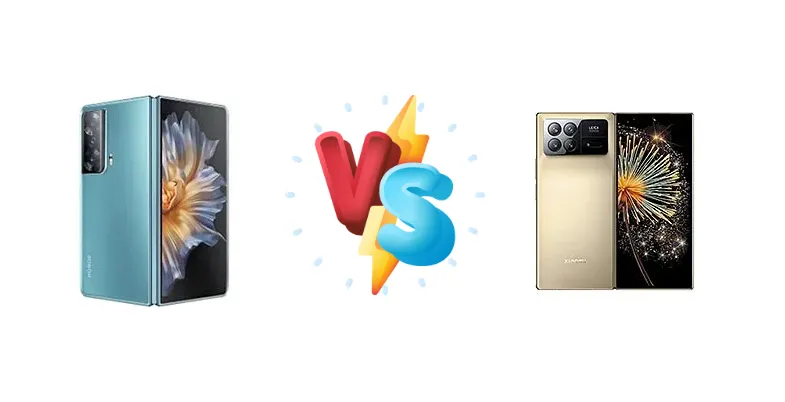
|
🏆 Quick Verdict
For most users, the Xiaomi Mix Fold 3 emerges as the superior choice. Its Snapdragon 8 Gen 2 chipset delivers a noticeable performance uplift, and the significantly improved battery endurance (117h vs 85h) addresses a key concern with foldable devices. While the Honor Magic Vs remains a capable device, the Mix Fold 3 offers a more future-proof and refined experience.
| PHONES | ||
|---|---|---|
| Phone Names | Honor Magic Vs | Xiaomi Mix Fold 3 |
| Network | ||
|---|---|---|
| 2G bands | GSM 850 / 900 / 1800 / 1900 | GSM 850 / 900 / 1800 / 1900 |
| 3G bands | HSDPA 800 / 850 / 900 / 1700(AWS) / 1900 / 2100 | HSDPA 800 / 850 / 900 / 1700(AWS) / 1900 / 2100 |
| 4G bands | 1, 2, 3, 4, 5, 7, 8, 12, 17, 18, 19, 20, 26, 28, 34, 38, 39, 40, 41 | 1, 2, 3, 4, 5, 7, 8, 12, 17, 18, 19, 26, 34, 38, 39, 40, 41, 42 |
| 5G bands | 1, 3, 5, 8, 28, 38, 41, 77, 78 SA/NSA | 1, 3, 5, 8, 28, 38, 40, 41, 77, 78, 79 SA/NSA |
| Speed | HSPA, LTE, 5G | HSPA, LTE, 5G |
| Technology | GSM / CDMA / HSPA / CDMA2000 / LTE / 5G | GSM / CDMA / HSPA / EVDO / LTE / 5G |
| CDMA2000 1x | - | |
| Launch | ||
|---|---|---|
| Announced | 2022, November 23 | 2023, August 14 |
| Status | Available. Released 2022, December 30 | Available. Released 2023, August 14 |
| Body | ||
|---|---|---|
| Build | Glass front, glass back or eco leather back, magnesium alloy frame, titanium alloy folding mechanism | Glass front (folded), plastic front (unfolded), glass back or aramid fiber back, aluminum frame |
| Dimensions | Unfolded: 160.3 x 141.5 x 6.1 mmFolded: 160.3 x 72.6 x 12.9 mm | Unfolded: 161.2 x 143.3 x 5.3 mm Folded: 161.2 x 73.5 x 10.9 mm |
| SIM | Nano-SIM + Nano-SIM | Nano-SIM + Nano-SIM |
| Weight | 261 g / 267 g (9.21 oz) | 255 g or 259 g (8.99 oz) |
| Display | ||
|---|---|---|
| Resolution | 1984 x 2272 pixels (~382 ppi density) | 1916 x 2160 pixels (~360 ppi density) |
| Size | 7.9 inches, 199.5 cm2 (~87.9% screen-to-body ratio) | 8.03 inches, 206.5 cm2 (~89.4% screen-to-body ratio) |
| Type | Foldable OLED, 1B colors, 90Hz, HDR10+, 800 nits | Foldable LTPO OLED+, 1B colors, 120Hz, HDR10+, Dolby Vision, 1300 nits (peak) |
| Cover display: OLED, 1B colors, 120Hz, HDR10+, 1200 nits, 6.45 inches, 1080 x 2560 pixels, 431 ppi | - | |
| Platform | ||
|---|---|---|
| CPU | Octa-core (1x3.0 GHz Cortex-X2 & 3x2.5 GHz Cortex-A710 & 4x1.80 GHz Cortex-A510) | Octa-core (1x3.36 GHz Cortex-X3 & 2x2.8 GHz Cortex-A715 & 2x2.8 GHz Cortex-A710 & 3x2.0 GHz Cortex-A510) |
| Chipset | Qualcomm SM8475 Snapdragon 8+ Gen 1 (4 nm) | Qualcomm SM8550-AC Snapdragon 8 Gen 2 (4 nm) |
| GPU | Adreno 730 | Adreno 740 |
| OS | Android 13, MagicOS 7.1 - InternationalAndroid 12, MagicOS 7 - China | Android 13, upgradable to Android 14, HyperOS |
| Memory | ||
|---|---|---|
| Card slot | No | No |
| Internal | 256GB 8GB RAM, 256GB 12GB RAM, 512GB 12GB RAM | 256GB 12GB RAM, 512GB 16GB RAM, 1TB 16GB RAM |
| Main Camera | ||
|---|---|---|
| Features | Dual-LED dual-tone flash, HDR, panorama | Color spectrum sensor, LED flash, HDR, panorama, Leica lenses |
| Quad | - | 50 MP, f/1.8, 23mm (wide), 1/1.49", 1.0µm, PDAF, OIS 10 MP, f/2.0, 75mm (telephoto), 1/3.94", 1.0µm, PDAF, OIS, 3.2x optical zoom 10 MP, f/2.9, 115mm (telephoto), 1/3.94", 1.0µm, PDAF, OIS, 5x optical zoom 12 MP, f/2.2, 15mm, 120˚ (ultrawide), 1/3.1", 1.12µm |
| Triple | 54 MP, f/1.9, 27mm (wide), 1/1.49", 1.0µm, PDAF 8 MP, f/2.4, 81mm (telephoto), PDAF, 3x optical zoom, OIS 50 MP, f/2.0, 13mm, 122˚ (ultrawide), AF | - |
| Video | 4K@30/60fps (10-bit), 1080p@30/60fps, gyro-EIS, HDR10+ | 8K@24fps, 4K@24/30/60fps, 1080p@30/60/120/240/960/1920fps, Dolby Vision HDR |
| Selfie camera | ||
|---|---|---|
| Features | HDR | HDR, panorama |
| Single | 16 MP, f/2.5, 24mm (wide) | 20 MP, f/2.3, 23mm (wide), 1/4.0", 0.8µm Cover camera: 20 MP, f/2.3, 23mm (wide), 1/4.0", 0.8µm |
| Video | 1080p@30fps, gyro-EIS | 1080p@30/60fps |
| Sound | ||
|---|---|---|
| 3.5mm jack | No | - |
| 35mm jack | No | No |
| Loudspeaker | Yes, with stereo speakers | Yes, with stereo speakers |
| Comms | ||
|---|---|---|
| Bluetooth | 5.2, A2DP, LE, aptX HD | 5.3, A2DP, LE |
| Infrared port | Yes | Yes |
| NFC | Yes | Yes |
| Positioning | GPS (L1+L5), GLONASS (L1), BDS (B1I+B1c+B2a), GALILEO (E1+E5a), QZSS (L1+L5) | GPS (L1+L5), GLONASS (G1), BDS (B1I+B1c+B2a), GALILEO (E1+E5a), QZSS (L1+L5), NavIC (L5) |
| Radio | No | No |
| USB | USB Type-C 3.1, OTG, Display Port 1.2 | USB Type-C 3.2, OTG |
| WLAN | Wi-Fi 802.11 a/b/g/n/ac/6, dual-band, Wi-Fi Direct | Wi-Fi 802.11 a/b/g/n/ac/6e/7, dual-band (tri-band after future SW update) |
| Features | ||
|---|---|---|
| Sensors | Fingerprint (side-mounted), accelerometer, gyro, proximity, compass | Fingerprint (side-mounted), accelerometer, gyro, proximity, compass, barometer |
| Battery | ||
|---|---|---|
| Charging | 66W wired 5W reverse wired | 67W wired, PD3.0, QC4, 100% in 40 min 50W wireless, 100% in 55 min |
| Type | Li-Po 5000 mAh | Li-Po 4800 mAh |
| Misc | ||
|---|---|---|
| Colors | Cyan, Black, Orange | Black, Gold |
| Models | FRI-AN00, FRI-NX9 | 2308CPXD0C |
| Price | About 2940 EUR | About 1150 EUR |
| Tests | ||
|---|---|---|
| Battery life | Endurance rating 85h | - |
| Camera | Photo / Video | - |
| Display | Contrast ratio: Infinite (nominal) | - |
| Loudspeaker | -23.4 LUFS (Very good) | - |
| Performance | AnTuTu: 831175 (v9) GeekBench: 3971 (v5.1), 4497 (v6) GFXBench: 50fps (ES 3.1 onscreen) | - |
Honor Magic Vs
- Potentially lower price point
- Established foldable design
- Competent performance for everyday tasks
- Older Snapdragon 8+ Gen 1 chipset
- Significantly shorter battery life
- Less bright display
Xiaomi Mix Fold 3
- Latest Snapdragon 8 Gen 2 chipset
- Exceptional battery life
- Brighter and potentially more refined display
- Faster charging (wired and wireless)
- Higher price tag
- Newer design may have unforeseen issues
Display Comparison
The Xiaomi Mix Fold 3 boasts a significantly brighter display, reaching a measured 1277 nits compared to the Honor Magic Vs’s 876 nits. This translates to superior visibility in direct sunlight. Both devices utilize foldable OLED panels, but the Mix Fold 3’s higher peak brightness and likely improved panel calibration offer a more vibrant and engaging viewing experience. While both have infinite (nominal) contrast ratios, the real-world difference will be noticeable in HDR content. We lack PWM frequency data, but the Mix Fold 3’s newer panel tech may offer improvements for users sensitive to flicker.
Camera Comparison
Both phones are listed as having 'Photo / Video' capabilities, but detailed camera specs are missing. Given Xiaomi’s recent focus on camera technology, it’s reasonable to assume the Mix Fold 3 will feature a more advanced camera system, potentially with a larger main sensor and more sophisticated image processing algorithms. The Honor Magic Vs, while likely capable, will likely rely more on software optimization to compete. Without specific sensor details, it’s difficult to make a definitive judgment, but Xiaomi’s brand history suggests a stronger emphasis on camera performance.
Performance
The core difference here lies in the chipsets. The Xiaomi Mix Fold 3’s Snapdragon 8 Gen 2 (SM8550-AC) represents a substantial leap over the Honor Magic Vs’s Snapdragon 8+ Gen 1 (SM8475). The Gen 2 features a newer Cortex-X3 prime core clocked at 3.36 GHz versus the X2 in the 8+ Gen 1, alongside more efficient Cortex-A715 cores. This results in faster application loading, smoother multitasking, and improved gaming performance. The Mix Fold 3 also benefits from potentially faster LPDDR5x RAM, further enhancing responsiveness. While the 8+ Gen 1 is still capable, the Gen 2 offers a more future-proof platform and better thermal efficiency, minimizing throttling during sustained workloads.
Battery Life
Battery life is a clear win for the Xiaomi Mix Fold 3. Its endurance rating of 117 hours significantly surpasses the Honor Magic Vs’s 85 hours. This difference is likely due to the more efficient Snapdragon 8 Gen 2 chipset and potentially optimized power management. Furthermore, the Mix Fold 3 offers faster charging with 67W wired (and 50W wireless), achieving a full charge in approximately 40 minutes (wired) and 55 minutes (wireless). The Honor Magic Vs is limited to 66W wired charging, which, while still fast, isn’t as competitive. The 5W reverse wired charging on both devices is a niche feature, useful for topping up accessories but not a primary selling point.
Buying Guide
Buy the Honor Magic Vs if you prioritize a more established foldable design with a proven track record and are seeking a more budget-conscious entry point into the foldable world. Buy the Xiaomi Mix Fold 3 if you demand the absolute best performance, longest battery life, and fastest charging speeds, and are willing to pay a premium for the latest technology.