
Honor Magic Vs vs Samsung Galaxy Z Fold4: A Deep Dive into Foldable Flagships
| Phones Images | |||||
|---|---|---|---|---|---|
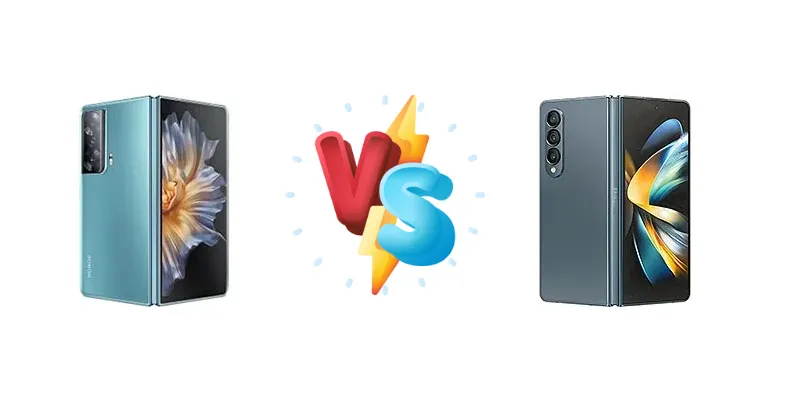
|
🏆 Quick Verdict
For the average user prioritizing longevity and faster charging, the Honor Magic Vs emerges as the winner. Its 85-hour endurance rating and 66W charging offer a tangible advantage over the Z Fold4’s 101-hour rating offset by its slower 25W charging. However, Samsung’s software and established ecosystem remain strong considerations.
| PHONES | ||
|---|---|---|
| Phone Names | Honor Magic Vs | Samsung Galaxy Z Fold4 |
| Network | ||
|---|---|---|
| 2G bands | GSM 850 / 900 / 1800 / 1900 | GSM 850 / 900 / 1800 / 1900 |
| 3G bands | HSDPA 800 / 850 / 900 / 1700(AWS) / 1900 / 2100 | HSDPA 850 / 900 / 1700(AWS) / 1900 / 2100 |
| 4G bands | 1, 2, 3, 4, 5, 7, 8, 12, 17, 18, 19, 20, 26, 28, 34, 38, 39, 40, 41 | 1, 2, 3, 4, 5, 7, 8, 12, 13, 17, 18, 19, 20, 25, 26, 28, 32, 38, 39, 40, 41, 66 - International |
| 5G bands | 1, 3, 5, 8, 28, 38, 41, 77, 78 SA/NSA | 1, 2, 3, 5, 7, 8, 12, 20, 25, 28, 38, 40, 41, 66, 75, 77, 78 SA/NSA/Sub6 - International |
| Speed | HSPA, LTE, 5G | HSPA 42.2/5.76 Mbps, LTE (7CA) Cat20 2000/200 Mbps, 5G |
| Technology | GSM / CDMA / HSPA / CDMA2000 / LTE / 5G | GSM / CDMA / HSPA / EVDO / LTE / 5G |
| CDMA2000 1x | CDMA2000 1xEV-DO | |
| Launch | ||
|---|---|---|
| Announced | 2022, November 23 | 2022, August 10 |
| Status | Available. Released 2022, December 30 | Available. Released 2022, August 25 |
| Body | ||
|---|---|---|
| Build | Glass front, glass back or eco leather back, magnesium alloy frame, titanium alloy folding mechanism | Glass front (Gorilla Glass Victus+) (folded), plastic front (unfolded), glass back (Gorilla Glass Victus+), aluminum frame |
| Dimensions | Unfolded: 160.3 x 141.5 x 6.1 mmFolded: 160.3 x 72.6 x 12.9 mm | Unfolded: 155.1 x 130.1 x 6.3 mmFolded: 155.1 x 67.1 x 14.2-15.8 mm |
| SIM | Nano-SIM + Nano-SIM | · Nano-SIM + eSIM· Nano-SIM + Nano-SIM + eSIM (max 2 at a time) |
| Weight | 261 g / 267 g (9.21 oz) | 263 g (9.28 oz) |
| - | IPX8 water resistant (up to 1.5m for 30 min) Armor aluminum frame with tougher drop and scratch resistance (advertised) Stylus support | |
| Display | ||
|---|---|---|
| Resolution | 1984 x 2272 pixels (~382 ppi density) | 1812 x 2176 pixels (~373 ppi density) |
| Size | 7.9 inches, 199.5 cm2 (~87.9% screen-to-body ratio) | 7.6 inches, 183.2 cm2 (~90.9% screen-to-body ratio) |
| Type | Foldable OLED, 1B colors, 90Hz, HDR10+, 800 nits | Foldable Dynamic AMOLED 2X, 120Hz, HDR10+, 1200 nits (peak) |
| Cover display: OLED, 1B colors, 120Hz, HDR10+, 1200 nits, 6.45 inches, 1080 x 2560 pixels, 431 ppi | Cover display: Dynamic AMOLED 2X, 120Hz, Corning Gorilla Glass Victus+ 6.2 inches, 904 x 2316 pixels, 23.1:9 ratio | |
| Platform | ||
|---|---|---|
| CPU | Octa-core (1x3.0 GHz Cortex-X2 & 3x2.5 GHz Cortex-A710 & 4x1.80 GHz Cortex-A510) | Octa-core (1x3.19 GHz Cortex-X2 & 3x2.75 GHz Cortex-A710 & 4x1.80 GHz Cortex-A510) |
| Chipset | Qualcomm SM8475 Snapdragon 8+ Gen 1 (4 nm) | Qualcomm SM8475 Snapdragon 8+ Gen 1 (4 nm) |
| GPU | Adreno 730 | Adreno 730 |
| OS | Android 13, MagicOS 7.1 - InternationalAndroid 12, MagicOS 7 - China | Android 12L, up to 4 major Android upgrades, One UI 6.1.1 |
| Memory | ||
|---|---|---|
| Card slot | No | No |
| Internal | 256GB 8GB RAM, 256GB 12GB RAM, 512GB 12GB RAM | 256GB 12GB RAM, 512GB 12GB RAM, 1TB 12GB RAM |
| - | UFS 3.1 | |
| Main Camera | ||
|---|---|---|
| Features | Dual-LED dual-tone flash, HDR, panorama | LED flash, HDR, panorama |
| Triple | 54 MP, f/1.9, 27mm (wide), 1/1.49", 1.0µm, PDAF 8 MP, f/2.4, 81mm (telephoto), PDAF, 3x optical zoom, OIS 50 MP, f/2.0, 13mm, 122˚ (ultrawide), AF | 50 MP, f/1.8, 23mm (wide), 1/1.56", 1.0µm, dual pixel PDAF, OIS 10 MP, f/2.4, 66mm (telephoto), 1/3.94", 1.0µm, PDAF, OIS, 3x optical zoom 12 MP, f/2.2, 12mm, 123˚ (ultrawide), 1/3.06", 1.12µm |
| Video | 4K@30/60fps (10-bit), 1080p@30/60fps, gyro-EIS, HDR10+ | 8K@24fps, 4K@60fps, 1080p@60/240fps (gyro-EIS), HDR10+ |
| Selfie camera | ||
|---|---|---|
| Features | HDR | HDR |
| Single | 16 MP, f/2.5, 24mm (wide) | 4 MP, f/1.8, 26mm (wide), 1/3.0", 2.0µm, under display Cover camera: 10 MP, f/2.2, 24mm (wide), 1/3.0", 1.22µm |
| Video | 1080p@30fps, gyro-EIS | 4K@30/60fps, 1080p@30/60fps, gyro-EIS |
| Sound | ||
|---|---|---|
| 3.5mm jack | No | No |
| 35mm jack | No | No |
| Loudspeaker | Yes, with stereo speakers | Yes, with stereo speakers |
| - | 32-bit/384kHz audio Tuned by AKG | |
| Comms | ||
|---|---|---|
| Bluetooth | 5.2, A2DP, LE, aptX HD | 5.2, A2DP, LE, aptX HD |
| Infrared port | Yes | - |
| NFC | Yes | Yes |
| Positioning | GPS (L1+L5), GLONASS (L1), BDS (B1I+B1c+B2a), GALILEO (E1+E5a), QZSS (L1+L5) | GPS, GLONASS, GALILEO, BDS |
| Radio | No | No |
| USB | USB Type-C 3.1, OTG, Display Port 1.2 | USB Type-C 3.2, OTG |
| WLAN | Wi-Fi 802.11 a/b/g/n/ac/6, dual-band, Wi-Fi Direct | Wi-Fi 802.11 a/b/g/n/ac/6e, dual-band, Wi-Fi Direct |
| Features | ||
|---|---|---|
| Sensors | Fingerprint (side-mounted), accelerometer, gyro, proximity, compass | Fingerprint (side-mounted), accelerometer, gyro, proximity, compass, barometer |
| - | Bixby natural language commands and dictation Samsung DeX (desktop experience support) Samsung Pay (Visa, MasterCard certified) Ultra Wideband (UWB) support | |
| Battery | ||
|---|---|---|
| Charging | 66W wired 5W reverse wired | 25W wired, 50% in 30 min 15W wireless 4.5W reverse wireless |
| Type | Li-Po 5000 mAh | Li-Po 4400 mAh |
| Misc | ||
|---|---|---|
| Colors | Cyan, Black, Orange | Graygreen, Phantom Black, Beige, Burgundy |
| Models | FRI-AN00, FRI-NX9 | SM-F936B, SM-F936B/DS, SM-F936U, SM-F936U1, SM-F936N, SM-F936W, SM-F9360 |
| Price | About 2940 EUR | $ 457.00 / € 511.80 / £ 485.00 / ₹ 73,899 |
| SAR | - | 0.96 W/kg (head) 0.92 W/kg (body) |
| SAR EU | - | 1.30 W/kg (head) 1.51 W/kg (body) |
| Tests | ||
|---|---|---|
| Battery life | Endurance rating 85h | Endurance rating 101h |
| Camera | Photo / Video | Photo / Video |
| Display | Contrast ratio: Infinite (nominal) | Contrast ratio: Infinite (nominal) |
| Loudspeaker | -23.4 LUFS (Very good) | -28.3 LUFS (Average) |
| Performance | AnTuTu: 831175 (v9) GeekBench: 3971 (v5.1), 4497 (v6) GFXBench: 50fps (ES 3.1 onscreen) | AnTuTu: 964530 (v9) GeekBench: 3981 (v5.1) GFXBench: 43fps (ES 3.1 onscreen) |
Honor Magic Vs
- Faster 66W wired charging significantly reduces charging time.
- Higher endurance rating suggests better overall battery efficiency.
- Potentially more aggressive pricing compared to the Z Fold4.
- Slightly lower peak display brightness.
- Potentially less refined software experience compared to Samsung.
Samsung Galaxy Z Fold4
- Higher peak display brightness for better outdoor visibility.
- More polished software experience and app optimization.
- Wider ecosystem integration with Samsung services.
- Slower 25W wired charging.
- Lower endurance rating compared to the Honor Magic Vs.
Display Comparison
Both the Honor Magic Vs and Samsung Galaxy Z Fold4 feature foldable displays with an infinite (nominal) contrast ratio. However, the Z Fold4 boasts a slightly higher peak brightness of 1000 nits compared to the Magic Vs’s 876 nits. While both are perfectly usable outdoors, the Z Fold4 will offer better visibility in direct sunlight. Both utilize dynamic refresh rate technology (likely LTPO) to conserve power, but specific refresh rate ranges aren’t provided. The hinge mechanism and crease visibility are critical, but unquantifiable, aspects where user preference will play a significant role.
Camera Comparison
Both phones feature capable camera systems, but detailed sensor information is lacking. The context data only indicates 'Photo / Video' capabilities. Given the flagship positioning, both likely include multi-camera setups with wide, ultrawide, and telephoto lenses. The Z Fold4’s established image processing algorithms and software features likely provide a more refined photographic experience. Without specific sensor details, it’s difficult to definitively declare a winner, but Samsung’s history suggests a more comprehensive camera experience.
Performance
Both devices are powered by the Qualcomm Snapdragon 8+ Gen 1 (4nm), but the Z Fold4’s CPU is clocked slightly higher at 3.19 GHz versus the Magic Vs’s 3.0 GHz. This difference, coupled with the Z Fold4’s 3x2.75 GHz Cortex-A710 cores (vs 2.5 GHz on the Magic Vs), translates to a marginal performance advantage in CPU-intensive tasks. Both utilize an Octa-core configuration with the same Cortex-A510 efficiency cores. Real-world performance differences will likely be minimal for most users, but the Z Fold4 has a slight edge in raw processing power. Both likely utilize LPDDR5X RAM, though specific speeds aren't provided.
Battery Life
The Galaxy Z Fold4 boasts an endurance rating of 101 hours, while the Honor Magic Vs achieves 85 hours. This suggests the Z Fold4 is more efficient overall, potentially due to software optimizations or slightly more efficient components. However, the Magic Vs compensates with significantly faster charging: 66W wired versus the Z Fold4’s 25W. The Magic Vs also offers 5W reverse wired charging, while the Z Fold4 provides 15W wireless and 4.5W reverse wireless. The faster charging on the Magic Vs dramatically reduces downtime, making it more convenient for users who frequently need to top up their battery.
Buying Guide
Buy the Honor Magic Vs if you need a foldable that prioritizes battery life and rapid charging, allowing you to stay productive on the go without constantly seeking an outlet. Buy the Samsung Galaxy Z Fold4 if you prefer a more polished software experience, tighter app optimization for the foldable form factor, and the broader ecosystem benefits of the Samsung brand. The Z Fold4 is also a better choice for users heavily invested in Samsung’s services.