
Honor Magic Vs vs. Motorola Razr+ 2025: A Deep Dive into Foldable Futures
| Phones Images | |||||
|---|---|---|---|---|---|
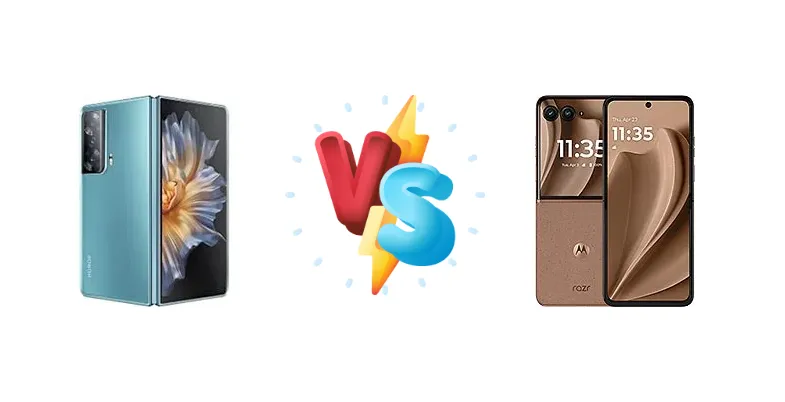
|
🏆 Quick Verdict
For users prioritizing sustained performance and all-day battery life, the Honor Magic Vs emerges as the winner. Its Snapdragon 8+ Gen 1 and 85-hour endurance rating provide a more reliable experience. However, the Razr+ 2025’s newer chipset and innovative form factor appeal to those seeking a stylish, pocketable device.
| PHONES | ||
|---|---|---|
| Phone Names | Honor Magic Vs | Motorola Razr+ 2025 |
| Network | ||
|---|---|---|
| 2G bands | GSM 850 / 900 / 1800 / 1900 | GSM 900 / 1800 / 1900 |
| 3G bands | HSDPA 800 / 850 / 900 / 1700(AWS) / 1900 / 2100 | HSDPA 850 / 900 / 1700(AWS) / 1900 / 2100 |
| 4G bands | 1, 2, 3, 4, 5, 7, 8, 12, 17, 18, 19, 20, 26, 28, 34, 38, 39, 40, 41 | 1, 2, 3, 4, 5, 7, 8, 12, 13, 14, 17, 18, 19, 20, 25, 26, 28, 29, 30, 38, 39, 40, 41, 46, 48, 66, 71 |
| 5G bands | 1, 3, 5, 8, 28, 38, 41, 77, 78 SA/NSA | 1, 2, 3, 5, 7, 12, 14, 20, 25, 26, 28, 29, 30, 38, 40, 41, 48, 66, 70, 71, 77, 78 SA/NSA/Sub6 |
| Speed | HSPA, LTE, 5G | HSPA, LTE, 5G |
| Technology | GSM / CDMA / HSPA / CDMA2000 / LTE / 5G | GSM / HSPA / LTE / 5G |
| CDMA2000 1x | - | |
| Launch | ||
|---|---|---|
| Announced | 2022, November 23 | 2025, April 24 |
| Status | Available. Released 2022, December 30 | Available. Released 2025, June 03 |
| Body | ||
|---|---|---|
| Build | Glass front, glass back or eco leather back, magnesium alloy frame, titanium alloy folding mechanism | Plastic front (unfolded), glass front (folded, Gorilla Glass Victus), silicone polymer back (eco leather), aluminum frame (6000 series), hinge (titanium) |
| Dimensions | Unfolded: 160.3 x 141.5 x 6.1 mmFolded: 160.3 x 72.6 x 12.9 mm | Unfolded: 171.4 x 74 x 7.1 mmFolded: 88.1 x 74 x 15.3 mm |
| SIM | Nano-SIM + Nano-SIM | Nano-SIM + eSIM |
| Weight | 261 g / 267 g (9.21 oz) | 189 g (6.67 oz) |
| Display | ||
|---|---|---|
| Resolution | 1984 x 2272 pixels (~382 ppi density) | 1080 x 2640 pixels (~413 ppi density) |
| Size | 7.9 inches, 199.5 cm2 (~87.9% screen-to-body ratio) | 6.9 inches, 107.6 cm2 (~84.9% screen-to-body ratio) |
| Type | Foldable OLED, 1B colors, 90Hz, HDR10+, 800 nits | Foldable LTPO AMOLED, 1B colors, Dolby Vision, 165Hz, HDR10+, 3000 nits (peak) |
| Cover display: OLED, 1B colors, 120Hz, HDR10+, 1200 nits, 6.45 inches, 1080 x 2560 pixels, 431 ppi | - | |
| Platform | ||
|---|---|---|
| CPU | Octa-core (1x3.0 GHz Cortex-X2 & 3x2.5 GHz Cortex-A710 & 4x1.80 GHz Cortex-A510) | Octa-core (1x3.0 GHz Cortex-X4 & 4x2.8 GHz Cortex-A720 & 3x2.0 GHz Cortex-A520) |
| Chipset | Qualcomm SM8475 Snapdragon 8+ Gen 1 (4 nm) | Qualcomm SM8635 Snapdragon 8s Gen 3 (4 nm) |
| GPU | Adreno 730 | Adreno 735 |
| OS | Android 13, MagicOS 7.1 - InternationalAndroid 12, MagicOS 7 - China | Android 15 |
| Memory | ||
|---|---|---|
| Card slot | No | No |
| Internal | 256GB 8GB RAM, 256GB 12GB RAM, 512GB 12GB RAM | 256GB 12GB RAM |
| Main Camera | ||
|---|---|---|
| Dual | - | 50 MP, f/1.7, 24mm (wide), 1/1.95", 0.8µm, dual pixel PDAF, OIS 50 MP, f/2.0, 47mm (telephoto), 1/2.76", 0.64µm, PDAF, 2x optical zoom |
| Features | Dual-LED dual-tone flash, HDR, panorama | LED flash, panorama, HDR |
| Triple | 54 MP, f/1.9, 27mm (wide), 1/1.49", 1.0µm, PDAF 8 MP, f/2.4, 81mm (telephoto), PDAF, 3x optical zoom, OIS 50 MP, f/2.0, 13mm, 122˚ (ultrawide), AF | - |
| Video | 4K@30/60fps (10-bit), 1080p@30/60fps, gyro-EIS, HDR10+ | 4K@30/60fps, 1080p@30/60/120/240/960fps, HDR10+, gyro-EIS |
| Selfie camera | ||
|---|---|---|
| Features | HDR | HDR |
| Single | 16 MP, f/2.5, 24mm (wide) | 32 MP, f/2.4, 25mm (wide), 1/3.14", 0.7µm |
| Video | 1080p@30fps, gyro-EIS | 4K@30/60fps, 1080p@30/60fps |
| Sound | ||
|---|---|---|
| 3.5mm jack | No | - |
| 35mm jack | No | No |
| Loudspeaker | Yes, with stereo speakers | Yes, with stereo speakers (with Dolby Atmos) |
| Comms | ||
|---|---|---|
| Bluetooth | 5.2, A2DP, LE, aptX HD | 5.4, A2DP, LE, aptX HD, aptX Adaptive, aptX Lossless |
| Infrared port | Yes | - |
| NFC | Yes | Yes |
| Positioning | GPS (L1+L5), GLONASS (L1), BDS (B1I+B1c+B2a), GALILEO (E1+E5a), QZSS (L1+L5) | GPS (L1+L5), GLONASS (L1), BDS (B1I+B1c+B2a), GALILEO (E1+E5a), QZSS (L1+L5) |
| Radio | No | No |
| USB | USB Type-C 3.1, OTG, Display Port 1.2 | USB Type-C 2.0, OTG |
| WLAN | Wi-Fi 802.11 a/b/g/n/ac/6, dual-band, Wi-Fi Direct | Wi-Fi 802.11 a/b/g/n/ac/6e/7, tri-band |
| Features | ||
|---|---|---|
| Sensors | Fingerprint (side-mounted), accelerometer, gyro, proximity, compass | Fingerprint (side-mounted), accelerometer, gyro, proximity, compass, barometer |
| Battery | ||
|---|---|---|
| Charging | 66W wired 5W reverse wired | 45W wired 15W wireless 5W reverse wired |
| Type | Li-Po 5000 mAh | 4000 mAh |
| Misc | ||
|---|---|---|
| Colors | Cyan, Black, Orange | Pantone: Mocha Mousse, Midnight Blue, Hot Pink |
| Models | FRI-AN00, FRI-NX9 | XT2451-1 |
| Price | About 2940 EUR | $ 500.00 |
| Tests | ||
|---|---|---|
| Battery life | Endurance rating 85h | - |
| Camera | Photo / Video | - |
| Display | Contrast ratio: Infinite (nominal) | - |
| Loudspeaker | -23.4 LUFS (Very good) | - |
| Performance | AnTuTu: 831175 (v9) GeekBench: 3971 (v5.1), 4497 (v6) GFXBench: 50fps (ES 3.1 onscreen) | - |
Honor Magic Vs
- Exceptional battery life (85h endurance)
- Larger internal display for productivity
- Faster wired charging (66W)
- Older chipset (Snapdragon 8+ Gen 1)
- Bulkier form factor compared to flip phones
Motorola Razr+ 2025
- Newer chipset (Snapdragon 8s Gen 3)
- Compact and stylish flip phone design
- Versatile charging options (45W wired, 15W wireless)
- Shorter battery life (10:12h active use)
- Potentially lower sustained performance
Display Comparison
The Honor Magic Vs boasts an 876-nit peak brightness, ensuring excellent visibility even outdoors. While the Razr+ 2025’s display specs are currently unavailable, Motorola historically focuses on vibrant color reproduction in its Razr line. The Magic Vs’s larger internal display is geared towards multitasking, while the Razr+ 2025 likely prioritizes a more compact form factor. The Razr+ 2025’s external display is a key differentiator, offering functionality beyond simple notifications, a feature absent on the Magic Vs. The contrast ratio of the Magic Vs is infinite (nominal), typical of OLED panels, but the Razr+ 2025’s panel technology remains to be seen.
Camera Comparison
Both devices feature photo and video capabilities, but detailed camera specifications are limited for the Magic Vs. The focus should be on image processing algorithms and sensor size. Without specific sensor details, it’s difficult to definitively declare a winner. Motorola often emphasizes computational photography, potentially giving the Razr+ 2025 an edge in challenging lighting conditions. The absence of detailed camera specs on the Magic Vs suggests it may not be a primary focus compared to the Razr+ 2025.
Performance
The Motorola Razr+ 2025’s Snapdragon 8s Gen 3 (4nm) represents a generational leap over the Honor Magic Vs’s Snapdragon 8+ Gen 1 (4nm). The 8s Gen 3 features the newer Cortex-X4 prime core clocked at 3.0 GHz, alongside four Cortex-A720 performance cores at 2.8 GHz, and three Cortex-A520 efficiency cores at 2.0 GHz. This architecture promises improved single-core and multi-core performance compared to the Magic Vs’s Cortex-X2, A710, and A510 configuration. While both chips are fabricated on a 4nm process, the newer architecture of the 8s Gen 3 should translate to better efficiency and sustained performance under load. The Razr+ 2025 will likely benefit from faster LPDDR5x RAM, further enhancing responsiveness.
Battery Life
The Honor Magic Vs claims an impressive 85-hour endurance rating, a significant advantage over the Motorola Razr+ 2025’s 10:12 hour active use score. This translates to potentially days of moderate use on the Magic Vs. However, the Razr+ 2025 offers 45W wired charging and 15W wireless charging, providing more versatile charging options than the Magic Vs’s 66W wired and 5W reverse wired charging. The smaller battery capacity of the Razr+ 2025 is a trade-off for its more compact design, but the faster charging speeds partially mitigate this disadvantage.
Buying Guide
Buy the Honor Magic Vs if you need a larger internal display for productivity, demand longer battery life for power users, and prefer a more traditional tablet-like experience when unfolded. Buy the Motorola Razr+ 2025 if you prioritize a compact, fashionable design, enjoy the nostalgia of a flip phone, and value the convenience of a large external display for quick interactions.