
Honor Magic Vs Ultimate vs Motorola Razr+ 2025: A Deep Dive into Foldable Flagships
| Phones Images | |||||
|---|---|---|---|---|---|
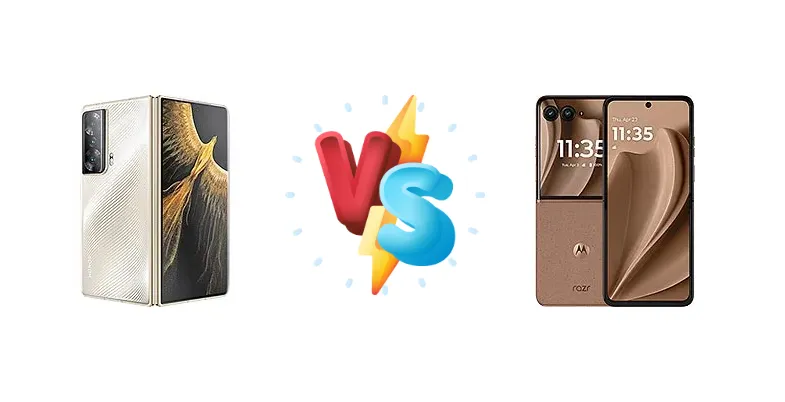
|
🏆 Quick Verdict
For the average user prioritizing sustained performance and a more mature software experience, the Honor Magic Vs Ultimate emerges as the winner. While the Razr+ 2025 boasts impressive battery life, the Snapdragon 8+ Gen 1 in the Honor device provides a more consistently powerful experience, especially for demanding tasks. However, the Razr+ 2025 is a strong contender for those prioritizing battery longevity.
| PHONES | ||
|---|---|---|
| Phone Names | Honor Magic Vs Ultimate | Motorola Razr+ 2025 |
| Network | ||
|---|---|---|
| 2G bands | GSM 850 / 900 / 1800 / 1900 | GSM 900 / 1800 / 1900 |
| 3G bands | HSDPA 800 / 850 / 900 / 1700(AWS) / 1900 / 2100 | HSDPA 850 / 900 / 1700(AWS) / 1900 / 2100 |
| 4G bands | 1, 2, 3, 4, 5, 7, 8, 12, 17, 18, 19, 20, 26, 28, 34, 38, 39, 40, 41 | 1, 2, 3, 4, 5, 7, 8, 12, 13, 14, 17, 18, 19, 20, 25, 26, 28, 29, 30, 38, 39, 40, 41, 46, 48, 66, 71 |
| 5G bands | 1, 3, 5, 8, 28, 38, 41, 77, 78 SA/NSA | 1, 2, 3, 5, 7, 12, 14, 20, 25, 26, 28, 29, 30, 38, 40, 41, 48, 66, 70, 71, 77, 78 SA/NSA/Sub6 |
| Speed | HSPA, LTE, 5G | HSPA, LTE, 5G |
| Technology | GSM / CDMA / HSPA / CDMA2000 / LTE / 5G | GSM / HSPA / LTE / 5G |
| CDMA2000 1x | - | |
| Launch | ||
|---|---|---|
| Announced | 2022, November 23 | 2025, April 24 |
| Status | Available. Released 2022, December 30 | Available. Released 2025, June 03 |
| Body | ||
|---|---|---|
| Build | Glass front, glass back, magnesium alloy frame, titanium alloy folding mechanism | Plastic front (unfolded), glass front (folded, Gorilla Glass Victus), silicone polymer back (eco leather), aluminum frame (6000 series), hinge (titanium) |
| Dimensions | Unfolded: 160.3 x 141.5 x 6.1 mmFolded: 160.3 x 72.6 x 12.9 mm | Unfolded: 171.4 x 74 x 7.1 mmFolded: 88.1 x 74 x 15.3 mm |
| SIM | Nano-SIM + Nano-SIM | Nano-SIM + eSIM |
| Weight | 265 g (9.35 oz) | 189 g (6.67 oz) |
| Display | ||
|---|---|---|
| Resolution | 1984 x 2272 pixels (~382 ppi density) | 1080 x 2640 pixels (~413 ppi density) |
| Size | 7.9 inches, 199.5 cm2 (~87.9% screen-to-body ratio) | 6.9 inches, 107.6 cm2 (~84.9% screen-to-body ratio) |
| Type | Foldable OLED, 1B colors, 90Hz, HDR10+, 800 nits | Foldable LTPO AMOLED, 1B colors, Dolby Vision, 165Hz, HDR10+, 3000 nits (peak) |
| Stylus support Cover display: OLED (nano glass-ceramic cover), 1B colors, 120Hz, HDR10+, 1200 nits, 6.45 inches, 1080 x 2560 pixels, 431 ppi | - | |
| Platform | ||
|---|---|---|
| CPU | Octa-core (1x3.2 GHz Cortex-X2 & 3x2.75 GHz Cortex-A710 & 4x2.0 GHz Cortex-A510) | Octa-core (1x3.0 GHz Cortex-X4 & 4x2.8 GHz Cortex-A720 & 3x2.0 GHz Cortex-A520) |
| Chipset | Qualcomm SM8475 Snapdragon 8+ Gen 1 (4 nm) | Qualcomm SM8635 Snapdragon 8s Gen 3 (4 nm) |
| GPU | Adreno 730 | Adreno 735 |
| OS | Android 12, MagicOS 7 | Android 15 |
| Memory | ||
|---|---|---|
| Card slot | No | No |
| Internal | 512GB 16GB RAM | 256GB 12GB RAM |
| Main Camera | ||
|---|---|---|
| Dual | - | 50 MP, f/1.7, 24mm (wide), 1/1.95", 0.8µm, dual pixel PDAF, OIS 50 MP, f/2.0, 47mm (telephoto), 1/2.76", 0.64µm, PDAF, 2x optical zoom |
| Features | Dual-LED dual-tone flash, HDR, panorama | LED flash, panorama, HDR |
| Triple | 54 MP, f/1.9, 27mm (wide), 1/1.49", 1.0µm, PDAF 8 MP, f/2.4, (telephoto), PDAF, 3x optical zoom, OIS 50 MP, f/2.0, 13mm, 122˚ (ultrawide), AF | - |
| Video | 4K@30/60fps (10-bit), 1080p@30/60fps, gyro-EIS, HDR10+ | 4K@30/60fps, 1080p@30/60/120/240/960fps, HDR10+, gyro-EIS |
| Selfie camera | ||
|---|---|---|
| Features | HDR | HDR |
| Single | 16 MP, f/2.5, (wide) | 32 MP, f/2.4, 25mm (wide), 1/3.14", 0.7µm |
| Video | 1080p@30fps, gyro-EIS | 4K@30/60fps, 1080p@30/60fps |
| Sound | ||
|---|---|---|
| 3.5mm jack | No | - |
| 35mm jack | No | No |
| Loudspeaker | Yes, with stereo speakers | Yes, with stereo speakers (with Dolby Atmos) |
| Comms | ||
|---|---|---|
| Bluetooth | 5.2, A2DP, LE, aptX HD | 5.4, A2DP, LE, aptX HD, aptX Adaptive, aptX Lossless |
| Infrared port | Yes | - |
| NFC | Yes | Yes |
| Positioning | GPS (L1+L5), GLONASS (L1), BDS (B1I+B1c+B2a), GALILEO (E1+E5a), QZSS (L1+L5) | GPS (L1+L5), GLONASS (L1), BDS (B1I+B1c+B2a), GALILEO (E1+E5a), QZSS (L1+L5) |
| Radio | No | No |
| USB | USB Type-C 3.1, OTG, Display Port 1.2 | USB Type-C 2.0, OTG |
| WLAN | Wi-Fi 802.11 a/b/g/n/ac/6, dual-band, Wi-Fi Direct | Wi-Fi 802.11 a/b/g/n/ac/6e/7, tri-band |
| Features | ||
|---|---|---|
| Sensors | Fingerprint (side-mounted), accelerometer, gyro, proximity, compass | Fingerprint (side-mounted), accelerometer, gyro, proximity, compass, barometer |
| Battery | ||
|---|---|---|
| Charging | 66W wired 5W reverse wired | 45W wired 15W wireless 5W reverse wired |
| Type | Li-Po 5000 mAh | 4000 mAh |
| Misc | ||
|---|---|---|
| Colors | Gold, Black | Pantone: Mocha Mousse, Midnight Blue, Hot Pink |
| Models | FRI-AN10 | XT2451-1 |
| Price | About 1500 EUR | $ 500.00 |
Honor Magic Vs Ultimate
- Proven Snapdragon 8+ Gen 1 performance
- Faster 66W wired charging
- Mature foldable software experience
- Potentially shorter battery life compared to Razr+ 2025
- Larger and heavier form factor
Motorola Razr+ 2025
- Excellent battery life (10:12h active use)
- More compact clamshell design
- Newer Snapdragon 8s Gen 3 chipset
- Slower 45W wired charging
- Software may require further optimization
Display Comparison
While specific display specs aren't provided for the Razr+ 2025 beyond its foldable nature, the Honor Magic Vs Ultimate benefits from a mature foldable panel design. The key difference lies in the chipset's ability to drive the display efficiently. Both devices likely utilize LTPO technology for variable refresh rates, but the Razr+ 2025's focus on battery life may prioritize lower refresh rates in certain scenarios. The Razr+'s clamshell design will inherently have a tighter crease radius, potentially impacting viewing angles compared to the broader fold of the Magic Vs Ultimate.
Camera Comparison
Without detailed camera specifications, a direct comparison is difficult. However, given the market positioning, the Honor Magic Vs Ultimate likely prioritizes a versatile camera system with a larger main sensor and more advanced image processing. Motorola typically focuses on computational photography, so the Razr+ 2025 may excel in challenging lighting conditions. The 8s Gen 3’s ISP (Image Signal Processor) will offer improvements in image processing speed and quality compared to the 8+ Gen 1, potentially leading to better dynamic range and noise reduction in the Razr+ 2025.
Performance
The Motorola Razr+ 2025’s Snapdragon 8s Gen 3 (4nm) represents a generational leap over the Honor Magic Vs Ultimate’s Snapdragon 8+ Gen 1 (4nm). The Cortex-X4 prime core in the 8s Gen 3, clocked at 3.0 GHz, offers a modest clock speed increase over the 8+ Gen 1’s 3.2 GHz Cortex-X2, but benefits from architectural improvements. The 8s Gen 3’s Cortex-A720 performance cores are also more efficient than the 8+ Gen 1’s A710s. However, the 8+ Gen 1’s proven thermal management and optimization within Honor’s software could mitigate the raw performance advantage of the 8s Gen 3, especially during sustained workloads. The Razr+ 2025 will likely benefit from the newer Adreno GPU, offering improved graphics performance.
Battery Life
The Motorola Razr+ 2025’s reported 10:12 hour active use score is a significant advantage. This suggests a combination of efficient chipset architecture and optimized software. The Honor Magic Vs Ultimate, with its 66W wired charging, offers faster charging speeds than the Razr+ 2025’s 45W wired and 15W wireless options. However, the Razr+ 2025’s superior battery life may negate the need for frequent top-ups. The 5W reverse wired charging on both devices is a convenience feature, but not a primary differentiator.
Buying Guide
Buy the Honor Magic Vs Ultimate if you need a foldable with proven performance for gaming, multitasking, and demanding applications, and value a more established software ecosystem. Buy the Motorola Razr+ 2025 if you prioritize all-day battery life, a more compact form factor, and are willing to accept potential software refinements as the platform matures. The Razr+ is ideal for users who primarily consume content and need a reliable, long-lasting device.