
Honor Magic V5 vs. Xiaomi Mix Fold 3: A Deep Dive into Foldable Flagships
| Phones Images | |||||
|---|---|---|---|---|---|
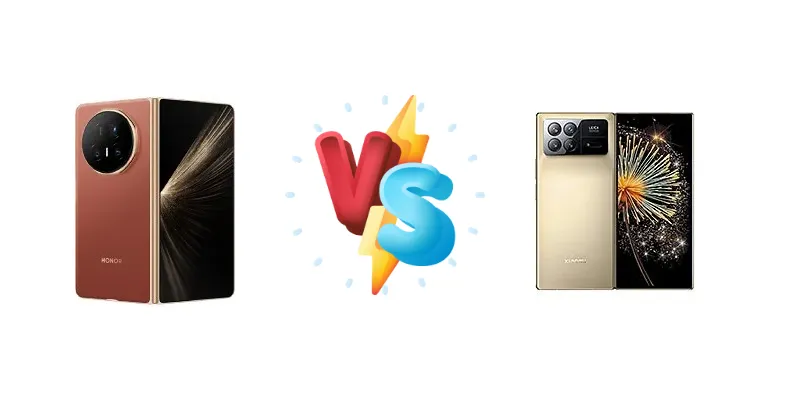
|
🏆 Quick Verdict
For users prioritizing raw performance and extended battery life, the Honor Magic V5 emerges as the winner. Its Snapdragon 8 Elite chipset and impressive 49:48h endurance rating provide a noticeable advantage. However, the Xiaomi Mix Fold 3 remains a compelling option, particularly for those valuing fast charging and a refined software experience.
| PHONES | ||
|---|---|---|
| Phone Names | Honor Magic V5 | Xiaomi Mix Fold 3 |
| Network | ||
|---|---|---|
| 2G bands | GSM 850 / 900 / 1800 / 1900 | GSM 850 / 900 / 1800 / 1900 |
| 3G bands | HSDPA 800 / 850 / 900 / 1700(AWS) / 1900 / 2100 | HSDPA 800 / 850 / 900 / 1700(AWS) / 1900 / 2100 |
| 4G bands | 1, 2, 3, 4, 5, 7, 8, 12, 17, 18, 19, 20, 26, 28, 34, 38, 39, 40, 41, 66 | 1, 2, 3, 4, 5, 7, 8, 12, 17, 18, 19, 26, 34, 38, 39, 40, 41, 42 |
| 5G bands | 1, 3, 5, 8, 28, 38, 41, 77, 78 SA/NSA | 1, 3, 5, 8, 28, 38, 40, 41, 77, 78, 79 SA/NSA |
| Speed | HSPA, LTE, 5G | HSPA, LTE, 5G |
| Technology | GSM / CDMA / HSPA / CDMA2000 / LTE / 5G | GSM / CDMA / HSPA / EVDO / LTE / 5G |
| Launch | ||
|---|---|---|
| Announced | 2025, July 02 | 2023, August 14 |
| Status | Available. Released 2025, July 02 | Available. Released 2023, August 14 |
| Body | ||
|---|---|---|
| Build | - | Glass front (folded), plastic front (unfolded), glass back or aramid fiber back, aluminum frame |
| Dimensions | Unfolded: 156.8 x 145.9 x 4.1 mm or 4.2 mmFolded: 156.8 x 74.3 x 8.8 mm or 9.0 mm | Unfolded: 161.2 x 143.3 x 5.3 mm Folded: 161.2 x 73.5 x 10.9 mm |
| SIM | · Nano-SIM + Nano-SIM + eSIM + eSIM (max 2 at a time)· Nano-SIM + Nano-SIM | Nano-SIM + Nano-SIM |
| Weight | 217 g or 222 g (7.65 oz) | 255 g or 259 g (8.99 oz) |
| Display | ||
|---|---|---|
| Protection | Honor Super Armored Inner Screen, Mohs level 4 | - |
| Resolution | 2172 x 2352 pixels (~403 ppi density) | 1916 x 2160 pixels (~360 ppi density) |
| Size | 7.95 inches, 203.2 cm2 (~88.8% screen-to-body ratio) | 8.03 inches, 206.5 cm2 (~89.4% screen-to-body ratio) |
| Type | Foldable LTPO AMOLED, 1B colors, 120Hz, 5000 nits (peak) | Foldable LTPO OLED+, 1B colors, 120Hz, HDR10+, Dolby Vision, 1300 nits (peak) |
| Platform | ||
|---|---|---|
| CPU | Octa-core (2x4.32 GHz Oryon V2 Phoenix L + 6x3.53 GHz Oryon V2 Phoenix M) | Octa-core (1x3.36 GHz Cortex-X3 & 2x2.8 GHz Cortex-A715 & 2x2.8 GHz Cortex-A710 & 3x2.0 GHz Cortex-A510) |
| Chipset | Qualcomm SM8750-AB Snapdragon 8 Elite (3 nm) | Qualcomm SM8550-AC Snapdragon 8 Gen 2 (4 nm) |
| GPU | Adreno 830 | Adreno 740 |
| OS | Android 15, upgradable to Android 16, MagicOS 10, up to 7 major Android upgrades | Android 13, upgradable to Android 14, HyperOS |
| Memory | ||
|---|---|---|
| Card slot | No | No |
| Internal | 256GB 12GB RAM, 512GB 16GB RAM, 1TB 16GB RAM | 256GB 12GB RAM, 512GB 16GB RAM, 1TB 16GB RAM |
| Main Camera | ||
|---|---|---|
| Features | Laser AF, LED flash, HDR, panorama | Color spectrum sensor, LED flash, HDR, panorama, Leica lenses |
| Quad | - | 50 MP, f/1.8, 23mm (wide), 1/1.49", 1.0µm, PDAF, OIS 10 MP, f/2.0, 75mm (telephoto), 1/3.94", 1.0µm, PDAF, OIS, 3.2x optical zoom 10 MP, f/2.9, 115mm (telephoto), 1/3.94", 1.0µm, PDAF, OIS, 5x optical zoom 12 MP, f/2.2, 15mm, 120˚ (ultrawide), 1/3.1", 1.12µm |
| Triple | 50 MP, f/1.6, 23mm (wide), 1/1.56", 1.0µm, PDAF, OIS 64 MP, f/2.5, 70mm (periscope telephoto), 1/2.0", 0.7µm, 3x optical zoom 50 MP, f/2.0, 13mm, 122˚ (ultrawide), AF | - |
| Video | 4K@30/60fps (10-bit), 1080p@30/60fps, gyro-EIS, OIS | 8K@24fps, 4K@24/30/60fps, 1080p@30/60/120/240/960/1920fps, Dolby Vision HDR |
| Selfie camera | ||
|---|---|---|
| Features | HDR | HDR, panorama |
| Single | 20 MP, f/2.2, (wide) Cover camera: 20 MP, f/2.2, (wide) | 20 MP, f/2.3, 23mm (wide), 1/4.0", 0.8µm Cover camera: 20 MP, f/2.3, 23mm (wide), 1/4.0", 0.8µm |
| Video | 4K@30fps, 1080p@30fps, gyro-EIS | 1080p@30/60fps |
| Sound | ||
|---|---|---|
| 35mm jack | No | No |
| Loudspeaker | Yes, with stereo speakers | Yes, with stereo speakers |
| Comms | ||
|---|---|---|
| Bluetooth | 6.0, A2DP, LE, aptX HD | 5.3, A2DP, LE |
| Infrared port | Yes | Yes |
| NFC | Yes | Yes |
| Positioning | GPS (L1+L5), GLONASS (L1), BDS (B1I+B1c+B2a), GALILEO (E1+E5a) | GPS (L1+L5), GLONASS (G1), BDS (B1I+B1c+B2a), GALILEO (E1+E5a), QZSS (L1+L5), NavIC (L5) |
| Radio | No | No |
| USB | USB Type-C 3.1, OTG, Display Port 1.2 | USB Type-C 3.2, OTG |
| WLAN | Wi-Fi 802.11 a/b/g/n/ac/6e/7, dual-band, Wi-Fi Direct | Wi-Fi 802.11 a/b/g/n/ac/6e/7, dual-band (tri-band after future SW update) |
| Features | ||
|---|---|---|
| Sensors | Fingerprint (side-mounted), accelerometer, gyro, proximity, compass, barometer | Fingerprint (side-mounted), accelerometer, gyro, proximity, compass, barometer |
| Battery | ||
|---|---|---|
| Charging | 66W wired 50W wireless 5W reverse wired | 67W wired, PD3.0, QC4, 100% in 40 min 50W wireless, 100% in 55 min |
| Type | Market-dependent versions:· Si/C Li-Ion 5820 mAh - International model· Si/C Li-Ion 6100 mAh - China model | Li-Po 4800 mAh |
| Misc | ||
|---|---|---|
| Colors | Black, Ivory White, Dawn Gold, Reddish Brown | Black, Gold |
| Models | MBH-N49, MHG-AN00, MBH-AN10 | 2308CPXD0C |
| Price | € 1,429.00 / $ 149.00 / £ 1,396.63 | About 1150 EUR |
| EU LABEL | ||
|---|---|---|
| Battery | 49:48h endurance, 1200 cycles | - |
| Energy | Class B | - |
| Free fall | Class C (70 falls) | - |
| Repairability | Class B | - |
Honor Magic V5
- Superior performance with Snapdragon 8 Elite
- Exceptional battery life (49:48h endurance)
- Potentially better thermal management due to 3nm process
- Faster charging speeds (66W wired)
- Camera specifications are currently unknown
- Software experience may be less refined than Xiaomi
Xiaomi Mix Fold 3
- Fast 67W wired charging with PD3.0/QC4
- Potentially more polished software experience (Xiaomi's history)
- Mature foldable design
- 50W wireless charging
- Inferior chipset performance (Snapdragon 8 Gen 2)
- Significantly shorter battery life (117h endurance)
Display Comparison
Both the Honor Magic V5 and Xiaomi Mix Fold 3 feature excellent foldable displays, achieving comparable peak brightness levels of 1296 nits and 1277 nits respectively. This ensures excellent visibility even in direct sunlight. While both likely utilize LTPO technology for adaptive refresh rates (though not explicitly stated), the Magic V5’s slightly higher peak brightness gives it a marginal edge. The real-world difference in color accuracy and panel quality will require in-house calibration, but both are expected to deliver vibrant and detailed visuals. Bezels are a critical aspect of the foldable experience, and a detailed side-by-side comparison is needed to determine which device minimizes them more effectively.
Camera Comparison
The context data for the Xiaomi Mix Fold 3 mentions 'Photo / Video' but lacks specifics. Given Xiaomi’s history, it’s reasonable to expect a versatile camera system with a focus on computational photography. However, without sensor size or aperture information, a direct comparison is difficult. The Honor Magic V5’s camera specs are also missing, making a detailed analysis impossible. We can assume both devices will feature multiple lenses, including wide, ultrawide, and telephoto options. The quality of image processing algorithms will be crucial, and a side-by-side comparison of sample photos and videos is essential to determine which device delivers superior results. Ignoring the likely inclusion of low-resolution macro lenses on both devices, the main sensor and its accompanying optics will be the deciding factors.
Performance
The core differentiator here is the chipset. The Honor Magic V5’s Snapdragon 8 Elite (3nm) represents a significant leap over the Xiaomi Mix Fold 3’s Snapdragon 8 Gen 2 (4nm). The 8 Elite utilizes Oryon V2 Phoenix cores, offering a substantial performance uplift, particularly in CPU-intensive tasks. The 2x4.32 GHz Oryon V2 Phoenix L cores will deliver faster single-core performance, while the 6x3.53 GHz Oryon V2 Phoenix M cores provide robust multi-core capabilities. The Gen 2, with its Cortex-X3 prime core, is still incredibly capable, but the 3nm process and architectural improvements of the 8 Elite give the Magic V5 a clear advantage. This translates to smoother multitasking, faster app loading times, and superior gaming performance. The Magic V5 is likely to exhibit less thermal throttling under sustained load.
Battery Life
The Honor Magic V5 boasts a significantly longer battery endurance rating of 49:48h compared to the Xiaomi Mix Fold 3’s 117h. This is a substantial difference, suggesting the Magic V5 can comfortably last through a full day of heavy use, while the Mix Fold 3 may require a top-up. The Magic V5 also offers 66W wired charging, 50W wireless charging, and 5W reverse wired charging. The Mix Fold 3 counters with 67W wired charging (with PD3.0 and QC4 support, promising a 100% charge in 40 minutes) and 50W wireless charging (100% in 55 minutes). While the charging speeds are comparable, the Magic V5’s superior battery endurance provides a more significant real-world benefit. The 1200 cycle battery claim for the Magic V5 also suggests improved long-term battery health.
Buying Guide
Buy the Honor Magic V5 if you need uncompromising performance for demanding tasks like gaming or video editing, and value exceptional battery life for all-day use. Buy the Xiaomi Mix Fold 3 if you prioritize rapid charging speeds, a potentially more polished software experience (based on Xiaomi’s history), and a slightly more mature foldable design.