
Honor Magic V5 vs. vivo X Fold3 Pro: A Deep Dive into Foldable Flagships
| Phones Images | |||||
|---|---|---|---|---|---|
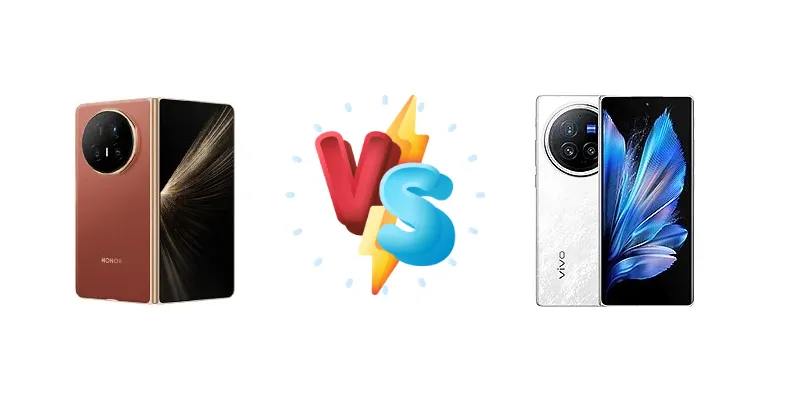
|
🏆 Quick Verdict
For the average user prioritizing display quality and rapid charging, the vivo X Fold3 Pro emerges as the winner. Its significantly brighter display and 100W charging offer a tangible advantage. However, the Honor Magic V5’s endurance and unique chipset architecture make it a compelling choice for power users.
| PHONES | ||
|---|---|---|
| Phone Names | Honor Magic V5 | vivo X Fold3 Pro |
| Network | ||
|---|---|---|
| 2G bands | GSM 850 / 900 / 1800 / 1900 | GSM 850 / 900 / 1800 / 1900 |
| 3G bands | HSDPA 800 / 850 / 900 / 1700(AWS) / 1900 / 2100 | HSDPA 800 / 850 / 900 / 1700(AWS) / 1900 / 2100 |
| 4G bands | 1, 2, 3, 4, 5, 7, 8, 12, 17, 18, 19, 20, 26, 28, 34, 38, 39, 40, 41, 66 | 1, 2, 3, 4, 5, 7, 8, 12, 17, 18, 19, 20, 25, 26, 28, 34, 38, 39, 40, 41, 42, 66 |
| 5G bands | 1, 3, 5, 8, 28, 38, 41, 77, 78 SA/NSA | 1, 2, 3, 5, 7, 8, 12, 20, 25, 26, 28, 38, 40, 41, 66, 77, 78 SA/NSA |
| Speed | HSPA, LTE, 5G | HSPA, LTE, 5G |
| Technology | GSM / CDMA / HSPA / CDMA2000 / LTE / 5G | GSM / CDMA / HSPA / CDMA2000 / LTE / 5G |
| Launch | ||
|---|---|---|
| Announced | 2025, July 02 | 2024, March 26 |
| Status | Available. Released 2025, July 02 | Available. Released 2024, April 23 |
| Body | ||
|---|---|---|
| Build | - | Carbon fiber hinge |
| Dimensions | Unfolded: 156.8 x 145.9 x 4.1 mm or 4.2 mmFolded: 156.8 x 74.3 x 8.8 mm or 9.0 mm | Unfolded: 160 x 142.4 x 5.2 mmFolded: 160 x 72.6 x 11.2 mm |
| SIM | · Nano-SIM + Nano-SIM + eSIM + eSIM (max 2 at a time)· Nano-SIM + Nano-SIM | Nano-SIM + Nano-SIM |
| Weight | 217 g or 222 g (7.65 oz) | 236 g (8.32 oz) |
| Display | ||
|---|---|---|
| Protection | Honor Super Armored Inner Screen, Mohs level 4 | - |
| Resolution | 2172 x 2352 pixels (~403 ppi density) | 2200 x 2480 pixels (~413 ppi density) |
| Size | 7.95 inches, 203.2 cm2 (~88.8% screen-to-body ratio) | 8.03 inches, 206.5 cm2 (~90.6% screen-to-body ratio) |
| Type | Foldable LTPO AMOLED, 1B colors, 120Hz, 5000 nits (peak) | Foldable LTPO AMOLED, 1B colors, 120Hz, HDR10+, Dolby Vision, 4500 nits (peak) |
| Platform | ||
|---|---|---|
| CPU | Octa-core (2x4.32 GHz Oryon V2 Phoenix L + 6x3.53 GHz Oryon V2 Phoenix M) | Octa-core (1x3.3 GHz Cortex-X4 & 3x3.2 GHz Cortex-A720 & 2x3.0 GHz Cortex-A720 & 2x2.3 GHz Cortex-A520) |
| Chipset | Qualcomm SM8750-AB Snapdragon 8 Elite (3 nm) | Qualcomm SM8650-AB Snapdragon 8 Gen 3 (4 nm) |
| GPU | Adreno 830 | Adreno 750 |
| OS | Android 15, upgradable to Android 16, MagicOS 10, up to 7 major Android upgrades | Android 14, upgradable to Android 15, Funtouch 15 (International), OriginOS 4 (China) |
| Memory | ||
|---|---|---|
| Card slot | No | No |
| Internal | 256GB 12GB RAM, 512GB 16GB RAM, 1TB 16GB RAM | 256GB 12GB RAM, 512GB 16GB RAM, 1TB 16GB RAM |
| Main Camera | ||
|---|---|---|
| Features | Laser AF, LED flash, HDR, panorama | Laser AF, color spectrum sensor, Zeiss optics, Zeiss T* lens coating, Dual-LED flash, panorama |
| Triple | 50 MP, f/1.6, 23mm (wide), 1/1.56", 1.0µm, PDAF, OIS 64 MP, f/2.5, 70mm (periscope telephoto), 1/2.0", 0.7µm, 3x optical zoom 50 MP, f/2.0, 13mm, 122˚ (ultrawide), AF | 50 MP, f/1.7, 23mm (wide), 1/1.3", PDAF, OIS 64 MP, f/2.6, 70mm (periscope telephoto), 1/2.0", PDAF (15cm - ∞), OIS, 3x optical zoom 50 MP, f/2.0, 119˚ (ultrawide), 1/2.76", PDAF |
| Video | 4K@30/60fps (10-bit), 1080p@30/60fps, gyro-EIS, OIS | 8K@30fps, 4K@30/60fps, 1080p@30/60fps, gyro-EIS |
| Selfie camera | ||
|---|---|---|
| Features | HDR | HDR |
| Single | 20 MP, f/2.2, (wide) Cover camera: 20 MP, f/2.2, (wide) | 32 MP, f/2.4, (wide) Cover camera: 32 MP, f/2.4, (wide) |
| Video | 4K@30fps, 1080p@30fps, gyro-EIS | 1080p@30fps |
| Sound | ||
|---|---|---|
| 35mm jack | No | No |
| Loudspeaker | Yes, with stereo speakers | Yes, with stereo speakers |
| Comms | ||
|---|---|---|
| Bluetooth | 6.0, A2DP, LE, aptX HD | 5.4, A2DP, LE, aptX HD, aptX Adaptive, aptX Lossless, LHDC (market/region dependent) |
| Infrared port | Yes | Yes |
| NFC | Yes | Yes |
| Positioning | GPS (L1+L5), GLONASS (L1), BDS (B1I+B1c+B2a), GALILEO (E1+E5a) | GPS (L1+L5), GLONASS (G1), BDS (B1I+B1c+B2a), GALILEO (E1+E5a), QZSS (L1+L5) |
| Radio | No | No |
| USB | USB Type-C 3.1, OTG, Display Port 1.2 | USB Type-C 3.2 Gen 2, OTG |
| WLAN | Wi-Fi 802.11 a/b/g/n/ac/6e/7, dual-band, Wi-Fi Direct | Wi-Fi 802.11 a/b/g/n/ac/6e/7, dual band (INT), tri-band (CN), Wi-Fi Direct |
| Features | ||
|---|---|---|
| Sensors | Fingerprint (side-mounted), accelerometer, gyro, proximity, compass, barometer | Dual screen fingerprint (under display, ultrasonic), accelerometer, gyro, proximity, compass, barometer |
| Battery | ||
|---|---|---|
| Charging | 66W wired 50W wireless 5W reverse wired | 100W wired, 100% in 31 min 50W wireless Reverse wireless |
| Type | Market-dependent versions:· Si/C Li-Ion 5820 mAh - International model· Si/C Li-Ion 6100 mAh - China model | Si/C Li-Ion 5700 mAh |
| Misc | ||
|---|---|---|
| Colors | Black, Ivory White, Dawn Gold, Reddish Brown | Celestial Black, White, Lunar White |
| Models | MBH-N49, MHG-AN00, MBH-AN10 | V2330 |
| Price | € 1,429.00 / $ 149.00 / £ 1,396.63 | $ 1,999.00 |
| EU LABEL | ||
|---|---|---|
| Battery | 49:48h endurance, 1200 cycles | - |
| Energy | Class B | - |
| Free fall | Class C (70 falls) | - |
| Repairability | Class B | - |
Honor Magic V5
- Longer projected battery lifespan (1200 cycles)
- Snapdragon 8 Elite’s 3nm process for potential efficiency
- Strong sustained performance potential
- Slower wired charging (66W)
- Lower peak display brightness
vivo X Fold3 Pro
- Incredibly fast 100W wired charging (31 min full charge)
- Significantly brighter display (2129 nits)
- Slightly better active use battery score
- Potentially lower battery lifespan (fewer charge cycles)
- Snapdragon 8 Gen 3 (4nm) may run warmer under sustained load
Display Comparison
The vivo X Fold3 Pro boasts a substantial advantage in display brightness, reaching a measured 2129 nits compared to the Honor Magic V5’s 1296 nits. This difference translates to significantly improved visibility in direct sunlight. While both utilize foldable OLED panels, the higher peak brightness of the vivo is a clear win for outdoor users. Details regarding refresh rate and panel type (LTPO) are missing, but both are expected to offer adaptive refresh rates for power efficiency. The Honor Magic V5’s display, while excellent, simply can’t match the sheer brilliance of the vivo.
Camera Comparison
Unfortunately, detailed camera specifications are absent. However, given the flagship positioning of both devices, we can expect high-quality camera systems. The focus should be on sensor size and image processing. Without specific details, it’s difficult to declare a winner. Both brands have a history of strong computational photography, so image quality will likely be excellent in various conditions. The absence of information regarding OIS and lens apertures prevents a deeper analysis.
Performance
The core of the performance difference lies in the chipsets. The vivo X Fold3 Pro utilizes the Snapdragon 8 Gen 3 (4nm), a proven performer, while the Honor Magic V5 features the Snapdragon 8 Elite (3nm). The 3nm process of the Snapdragon 8 Elite *should* offer better power efficiency and thermal headroom, but the Gen 3’s Cortex-X4 prime core clocked at 3.3 GHz provides a strong counterpoint. The Honor’s CPU configuration (2x4.32 GHz Oryon V2 Phoenix L + 6x3.53 GHz Oryon V2 Phoenix M) suggests a focus on sustained multi-core performance. The vivo’s CPU (1x3.3 GHz Cortex-X4 & 3x3.2 GHz Cortex-A720 & 2x3.0 GHz Cortex-A720 & 2x2.3 GHz Cortex-A520) is more traditional. Real-world performance will depend on thermal management, but the Honor’s architecture hints at a potential edge in demanding tasks.
Battery Life
The vivo X Fold3 Pro’s 100W wired charging is a game-changer, achieving a full charge in just 31 minutes. This is significantly faster than the Honor Magic V5’s 66W charging. While the Honor Magic V5 boasts a longer projected battery lifespan with 1200 charge cycles, the vivo’s faster charging mitigates the impact of a potentially smaller battery capacity. The Honor Magic V5’s 49:48h endurance score and 12:20h active use score are respectable, but the vivo X Fold3 Pro’s 13:26h active use score suggests slightly better real-world battery performance. The inclusion of 50W wireless charging on both devices and reverse wired/wireless charging on both adds to their versatility.
Buying Guide
Buy the Honor Magic V5 if you prioritize long-term battery health and sustained performance under heavy load, thanks to its Snapdragon 8 Elite and impressive 1200 charge cycles. Buy the vivo X Fold3 Pro if you value a stunningly bright display for outdoor visibility and the convenience of incredibly fast 100W wired charging, making it ideal for users constantly on the go.