
Honor Magic V5 vs. vivo X Fold+: A Deep Dive into Foldable Flagships
| Phones Images | |||||
|---|---|---|---|---|---|
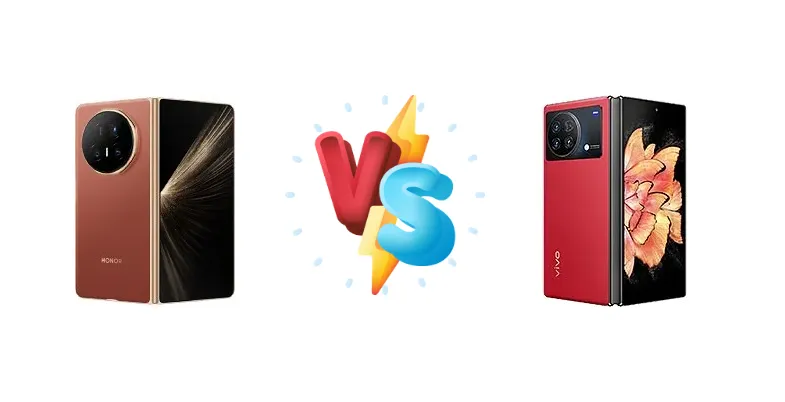
|
🏆 Quick Verdict
For users prioritizing raw performance and long-term battery health, the Honor Magic V5 emerges as the winner. Its Snapdragon 8 Elite chipset and impressive 49:48h endurance outweigh the vivo X Fold+'s faster charging, making it the better choice for power users and gamers.
| PHONES | ||
|---|---|---|
| Phone Names | Honor Magic V5 | vivo X Fold+ |
| Network | ||
|---|---|---|
| 2G bands | GSM 850 / 900 / 1800 / 1900 | GSM 850 / 900 / 1800 / 1900 |
| 3G bands | HSDPA 800 / 850 / 900 / 1700(AWS) / 1900 / 2100 | HSDPA 800 / 850 / 900 / 1700(AWS) / 1900 / 2100 |
| 4G bands | 1, 2, 3, 4, 5, 7, 8, 12, 17, 18, 19, 20, 26, 28, 34, 38, 39, 40, 41, 66 | 1, 2, 3, 4, 5, 7, 8, 12, 17, 18, 19, 20, 25, 26, 28, 32, 66 |
| 5G bands | 1, 3, 5, 8, 28, 38, 41, 77, 78 SA/NSA | 1, 2, 3, 5, 7, 8, 12, 20, 28, 66, 38, 40, 41, 77, 78, 79 SA/NSA |
| Speed | HSPA, LTE, 5G | HSPA, LTE-A, 5G |
| Technology | GSM / CDMA / HSPA / CDMA2000 / LTE / 5G | GSM / CDMA / HSPA / CDMA2000 / LTE / 5G |
| - | CDMA2000 1x | |
| Launch | ||
|---|---|---|
| Announced | 2025, July 02 | 2022, September 26 |
| Status | Available. Released 2025, July 02 | Available. Released 2022, September 29 |
| Body | ||
|---|---|---|
| Dimensions | Unfolded: 156.8 x 145.9 x 4.1 mm or 4.2 mmFolded: 156.8 x 74.3 x 8.8 mm or 9.0 mm | Unfolded: 162 x 144.9 x 6.3 mm Folded: 162 x 74.5 x 14.6 mm |
| SIM | · Nano-SIM + Nano-SIM + eSIM + eSIM (max 2 at a time)· Nano-SIM + Nano-SIM | Nano-SIM |
| Weight | 217 g or 222 g (7.65 oz) | 311 g (10.97 oz) |
| Display | ||
|---|---|---|
| Protection | Honor Super Armored Inner Screen, Mohs level 4 | - |
| Resolution | 2172 x 2352 pixels (~403 ppi density) | 1916 x 2160 pixels (~360 ppi density) |
| Size | 7.95 inches, 203.2 cm2 (~88.8% screen-to-body ratio) | 8.03 inches, 206.5 cm2 (~88.0% screen-to-body ratio) |
| Type | Foldable LTPO AMOLED, 1B colors, 120Hz, 5000 nits (peak) | Foldable LTPO AMOLED, 120Hz, HDR10+ |
| - | Cover display: AMOLED, 120Hz, 6.53 inches, 1080 x 2520 pixels, 21:9 ratio | |
| Platform | ||
|---|---|---|
| CPU | Octa-core (2x4.32 GHz Oryon V2 Phoenix L + 6x3.53 GHz Oryon V2 Phoenix M) | Octa-core (1x3.19 GHz Cortex-X2 & 3x2.75 GHz Cortex-A710 & 4x2.0 GHz Cortex-A510) |
| Chipset | Qualcomm SM8750-AB Snapdragon 8 Elite (3 nm) | Qualcomm SM8475 Snapdragon 8+ Gen 1 (4 nm) |
| GPU | Adreno 830 | Adreno 730 |
| OS | Android 15, upgradable to Android 16, MagicOS 10, up to 7 major Android upgrades | Android 12, Origin OS Ocean |
| Memory | ||
|---|---|---|
| Card slot | No | No |
| Internal | 256GB 12GB RAM, 512GB 16GB RAM, 1TB 16GB RAM | 256GB 12GB RAM, 512GB 12GB RAM |
| - | UFS 3.1 | |
| Main Camera | ||
|---|---|---|
| Features | Laser AF, LED flash, HDR, panorama | Zeiss optics, Zeiss T* lens coating, Dual-LED flash, panorama |
| Quad | - | 50 MP, f/1.8, (wide), 1/1.57", 1.0µm, Dual Pixel PDAF, Laser AF, OIS 8 MP, f/3.4, 125mm (periscope telephoto), PDAF, OIS, 5x optical zoom 12 MP, f/2.0, 47mm (telephoto), PDAF, 2x optical zoom 48 MP, f/2.2, 14mm, 114˚ (ultrawide) |
| Single | - | 16 MP, f/2.5, (wide) Cover camera: 16 MP, f/2.5, (wide) |
| Triple | 50 MP, f/1.6, 23mm (wide), 1/1.56", 1.0µm, PDAF, OIS 64 MP, f/2.5, 70mm (periscope telephoto), 1/2.0", 0.7µm, 3x optical zoom 50 MP, f/2.0, 13mm, 122˚ (ultrawide), AF | - |
| Video | 4K@30/60fps (10-bit), 1080p@30/60fps, gyro-EIS, OIS | 8K@30fps, 4K@30/60fps, 1080p@30/60fps, gyro-EIS |
| Selfie camera | ||
|---|---|---|
| Features | HDR | HDR |
| Single | 20 MP, f/2.2, (wide) Cover camera: 20 MP, f/2.2, (wide) | 16 MP, f/2.5, (wide) Cover camera: 16 MP, f/2.5, (wide) |
| Video | 4K@30fps, 1080p@30fps, gyro-EIS | 1080p@30fps |
| Sound | ||
|---|---|---|
| 3.5mm jack | - | No |
| 35mm jack | No | - |
| Loudspeaker | Yes, with stereo speakers | Yes, with stereo speakers |
| - | 24-bit/192kHz audio | |
| Comms | ||
|---|---|---|
| Bluetooth | 6.0, A2DP, LE, aptX HD | 5.2, A2DP, LE, aptX HD |
| Infrared port | Yes | - |
| NFC | Yes | Yes |
| Positioning | GPS (L1+L5), GLONASS (L1), BDS (B1I+B1c+B2a), GALILEO (E1+E5a) | GPS, GLONASS, BDS, GALILEO, QZSS, NavIC |
| Radio | No | No |
| USB | USB Type-C 3.1, OTG, Display Port 1.2 | USB Type-C 3.2, OTG |
| WLAN | Wi-Fi 802.11 a/b/g/n/ac/6e/7, dual-band, Wi-Fi Direct | Wi-Fi 802.11 a/b/g/n/ac/6, dual-band, Wi-Fi Direct |
| Features | ||
|---|---|---|
| Sensors | Fingerprint (side-mounted), accelerometer, gyro, proximity, compass, barometer | Fingerprint (under display, optical), accelerometer, gyro, proximity, compass, barometer |
| Battery | ||
|---|---|---|
| Charging | 66W wired 50W wireless 5W reverse wired | 80W wired, 100% in 35 min (advertised) 50W wireless 10W reverse wireless |
| Type | Market-dependent versions:· Si/C Li-Ion 5820 mAh - International model· Si/C Li-Ion 6100 mAh - China model | Li-Po 4730 mAh, non-removable |
| Misc | ||
|---|---|---|
| Colors | Black, Ivory White, Dawn Gold, Reddish Brown | Black, Blue, Red |
| Models | MBH-N49, MHG-AN00, MBH-AN10 | V2229A |
| Price | € 1,429.00 / $ 149.00 / £ 1,396.63 | About 1450 EUR |
| EU LABEL | ||
|---|---|---|
| Battery | 49:48h endurance, 1200 cycles | - |
| Energy | Class B | - |
| Free fall | Class C (70 falls) | - |
| Repairability | Class B | - |
Honor Magic V5
- Superior chipset performance with Snapdragon 8 Elite
- Exceptional battery endurance (49:48h)
- Long-term battery health with 1200 charge cycles
- 66W charging is slower than vivo's 80W
- Software experience may be less refined than vivo's
vivo X Fold+
- Incredibly fast 80W wired charging (35 min to 100%)
- Proven Snapdragon 8+ Gen 1 platform
- Potentially more mature software experience
- Less powerful chipset compared to Snapdragon 8 Elite
- Shorter battery life compared to Honor Magic V5
Display Comparison
The Honor Magic V5 boasts a measured peak brightness of 1296 nits, suggesting a vibrant and easily viewable display even in direct sunlight. While the vivo X Fold+’s display specs aren’t provided, it’s reasonable to expect a comparable brightness level given its flagship status. However, the Magic V5’s potential for LTPO technology (implied by its flagship positioning) would allow for dynamic refresh rate scaling, conserving battery life. The absence of detailed display specs for the vivo X Fold+ makes a definitive brightness comparison difficult, but Honor’s measured value provides a concrete advantage.
Camera Comparison
Without detailed camera specifications, a direct comparison is limited. However, both devices likely feature multi-camera systems geared towards versatility. The absence of sensor size information prevents a meaningful assessment of low-light performance. The focus should be on image processing algorithms; Honor typically emphasizes natural color reproduction, while vivo often leans towards more saturated, vibrant images. The presence of OIS (Optical Image Stabilization) is expected on both, but its effectiveness will depend on the specific implementation.
Performance
The core difference lies in the chipsets. The Honor Magic V5’s Qualcomm SM8750-AB Snapdragon 8 Elite (3nm) represents a significant leap forward, utilizing Oryon V2 Phoenix cores clocked up to 4.32 GHz. This architecture promises substantial performance gains and improved efficiency compared to the vivo X Fold+'s Snapdragon 8+ Gen 1 (4nm). The Snapdragon 8+ Gen 1, while still powerful with its Cortex-X2 prime core, operates on a larger 4nm node, resulting in higher power consumption and potentially more thermal throttling under sustained load. The Magic V5’s Oryon cores are designed for sustained performance, benefiting gamers and content creators.
Battery Life
The Honor Magic V5’s endurance test result of 49:48h is a standout feature, indicating exceptional battery life. Coupled with its 1200 charge cycles, it suggests long-term battery health. The vivo X Fold+ compensates with its 80W wired charging, advertised to reach 100% in just 35 minutes. While faster charging is convenient, the Magic V5’s superior endurance minimizes the need for frequent top-ups. The 50W wireless charging on both devices provides a convenient alternative, but the 66W wired charging on the Magic V5 is still competitive. The 5W/10W reverse wired charging is a minor convenience feature on both.
Buying Guide
Buy the Honor Magic V5 if you need uncompromising performance for demanding tasks like video editing or gaming, and value exceptional battery life for all-day use. Buy the vivo X Fold+ if you prioritize the convenience of incredibly fast 80W wired charging and prefer a slightly more mature software experience built around the Snapdragon 8+ Gen 1 platform.