
Honor Magic V5 vs. Samsung Galaxy Z Fold5: A Foldable Flagship Face-Off
| Phones Images | |||||
|---|---|---|---|---|---|
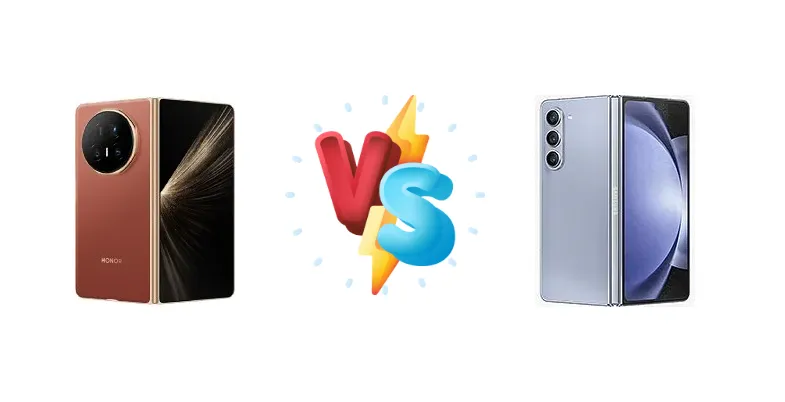
|
🏆 Quick Verdict
For users prioritizing sustained performance and battery longevity, the Honor Magic V5 emerges as the winner. Its Snapdragon 8 Elite chipset and impressive 49:48h endurance rating offer a tangible advantage. However, the Galaxy Z Fold5’s refined software and established ecosystem remain compelling for Samsung loyalists.
| PHONES | ||
|---|---|---|
| Phone Names | Honor Magic V5 | Samsung Galaxy Z Fold5 |
| Network | ||
|---|---|---|
| 2G bands | GSM 850 / 900 / 1800 / 1900 | GSM 850 / 900 / 1800 / 1900 |
| 3G bands | HSDPA 800 / 850 / 900 / 1700(AWS) / 1900 / 2100 | HSDPA 850 / 900 / 1700(AWS) / 1900 / 2100 |
| 4G bands | 1, 2, 3, 4, 5, 7, 8, 12, 17, 18, 19, 20, 26, 28, 34, 38, 39, 40, 41, 66 | 1, 2, 3, 4, 5, 7, 8, 12, 13, 17, 18, 19, 20, 25, 26, 28, 38, 39, 40, 41, 66 - International |
| 5G bands | 1, 3, 5, 8, 28, 38, 41, 77, 78 SA/NSA | 1, 2, 3, 5, 7, 8, 12, 20, 25, 28, 38, 40, 41, 66, 77, 78 SA/NSA/Sub6 - International |
| Speed | HSPA, LTE, 5G | HSPA, LTE, 5G |
| Technology | GSM / CDMA / HSPA / CDMA2000 / LTE / 5G | GSM / CDMA / HSPA / EVDO / LTE / 5G |
| Launch | ||
|---|---|---|
| Announced | 2025, July 02 | 2023, July 26 |
| Status | Available. Released 2025, July 02 | Available. Released 2023, August 11 |
| Body | ||
|---|---|---|
| Build | - | Glass front (Gorilla Glass Victus 2) (folded), plastic front (unfolded), glass back (Gorilla Glass Victus 2), aluminum frame |
| Dimensions | Unfolded: 156.8 x 145.9 x 4.1 mm or 4.2 mmFolded: 156.8 x 74.3 x 8.8 mm or 9.0 mm | Unfolded: 154.9 x 129.9 x 6.1 mmFolded: 154.9 x 67.1 x 13.4 mm |
| SIM | · Nano-SIM + Nano-SIM + eSIM + eSIM (max 2 at a time)· Nano-SIM + Nano-SIM | · Nano-SIM + eSIM· Nano-SIM + Nano-SIM + eSIM (max 2 at a time) |
| Weight | 217 g or 222 g (7.65 oz) | 253 g (8.92 oz) |
| Display | ||
|---|---|---|
| Protection | Honor Super Armored Inner Screen, Mohs level 4 | - |
| Resolution | 2172 x 2352 pixels (~403 ppi density) | 1812 x 2176 pixels (~373 ppi density) |
| Size | 7.95 inches, 203.2 cm2 (~88.8% screen-to-body ratio) | 7.6 inches, 183.2 cm2 (~91.1% screen-to-body ratio) |
| Type | Foldable LTPO AMOLED, 1B colors, 120Hz, 5000 nits (peak) | Foldable Dynamic AMOLED 2X, 120Hz, HDR10+ |
| Platform | ||
|---|---|---|
| CPU | Octa-core (2x4.32 GHz Oryon V2 Phoenix L + 6x3.53 GHz Oryon V2 Phoenix M) | Octa-core (1x3.36 GHz Cortex-X3 & 2x2.8 GHz Cortex-A715 & 2x2.8 GHz Cortex-A710 & 3x2.0 GHz Cortex-A510) |
| Chipset | Qualcomm SM8750-AB Snapdragon 8 Elite (3 nm) | Qualcomm SM8550-AC Snapdragon 8 Gen 2 (4 nm) |
| GPU | Adreno 830 | Adreno 740 |
| OS | Android 15, upgradable to Android 16, MagicOS 10, up to 7 major Android upgrades | Android 13, up to 4 major Android upgrades, One UI 6.1.1 |
| Memory | ||
|---|---|---|
| Card slot | No | No |
| Internal | 256GB 12GB RAM, 512GB 16GB RAM, 1TB 16GB RAM | 256GB 12GB RAM, 512GB 12GB RAM, 1TB 12GB RAM |
| Main Camera | ||
|---|---|---|
| Features | Laser AF, LED flash, HDR, panorama | LED flash, HDR, panorama |
| Triple | 50 MP, f/1.6, 23mm (wide), 1/1.56", 1.0µm, PDAF, OIS 64 MP, f/2.5, 70mm (periscope telephoto), 1/2.0", 0.7µm, 3x optical zoom 50 MP, f/2.0, 13mm, 122˚ (ultrawide), AF | 50 MP, f/1.8, 23mm (wide), 1/1.56", 1.0µm, dual pixel PDAF, OIS 10 MP, f/2.4, 66mm (telephoto), 1/3.94", 1.0µm, PDAF, OIS, 3x optical zoom 12 MP, f/2.2, 12mm, 123˚ (ultrawide), 1/3.06", 1.12µm |
| Video | 4K@30/60fps (10-bit), 1080p@30/60fps, gyro-EIS, OIS | 8K@30fps, 4K@60fps, 1080p@60/240fps (gyro-EIS), HDR10+ |
| Selfie camera | ||
|---|---|---|
| Features | HDR | HDR |
| Single | 20 MP, f/2.2, (wide) Cover camera: 20 MP, f/2.2, (wide) | 4 MP, f/1.8, 26mm (wide), 1/3.0", 2.0µm, under display Cover camera: 10 MP, f/2.2, 24mm (wide), 1/3.0", 1.22µm |
| Video | 4K@30fps, 1080p@30fps, gyro-EIS | 4K@30/60fps, 1080p@30/60fps, gyro-EIS |
| Sound | ||
|---|---|---|
| 35mm jack | No | No |
| Loudspeaker | Yes, with stereo speakers | Yes, with stereo speakers |
| Comms | ||
|---|---|---|
| Bluetooth | 6.0, A2DP, LE, aptX HD | 5.3, A2DP, LE, aptX HD |
| Infrared port | Yes | - |
| NFC | Yes | Yes |
| Positioning | GPS (L1+L5), GLONASS (L1), BDS (B1I+B1c+B2a), GALILEO (E1+E5a) | GPS, GLONASS, GALILEO, BDS |
| Radio | No | No |
| USB | USB Type-C 3.1, OTG, Display Port 1.2 | USB Type-C 3.2, OTG |
| WLAN | Wi-Fi 802.11 a/b/g/n/ac/6e/7, dual-band, Wi-Fi Direct | Wi-Fi 802.11 a/b/g/n/ac/6e, tri-band, Wi-Fi Direct |
| Features | ||
|---|---|---|
| Sensors | Fingerprint (side-mounted), accelerometer, gyro, proximity, compass, barometer | Fingerprint (side-mounted), accelerometer, gyro, proximity, compass, barometer |
| Battery | ||
|---|---|---|
| Charging | 66W wired 50W wireless 5W reverse wired | 25W wired, 50% in 30 min 15W wireless 4.5W reverse wireless |
| Type | Market-dependent versions:· Si/C Li-Ion 5820 mAh - International model· Si/C Li-Ion 6100 mAh - China model | Li-Po 4400 mAh |
| Misc | ||
|---|---|---|
| Colors | Black, Ivory White, Dawn Gold, Reddish Brown | Icy Blue, Phantom Black, Cream, Gray, Blue |
| Models | MBH-N49, MHG-AN00, MBH-AN10 | SM-F946B, SM-F946B/DS, SM-F946U, SM-F946U1, SM-F946N, SM-F946W, SM-F9460 |
| Price | € 1,429.00 / $ 149.00 / £ 1,396.63 | € 660.00 / $ 607.00 / £ 520.69 / ₹ 86,000 |
| SAR | - | 1.16 W/kg (head) |
| SAR EU | - | 1.24 W/kg (head) 1.19 W/kg (body) |
| EU LABEL | ||
|---|---|---|
| Battery | 49:48h endurance, 1200 cycles | - |
| Energy | Class B | - |
| Free fall | Class C (70 falls) | - |
| Repairability | Class B | - |
Honor Magic V5
- Superior performance with Snapdragon 8 Elite
- Exceptional battery life and fast charging
- Potentially longer battery lifespan (1200 cycles)
- Software experience may not be as refined as Samsung’s
- Long-term durability of the foldable display is unproven
Samsung Galaxy Z Fold5
- Polished and mature software experience
- Seamless integration with the Samsung ecosystem
- Established foldable design with proven durability
- Less powerful chipset compared to the Snapdragon 8 Elite
- Shorter battery life and slower charging speeds
Display Comparison
Both the Honor Magic V5 and Samsung Galaxy Z Fold5 boast impressive foldable displays, achieving similar peak brightness levels at 1296 nits and 1257 nits respectively. This ensures excellent visibility even in direct sunlight. However, the specifics of panel technology and hinge design aren’t provided, making a direct comparison of crease visibility and durability difficult. The Z Fold5’s established track record in foldable display durability is a point in its favor, while the Magic V5’s newer design requires long-term testing. Color accuracy is likely comparable given both brands’ reputations, but detailed calibration data is absent.
Camera Comparison
The provided data lacks detailed camera specifications, making a comprehensive comparison challenging. The Galaxy Z Fold5 is known for its versatile camera system, offering strong photo and video capabilities. However, without sensor size, aperture, or OIS details for either device, it’s difficult to assess image quality. The Z Fold5’s established image processing algorithms likely provide a more refined and consistent experience out of the box. We can assume both phones will offer a competent camera experience, but the Z Fold5 likely has an edge due to Samsung’s camera expertise.
Performance
The core differentiator lies in the chipsets. The Honor Magic V5’s Qualcomm SM8750-AB Snapdragon 8 Elite (3nm) represents a significant leap over the Samsung Galaxy Z Fold5’s Snapdragon 8 Gen 2 (4nm). The 3nm process node of the 8 Elite translates to improved power efficiency and thermal performance, allowing for sustained peak performance. The Magic V5’s CPU, featuring Oryon V2 Phoenix cores clocked up to 4.32 GHz, promises faster processing speeds compared to the Z Fold5’s Cortex-X3 core at 3.36 GHz. While both utilize LPDDR5x RAM, the 8 Elite’s architectural advantages will likely result in smoother multitasking and faster app loading times, particularly benefiting demanding users and gamers.
Battery Life
The Honor Magic V5 significantly outperforms the Galaxy Z Fold5 in battery endurance. The Magic V5 achieves a remarkable 49:48h endurance rating, compared to the Z Fold5’s older 95h rating (likely measured differently). More telling is the active use score: 12:20h for the Magic V5 versus 12:01h for the Z Fold5. This, combined with the 66W wired charging (and 50W wireless) on the Magic V5, versus the Z Fold5’s 25W wired and 15W wireless, means the Magic V5 offers significantly faster charging and longer usage between charges. The 1200 charge cycles rating for the Magic V5 also suggests superior long-term battery health.
Buying Guide
Buy the Honor Magic V5 if you demand the absolute best performance in a foldable, need exceptional battery life for power users, and are comfortable with Honor’s software experience. Buy the Samsung Galaxy Z Fold5 if you prioritize a polished software experience, seamless integration with the Samsung ecosystem, and a more compact, refined foldable design, even if it means sacrificing some battery life and raw processing power.