
Honor Magic V2 vs Xiaomi Mix Fold 3: A Deep Dive into Foldable Flagships
| Phones Images | |||||
|---|---|---|---|---|---|
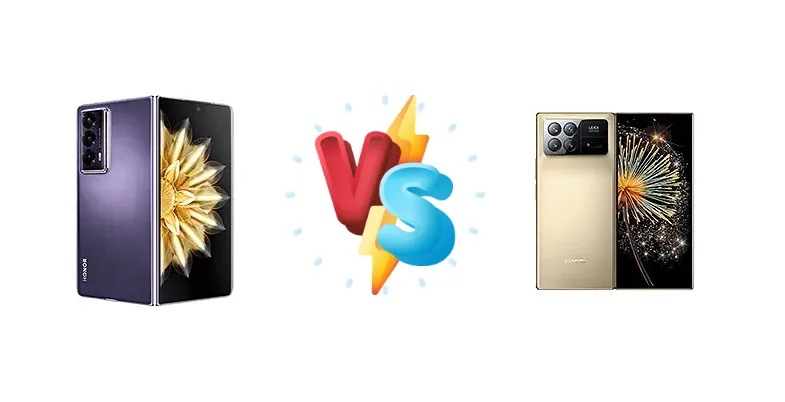
|
🏆 Quick Verdict
For most users, the Xiaomi Mix Fold 3 emerges as the stronger contender. Its significantly brighter display (1277 nits vs 933 nits) and faster charging (67W wired, 50W wireless) provide a more premium and convenient experience, offsetting the slightly shorter active battery life.
| PHONES | ||
|---|---|---|
| Phone Names | Honor Magic V2 | Xiaomi Mix Fold 3 |
| Network | ||
|---|---|---|
| 2G bands | GSM 850 / 900 / 1800 / 1900 | GSM 850 / 900 / 1800 / 1900 |
| 3G bands | HSDPA 800 / 850 / 900 / 1700(AWS) / 1900 / 2100 | HSDPA 800 / 850 / 900 / 1700(AWS) / 1900 / 2100 |
| 4G bands | 1, 2, 3, 4, 5, 7, 8, 12, 17, 18, 19, 20, 26, 28, 34, 38, 39, 40, 41, 66 | 1, 2, 3, 4, 5, 7, 8, 12, 17, 18, 19, 26, 34, 38, 39, 40, 41, 42 |
| 5G bands | 1, 3, 5, 8, 28, 38, 41, 77, 78 SA/NSA | 1, 3, 5, 8, 28, 38, 40, 41, 77, 78, 79 SA/NSA |
| Speed | HSPA, LTE, 5G | HSPA, LTE, 5G |
| Technology | GSM / CDMA / HSPA / CDMA2000 / LTE / 5G | GSM / CDMA / HSPA / EVDO / LTE / 5G |
| Launch | ||
|---|---|---|
| Announced | 2023, July 12 | 2023, August 14 |
| Status | Available. Released 2023, July 27 | Available. Released 2023, August 14 |
| Body | ||
|---|---|---|
| Build | Glass front, glass back or eco leather back, magnesium alloy frame, titanium alloy folding mechanism | Glass front (folded), plastic front (unfolded), glass back or aramid fiber back, aluminum frame |
| Dimensions | Unfolded: 156.7 x 145.4 x 4.7 mm or 4.8 mmFolded: 156.7 x 74.1 x 9.9 mm or 10.1 mm | Unfolded: 161.2 x 143.3 x 5.3 mm Folded: 161.2 x 73.5 x 10.9 mm |
| SIM | · Nano-SIM + eSIM· Nano-SIM + Nano-SIM | Nano-SIM + Nano-SIM |
| Weight | 231 g or 237 g (8.15 oz) | 255 g or 259 g (8.99 oz) |
| Display | ||
|---|---|---|
| Resolution | 2156 x 2344 pixels (~402 ppi density) | 1916 x 2160 pixels (~360 ppi density) |
| Size | 7.92 inches, 201.6 cm2 (~88.5% screen-to-body ratio) | 8.03 inches, 206.5 cm2 (~89.4% screen-to-body ratio) |
| Type | Foldable LTPO OLED, 1B colors, 120Hz, HDR10+, 1600 nits (peak) | Foldable LTPO OLED+, 1B colors, 120Hz, HDR10+, Dolby Vision, 1300 nits (peak) |
| Platform | ||
|---|---|---|
| CPU | Octa-core (1x3.19 GHz (INTL) / 1x3.36 GHz (CN) Cortex-X3 & 2x2.8 GHz Cortex-A715 & 2x2.8 GHz Cortex-A710 & 3x2.0 GHz Cortex-A510) | Octa-core (1x3.36 GHz Cortex-X3 & 2x2.8 GHz Cortex-A715 & 2x2.8 GHz Cortex-A710 & 3x2.0 GHz Cortex-A510) |
| Chipset | Qualcomm SM8550-AB Snapdragon 8 Gen 2 (4 nm) - IntlQualcomm SM8550-AC Snapdragon 8 Gen 2 (4 nm) - China | Qualcomm SM8550-AC Snapdragon 8 Gen 2 (4 nm) |
| GPU | Adreno 740 | Adreno 740 |
| OS | Android 13, upgradable to Android 14, MagicOS 8 | Android 13, upgradable to Android 14, HyperOS |
| Memory | ||
|---|---|---|
| Card slot | No | No |
| Internal | 256GB 16GB RAM, 512GB 16GB RAM, 1TB 16GB RAM | 256GB 12GB RAM, 512GB 16GB RAM, 1TB 16GB RAM |
| Main Camera | ||
|---|---|---|
| Features | Multi-zone Laser AF (8x8 dToF), color spectrum sensor, LED flash, HDR, panorama | Color spectrum sensor, LED flash, HDR, panorama, Leica lenses |
| Quad | - | 50 MP, f/1.8, 23mm (wide), 1/1.49", 1.0µm, PDAF, OIS 10 MP, f/2.0, 75mm (telephoto), 1/3.94", 1.0µm, PDAF, OIS, 3.2x optical zoom 10 MP, f/2.9, 115mm (telephoto), 1/3.94", 1.0µm, PDAF, OIS, 5x optical zoom 12 MP, f/2.2, 15mm, 120˚ (ultrawide), 1/3.1", 1.12µm |
| Triple | 50 MP, f/1.9, (wide), PDAF, OIS 20 MP, f/2.4, 62mm (telephoto), PDAF, 2.5x optical zoom, OIS 50 MP, f/2.0, 13mm (ultrawide), AF | - |
| Video | 4K@30/60fps (10-bit), 1080p@30/60fps, gyro-EIS, HDR10+, OIS | 8K@24fps, 4K@24/30/60fps, 1080p@30/60/120/240/960/1920fps, Dolby Vision HDR |
| Selfie camera | ||
|---|---|---|
| Features | HDR | HDR, panorama |
| Single | 16 MP, f/2.2, (wide) | 20 MP, f/2.3, 23mm (wide), 1/4.0", 0.8µm Cover camera: 20 MP, f/2.3, 23mm (wide), 1/4.0", 0.8µm |
| Video | 4K@30fps, 1080p@30fps, gyro-EIS | 1080p@30/60fps |
| Sound | ||
|---|---|---|
| 35mm jack | No | No |
| Loudspeaker | Yes, with stereo speakers | Yes, with stereo speakers |
| Comms | ||
|---|---|---|
| Bluetooth | 5.3, A2DP, LE, aptX HD | 5.3, A2DP, LE |
| Infrared port | Yes | Yes |
| NFC | Yes | Yes |
| Positioning | GPS (L1+L5), GLONASS (L1), BDS (B1I+B1c+B2a), GALILEO (E1+E5a), QZSS (L1+L5) | GPS (L1+L5), GLONASS (G1), BDS (B1I+B1c+B2a), GALILEO (E1+E5a), QZSS (L1+L5), NavIC (L5) |
| Radio | No | No |
| USB | USB Type-C 3.1, OTG, Display Port 1.2 | USB Type-C 3.2, OTG |
| WLAN | Wi-Fi 802.11 a/b/g/n/ac/6e/7, dual-band, Wi-Fi Direct | Wi-Fi 802.11 a/b/g/n/ac/6e/7, dual-band (tri-band after future SW update) |
| Features | ||
|---|---|---|
| Sensors | Fingerprint (side-mounted), accelerometer, gyro, proximity, compass | Fingerprint (side-mounted), accelerometer, gyro, proximity, compass, barometer |
| Battery | ||
|---|---|---|
| Charging | 66W wired 5W reverse wired | 67W wired, PD3.0, QC4, 100% in 40 min 50W wireless, 100% in 55 min |
| Type | Si/C Li-Ion 5000 mAh | Li-Po 4800 mAh |
| Misc | ||
|---|---|---|
| Colors | Black, Silk Black, Silk Purple, Gold | Black, Gold |
| Models | VER-AN10, VER-N49 | 2308CPXD0C |
| Price | $ 850.00 / £ 849.00 / € 784.31 | About 1150 EUR |
| SAR EU | 0.85 W/kg (head) 1.29 W/kg (body) | - |
Honor Magic V2
- Potentially lighter and slimmer design
- Competitive Snapdragon 8 Gen 2 performance
- Respectable battery life (10:35h active use)
- Lower peak display brightness (933 nits)
- Slower charging speeds (66W wired, 5W reverse)
- Limited camera information
Xiaomi Mix Fold 3
- Significantly brighter display (1277 nits)
- Faster wired and wireless charging (67W/50W)
- Potentially more versatile camera system
- Likely heavier and bulkier design
- May experience more thermal throttling under sustained load
- Higher price point (potentially)
Display Comparison
The Xiaomi Mix Fold 3 boasts a substantial advantage in display brightness, reaching a measured 1277 nits compared to the Honor Magic V2’s 933 nits. This translates to superior visibility in direct sunlight. While both utilize foldable OLED panels, the higher peak brightness of the Mix Fold 3 suggests a more advanced panel technology or calibration. Both are likely to employ LTPO technology for variable refresh rates, conserving battery, but Xiaomi’s panel is demonstrably brighter. Bezels are comparable, but the brightness difference is the key differentiator.
Camera Comparison
Context data is limited regarding camera specifics. However, given Xiaomi’s history, the Mix Fold 3 likely prioritizes a versatile camera system with a focus on computational photography. The Honor Magic V2, while likely capable, may lean towards a more natural image processing style. Without sensor size or aperture information, it’s difficult to make a definitive judgment. We can assume both will offer multi-camera setups, but the Mix Fold 3’s brand reputation suggests a more feature-rich camera experience.
Performance
Both the Honor Magic V2 (International variant) and the Xiaomi Mix Fold 3 are powered by the Qualcomm Snapdragon 8 Gen 2 (4nm). However, the Xiaomi Mix Fold 3 consistently uses the SM8550-AC variant, while the Honor Magic V2 offers both SM8550-AB (International) and SM8550-AC (China) options. The CPU configurations are nearly identical, featuring a Cortex-X3 prime core, A715 and A710 performance cores, and A510 efficiency cores. The slight clock speed difference (3.19 GHz vs 3.36 GHz) in the International Honor variant is unlikely to translate to a noticeable real-world performance difference. Thermal management will be crucial; the larger chassis of the Mix Fold 3 *may* offer slightly better sustained performance under heavy load, but this requires independent testing.
Battery Life
The Honor Magic V2 achieves an active use battery score of 10:35h, while the Xiaomi Mix Fold 3 has an endurance rating of 117h. While these are different metrics, the Mix Fold 3’s endurance rating suggests a longer overall battery life, despite the Honor’s respectable active use time. The Mix Fold 3 also offers significantly faster charging: 67W wired (0-100% in 40 minutes) and 50W wireless (0-100% in 55 minutes) compared to the Honor’s 66W wired and 5W reverse wired. The addition of wireless charging on the Mix Fold 3 is a significant convenience factor.
Buying Guide
Buy the Honor Magic V2 if you prioritize a lighter, slimmer foldable design and are willing to trade off some display brightness and charging speed. Buy the Xiaomi Mix Fold 3 if you value a brighter, more vibrant display, faster charging – including wireless – and a more robust overall feature set, even if it means a slightly bulkier device.