
Honor Magic V2 vs. Xiaomi 13 Ultra: A Deep Dive into Foldable Innovation and Camera Excellence
| Phones Images | |||||
|---|---|---|---|---|---|
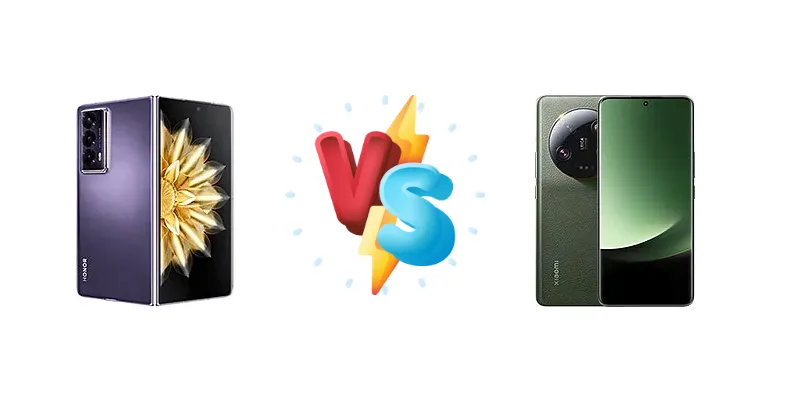
|
🏆 Quick Verdict
For the average user prioritizing a unique form factor and solid all-around performance, the Honor Magic V2 emerges as the winner. Its foldable design offers versatility, and its 10:35 active use battery life is commendable. However, photography enthusiasts will find the Xiaomi 13 Ultra’s superior camera system undeniably compelling.
| PHONES | ||
|---|---|---|
| Phone Names | Honor Magic V2 | Xiaomi 13 Ultra |
| Network | ||
|---|---|---|
| 2G bands | GSM 850 / 900 / 1800 / 1900 | GSM 850 / 900 / 1800 / 1900 |
| 3G bands | HSDPA 800 / 850 / 900 / 1700(AWS) / 1900 / 2100 | HSDPA 800 / 850 / 900 / 1700(AWS) / 1900 / 2100 |
| 4G bands | 1, 2, 3, 4, 5, 7, 8, 12, 17, 18, 19, 20, 26, 28, 34, 38, 39, 40, 41, 66 | 1, 2, 3, 4, 5, 7, 8, 18, 19, 20, 26, 28, 38, 40, 41, 66 - International |
| 5G bands | 1, 3, 5, 8, 28, 38, 41, 77, 78 SA/NSA | 1, 3, 5, 7, 8, 20, 28, 38, 40, 41, 77, 78, 79 SA/NSA - International |
| Speed | HSPA, LTE, 5G | HSPA, LTE, 5G |
| Technology | GSM / CDMA / HSPA / CDMA2000 / LTE / 5G | GSM / CDMA / HSPA / EVDO / LTE / 5G |
| - | CDMA2000 1xEV-DO | |
| Launch | ||
|---|---|---|
| Announced | 2023, July 12 | 2023, April 18 |
| Status | Available. Released 2023, July 27 | Available. Released 2023, April 21 |
| Body | ||
|---|---|---|
| Build | Glass front, glass back or eco leather back, magnesium alloy frame, titanium alloy folding mechanism | Glass front (Gorilla Glass Victus), eco leather back, aluminum frame |
| Dimensions | Unfolded: 156.7 x 145.4 x 4.7 mm or 4.8 mmFolded: 156.7 x 74.1 x 9.9 mm or 10.1 mm | 163.2 x 74.6 x 9.1 mm (6.43 x 2.94 x 0.36 in) |
| SIM | · Nano-SIM + eSIM· Nano-SIM + Nano-SIM | Nano-SIM + Nano-SIM |
| Weight | 231 g or 237 g (8.15 oz) | 227 g (8.01 oz) |
| - | IP68 dust/water resistant (up to 1.5m for 30 min) | |
| Display | ||
|---|---|---|
| Protection | - | Corning Gorilla Glass Victus |
| Resolution | 2156 x 2344 pixels (~402 ppi density) | 1440 x 3200 pixels, 20:9 ratio (~522 ppi density) |
| Size | 7.92 inches, 201.6 cm2 (~88.5% screen-to-body ratio) | 6.73 inches, 108.9 cm2 (~89.5% screen-to-body ratio) |
| Type | Foldable LTPO OLED, 1B colors, 120Hz, HDR10+, 1600 nits (peak) | LTPO AMOLED, 68B colors, 120Hz, Dolby Vision, HDR10+, 1300 nits (HBM), 2600 nits (peak) |
| Platform | ||
|---|---|---|
| CPU | Octa-core (1x3.19 GHz (INTL) / 1x3.36 GHz (CN) Cortex-X3 & 2x2.8 GHz Cortex-A715 & 2x2.8 GHz Cortex-A710 & 3x2.0 GHz Cortex-A510) | Octa-core (1x3.2 GHz Cortex-X3 & 2x2.8 GHz Cortex-A715 & 2x2.8 GHz Cortex-A710 & 3x2.0 GHz Cortex-A510) |
| Chipset | Qualcomm SM8550-AB Snapdragon 8 Gen 2 (4 nm) - IntlQualcomm SM8550-AC Snapdragon 8 Gen 2 (4 nm) - China | Qualcomm SM8550-AB Snapdragon 8 Gen 2 (4 nm) |
| GPU | Adreno 740 | Adreno 740 |
| OS | Android 13, upgradable to Android 14, MagicOS 8 | Android 13, upgradable to Android 14, HyperOS |
| Memory | ||
|---|---|---|
| Card slot | No | No |
| Internal | 256GB 16GB RAM, 512GB 16GB RAM, 1TB 16GB RAM | 256GB 12GB RAM, 512GB 12GB RAM, 512GB 16GB RAM, 1TB 16GB RAM |
| - | UFS 4.0 | |
| Main Camera | ||
|---|---|---|
| Features | Multi-zone Laser AF (8x8 dToF), color spectrum sensor, LED flash, HDR, panorama | Laser AF, color spectrum sensor, Leica lenses, Dual-LED flash, HDR, panorama, 67mm filter ring holder (optional) |
| Quad | - | 50 MP, f/1.9 or f/4.0, 23mm (wide), 1.0"-type, 1.6µm, dual pixel PDAF, OIS 50 MP, f/1.8, 75mm (telephoto), 1/2.51", 0.7µm, dual pixel PDAF, OIS, 3.2x optical zoom 50 MP, f/3.0, 120mm (periscope telephoto), 1/2.51", 0.7µm, dual pixel PDAF, OIS, 5x optical zoom 50 MP, f/1.8, 12mm, 122˚ (ultrawide), 1/2.51", 0.7µm, dual pixel PDAF TOF 3D, (depth) |
| Triple | 50 MP, f/1.9, (wide), PDAF, OIS 20 MP, f/2.4, 62mm (telephoto), PDAF, 2.5x optical zoom, OIS 50 MP, f/2.0, 13mm (ultrawide), AF | - |
| Video | 4K@30/60fps (10-bit), 1080p@30/60fps, gyro-EIS, HDR10+, OIS | 8K@24fps, 4K@24/30/60fps, 1080p@30/60/120/240/480/960/1920fps, gyro-EIS, Dolby Vision HDR 10-bit rec. (4K@60fps, 1080p) |
| Selfie camera | ||
|---|---|---|
| Features | HDR | HDR, panorama |
| Single | 16 MP, f/2.2, (wide) | 32 MP, f/2.0, 22mm (wide), 1/3.14", 0.7µm |
| Video | 4K@30fps, 1080p@30fps, gyro-EIS | 1080p@30/60fps, gyro-EIS |
| Sound | ||
|---|---|---|
| 3.5mm jack | - | No |
| 35mm jack | No | No |
| Loudspeaker | Yes, with stereo speakers | Yes, with stereo speakers |
| - | 24-bit/192kHz audio | |
| Comms | ||
|---|---|---|
| Bluetooth | 5.3, A2DP, LE, aptX HD | 5.3, A2DP, LE, aptX HD, aptX Adaptive |
| Infrared port | Yes | Yes |
| NFC | Yes | Yes |
| Positioning | GPS (L1+L5), GLONASS (L1), BDS (B1I+B1c+B2a), GALILEO (E1+E5a), QZSS (L1+L5) | GPS (L1+L5), GLONASS (L1), BDS (B1I+B1c+B2a), GALILEO (E1+E5a), QZSS (L1+L5), NavIC (L5) |
| Radio | No | No |
| USB | USB Type-C 3.1, OTG, Display Port 1.2 | USB Type-C 3.2, DisplayPort, OTG |
| WLAN | Wi-Fi 802.11 a/b/g/n/ac/6e/7, dual-band, Wi-Fi Direct | Wi-Fi 802.11 a/b/g/n/ac/6e/7, tri-band, Wi-Fi Direct |
| Features | ||
|---|---|---|
| Sensors | Fingerprint (side-mounted), accelerometer, gyro, proximity, compass | Fingerprint (under display, optical), accelerometer, proximity, gyro, compass, barometer |
| - | Virtual proximity sensing | |
| Battery | ||
|---|---|---|
| Charging | 66W wired 5W reverse wired | 90W wired, PD3.0, QC4, 100% in 35 min 50W wireless, 100% in 49 min 10W reverse wireless |
| Type | Si/C Li-Ion 5000 mAh | Li-Po 5000 mAh |
| Misc | ||
|---|---|---|
| Colors | Black, Silk Black, Silk Purple, Gold | Black, Olive Green, White, Orange, Yellow, Blue |
| Models | VER-AN10, VER-N49 | 2304FPN6DC, 2304FPN6DG |
| Price | $ 850.00 / £ 849.00 / € 784.31 | € 797.98 / $ 389.69 |
| SAR EU | 0.85 W/kg (head) 1.29 W/kg (body) | 0.99 W/kg (head) 1.00 W/kg (body) |
Honor Magic V2
- Innovative foldable design offers versatility.
- Slightly longer battery life in active use.
- Potentially faster CPU performance (China variant).
- Display brightness is lower than the Xiaomi 13 Ultra.
- Camera system is not as advanced as the competition.
Xiaomi 13 Ultra
- Exceptional camera system with Leica optics.
- Significantly brighter display for outdoor visibility.
- Faster wired and wireless charging speeds.
- Slightly shorter battery life in active use.
- Traditional smartphone form factor lacks the versatility of a foldable.
Display Comparison
The Xiaomi 13 Ultra boasts a significantly brighter display, reaching 1207 nits compared to the Honor Magic V2’s 933 nits. This translates to superior visibility in direct sunlight. While both utilize OLED technology, the Magic V2’s foldable nature introduces a crease, a trade-off for the larger screen real estate. The 13 Ultra’s flat display offers a more traditional viewing experience. Both devices likely employ high refresh rate panels, though the exact refresh rate isn't specified, contributing to smooth scrolling and animations. The difference in peak brightness will be most noticeable for users who frequently consume content outdoors.
Camera Comparison
The Xiaomi 13 Ultra is unequivocally the camera champion here. While the context data doesn’t detail specific camera specs, the device is renowned for its Leica-engineered camera system, featuring a large 1-inch sensor and advanced image processing. The Honor Magic V2, while capable, doesn’t compete at this level. The 13 Ultra’s focus on photography extends to its video capabilities, offering professional-grade recording options. The absence of detailed camera information for the Magic V2 suggests it prioritizes a more balanced feature set rather than specializing in photography.
Performance
Both the Honor Magic V2 (International and Chinese variants) and the Xiaomi 13 Ultra are powered by the Qualcomm Snapdragon 8 Gen 2 (4nm). However, the Chinese variant of the Magic V2 features a slightly higher clocked CPU (3.36 GHz vs 3.19 GHz for the International version), potentially offering a marginal performance boost in CPU-intensive tasks. The Xiaomi 13 Ultra’s CPU is clocked at 3.2 GHz. Both devices utilize the same core configuration (1x Cortex-X3, 2x Cortex-A715, 2x Cortex-A710, 3x Cortex-A510). Real-world performance differences will likely be minimal, with thermal management playing a larger role in sustained performance. Both will benefit from the 4nm process node, offering improved efficiency and reduced throttling compared to older generations.
Battery Life
The Honor Magic V2 edges out the Xiaomi 13 Ultra in battery endurance, achieving 10:35 hours of active use compared to the 13 Ultra’s 10:09 hours. This difference, while not massive, is significant considering the foldable’s larger screen. The Xiaomi 13 Ultra compensates with significantly faster charging: 90W wired (0-100% in 35 minutes) and 50W wireless (0-100% in 49 minutes) versus the Magic V2’s 66W wired. The 13 Ultra also offers 10W reverse wireless charging, a feature absent on the Magic V2. The faster charging speeds of the Xiaomi 13 Ultra are a major convenience factor for users who frequently need to top up their battery.
Buying Guide
Buy the Honor Magic V2 if you need a versatile device that combines smartphone and tablet functionality, appreciate the innovation of a foldable screen, and value a balanced feature set. Buy the Xiaomi 13 Ultra if you prioritize mobile photography above all else, demand the highest possible image quality, and are willing to trade the foldable form factor for a dedicated camera experience.