
Honor Magic V2 vs. Huawei Mate X3: A Deep Dive into Foldable Flagships
| Phones Images | |||||
|---|---|---|---|---|---|
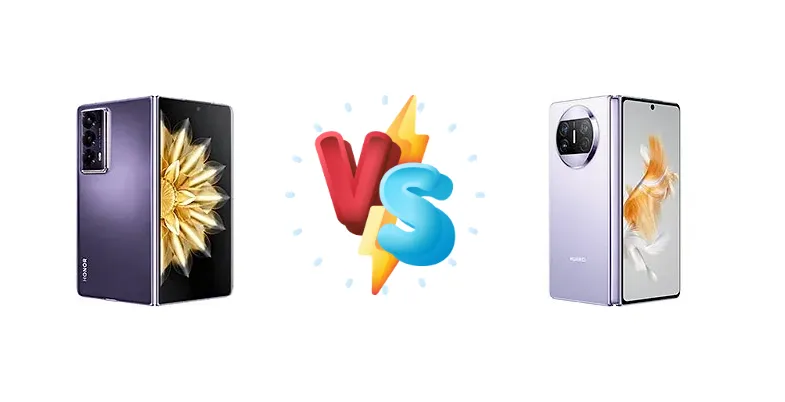
|
🏆 Quick Verdict
For most users, the Honor Magic V2 emerges as the superior choice. Its Snapdragon 8 Gen 2 chipset delivers demonstrably faster performance and improved thermal efficiency compared to the Mate X3’s Snapdragon 8+ Gen 1. While the Mate X3 offers wireless charging, the V2’s longer active use battery life and superior processing power make it the more versatile device.
| PHONES | ||
|---|---|---|
| Phone Names | Honor Magic V2 | Huawei Mate X3 |
| Network | ||
|---|---|---|
| 2G bands | GSM 850 / 900 / 1800 / 1900 | GSM 850 / 900 / 1800 / 1900 |
| 3G bands | HSDPA 800 / 850 / 900 / 1700(AWS) / 1900 / 2100 | HSDPA 800 / 850 / 900 / 1700(AWS) / 1900 / 2100 |
| 4G bands | 1, 2, 3, 4, 5, 7, 8, 12, 17, 18, 19, 20, 26, 28, 34, 38, 39, 40, 41, 66 | 1, 2, 3, 4, 5, 7, 8, 12, 17, 18, 19, 20, 26, 28, 34, 38, 39, 40, 41 |
| 5G bands | 1, 3, 5, 8, 28, 38, 41, 77, 78 SA/NSA | - |
| Speed | HSPA, LTE, 5G | HSPA, LTE |
| Technology | GSM / CDMA / HSPA / CDMA2000 / LTE / 5G | GSM / CDMA / HSPA / EVDO / LTE |
| - | CDMA2000 1xEV-DO | |
| Launch | ||
|---|---|---|
| Announced | 2023, July 12 | 2023, March 23 |
| Status | Available. Released 2023, July 27 | Available. Released 2023, April 08 |
| Body | ||
|---|---|---|
| Build | Glass front, glass back or eco leather back, magnesium alloy frame, titanium alloy folding mechanism | Glass front, glass back or eco leather back, aluminum frame |
| Dimensions | Unfolded: 156.7 x 145.4 x 4.7 mm or 4.8 mmFolded: 156.7 x 74.1 x 9.9 mm or 10.1 mm | Unfolded: 156.9 x 141.5 x 5.3 mmFolded: 156.9 x 72.4 x 11.1 mm |
| SIM | · Nano-SIM + eSIM· Nano-SIM + Nano-SIM | Nano-SIM + Nano-SIM |
| Weight | 231 g or 237 g (8.15 oz) | 239 g or 241 g (8.43 oz) |
| - | IPX8 dust/water resistant (up to 1.5m for 30 min) | |
| Display | ||
|---|---|---|
| Protection | - | Kunlun Glass (cover display only) |
| Resolution | 2156 x 2344 pixels (~402 ppi density) | 2224 x 2496 pixels (~426 ppi density) |
| Size | 7.92 inches, 201.6 cm2 (~88.5% screen-to-body ratio) | 7.85 inches, 197.5 cm2 (~88.9% screen-to-body ratio) |
| Type | Foldable LTPO OLED, 1B colors, 120Hz, HDR10+, 1600 nits (peak) | Foldable OLED, 1B colors, 120Hz |
| - | Cover display: OLED, 120Hz, 6.4 inches, 1080 x 2504 pixels | |
| Platform | ||
|---|---|---|
| CPU | Octa-core (1x3.19 GHz (INTL) / 1x3.36 GHz (CN) Cortex-X3 & 2x2.8 GHz Cortex-A715 & 2x2.8 GHz Cortex-A710 & 3x2.0 GHz Cortex-A510) | Octa-core (1x3.19 GHz Cortex-X2 & 3x2.75 GHz Cortex-A710 & 4x2.0 GHz Cortex-A510) |
| Chipset | Qualcomm SM8550-AB Snapdragon 8 Gen 2 (4 nm) - IntlQualcomm SM8550-AC Snapdragon 8 Gen 2 (4 nm) - China | Qualcomm SM8475 Snapdragon 8+ Gen 1 4G (4 nm) |
| GPU | Adreno 740 | Adreno 730 |
| OS | Android 13, upgradable to Android 14, MagicOS 8 | HarmonyOS 3.1 (China), EMUI 13.1 (Europe), no Google Play Services |
| Memory | ||
|---|---|---|
| Card slot | No | Nano Memory (uses shared SIM slot) |
| Internal | 256GB 16GB RAM, 512GB 16GB RAM, 1TB 16GB RAM | 256GB 12GB RAM, 512GB 12GB RAM, 1TB 12GB RAM |
| - | UFS | |
| Main Camera | ||
|---|---|---|
| Features | Multi-zone Laser AF (8x8 dToF), color spectrum sensor, LED flash, HDR, panorama | Laser AF, color spectrum sensor, LED flash, panorama, HDR |
| Triple | 50 MP, f/1.9, (wide), PDAF, OIS 20 MP, f/2.4, 62mm (telephoto), PDAF, 2.5x optical zoom, OIS 50 MP, f/2.0, 13mm (ultrawide), AF | 50 MP, f/1.8, 23mm (wide), PDAF, OIS 12 MP, f/3.4, 125mm (periscope telephoto), PDAF, OIS, 5x optical zoom 13 MP, f/2.2, 13mm (ultrawide), AF |
| Video | 4K@30/60fps (10-bit), 1080p@30/60fps, gyro-EIS, HDR10+, OIS | 4K@30/60fps, 1080p@30/60fps, gyro-EIS |
| Selfie camera | ||
|---|---|---|
| Features | HDR | HDR, panorama |
| Single | 16 MP, f/2.2, (wide) | 8 MP, f/2.4, (wide) Cover camera: 8 MP, f/2.4, (wide) |
| Video | 4K@30fps, 1080p@30fps, gyro-EIS | 4K@30fps, 1080p@30fps |
| Sound | ||
|---|---|---|
| 3.5mm jack | - | No |
| 35mm jack | No | No |
| Loudspeaker | Yes, with stereo speakers | Yes, with stereo speakers |
| Comms | ||
|---|---|---|
| Bluetooth | 5.3, A2DP, LE, aptX HD | 5.2, A2DP, LE |
| Infrared port | Yes | Yes |
| NFC | Yes | Yes |
| Positioning | GPS (L1+L5), GLONASS (L1), BDS (B1I+B1c+B2a), GALILEO (E1+E5a), QZSS (L1+L5) | GPS (L1+L5), GLONASS (B1I+B1c+B2a), BDS (B1I+B1c+B2a), GALILEO (E1+E5a), QZSS (L1+L5), NavIC |
| Radio | No | No |
| USB | USB Type-C 3.1, OTG, Display Port 1.2 | USB Type-C 3.1, DisplayPort 1.2, OTG |
| WLAN | Wi-Fi 802.11 a/b/g/n/ac/6e/7, dual-band, Wi-Fi Direct | Wi-Fi 802.11 a/b/g/n/ac/6, dual-band, Wi-Fi Direct |
| Features | ||
|---|---|---|
| Sensors | Fingerprint (side-mounted), accelerometer, gyro, proximity, compass | Fingerprint (side-mounted), accelerometer, gyro, proximity, compass, barometer, altimeter |
| - | BDS Satellite Message | |
| Battery | ||
|---|---|---|
| Charging | 66W wired 5W reverse wired | 66W wired 50W wireless 7.5W reverse wireless |
| Type | Si/C Li-Ion 5000 mAh | Market-dependent versions:· Li-Po 4800 mAh (Global)· Si/C Li-Ion 5060 mAh (China only) |
| Misc | ||
|---|---|---|
| Colors | Black, Silk Black, Silk Purple, Gold | Black, White, Violet, Dark Green, Gold |
| Models | VER-AN10, VER-N49 | ALT-AL00, ALT-L29 |
| Price | $ 850.00 / £ 849.00 / € 784.31 | About 1500 EUR |
| SAR EU | 0.85 W/kg (head) 1.29 W/kg (body) | - |
| Tests | ||
|---|---|---|
| Battery life | - | Endurance rating 81h |
| Camera | - | Photo / Video |
| Display | - | Contrast ratio: Infinite (nominal) |
| Loudspeaker | - | -26.3 LUFS (Good) |
| Performance | - | AnTuTu: 993592 (v9) GeekBench: 4283 (v5.5), 4512 (v6) GFXBench: 41fps (ES 3.1 onscreen) |
Honor Magic V2
- Significantly faster processor with Snapdragon 8 Gen 2
- Longer measured battery life in active use
- Improved thermal efficiency for sustained performance
- Lacks wireless charging
- Display panel details are limited
Huawei Mate X3
- Convenient 50W wireless charging
- Established foldable design
- High endurance rating (simulated)
- Older Snapdragon 8+ Gen 1 chipset
- Lower peak performance compared to the V2
Display Comparison
Both the Honor Magic V2 and Huawei Mate X3 boast impressive foldable displays, achieving similar peak brightness levels at 933 nits and 926 nits respectively. However, the nuances matter. While both feature infinite (nominal) contrast ratios, the V2’s panel technology isn’t specified, suggesting it may lack the advanced LTPO technology found in some competitors, potentially impacting variable refresh rate efficiency. The Mate X3’s display, while bright, doesn’t offer any specific advantages in color accuracy or viewing angles based on available data. The key difference lies in the overall user experience, which is heavily influenced by software optimization and hinge quality – areas not fully detailed in the provided specs.
Camera Comparison
Both devices are listed with 'Photo / Video' capabilities, but lack specific details regarding sensor size, aperture, or optical image stabilization (OIS). This makes a direct comparison impossible. However, given Huawei’s historical strength in mobile photography, the Mate X3 likely benefits from sophisticated image processing algorithms. Without concrete sensor specifications, it’s reasonable to assume the Mate X3 prioritizes computational photography, while the Magic V2 may lean towards a more natural image profile. The absence of details regarding the secondary cameras (ultrawide, telephoto) further complicates the assessment.
Performance
The performance gap is the most significant differentiator. The Honor Magic V2, equipped with the Qualcomm SM8550-AB/AC Snapdragon 8 Gen 2 (4nm), offers a substantial leap in processing power over the Huawei Mate X3’s Snapdragon 8+ Gen 1 (4nm). The Snapdragon 8 Gen 2’s Cortex-X3 prime core, clocked at 3.19 GHz (INTL) or 3.36 GHz (CN), provides a noticeable advantage in single-core performance, crucial for responsive UI and app loading. The V2’s CPU configuration, with its mix of Cortex-A715 and A710 cores, further enhances multi-core performance. The 4nm process node of the Snapdragon 8 Gen 2 also translates to improved thermal efficiency, mitigating throttling during sustained workloads. The Mate X3’s older chipset, while capable, simply cannot match the V2’s raw power.
Battery Life
The Honor Magic V2 delivers a measured active use battery life of 10:35h, a concrete figure demonstrating real-world endurance. The Huawei Mate X3, conversely, is presented with an 'Endurance rating' of 81h, a metric derived from simulated usage patterns. While 81h sounds impressive, it’s less indicative of actual user experience. Both devices offer 66W wired charging, but the Mate X3 adds 50W wireless charging and 7.5W reverse wireless charging, providing greater flexibility. However, the V2’s longer active use time suggests more efficient power management despite lacking wireless charging.
Buying Guide
Buy the Honor Magic V2 if you demand the absolute best performance for demanding tasks like gaming, video editing, or heavy multitasking. Its newer chipset and optimized thermal design will provide a smoother, more sustained experience. Buy the Huawei Mate X3 if wireless charging is a non-negotiable feature and you prioritize a refined, established foldable design. The Mate X3’s endurance rating suggests efficient power management, but at the cost of peak performance.