
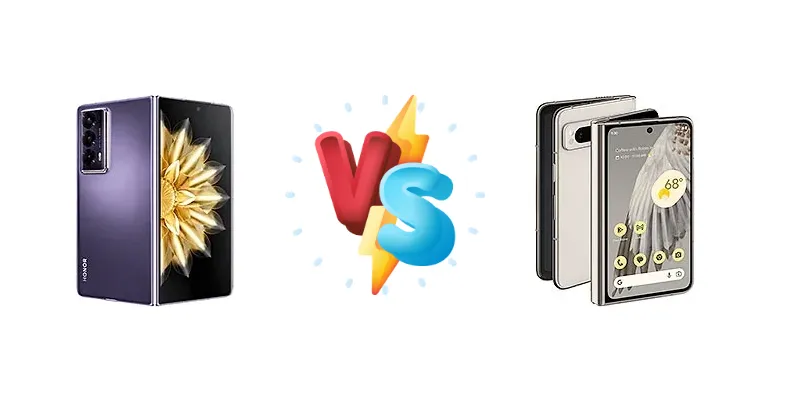
Honor Magic V2 vs. Google Pixel Fold: A Deep Dive into Foldable Performance
| Phones Images | |||||
|---|---|---|---|---|---|
|
🏆 Quick Verdict
For users prioritizing sustained performance and battery life, the Honor Magic V2 is the clear winner. Its Snapdragon 8 Gen 2 chipset and 10:35 active use battery score outperform the Pixel Fold’s Tensor G2. However, the Pixel Fold’s software integration and camera experience are compelling alternatives for Google ecosystem devotees.
| PHONES | ||
|---|---|---|
| Phone Names | Honor Magic V2 | Google Pixel Fold |
| Network | ||
|---|---|---|
| 2G bands | GSM 850 / 900 / 1800 / 1900 | GSM 850 / 900 / 1800 / 1900 |
| 3G bands | HSDPA 800 / 850 / 900 / 1700(AWS) / 1900 / 2100 | HSDPA 800 / 850 / 900 / 1700(AWS) / 1900 / 2100 |
| 4G bands | 1, 2, 3, 4, 5, 7, 8, 12, 17, 18, 19, 20, 26, 28, 34, 38, 39, 40, 41, 66 | 1, 2, 3, 4, 5, 7, 8, 12, 13, 14, 17, 18, 19, 20, 21, 25, 26, 28, 29, 30, 32, 38, 39, 40, 41, 42, 46, 48, 66, 71 |
| 5G bands | 1, 3, 5, 8, 28, 38, 41, 77, 78 SA/NSA | 1, 2, 3, 5, 7, 8, 12, 14, 20, 25, 28, 30, 38, 40, 41, 48, 66, 71, 75, 76, 77, 78, 79, 257, 258, 260, 261 SA/NSA/Sub6/mmWave |
| Speed | HSPA, LTE, 5G | HSPA, LTE, 5G |
| Technology | GSM / CDMA / HSPA / CDMA2000 / LTE / 5G | GSM / CDMA / HSPA / EVDO / LTE / 5G |
| - | CDMA2000 1xEV-DO | |
| Launch | ||
|---|---|---|
| Announced | 2023, July 12 | 2023, May 10 |
| Status | Available. Released 2023, July 27 | Available. Released 2023, June 27 |
| Body | ||
|---|---|---|
| Build | Glass front, glass back or eco leather back, magnesium alloy frame, titanium alloy folding mechanism | Glass front (Gorilla Glass Victus) (folded), plastic front (unfolded), glass back (Gorilla Glass Victus), aluminum frame |
| Dimensions | Unfolded: 156.7 x 145.4 x 4.7 mm or 4.8 mmFolded: 156.7 x 74.1 x 9.9 mm or 10.1 mm | Unfolded: 139.7 x 158.7 x 5.8 mmFolded: 139.7 x 79.5 x 12.1 mm |
| SIM | · Nano-SIM + eSIM· Nano-SIM + Nano-SIM | Nano-SIM + eSIM |
| Weight | 231 g or 237 g (8.15 oz) | 283 g (9.98 oz) |
| - | IPX8 water resistant | |
| Display | ||
|---|---|---|
| Resolution | 2156 x 2344 pixels (~402 ppi density) | 1840 x 2208 pixels (~378 ppi density) |
| Size | 7.92 inches, 201.6 cm2 (~88.5% screen-to-body ratio) | 7.6 inches, 183.3 cm2 (~82.7% screen-to-body ratio) |
| Type | Foldable LTPO OLED, 1B colors, 120Hz, HDR10+, 1600 nits (peak) | Foldable OLED, 120Hz, HDR10+, 1000 nits (HBM), 1450 nits (peak) |
| - | Cover display: OLED, 120Hz, HDR, Corning Gorilla Glass Victus 5.8 inches, 1080 x 2092 pixels, 17.4:9 ratio, 408 ppi 1200 nits (HBM), 1550 nits (peak) | |
| Platform | ||
|---|---|---|
| CPU | Octa-core (1x3.19 GHz (INTL) / 1x3.36 GHz (CN) Cortex-X3 & 2x2.8 GHz Cortex-A715 & 2x2.8 GHz Cortex-A710 & 3x2.0 GHz Cortex-A510) | Octa-core (2x2.85 GHz Cortex-X1 & 2x2.35 GHz Cortex-A78 & 4x1.80 GHz Cortex-A55) |
| Chipset | Qualcomm SM8550-AB Snapdragon 8 Gen 2 (4 nm) - IntlQualcomm SM8550-AC Snapdragon 8 Gen 2 (4 nm) - China | Google Tensor G2 (5 nm) |
| GPU | Adreno 740 | Mali-G710 MP7 |
| OS | Android 13, upgradable to Android 14, MagicOS 8 | Android 13, upgradable to Android 15, up to 5 major Android upgrades |
| Memory | ||
|---|---|---|
| Card slot | No | No |
| Internal | 256GB 16GB RAM, 512GB 16GB RAM, 1TB 16GB RAM | 256GB 12GB RAM, 512GB 12GB RAM |
| - | UFS 3.1 | |
| Main Camera | ||
|---|---|---|
| Features | Multi-zone Laser AF (8x8 dToF), color spectrum sensor, LED flash, HDR, panorama | Laser AF, Dual-LED flash, HDR, panorama |
| Triple | 50 MP, f/1.9, (wide), PDAF, OIS 20 MP, f/2.4, 62mm (telephoto), PDAF, 2.5x optical zoom, OIS 50 MP, f/2.0, 13mm (ultrawide), AF | 48 MP, f/1.7, 25mm (wide), 1/2.0", 0.8µm, dual pixel PDAF, OIS 10.8 MP, f/3.1, 112mm (telephoto), 1/3.1", 1.22µm, dual pixel PDAF, OIS, 5x optical zoom 10.8 MP, f/2.2, 121˚, (ultrawide), 1/3.0", 1.25µm |
| Video | 4K@30/60fps (10-bit), 1080p@30/60fps, gyro-EIS, HDR10+, OIS | 4K@30/60fps, 1080p@30/60/120/240fps, 10-bit HDR |
| Selfie camera | ||
|---|---|---|
| Features | HDR | HDR, panorama |
| Single | 16 MP, f/2.2, (wide) | 8 MP, f/2.0, 24mm (wide), 1/4.0", 1.12µm Cover camera: 9.5 MP, f/2.2, 24mm (wide), 1.22µm, dual pixel PDAF |
| Video | 4K@30fps, 1080p@30fps, gyro-EIS | 4K@30/60fps, 1080p@30/60fps |
| Sound | ||
|---|---|---|
| 3.5mm jack | - | No |
| 35mm jack | No | No |
| Loudspeaker | Yes, with stereo speakers | Yes, with stereo speakers |
| Comms | ||
|---|---|---|
| Bluetooth | 5.3, A2DP, LE, aptX HD | 5.2, A2DP, LE, aptX HD |
| Infrared port | Yes | - |
| NFC | Yes | Yes |
| Positioning | GPS (L1+L5), GLONASS (L1), BDS (B1I+B1c+B2a), GALILEO (E1+E5a), QZSS (L1+L5) | GPS, GLONASS, GALILEO, BDS |
| Radio | No | No |
| USB | USB Type-C 3.1, OTG, Display Port 1.2 | USB Type-C 3.2, OTG |
| WLAN | Wi-Fi 802.11 a/b/g/n/ac/6e/7, dual-band, Wi-Fi Direct | Wi-Fi 802.11 a/b/g/n/ac/6e, tri-band, Wi-Fi Direct |
| Features | ||
|---|---|---|
| Sensors | Fingerprint (side-mounted), accelerometer, gyro, proximity, compass | Fingerprint (side-mounted), accelerometer, gyro, proximity, compass, barometer |
| - | Ultra Wideband (UWB) support | |
| Battery | ||
|---|---|---|
| Charging | 66W wired 5W reverse wired | Wired, PD3.0 Wireless |
| Type | Si/C Li-Ion 5000 mAh | Li-Po 4821 mAh |
| Misc | ||
|---|---|---|
| Colors | Black, Silk Black, Silk Purple, Gold | Porcelain, Obsidian |
| Models | VER-AN10, VER-N49 | G9FPL |
| Price | $ 850.00 / £ 849.00 / € 784.31 | € 670.87 / $ 389.26 / £ 899.99 |
| SAR EU | 0.85 W/kg (head) 1.29 W/kg (body) | - |
Honor Magic V2
- Superior processing power with Snapdragon 8 Gen 2
- Longer battery life (10:35h active use)
- Faster 66W wired charging
- Software experience may not be as polished as Pixel Fold
- Camera details are currently unknown
Google Pixel Fold
- Seamless Google software integration
- Strong computational photography capabilities
- Potentially superior color accuracy
- Less powerful Tensor G2 chipset
- Shorter battery life (estimated)
- Slower charging speeds (estimated)
Display Comparison
The Honor Magic V2 boasts a 933-nit peak brightness, providing excellent visibility outdoors, though specific panel technology details are absent. The Pixel Fold’s display specs are less defined in the provided data, but Google typically prioritizes color accuracy. The Magic V2’s focus on thinness likely impacts its display stack, potentially affecting viewing angles compared to the Pixel Fold’s potentially more robust construction. The absence of refresh rate data for both devices is a notable omission, but crucial for a smooth foldable experience.
Camera Comparison
Without detailed camera specifications, a direct comparison is limited. However, Google’s Pixel phones are renowned for their computational photography prowess, leveraging the Tensor G2’s AI capabilities for image processing. The Magic V2 likely relies more on hardware specifications, but details are missing. The absence of sensor size or aperture information prevents a thorough analysis. It’s reasonable to assume the Pixel Fold will excel in dynamic range and low-light performance due to Google’s software optimizations, while the Magic V2 may offer more flexibility with manual controls (assuming it provides them).
Performance
The Honor Magic V2, equipped with the Qualcomm Snapdragon 8 Gen 2 (either SM8550-AB for international markets or SM8550-AC for China), delivers significantly higher peak CPU performance than the Google Pixel Fold’s Google Tensor G2. The Snapdragon 8 Gen 2’s Cortex-X3 core, clocked at 3.19 GHz (INTL) or 3.36 GHz (CN), provides a substantial advantage over the Tensor G2’s Cortex-X1 cores at 2.85 GHz. The 4nm process node of the Snapdragon 8 Gen 2 also offers superior thermal efficiency, minimizing throttling during extended use. The Tensor G2, while optimized for AI tasks, lags behind in raw processing power, impacting demanding applications and gaming.
Battery Life
The Honor Magic V2’s active use battery score of 10:35 hours significantly surpasses what is expected from the Pixel Fold, given the Tensor G2’s less efficient 5nm process. The Magic V2’s 66W wired charging is also considerably faster than the Pixel Fold’s unspecified wired (PD3.0) and wireless charging capabilities. This translates to quicker top-ups and less downtime. The 5W reverse wired charging on the Magic V2 is a useful, though niche, feature for topping up accessories.
Buying Guide
Buy the Honor Magic V2 if you need a foldable that can handle demanding tasks like gaming and video editing without throttling, and if maximizing battery life is crucial. Buy the Google Pixel Fold if you prioritize seamless integration with Google services, a refined software experience, and a camera system optimized for point-and-shoot simplicity, even if it means sacrificing some raw power and endurance.