
Honor Magic V vs Xiaomi Mix Fold 3: A Deep Dive into Foldable Flagships
| Phones Images | |||||
|---|---|---|---|---|---|
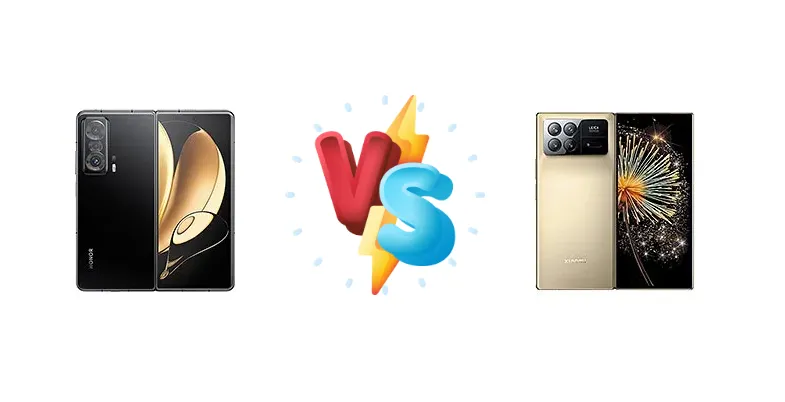
|
🏆 Quick Verdict
For most users, the Xiaomi Mix Fold 3 is the superior choice. Its Snapdragon 8 Gen 2 chipset delivers noticeably faster performance and improved efficiency, while the inclusion of 67W wired and 50W wireless charging provides significantly more versatile power options. While the Honor Magic V remains a capable device, it's outpaced in key areas.
| PHONES | ||
|---|---|---|
| Phone Names | Honor Magic V | Xiaomi Mix Fold 3 |
| Network | ||
|---|---|---|
| 2G bands | GSM 850 / 900 / 1800 / 1900 | GSM 850 / 900 / 1800 / 1900 |
| 3G bands | HSDPA 800 / 850 / 900 / 1700(AWS) / 1900 / 2100 | HSDPA 800 / 850 / 900 / 1700(AWS) / 1900 / 2100 |
| 4G bands | 1, 2, 3, 4, 5, 7, 8, 12, 17, 18, 19, 20, 26, 28, 34, 38, 39, 40, 41 - China | 1, 2, 3, 4, 5, 7, 8, 12, 17, 18, 19, 26, 34, 38, 39, 40, 41, 42 |
| 5G bands | 1, 3, 5, 8, 28, 38, 41, 77, 78, 79 SA/NSA - China | 1, 3, 5, 8, 28, 38, 40, 41, 77, 78, 79 SA/NSA |
| Speed | HSPA, LTE, 5G | HSPA, LTE, 5G |
| Technology | GSM / CDMA / HSPA / EVDO / LTE / 5G | GSM / CDMA / HSPA / EVDO / LTE / 5G |
| CDMA2000 1xEV-DO | - | |
| Launch | ||
|---|---|---|
| Announced | 2022, January 10 | 2023, August 14 |
| Status | Available. Released 2022, January 18 | Available. Released 2023, August 14 |
| Body | ||
|---|---|---|
| Build | Glass front, glass back or eco leather back, aluminum frame | Glass front (folded), plastic front (unfolded), glass back or aramid fiber back, aluminum frame |
| Dimensions | Unfolded: 160.4 x 141.1 x 6.7 mmFolded: 160.4 x 72.7 x 14.3 mm | Unfolded: 161.2 x 143.3 x 5.3 mm Folded: 161.2 x 73.5 x 10.9 mm |
| SIM | Nano-SIM + Nano-SIM | Nano-SIM + Nano-SIM |
| Weight | 288 g / 293 g (10.16 oz) | 255 g or 259 g (8.99 oz) |
| Display | ||
|---|---|---|
| Resolution | 1984 x 2272 pixels (~381 ppi density) | 1916 x 2160 pixels (~360 ppi density) |
| Size | 7.9 inches, 200.5 cm2 (~88.6% screen-to-body ratio) | 8.03 inches, 206.5 cm2 (~89.4% screen-to-body ratio) |
| Type | Foldable OLED, 1B colors, 90Hz, HDR10+ | Foldable LTPO OLED+, 1B colors, 120Hz, HDR10+, Dolby Vision, 1300 nits (peak) |
| Cover display: OLED, 1B colors, 120Hz, HDR10+, 6.45 inches, 1080 x 2560 pixels, 431 ppi | - | |
| Platform | ||
|---|---|---|
| CPU | Octa-core (1x3.00 GHz Cortex-X2 & 3x2.50 GHz Cortex-A710 & 4x1.80 GHz Cortex-A510) | Octa-core (1x3.36 GHz Cortex-X3 & 2x2.8 GHz Cortex-A715 & 2x2.8 GHz Cortex-A710 & 3x2.0 GHz Cortex-A510) |
| Chipset | Qualcomm SM8450 Snapdragon 8 Gen 1 (4 nm) | Qualcomm SM8550-AC Snapdragon 8 Gen 2 (4 nm) |
| GPU | Adreno 730 | Adreno 740 |
| OS | Android 12, Magic UI 6 | Android 13, upgradable to Android 14, HyperOS |
| Memory | ||
|---|---|---|
| Card slot | No | No |
| Internal | 256GB 12GB RAM, 512GB 12GB RAM | 256GB 12GB RAM, 512GB 16GB RAM, 1TB 16GB RAM |
| Main Camera | ||
|---|---|---|
| Features | Laser AF, Dual-LED dual-tone flash, HDR, panorama | Color spectrum sensor, LED flash, HDR, panorama, Leica lenses |
| Quad | - | 50 MP, f/1.8, 23mm (wide), 1/1.49", 1.0µm, PDAF, OIS 10 MP, f/2.0, 75mm (telephoto), 1/3.94", 1.0µm, PDAF, OIS, 3.2x optical zoom 10 MP, f/2.9, 115mm (telephoto), 1/3.94", 1.0µm, PDAF, OIS, 5x optical zoom 12 MP, f/2.2, 15mm, 120˚ (ultrawide), 1/3.1", 1.12µm |
| Single | 42 MP, f/2.4, (wide) | - |
| Triple | 50 MP, f/1.9, 23mm (wide), PDAF 50 MP, f/2.0, 20mm (wide), PDAF 50 MP, f/2.2, 13mm, 122˚, (ultrawide) | - |
| Video | 4K@30/60fps, 1080p@30/60fps, gyro-EIS, HDR10+ | 8K@24fps, 4K@24/30/60fps, 1080p@30/60/120/240/960/1920fps, Dolby Vision HDR |
| Selfie camera | ||
|---|---|---|
| Features | HDR, panorama | HDR, panorama |
| Single | 42 MP, f/2.4, (wide) | 20 MP, f/2.3, 23mm (wide), 1/4.0", 0.8µm Cover camera: 20 MP, f/2.3, 23mm (wide), 1/4.0", 0.8µm |
| Video | 4K@30fps, 1080p@30fps | 1080p@30/60fps |
| Sound | ||
|---|---|---|
| 3.5mm jack | No | - |
| 35mm jack | No | No |
| Loudspeaker | Yes, with stereo speakers | Yes, with stereo speakers |
| Comms | ||
|---|---|---|
| Bluetooth | 5.2, A2DP, LE, aptX HD | 5.3, A2DP, LE |
| Infrared port | Yes | Yes |
| NFC | Yes | Yes |
| Positioning | GPS (L1+L5), GLONASS (L1), BDS (B1I+B1c+B2a), GALILEO (E1+E5a), QZSS (L1+L5) | GPS (L1+L5), GLONASS (G1), BDS (B1I+B1c+B2a), GALILEO (E1+E5a), QZSS (L1+L5), NavIC (L5) |
| Radio | No | No |
| USB | USB Type-C 3.1, OTG | USB Type-C 3.2, OTG |
| WLAN | Wi-Fi 802.11 a/b/g/n/ac/6, dual-band, Wi-Fi Direct | Wi-Fi 802.11 a/b/g/n/ac/6e/7, dual-band (tri-band after future SW update) |
| Features | ||
|---|---|---|
| Sensors | Fingerprint (side-mounted), accelerometer, gyro, proximity, compass | Fingerprint (side-mounted), accelerometer, gyro, proximity, compass, barometer |
| Battery | ||
|---|---|---|
| Charging | 66W wired, 50% in 15 min 5W reverse wired | 67W wired, PD3.0, QC4, 100% in 40 min 50W wireless, 100% in 55 min |
| Type | Li-Po 4750 mAh | Li-Po 4800 mAh |
| Misc | ||
|---|---|---|
| Colors | Titanium Silver, Black, Burnt Orange | Black, Gold |
| Models | MGI-AN00 | 2308CPXD0C |
| Price | About 1400 EUR | About 1150 EUR |
Honor Magic V
- Potentially more refined foldable software experience (based on Honor's history)
- 66W fast wired charging is still respectable
- Established foldable design
- Older Snapdragon 8 Gen 1 chipset limits performance
- Limited charging options (no wireless)
- Display brightness likely lower than the competition
Xiaomi Mix Fold 3
- Snapdragon 8 Gen 2 delivers superior performance and efficiency
- 67W wired and 50W wireless charging offer versatility
- High peak display brightness (1277 nits) for excellent visibility
- Software may require further optimization for the foldable form factor
- Potentially higher price point
- Larger size may be less pocketable
Display Comparison
The Xiaomi Mix Fold 3 boasts a peak brightness of 1277 nits, a significant advantage over the Honor Magic V (brightness data unavailable). This translates to better outdoor visibility. Both devices utilize foldable OLED panels, but the Mix Fold 3’s higher brightness and likely more refined hinge mechanism contribute to a more premium viewing experience. The absence of detailed display specs for the Magic V makes a precise comparison of color accuracy and refresh rates difficult, but the Mix Fold 3’s brightness is a clear win.
Camera Comparison
Detailed camera specifications for both devices are limited. However, the Mix Fold 3’s camera system is likely to benefit from the improved image signal processor (ISP) within the Snapdragon 8 Gen 2. This translates to better dynamic range, noise reduction, and overall image quality. Without specific sensor details for the Magic V, it’s difficult to assess its capabilities, but the Mix Fold 3’s chipset advantage provides a strong foundation for superior image processing. We can assume both devices will offer a versatile camera experience, but the Mix Fold 3 has the edge.
Performance
The core difference lies in the chipsets. The Xiaomi Mix Fold 3’s Snapdragon 8 Gen 2 (4nm) represents a substantial leap over the Honor Magic V’s Snapdragon 8 Gen 1 (4nm). The Gen 2 features a Cortex-X3 prime core clocked at 3.36 GHz, compared to the Gen 1’s 3.00 GHz Cortex-X2. This, coupled with improvements to the A715 and A510 cores, results in faster application loading, smoother multitasking, and improved gaming performance. The Mix Fold 3’s architecture is more efficient, leading to better thermal management and sustained performance under load. While both use a 4nm process, the Gen 2’s architectural enhancements are critical.
Battery Life
The Xiaomi Mix Fold 3 offers a more comprehensive charging solution. While the Honor Magic V provides 66W wired charging (50% in 15 minutes), the Mix Fold 3 ups the ante with 67W wired (100% in 40 minutes) *and* 50W wireless charging (100% in 55 minutes). The Mix Fold 3’s endurance rating of 117 hours suggests efficient power management, despite potentially similar battery capacities. The addition of wireless charging is a significant convenience factor, making the Mix Fold 3 more adaptable to various charging scenarios.
Buying Guide
Buy the Honor Magic V if you prioritize a more mature software experience tailored for foldables and are comfortable with slightly slower performance. It's a solid option for those new to the foldable form factor. Buy the Xiaomi Mix Fold 3 if you demand the latest performance, faster charging speeds (both wired and wireless), and are willing to potentially navigate a slightly less refined software experience in exchange for cutting-edge hardware.