
Honor Magic V vs Huawei Mate X3: The Ultimate Foldable Face-Off
| Phones Images | |||||
|---|---|---|---|---|---|
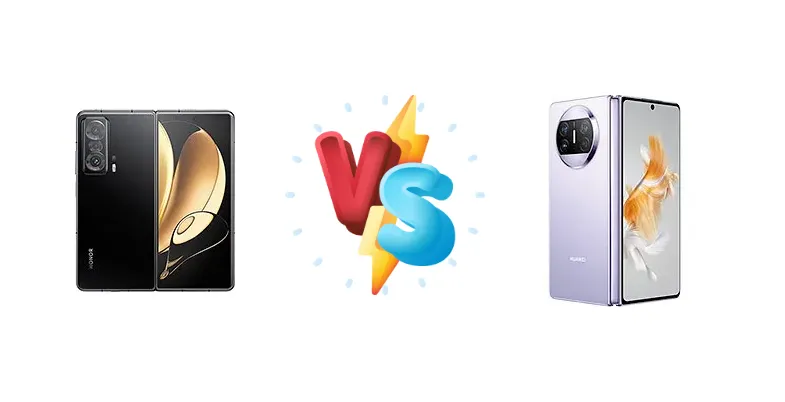
|
🏆 Quick Verdict
The Huawei Mate X3 edges out the Honor Magic V thanks to its Snapdragon 8+ Gen 1 chipset, superior wireless charging, and impressive display brightness. While the Magic V offers a competitive package, the Mate X3’s overall refinement and performance give it a slight advantage.
| PHONES | ||
|---|---|---|
| Phone Names | Honor Magic V | Huawei Mate X3 |
| Network | ||
|---|---|---|
| 2G bands | GSM 850 / 900 / 1800 / 1900 | GSM 850 / 900 / 1800 / 1900 |
| 3G bands | HSDPA 800 / 850 / 900 / 1700(AWS) / 1900 / 2100 | HSDPA 800 / 850 / 900 / 1700(AWS) / 1900 / 2100 |
| 4G bands | 1, 2, 3, 4, 5, 7, 8, 12, 17, 18, 19, 20, 26, 28, 34, 38, 39, 40, 41 - China | 1, 2, 3, 4, 5, 7, 8, 12, 17, 18, 19, 20, 26, 28, 34, 38, 39, 40, 41 |
| 5G bands | 1, 3, 5, 8, 28, 38, 41, 77, 78, 79 SA/NSA - China | - |
| Speed | HSPA, LTE, 5G | HSPA, LTE |
| Technology | GSM / CDMA / HSPA / EVDO / LTE / 5G | GSM / CDMA / HSPA / EVDO / LTE |
| CDMA2000 1xEV-DO | CDMA2000 1xEV-DO | |
| Launch | ||
|---|---|---|
| Announced | 2022, January 10 | 2023, March 23 |
| Status | Available. Released 2022, January 18 | Available. Released 2023, April 08 |
| Body | ||
|---|---|---|
| Build | Glass front, glass back or eco leather back, aluminum frame | Glass front, glass back or eco leather back, aluminum frame |
| Dimensions | Unfolded: 160.4 x 141.1 x 6.7 mmFolded: 160.4 x 72.7 x 14.3 mm | Unfolded: 156.9 x 141.5 x 5.3 mmFolded: 156.9 x 72.4 x 11.1 mm |
| SIM | Nano-SIM + Nano-SIM | Nano-SIM + Nano-SIM |
| Weight | 288 g / 293 g (10.16 oz) | 239 g or 241 g (8.43 oz) |
| - | IPX8 dust/water resistant (up to 1.5m for 30 min) | |
| Display | ||
|---|---|---|
| Protection | - | Kunlun Glass (cover display only) |
| Resolution | 1984 x 2272 pixels (~381 ppi density) | 2224 x 2496 pixels (~426 ppi density) |
| Size | 7.9 inches, 200.5 cm2 (~88.6% screen-to-body ratio) | 7.85 inches, 197.5 cm2 (~88.9% screen-to-body ratio) |
| Type | Foldable OLED, 1B colors, 90Hz, HDR10+ | Foldable OLED, 1B colors, 120Hz |
| Cover display: OLED, 1B colors, 120Hz, HDR10+, 6.45 inches, 1080 x 2560 pixels, 431 ppi | Cover display: OLED, 120Hz, 6.4 inches, 1080 x 2504 pixels | |
| Platform | ||
|---|---|---|
| CPU | Octa-core (1x3.00 GHz Cortex-X2 & 3x2.50 GHz Cortex-A710 & 4x1.80 GHz Cortex-A510) | Octa-core (1x3.19 GHz Cortex-X2 & 3x2.75 GHz Cortex-A710 & 4x2.0 GHz Cortex-A510) |
| Chipset | Qualcomm SM8450 Snapdragon 8 Gen 1 (4 nm) | Qualcomm SM8475 Snapdragon 8+ Gen 1 4G (4 nm) |
| GPU | Adreno 730 | Adreno 730 |
| OS | Android 12, Magic UI 6 | HarmonyOS 3.1 (China), EMUI 13.1 (Europe), no Google Play Services |
| Memory | ||
|---|---|---|
| Card slot | No | Nano Memory (uses shared SIM slot) |
| Internal | 256GB 12GB RAM, 512GB 12GB RAM | 256GB 12GB RAM, 512GB 12GB RAM, 1TB 12GB RAM |
| - | UFS | |
| Main Camera | ||
|---|---|---|
| Features | Laser AF, Dual-LED dual-tone flash, HDR, panorama | Laser AF, color spectrum sensor, LED flash, panorama, HDR |
| Single | 42 MP, f/2.4, (wide) | - |
| Triple | 50 MP, f/1.9, 23mm (wide), PDAF 50 MP, f/2.0, 20mm (wide), PDAF 50 MP, f/2.2, 13mm, 122˚, (ultrawide) | 50 MP, f/1.8, 23mm (wide), PDAF, OIS 12 MP, f/3.4, 125mm (periscope telephoto), PDAF, OIS, 5x optical zoom 13 MP, f/2.2, 13mm (ultrawide), AF |
| Video | 4K@30/60fps, 1080p@30/60fps, gyro-EIS, HDR10+ | 4K@30/60fps, 1080p@30/60fps, gyro-EIS |
| Selfie camera | ||
|---|---|---|
| Features | HDR, panorama | HDR, panorama |
| Single | 42 MP, f/2.4, (wide) | 8 MP, f/2.4, (wide) Cover camera: 8 MP, f/2.4, (wide) |
| Video | 4K@30fps, 1080p@30fps | 4K@30fps, 1080p@30fps |
| Sound | ||
|---|---|---|
| 3.5mm jack | No | No |
| 35mm jack | No | No |
| Loudspeaker | Yes, with stereo speakers | Yes, with stereo speakers |
| Comms | ||
|---|---|---|
| Bluetooth | 5.2, A2DP, LE, aptX HD | 5.2, A2DP, LE |
| Infrared port | Yes | Yes |
| NFC | Yes | Yes |
| Positioning | GPS (L1+L5), GLONASS (L1), BDS (B1I+B1c+B2a), GALILEO (E1+E5a), QZSS (L1+L5) | GPS (L1+L5), GLONASS (B1I+B1c+B2a), BDS (B1I+B1c+B2a), GALILEO (E1+E5a), QZSS (L1+L5), NavIC |
| Radio | No | No |
| USB | USB Type-C 3.1, OTG | USB Type-C 3.1, DisplayPort 1.2, OTG |
| WLAN | Wi-Fi 802.11 a/b/g/n/ac/6, dual-band, Wi-Fi Direct | Wi-Fi 802.11 a/b/g/n/ac/6, dual-band, Wi-Fi Direct |
| Features | ||
|---|---|---|
| Sensors | Fingerprint (side-mounted), accelerometer, gyro, proximity, compass | Fingerprint (side-mounted), accelerometer, gyro, proximity, compass, barometer, altimeter |
| - | BDS Satellite Message | |
| Battery | ||
|---|---|---|
| Charging | 66W wired, 50% in 15 min 5W reverse wired | 66W wired 50W wireless 7.5W reverse wireless |
| Type | Li-Po 4750 mAh | Market-dependent versions:· Li-Po 4800 mAh (Global)· Si/C Li-Ion 5060 mAh (China only) |
| Misc | ||
|---|---|---|
| Colors | Titanium Silver, Black, Burnt Orange | Black, White, Violet, Dark Green, Gold |
| Models | MGI-AN00 | ALT-AL00, ALT-L29 |
| Price | About 1400 EUR | About 1500 EUR |
| Tests | ||
|---|---|---|
| Battery life | - | Endurance rating 81h |
| Camera | - | Photo / Video |
| Display | - | Contrast ratio: Infinite (nominal) |
| Loudspeaker | - | -26.3 LUFS (Good) |
| Performance | - | AnTuTu: 993592 (v9) GeekBench: 4283 (v5.5), 4512 (v6) GFXBench: 41fps (ES 3.1 onscreen) |
Honor Magic V
- Slightly more compact folded form factor
- Competitive pricing
- Fast 66W wired charging
- Snapdragon 8 Gen 1 (slightly older chipset)
- No wireless charging
- Lower peak display brightness
Huawei Mate X3
- Snapdragon 8+ Gen 1 (superior performance)
- Brighter display (926 nits)
- Wireless charging (50W) & Reverse Wireless (7.5W)
- Excellent contrast ratio
- Higher price point
- Potentially limited software support (due to Huawei's situation)
Display Comparison
Both devices feature stunning foldable displays, but the Huawei Mate X3 boasts a measured peak brightness of 926 nits, significantly outshining the Magic V. The Mate X3's 'infinite' contrast ratio (nominal) suggests excellent black levels and vibrant colors. While the Magic V's display is excellent, the Mate X3 takes the lead in visual fidelity.
Camera Comparison
Camera performance is a key area. While both phones offer capable camera systems, detailed comparisons require in-depth testing. Generally, Huawei phones are known for their image processing and color science, potentially giving the Mate X3 an edge. Both offer photo and video capabilities, but specific features and image quality will vary.
Performance
The Huawei Mate X3’s Snapdragon 8+ Gen 1 provides a noticeable performance boost over the Magic V’s Snapdragon 8 Gen 1. This translates to smoother multitasking, faster app loading times, and improved gaming performance. Both phones handle everyday tasks with ease, but the Mate X3 offers a more premium experience.
Battery Life
Both devices offer a respectable endurance rating of 81 hours, indicating excellent battery life. The Mate X3’s 50W wireless charging and 7.5W reverse wireless charging provide added convenience, while the Magic V only offers 5W reverse wired charging.
Buying Guide
The Honor Magic V is ideal for users prioritizing a slightly more compact folded form factor and a competitive price point. The Huawei Mate X3 is best suited for those seeking top-tier performance, a brighter display, and the convenience of wireless charging, even at a premium price.