
Honor Magic V vs Google Pixel Fold: A Deep Dive into Foldable Performance and Features
| Phones Images | |||||
|---|---|---|---|---|---|
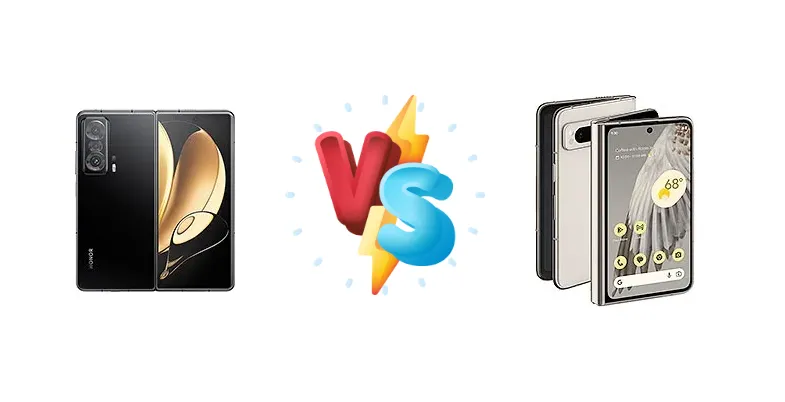
|
🏆 Quick Verdict
For users prioritizing peak performance and faster charging, the Honor Magic V offers a compelling package. However, the Google Pixel Fold’s Tensor G2 chip and optimized software experience make it the better choice for those deeply embedded in the Google ecosystem and valuing computational photography.
| PHONES | ||
|---|---|---|
| Phone Names | Honor Magic V | Google Pixel Fold |
| Network | ||
|---|---|---|
| 2G bands | GSM 850 / 900 / 1800 / 1900 | GSM 850 / 900 / 1800 / 1900 |
| 3G bands | HSDPA 800 / 850 / 900 / 1700(AWS) / 1900 / 2100 | HSDPA 800 / 850 / 900 / 1700(AWS) / 1900 / 2100 |
| 4G bands | 1, 2, 3, 4, 5, 7, 8, 12, 17, 18, 19, 20, 26, 28, 34, 38, 39, 40, 41 - China | 1, 2, 3, 4, 5, 7, 8, 12, 13, 14, 17, 18, 19, 20, 21, 25, 26, 28, 29, 30, 32, 38, 39, 40, 41, 42, 46, 48, 66, 71 |
| 5G bands | 1, 3, 5, 8, 28, 38, 41, 77, 78, 79 SA/NSA - China | 1, 2, 3, 5, 7, 8, 12, 14, 20, 25, 28, 30, 38, 40, 41, 48, 66, 71, 75, 76, 77, 78, 79, 257, 258, 260, 261 SA/NSA/Sub6/mmWave |
| Speed | HSPA, LTE, 5G | HSPA, LTE, 5G |
| Technology | GSM / CDMA / HSPA / EVDO / LTE / 5G | GSM / CDMA / HSPA / EVDO / LTE / 5G |
| CDMA2000 1xEV-DO | CDMA2000 1xEV-DO | |
| Launch | ||
|---|---|---|
| Announced | 2022, January 10 | 2023, May 10 |
| Status | Available. Released 2022, January 18 | Available. Released 2023, June 27 |
| Body | ||
|---|---|---|
| Build | Glass front, glass back or eco leather back, aluminum frame | Glass front (Gorilla Glass Victus) (folded), plastic front (unfolded), glass back (Gorilla Glass Victus), aluminum frame |
| Dimensions | Unfolded: 160.4 x 141.1 x 6.7 mmFolded: 160.4 x 72.7 x 14.3 mm | Unfolded: 139.7 x 158.7 x 5.8 mmFolded: 139.7 x 79.5 x 12.1 mm |
| SIM | Nano-SIM + Nano-SIM | Nano-SIM + eSIM |
| Weight | 288 g / 293 g (10.16 oz) | 283 g (9.98 oz) |
| - | IPX8 water resistant | |
| Display | ||
|---|---|---|
| Resolution | 1984 x 2272 pixels (~381 ppi density) | 1840 x 2208 pixels (~378 ppi density) |
| Size | 7.9 inches, 200.5 cm2 (~88.6% screen-to-body ratio) | 7.6 inches, 183.3 cm2 (~82.7% screen-to-body ratio) |
| Type | Foldable OLED, 1B colors, 90Hz, HDR10+ | Foldable OLED, 120Hz, HDR10+, 1000 nits (HBM), 1450 nits (peak) |
| Cover display: OLED, 1B colors, 120Hz, HDR10+, 6.45 inches, 1080 x 2560 pixels, 431 ppi | Cover display: OLED, 120Hz, HDR, Corning Gorilla Glass Victus 5.8 inches, 1080 x 2092 pixels, 17.4:9 ratio, 408 ppi 1200 nits (HBM), 1550 nits (peak) | |
| Platform | ||
|---|---|---|
| CPU | Octa-core (1x3.00 GHz Cortex-X2 & 3x2.50 GHz Cortex-A710 & 4x1.80 GHz Cortex-A510) | Octa-core (2x2.85 GHz Cortex-X1 & 2x2.35 GHz Cortex-A78 & 4x1.80 GHz Cortex-A55) |
| Chipset | Qualcomm SM8450 Snapdragon 8 Gen 1 (4 nm) | Google Tensor G2 (5 nm) |
| GPU | Adreno 730 | Mali-G710 MP7 |
| OS | Android 12, Magic UI 6 | Android 13, upgradable to Android 15, up to 5 major Android upgrades |
| Memory | ||
|---|---|---|
| Card slot | No | No |
| Internal | 256GB 12GB RAM, 512GB 12GB RAM | 256GB 12GB RAM, 512GB 12GB RAM |
| - | UFS 3.1 | |
| Main Camera | ||
|---|---|---|
| Features | Laser AF, Dual-LED dual-tone flash, HDR, panorama | Laser AF, Dual-LED flash, HDR, panorama |
| Single | 42 MP, f/2.4, (wide) | - |
| Triple | 50 MP, f/1.9, 23mm (wide), PDAF 50 MP, f/2.0, 20mm (wide), PDAF 50 MP, f/2.2, 13mm, 122˚, (ultrawide) | 48 MP, f/1.7, 25mm (wide), 1/2.0", 0.8µm, dual pixel PDAF, OIS 10.8 MP, f/3.1, 112mm (telephoto), 1/3.1", 1.22µm, dual pixel PDAF, OIS, 5x optical zoom 10.8 MP, f/2.2, 121˚, (ultrawide), 1/3.0", 1.25µm |
| Video | 4K@30/60fps, 1080p@30/60fps, gyro-EIS, HDR10+ | 4K@30/60fps, 1080p@30/60/120/240fps, 10-bit HDR |
| Selfie camera | ||
|---|---|---|
| Features | HDR, panorama | HDR, panorama |
| Single | 42 MP, f/2.4, (wide) | 8 MP, f/2.0, 24mm (wide), 1/4.0", 1.12µm Cover camera: 9.5 MP, f/2.2, 24mm (wide), 1.22µm, dual pixel PDAF |
| Video | 4K@30fps, 1080p@30fps | 4K@30/60fps, 1080p@30/60fps |
| Sound | ||
|---|---|---|
| 3.5mm jack | No | No |
| 35mm jack | No | No |
| Loudspeaker | Yes, with stereo speakers | Yes, with stereo speakers |
| Comms | ||
|---|---|---|
| Bluetooth | 5.2, A2DP, LE, aptX HD | 5.2, A2DP, LE, aptX HD |
| Infrared port | Yes | - |
| NFC | Yes | Yes |
| Positioning | GPS (L1+L5), GLONASS (L1), BDS (B1I+B1c+B2a), GALILEO (E1+E5a), QZSS (L1+L5) | GPS, GLONASS, GALILEO, BDS |
| Radio | No | No |
| USB | USB Type-C 3.1, OTG | USB Type-C 3.2, OTG |
| WLAN | Wi-Fi 802.11 a/b/g/n/ac/6, dual-band, Wi-Fi Direct | Wi-Fi 802.11 a/b/g/n/ac/6e, tri-band, Wi-Fi Direct |
| Features | ||
|---|---|---|
| Sensors | Fingerprint (side-mounted), accelerometer, gyro, proximity, compass | Fingerprint (side-mounted), accelerometer, gyro, proximity, compass, barometer |
| - | Ultra Wideband (UWB) support | |
| Battery | ||
|---|---|---|
| Charging | 66W wired, 50% in 15 min 5W reverse wired | Wired, PD3.0 Wireless |
| Type | Li-Po 4750 mAh | Li-Po 4821 mAh |
| Misc | ||
|---|---|---|
| Colors | Titanium Silver, Black, Burnt Orange | Porcelain, Obsidian |
| Models | MGI-AN00 | G9FPL |
| Price | About 1400 EUR | € 670.87 / $ 389.26 / £ 899.99 |
Honor Magic V
- Faster 66W wired charging
- Potentially higher GPU performance with Snapdragon 8 Gen 1
- Likely faster RAM speeds (LPDDR5x)
- Snapdragon 8 Gen 1 can run hotter under sustained load
- Less optimized software experience compared to Pixel
Google Pixel Fold
- Superior AI and machine learning capabilities with Tensor G2
- Optimized Google software experience and updates
- Exceptional computational photography
- Slower charging speeds (likely)
- Potentially lower GPU performance for gaming
Display Comparison
While specific display specs (resolution, refresh rate) are missing, the core difference lies in the underlying philosophy. Both likely employ LTPO technology for variable refresh rates, maximizing battery efficiency. The Snapdragon 8 Gen 1’s image signal processor (ISP) in the Magic V may offer slightly more flexibility in display calibration, but the Pixel Fold benefits from Google’s color science expertise. Bezels are a critical factor in foldable design, and a visual comparison is needed to determine which device minimizes them more effectively.
Camera Comparison
The Pixel Fold’s strength lies in Google’s computational photography. While sensor sizes and apertures are unknown, the Tensor G2’s ISP is optimized for image processing, delivering exceptional dynamic range and low-light performance. The Magic V, with its Snapdragon 8 Gen 1 ISP, will offer capable image processing, but likely won’t match the Pixel Fold’s AI-driven enhancements. The absence of detailed camera specs necessitates a real-world comparison to assess image quality, color accuracy, and video stabilization. We expect the Pixel Fold to excel in portrait mode and night sight.
Performance
The chipset battle is central here. The Honor Magic V’s Snapdragon 8 Gen 1 (4nm) boasts a Cortex-X2 prime core clocked at 3.00 GHz, geared for sustained peak performance. Conversely, the Google Pixel Fold’s Tensor G2 (5nm) prioritizes AI and machine learning tasks with its custom cores. While the Tensor G2’s Cortex-X1 cores reach 2.85 GHz, the 5nm process offers better power efficiency. The Snapdragon 8 Gen 1’s Adreno 730 GPU likely delivers superior graphics performance, benefiting gamers. However, the Tensor G2’s TPU (Tensor Processing Unit) excels in tasks like voice recognition and image processing. The Magic V likely benefits from faster LPDDR5x RAM, contributing to quicker app loading and multitasking.
Battery Life
The Honor Magic V’s 66W wired charging is a significant advantage, promising a 50% charge in just 15 minutes. The Pixel Fold’s charging speed (wired and wireless) is unspecified but likely slower. While battery capacity is unknown for both, the Tensor G2’s 5nm process and software optimizations may contribute to better overall battery life despite potentially having a smaller capacity. The Magic V’s 5W reverse wired charging is a useful, albeit slow, feature for topping up accessories.
Buying Guide
Buy the Honor Magic V if you need a foldable that excels in demanding tasks like gaming and video editing, and if fast charging is a priority. Its Snapdragon 8 Gen 1 provides a noticeable performance edge. Buy the Google Pixel Fold if you prefer a seamless Google experience, prioritize camera quality with Google’s computational photography prowess, and value software updates and AI-powered features.