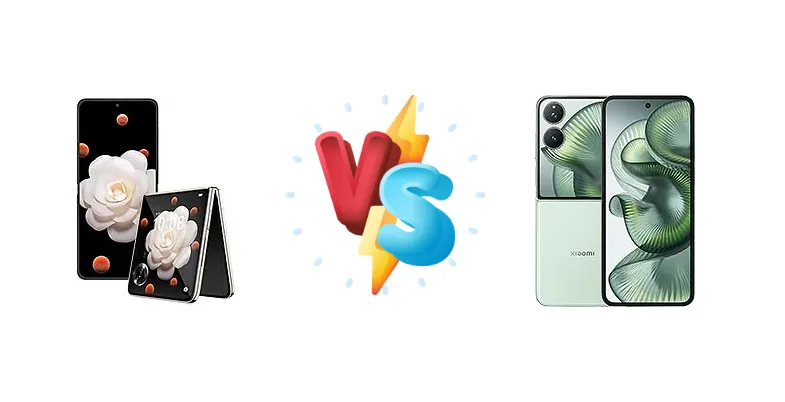
The flip phone market is heating up, with both Honor and Xiaomi offering compelling options. The Honor Magic V Flip aims for a balance of style and performance with the Snapdragon 8+ Gen 1, while the Xiaomi Mix Flip 2 pushes the boundaries with the newer, more efficient Snapdragon 8 Elite. This comparison dissects the key differences to determine which device delivers the best experience.
🏆 Quick Verdict
For users prioritizing raw processing power and future-proofing, the Xiaomi Mix Flip 2 is the clear winner thanks to its Snapdragon 8 Elite chipset and 50W wireless charging. However, the Honor Magic V Flip remains a strong contender, offering a very capable experience at a potentially lower price point.
| Network |
|---|
| 2G bands | GSM 850 / 900 / 1800 / 1900 | GSM 900 / 1800 / 1900 |
| 3G bands | HSDPA 800 / 850 / 900 / 1700(AWS) / 1900 / 2100 | HSDPA 800 / 850 / 900 / 1700(AWS) / 1900 / 2100 |
| 4G bands | LTE | 1, 2, 3, 4, 5, 7, 8, 12, 17, 18, 19, 20, 26, 28, 34, 38, 39, 40, 41, 42, 48, 66 |
| 5G bands | SA/NSA | 1, 2, 3, 5, 7, 8, 12, 20, 26, 28, 38, 40, 41, 48, 66, 77, 78, 80, 81, 83, 84, 89 SA/NSA |
| Speed | HSPA, LTE, 5G | HSPA, LTE, 5G |
| Technology | GSM / CDMA / HSPA / CDMA2000 / LTE / 5G | GSM / CDMA / HSPA / CDMA2000 / LTE / 5G |
| Launch |
|---|
| Announced | 2024, June 13 | 2025, June 26 |
| Status | Available. Released 2024, June 19 | Available. Released 2025, June 26 |
| Body |
|---|
| Build | Aluminum frame | - |
| Dimensions | Unfolded: 167.3 x 75.6 x 7.2 mm Folded: 86.5 x 75.6 x 14.9 mm | Unfolded: 166.9 x 73.8 x 7.6 mmFolded: 86.1 x 73.8 x 15.9 mm |
| SIM | Nano-SIM + Nano-SIM | Nano-SIM + Nano-SIM |
| Weight | 193 g (6.81 oz) | 199 g (7.02 oz) |
| Display |
|---|
| Resolution | 1080 x 2520 pixels, 21:9 ratio (~403 ppi density) | 1224 x 2912 pixels (~460 ppi density) |
| Size | 6.8 inches, 108.0 cm2 (~85.4% screen-to-body ratio) | 6.86 inches, 108.5 cm2 (~88.1% screen-to-body ratio) |
| Type | Foldable LTPO OLED, 1B colors, 120Hz, HDR, Dolby Vision, BT.2020, 3000 nits (peak) | Foldable LTPO AMOLED, 1B colors, Dolby Vision, HDR10+, HDR Vivid, 120Hz, 3200 nits (peak) |
| Platform |
|---|
| CPU | Octa-core (1x3.0 GHz Cortex-X2 & 3x2.5 GHz Cortex-A710 & 4x1.80 GHz Cortex-A510) | Octa-core (2x4.32 GHz Oryon V2 Phoenix L + 6x3.53 GHz Oryon V2 Phoenix M) |
| Chipset | Qualcomm SM8475 Snapdragon 8+ Gen 1 (4 nm) | Qualcomm SM8750-AB Snapdragon 8 Elite (3 nm) |
| GPU | Adreno 730 | Adreno 830 |
| OS | Android 14, MagicOS 8 | Android 15, HyperOS 2 |
| Memory |
|---|
| Card slot | No | No |
| Internal | 256GB 12GB RAM, 512GB 12GB RAM, 1TB 12GB RAM, 1TB 16GB RAM | 256GB 12GB RAM, 512GB 12GB RAM, 1TB 16GB RAM |
| Main Camera |
|---|
| Dual | 50 MP, f/1.9, 23mm (wide), 1/1.56", 1.0µm, PDAF, OIS
12 MP, f/2.2, 112˚ (ultrawide), AF | 50 MP, f/1.7, 23mm (wide), 1/1.55", 1.0µm, dual pixel PDAF, OIS
50 MP, f/2.2, 14mm, 115˚ (ultrawide), PDAF |
| Features | LED flash, HDR, panorama | Color spectrum sensor, LED flash, panorama, HDR, Leica lenses |
| Video | 4K, 1080p, gyro-EIS | 8K@24fps, 4K@30/60fps, 1080p@30/60/120/240/960fps, Dolby Vision HDR |
| Selfie camera |
|---|
| Features | - | Dolby Vision HDR |
| Single | 50 MP, f/2.0, (wide), AF | 32 MP, f/2.0, 21mm (wide), 0.7µm |
| Video | 4K, 1080p | 4K@30/60fps, 1080p@30/60fps |
| Sound |
|---|
| 35mm jack | No | No |
| Loudspeaker | Yes, with stereo speakers | Yes, with stereo speakers |
| Comms |
|---|
| Bluetooth | 5.3, A2DP, LE, aptX HD | 5.4, A2DP, LE, aptX HD, aptX Adaptive, LHDC |
| Infrared port | - | Yes |
| NFC | Yes | Yes |
| Positioning | GPS, GALILEO, GLONASS, QZSS, BDS (B1I+B1c) | GPS (L1+L5), BDS (B1I+B1c+B2a), GALILEO (E1+E5a), QZSS (L1+L5), NavIC (L5), GLONASS |
| Radio | No | No |
| USB | USB Type-C 2.0, OTG | USB Type-C 2.0 |
| WLAN | Wi-Fi 802.11 a/b/g/n/ac/6, dual-band, Wi-Fi Direct | Wi-Fi 802.11 a/b/g/n/ac/6/7, dual-band, Wi-Fi Direct |
| Features |
|---|
| Sensors | Fingerprint (side-mounted), gyro, accelerometer, proximity (ultrasonic), compass | Fingerprint (side-mounted), accelerometer, gyro, proximity, compass, barometer |
| Battery |
|---|
| Charging | 66W wired, 45% in 15 min
5W reverse wired | 67W wired, PD3.0, QC4
50W wireless |
| Type | Si/C Li-Ion 4800 mAh | Si/C Li-Ion 5165 mAh |
| Misc |
|---|
| Colors | Black, White, Champagne, Green | White, Purple, Green, Checkered Gold |
| Models | LRA-AN00 | 2505APX7BC |
| Price | About 640 EUR | About 720 EUR |
Honor Magic V Flip
- Fast 66W wired charging
- Stylish flip phone design
- Capable Snapdragon 8+ Gen 1 processor
- Lacks wireless charging
- Older chipset compared to the competition
Xiaomi Mix Flip 2
- Cutting-edge Snapdragon 8 Elite chipset
- 50W wireless charging support
- Improved power efficiency with 3nm process
- Potentially higher price point
- May run hotter under extreme sustained load (though mitigated by 3nm)
Display Comparison
Both devices are expected to feature similar external and internal display sizes typical of flip phones, but detailed specs are missing. However, the chipset differences suggest the Mix Flip 2 may benefit from more efficient display driving, potentially leading to slightly better battery life. The Snapdragon 8 Elite’s improved ISP could also translate to more accurate color reproduction on the Mix Flip 2’s panels. We anticipate both will utilize OLED technology, but the Mix Flip 2 may have a slight edge in peak brightness due to the more advanced processor.
Camera Comparison
Without detailed camera specifications, a direct comparison is difficult. However, the Snapdragon 8 Elite’s improved image signal processor (ISP) gives the Xiaomi Mix Flip 2 a potential advantage in image processing, particularly in low-light conditions. The ISP can handle more data and apply more sophisticated algorithms, resulting in sharper, more detailed photos. We expect both phones to offer similar features like portrait mode and night mode, but the Mix Flip 2’s processing capabilities could deliver superior results. The absence of detailed sensor information makes it impossible to assess dynamic range or low-light performance definitively.
Performance
The core difference lies in the chipsets. The Xiaomi Mix Flip 2’s Snapdragon 8 Elite (3nm) represents a significant leap over the Honor Magic V Flip’s Snapdragon 8+ Gen 1 (4nm). The 8 Elite utilizes Oryon V2 Phoenix cores, offering a substantial performance uplift in both CPU and GPU tasks. The 3nm process also translates to improved thermal efficiency, meaning the Mix Flip 2 is less likely to throttle under sustained load – crucial for gamers and power users. The Honor Magic V Flip’s Snapdragon 8+ Gen 1 remains a very capable chip, but it will struggle to match the sustained performance of the newer 8 Elite. The Mix Flip 2’s LPDDR5x RAM will also contribute to faster data transfer speeds.
Battery Life
While specific battery capacities are unknown, the charging speeds are a key differentiator. The Xiaomi Mix Flip 2 boasts 67W wired charging with PD3.0 and QC4, alongside 50W wireless charging – a significant convenience. The Honor Magic V Flip offers 66W wired charging, which is comparable, but lacks wireless charging. The 3nm process of the Snapdragon 8 Elite in the Mix Flip 2 should also contribute to better power efficiency, potentially offsetting any capacity differences. The Mix Flip 2’s faster charging and wireless capabilities provide a more versatile and convenient charging experience.
Buying Guide
Buy the Honor Magic V Flip if you need a stylish and capable flip phone with fast 66W wired charging and are comfortable with a slightly older, but still powerful, chipset. Buy the Xiaomi Mix Flip 2 if you prioritize top-tier performance, the convenience of 50W wireless charging, and a more advanced processor built on a 3nm process for improved efficiency and longevity.
Frequently Asked Questions
❓ Will the Snapdragon 8+ Gen 1 in the Honor Magic V Flip struggle with demanding games like Genshin Impact?
While the Snapdragon 8+ Gen 1 is capable, it will likely exhibit more thermal throttling than the Snapdragon 8 Elite in the Xiaomi Mix Flip 2 during extended gaming sessions. Expect slightly lower frame rates and potential for frame drops in graphically intensive titles. The Mix Flip 2’s 3nm process and improved thermal management provide a more consistent gaming experience.
❓ Does the Xiaomi Mix Flip 2's 50W wireless charging significantly reduce charging times compared to wired charging?
Yes, 50W wireless charging is remarkably fast and will provide a substantial charge in a relatively short period. While still slower than 67W wired charging, it offers a convenient alternative, especially for topping up the battery throughout the day. Expect a full charge via wireless to take around 60-90 minutes, depending on the charger used.
❓ How does the 3nm process of the Snapdragon 8 Elite impact real-world battery life on the Xiaomi Mix Flip 2?
The 3nm process is significantly more power-efficient than the 4nm process used in the Snapdragon 8+ Gen 1. This translates to lower power consumption for the same tasks, resulting in longer battery life. While the actual difference will vary based on usage patterns, expect the Mix Flip 2 to offer noticeably better battery endurance.