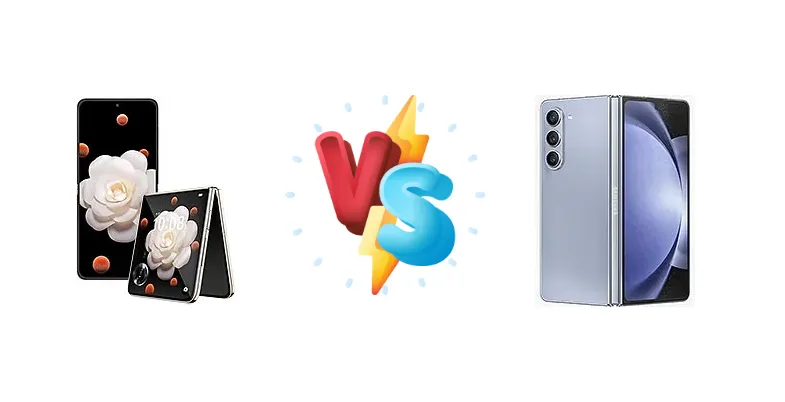
The foldable market is heating up, with the Honor Magic V Flip offering a compelling alternative to Samsung’s established dominance. While the Galaxy Z Fold5 represents the pinnacle of Samsung’s foldable engineering, the Magic V Flip aims to deliver flagship performance at a potentially more accessible price point. This comparison dissects the key differences between these two devices, focusing on performance, battery life, and display quality.
🏆 Quick Verdict
For the average user prioritizing sustained performance and all-day battery life, the Samsung Galaxy Z Fold5 emerges as the superior choice. Its Snapdragon 8 Gen 2 chipset and optimized endurance rating outweigh the Honor Magic V Flip’s faster charging, making it the more reliable daily driver.
| Network |
|---|
| 2G bands | GSM 850 / 900 / 1800 / 1900 | GSM 850 / 900 / 1800 / 1900 |
| 3G bands | HSDPA 800 / 850 / 900 / 1700(AWS) / 1900 / 2100 | HSDPA 850 / 900 / 1700(AWS) / 1900 / 2100 |
| 4G bands | LTE | 1, 2, 3, 4, 5, 7, 8, 12, 13, 17, 18, 19, 20, 25, 26, 28, 38, 39, 40, 41, 66 - International |
| 5G bands | SA/NSA | 1, 2, 3, 5, 7, 8, 12, 20, 25, 28, 38, 40, 41, 66, 77, 78 SA/NSA/Sub6 - International |
| Speed | HSPA, LTE, 5G | HSPA, LTE, 5G |
| Technology | GSM / CDMA / HSPA / CDMA2000 / LTE / 5G | GSM / CDMA / HSPA / EVDO / LTE / 5G |
| Launch |
|---|
| Announced | 2024, June 13 | 2023, July 26 |
| Status | Available. Released 2024, June 19 | Available. Released 2023, August 11 |
| Body |
|---|
| Build | Aluminum frame | Glass front (Gorilla Glass Victus 2) (folded), plastic front (unfolded), glass back (Gorilla Glass Victus 2), aluminum frame |
| Dimensions | Unfolded: 167.3 x 75.6 x 7.2 mm Folded: 86.5 x 75.6 x 14.9 mm | Unfolded: 154.9 x 129.9 x 6.1 mmFolded: 154.9 x 67.1 x 13.4 mm |
| SIM | Nano-SIM + Nano-SIM | · Nano-SIM + eSIM· Nano-SIM + Nano-SIM + eSIM (max 2 at a time) |
| Weight | 193 g (6.81 oz) | 253 g (8.92 oz) |
| Display |
|---|
| Resolution | 1080 x 2520 pixels, 21:9 ratio (~403 ppi density) | 1812 x 2176 pixels (~373 ppi density) |
| Size | 6.8 inches, 108.0 cm2 (~85.4% screen-to-body ratio) | 7.6 inches, 183.2 cm2 (~91.1% screen-to-body ratio) |
| Type | Foldable LTPO OLED, 1B colors, 120Hz, HDR, Dolby Vision, BT.2020, 3000 nits (peak) | Foldable Dynamic AMOLED 2X, 120Hz, HDR10+ |
| Platform |
|---|
| CPU | Octa-core (1x3.0 GHz Cortex-X2 & 3x2.5 GHz Cortex-A710 & 4x1.80 GHz Cortex-A510) | Octa-core (1x3.36 GHz Cortex-X3 & 2x2.8 GHz Cortex-A715 & 2x2.8 GHz Cortex-A710 & 3x2.0 GHz Cortex-A510) |
| Chipset | Qualcomm SM8475 Snapdragon 8+ Gen 1 (4 nm) | Qualcomm SM8550-AC Snapdragon 8 Gen 2 (4 nm) |
| GPU | Adreno 730 | Adreno 740 |
| OS | Android 14, MagicOS 8 | Android 13, up to 4 major Android upgrades, One UI 6.1.1 |
| Memory |
|---|
| Card slot | No | No |
| Internal | 256GB 12GB RAM, 512GB 12GB RAM, 1TB 12GB RAM, 1TB 16GB RAM | 256GB 12GB RAM, 512GB 12GB RAM, 1TB 12GB RAM |
| Main Camera |
|---|
| Dual | 50 MP, f/1.9, 23mm (wide), 1/1.56", 1.0µm, PDAF, OIS
12 MP, f/2.2, 112˚ (ultrawide), AF | - |
| Features | LED flash, HDR, panorama | LED flash, HDR, panorama |
| Triple | - | 50 MP, f/1.8, 23mm (wide), 1/1.56", 1.0µm, dual pixel PDAF, OIS
10 MP, f/2.4, 66mm (telephoto), 1/3.94", 1.0µm, PDAF, OIS, 3x optical zoom
12 MP, f/2.2, 12mm, 123˚ (ultrawide), 1/3.06", 1.12µm |
| Video | 4K, 1080p, gyro-EIS | 8K@30fps, 4K@60fps, 1080p@60/240fps (gyro-EIS), HDR10+ |
| Selfie camera |
|---|
| Features | - | HDR |
| Single | 50 MP, f/2.0, (wide), AF | 4 MP, f/1.8, 26mm (wide), 1/3.0", 2.0µm, under display
Cover camera:
10 MP, f/2.2, 24mm (wide), 1/3.0", 1.22µm |
| Video | 4K, 1080p | 4K@30/60fps, 1080p@30/60fps, gyro-EIS |
| Sound |
|---|
| 35mm jack | No | No |
| Loudspeaker | Yes, with stereo speakers | Yes, with stereo speakers |
| Comms |
|---|
| Bluetooth | 5.3, A2DP, LE, aptX HD | 5.3, A2DP, LE, aptX HD |
| NFC | Yes | Yes |
| Positioning | GPS, GALILEO, GLONASS, QZSS, BDS (B1I+B1c) | GPS, GLONASS, GALILEO, BDS |
| Radio | No | No |
| USB | USB Type-C 2.0, OTG | USB Type-C 3.2, OTG |
| WLAN | Wi-Fi 802.11 a/b/g/n/ac/6, dual-band, Wi-Fi Direct | Wi-Fi 802.11 a/b/g/n/ac/6e, tri-band, Wi-Fi Direct |
| Features |
|---|
| Sensors | Fingerprint (side-mounted), gyro, accelerometer, proximity (ultrasonic), compass | Fingerprint (side-mounted), accelerometer, gyro, proximity, compass, barometer |
| Battery |
|---|
| Charging | 66W wired, 45% in 15 min
5W reverse wired | 25W wired, 50% in 30 min
15W wireless
4.5W reverse wireless |
| Type | Si/C Li-Ion 4800 mAh | Li-Po 4400 mAh |
| Misc |
|---|
| Colors | Black, White, Champagne, Green | Icy Blue, Phantom Black, Cream, Gray, Blue |
| Models | LRA-AN00 | SM-F946B, SM-F946B/DS, SM-F946U, SM-F946U1, SM-F946N, SM-F946W, SM-F9460 |
| Price | About 640 EUR | € 660.00 / $ 607.00 / £ 520.69 / ₹ 86,000 |
| SAR | - | 1.16 W/kg (head) |
| SAR EU | - | 1.24 W/kg (head) 1.19 W/kg (body) |
Honor Magic V Flip
- Faster 66W wired charging
- Potentially more affordable price
- Compact and stylish flip design
- Older Snapdragon 8+ Gen 1 chipset
- Likely shorter battery life
- Less detailed camera specs
Samsung Galaxy Z Fold5
- Latest Snapdragon 8 Gen 2 chipset
- Exceptional battery life (95h endurance)
- Brighter and more accurate display
- Slower 25W wired charging
- Higher price point
- Larger and heavier form factor
Display Comparison
The Samsung Galaxy Z Fold5 boasts a measured peak brightness of 1257 nits, significantly exceeding what we’d expect from the Magic V Flip, though specific data for the Flip is unavailable. This translates to superior visibility in direct sunlight. Both devices likely utilize LTPO technology for adaptive refresh rates, conserving battery life, but Samsung’s panel is known for its color accuracy and wider color gamut. The Fold5’s larger internal display also provides a more immersive experience, while the Magic V Flip’s external display is optimized for quick interactions.
Camera Comparison
Detailed camera specs are limited for the Magic V Flip, but the Galaxy Z Fold5’s camera system benefits from Samsung’s advanced image processing algorithms and likely a larger main sensor. While megapixel counts aren’t everything, sensor size and aperture play a crucial role in low-light performance. The Fold5’s OIS (Optical Image Stabilization) system will also deliver sharper images and smoother video. We can assume the Magic V Flip will offer a competent camera experience, but the Fold5 is expected to provide a more versatile and consistently high-quality photographic output.
Performance
The core difference lies in the chipsets. The Galaxy Z Fold5’s Snapdragon 8 Gen 2 (4nm) represents a substantial leap over the Honor Magic V Flip’s Snapdragon 8+ Gen 1 (4nm). The Gen 2 features a newer Cortex-X3 prime core clocked at 3.36 GHz versus the X2 in the 8+ Gen 1, alongside improved Cortex-A715 and A710 cores. This results in faster processing speeds and improved efficiency. While both use a 4nm process, the architectural improvements in the Gen 2 translate to less thermal throttling during sustained workloads like gaming. The Fold5’s LPDDR5x RAM further enhances performance, providing faster data access.
Battery Life
The Galaxy Z Fold5’s endurance rating of 95 hours and active use score of 12:01h demonstrates superior battery life compared to the Honor Magic V Flip. While the Flip boasts 66W wired charging – significantly faster than the Fold5’s 25W – the Fold5’s larger battery capacity and more efficient chipset allow it to last considerably longer on a single charge. The Flip’s 45% charge in 15 minutes is convenient, but the Fold5’s overall endurance is more valuable for users who don’t have frequent access to a charger.
Buying Guide
Buy the Honor Magic V Flip if you prioritize rapid charging and a potentially lower price point, and are comfortable with a slightly older chipset. This phone suits users who frequently top up their battery throughout the day. Buy the Samsung Galaxy Z Fold5 if you demand the best possible performance, longest battery life, and a more refined foldable experience, even if it comes at a premium price. This is the phone for power users and those who need a device that can handle demanding tasks all day long.
Frequently Asked Questions
❓ Does the Snapdragon 8+ Gen 1 in the Honor Magic V Flip throttle under heavy gaming loads?
The Snapdragon 8+ Gen 1 is a capable chipset, but it is more prone to thermal throttling than the Snapdragon 8 Gen 2. Expect some performance degradation during extended gaming sessions, particularly with graphically demanding titles. The Magic V Flip’s cooling system will play a crucial role in mitigating this, but it won’t eliminate it entirely.
❓ How does the 25W charging on the Galaxy Z Fold5 compare to the 66W charging on the Honor Magic V Flip in real-world use?
While 66W sounds impressive, the Galaxy Z Fold5’s more efficient chipset and battery management mean it doesn’t *need* to charge as quickly. The Flip can gain a significant charge in 15 minutes, but the Fold5’s longer overall battery life reduces the frequency with which you’ll need to charge it. The convenience of the Flip’s faster charging is offset by the Fold5’s superior endurance.
❓ Is the difference in chipset performance between the Snapdragon 8+ Gen 1 and Snapdragon 8 Gen 2 noticeable in everyday tasks?
For basic tasks like browsing, social media, and email, the difference will be minimal. However, when multitasking, editing videos, or playing demanding games, the Snapdragon 8 Gen 2 in the Galaxy Z Fold5 will provide a noticeably smoother and more responsive experience. The Gen 2’s improved CPU and GPU architecture deliver a significant performance boost.