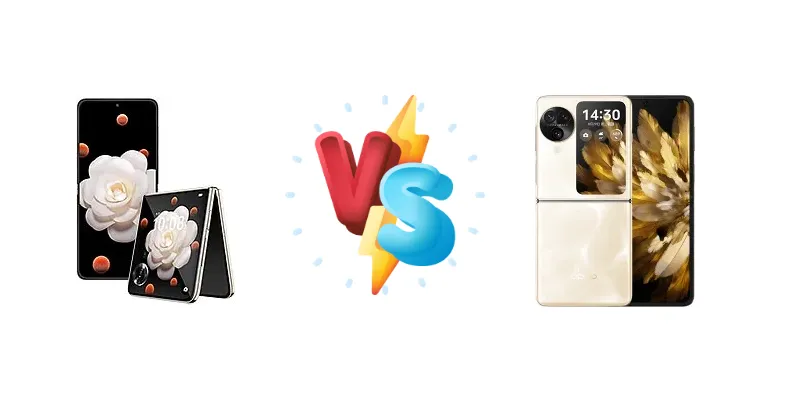
The flip phone is back, and the Honor Magic V Flip and Oppo Find N3 Flip represent the cutting edge of this resurgent form factor. Both aim to blend nostalgia with modern smartphone capabilities, but they take different approaches to performance, battery life, and charging. This comparison dives deep into the specifics to determine which flip phone best suits your needs.
🏆 Quick Verdict
For users prioritizing raw processing power and faster charging, the Honor Magic V Flip, with its Snapdragon 8+ Gen 1, is the better choice. However, the Oppo Find N3 Flip counters with significantly longer battery life in real-world usage, making it ideal for those who value all-day endurance.
| Network |
|---|
| 2G bands | GSM 850 / 900 / 1800 / 1900 | GSM 850 / 900 / 1800 / 1900 |
| 3G bands | HSDPA 800 / 850 / 900 / 1700(AWS) / 1900 / 2100 | HSDPA 800 / 850 / 900 / 1700(AWS) / 1900 / 2100 |
| 4G bands | LTE | 1, 2, 3, 4, 5, 7, 8, 12, 17, 18, 19, 20, 26, 28, 38, 39, 40, 41, 66 - International |
| 5G bands | SA/NSA | 1, 2, 3, 5, 7, 8, 12, 20, 28, 38, 40, 41, 66, 77, 78 SA/NSA - International |
| Speed | HSPA, LTE, 5G | HSPA, LTE, 5G |
| Technology | GSM / CDMA / HSPA / CDMA2000 / LTE / 5G | GSM / CDMA / HSPA / LTE / 5G |
| Launch |
|---|
| Announced | 2024, June 13 | 2023, August 29 |
| Status | Available. Released 2024, June 19 | Available. Released 2023, September 08 |
| Body |
|---|
| Build | Aluminum frame | Plastic front (unfolded), glass back (unfolded), aluminum frame |
| Dimensions | Unfolded: 167.3 x 75.6 x 7.2 mm Folded: 86.5 x 75.6 x 14.9 mm | Unfolded: 166.4 x 75.8 x 7.8 mm Folded: 85.5 x 75.8 x 16.5 mm |
| SIM | Nano-SIM + Nano-SIM | Nano-SIM + Nano-SIM |
| Weight | 193 g (6.81 oz) | 198 g (6.98 oz) |
| Display |
|---|
| Resolution | 1080 x 2520 pixels, 21:9 ratio (~403 ppi density) | 1080 x 2520 pixels, 21:9 ratio (~403 ppi density) |
| Size | 6.8 inches, 108.0 cm2 (~85.4% screen-to-body ratio) | 6.8 inches, 108.0 cm2 (~85.6% screen-to-body ratio) |
| Type | Foldable LTPO OLED, 1B colors, 120Hz, HDR, Dolby Vision, BT.2020, 3000 nits (peak) | Foldable LTPO AMOLED, 120Hz, HDR10+, 1200 nits (HBM), 1600 nits (peak) |
| Platform |
|---|
| CPU | Octa-core (1x3.0 GHz Cortex-X2 & 3x2.5 GHz Cortex-A710 & 4x1.80 GHz Cortex-A510) | Octa-core (1x3.05 GHz Cortex-X3 & 3x2.85 GHz Cortex-A715 & 4x1.80 GHz Cortex-A510) |
| Chipset | Qualcomm SM8475 Snapdragon 8+ Gen 1 (4 nm) | Mediatek Dimensity 9200 (4 nm) |
| GPU | Adreno 730 | Immortalis-G715 MC11 |
| OS | Android 14, MagicOS 8 | Android 13, up to 4 major Android upgrades, ColorOS 14 |
| Memory |
|---|
| Card slot | No | No |
| Internal | 256GB 12GB RAM, 512GB 12GB RAM, 1TB 12GB RAM, 1TB 16GB RAM | 256GB 12GB RAM, 512GB 12GB RAM |
| Main Camera |
|---|
| Dual | 50 MP, f/1.9, 23mm (wide), 1/1.56", 1.0µm, PDAF, OIS
12 MP, f/2.2, 112˚ (ultrawide), AF | - |
| Features | LED flash, HDR, panorama | LED flash, HDR, panorama |
| Triple | - | 50 MP, f/1.8, 24mm (wide), 1/1.56", 1.0µm, multi-directional PDAF, OIS
32 MP, f/2.0, 47mm (telephoto), 2x optical zoom, PDAF
48 MP, f/2.2, 14mm, 114˚ (ultrawide), AF |
| Video | 4K, 1080p, gyro-EIS | 4K@30fps, 1080p@30/60/240fps; gyro-EIS |
| Selfie camera |
|---|
| Features | - | HDR, panorama |
| Single | 50 MP, f/2.0, (wide), AF | 32 MP, f/2.4, 21mm (wide), 1/2.74", 0.8µm, AF |
| Video | 4K, 1080p | 4K@30fps, 1080p@30; gyro-EIS |
| Sound |
|---|
| 35mm jack | No | No |
| Loudspeaker | Yes, with stereo speakers | Yes, with stereo speakers |
| Comms |
|---|
| Bluetooth | 5.3, A2DP, LE, aptX HD | 5.3, A2DP, LE, aptX HD |
| NFC | Yes | Yes (market/region dependent) |
| Positioning | GPS, GALILEO, GLONASS, QZSS, BDS (B1I+B1c) | GPS (L1+L5), GLONASS (L1), BDS (B1I+B1C+B2a+B2b), GALILEO (E1+E5a+E5b), QZSS (L1+L5) |
| Radio | No | No |
| USB | USB Type-C 2.0, OTG | USB Type-C 2.0, OTG |
| WLAN | Wi-Fi 802.11 a/b/g/n/ac/6, dual-band, Wi-Fi Direct | Wi-Fi 802.11 a/b/g/n/ac, dual-band, Wi-Fi Direct - InternationalWi-Fi 802.11 a/b/g/n/ac/6/7, tri-band, Wi-Fi Direct - China only |
| Features |
|---|
| Sensors | Fingerprint (side-mounted), gyro, accelerometer, proximity (ultrasonic), compass | Fingerprint (side-mounted), accelerometer, gyro, proximity, compass |
| Battery |
|---|
| Charging | 66W wired, 45% in 15 min
5W reverse wired | 44W wired, 50% in 23 min
Reverse wired |
| Type | Si/C Li-Ion 4800 mAh | Li-Po 4300 mAh |
| Misc |
|---|
| Colors | Black, White, Champagne, Green | Cream Gold, Misty Pink, Sleek Black |
| Models | LRA-AN00 | PHT110, CPH2519 |
| Price | About 640 EUR | About 1200 EUR |
Honor Magic V Flip
- Faster 66W wired charging
- Potentially better gaming performance with Snapdragon 8+ Gen 1
- Proven thermal management of Snapdragon chipset
- Likely shorter battery life compared to Oppo
- Display brightness likely lower than Oppo
Oppo Find N3 Flip
- Exceptional battery life (12:58h active use)
- Brighter display (939 nits)
- Potentially more efficient Dimensity 9200 chipset
- Slower 44W wired charging
- Snapdragon may offer a slight edge in gaming
Display Comparison
The Oppo Find N3 Flip boasts a notably brighter display, reaching a measured 939 nits, which translates to better visibility outdoors. While the Honor Magic V Flip’s display specs aren’t provided, the N3 Flip’s brightness advantage is significant. Both likely utilize LTPO technology for adaptive refresh rates, conserving battery, but the N3 Flip’s panel appears to be superior in terms of peak luminance. Bezels are a critical factor in flip phone design, and a detailed side-by-side comparison would be needed to determine which device minimizes them more effectively.
Camera Comparison
Detailed camera specs are limited, but the Oppo Find N3 Flip’s emphasis on 'Photo / Video' suggests a strong focus on image quality. Sensor size and lens apertures are crucial, and without those details, it’s difficult to make a definitive judgment. The presence of OIS (Optical Image Stabilization) on the N3 Flip is likely, given Oppo’s history, which would improve low-light performance and video stability. We can safely assume both phones include a standard wide and ultrawide lens, but the quality of image processing algorithms will be a key differentiator. The 2MP macro cameras often found in this segment are unlikely to be a significant factor for most users.
Performance
The core difference lies in the chipsets. The Honor Magic V Flip utilizes the Qualcomm Snapdragon 8+ Gen 1 (4nm), while the Oppo Find N3 Flip features the MediaTek Dimensity 9200 (4nm). The Dimensity 9200’s Cortex-X3 core, clocked at 3.05 GHz, offers a slight architectural advantage over the Snapdragon 8+ Gen 1’s Cortex-X2 (3.0 GHz). However, the Snapdragon 8+ Gen 1 is a proven performer with excellent thermal management. Both phones likely pair their chipsets with ample LPDDR5x RAM, ensuring smooth multitasking. The Snapdragon’s Adreno GPU is generally considered superior for gaming, giving the Honor an edge for mobile gamers.
Battery Life
The Oppo Find N3 Flip shines in battery endurance, achieving an impressive 12:58h of active use and a 92h endurance rating. The Honor Magic V Flip’s battery capacity isn’t specified, but its 66W wired charging is faster than the N3 Flip’s 44W. The Honor can reach 45% charge in just 15 minutes, while the Oppo takes 23 minutes to reach 50%. This faster charging is a significant benefit for users who frequently need to top up their battery. However, the N3 Flip’s superior battery life means fewer charging cycles are needed overall.
Buying Guide
Buy the Honor Magic V Flip if you need a phone capable of handling demanding tasks like gaming and video editing, and if quick top-ups are a priority thanks to its 66W charging. Buy the Oppo Find N3 Flip if you prioritize battery life above all else, and want a phone that can comfortably last a full day – and beyond – on a single charge. The N3 Flip is also the better option for users who frequently consume media due to its higher peak brightness.
Frequently Asked Questions
❓ Does the MediaTek Dimensity 9200 in the Oppo Find N3 Flip tend to overheat during prolonged gaming sessions?
The Dimensity 9200 is a thermally efficient chipset, and Oppo typically employs effective cooling solutions. While it may get warm during extended gaming, it's unlikely to experience significant throttling, especially compared to older chipsets. However, the Snapdragon 8+ Gen 1 in the Honor Magic V Flip is also known for its thermal performance, making it a competitive option for gamers.
❓ How does the 44W charging on the Oppo Find N3 Flip compare to the 66W charging on the Honor Magic V Flip in terms of real-world usage?
While 66W is faster on paper, the Oppo Find N3 Flip’s superior battery life means you’ll need to charge it less frequently. The Honor Magic V Flip’s 66W charging can provide a significant boost in a short amount of time (45% in 15 minutes), which is ideal for quick top-ups. However, the N3 Flip’s longer battery life reduces the need for frequent charging, potentially making the slower charging speed less of an issue for many users.
❓ Is the hinge durability a concern with either the Honor Magic V Flip or the Oppo Find N3 Flip?
Both Honor and Oppo have invested heavily in hinge technology for their flip phones. Both devices have undergone rigorous testing to ensure durability. However, the long-term reliability of flip phone hinges remains a potential concern with any foldable device. It's recommended to check user reviews and warranty information for both phones to assess potential risks.