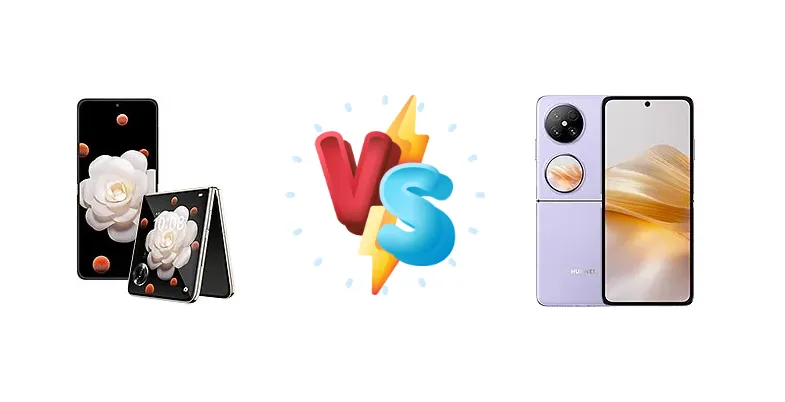
The flip phone is back, and both Honor and Huawei are vying for dominance with their premium offerings. The Honor Magic V Flip leverages Qualcomm’s Snapdragon 8+ Gen 1, while the Huawei Pocket 2 relies on an octa-core processor. This comparison dives deep into the nuances of each device, focusing on performance, charging, and the overall user experience to determine which flip phone best justifies its price tag.
🏆 Quick Verdict
For the average user prioritizing raw performance and established software support, the Honor Magic V Flip emerges as the winner. Its Snapdragon 8+ Gen 1 chipset provides a noticeable edge in demanding tasks, and the 66W wired charging is competitive. However, the Huawei Pocket 2’s 40W wireless charging is a compelling alternative for those valuing convenience.
| Network |
|---|
| 2G bands | GSM 850 / 900 / 1800 / 1900 | GSM 850 / 900 / 1800 / 1900 |
| 3G bands | HSDPA 800 / 850 / 900 / 1700(AWS) / 1900 / 2100 | HSDPA 800 / 850 / 900 / 1700(AWS) / 1900 / 2100 |
| 4G bands | LTE | 1, 2, 3, 4, 5, 7, 8, 12, 17, 18, 19, 20, 26, 28, 34, 38, 39, 40, 41 |
| 5G bands | SA/NSA | - |
| Speed | HSPA, LTE, 5G | HSPA, LTE |
| Technology | GSM / CDMA / HSPA / CDMA2000 / LTE / 5G | GSM / CDMA / HSPA / CDMA2000 / LTE |
| Launch |
|---|
| Announced | 2024, June 13 | 2024, February 22 |
| Status | Available. Released 2024, June 19 | Available. Released 2024, February 22 |
| Body |
|---|
| Build | Aluminum frame | - |
| Dimensions | Unfolded: 167.3 x 75.6 x 7.2 mm Folded: 86.5 x 75.6 x 14.9 mm | Unfolded: 170 x 75.5 x 7.3 mmFolded: 87.8 x 75.5 x 15.3 mm |
| SIM | Nano-SIM + Nano-SIM | Nano-SIM + Nano-SIM |
| Weight | 193 g (6.81 oz) | 199 g or 202 g (7.02 oz) |
| Display |
|---|
| Resolution | 1080 x 2520 pixels, 21:9 ratio (~403 ppi density) | 1136 x 2690 pixels (~420 ppi density) |
| Size | 6.8 inches, 108.0 cm2 (~85.4% screen-to-body ratio) | 6.94 inches, 111.9 cm2 (~87.2% screen-to-body ratio) |
| Type | Foldable LTPO OLED, 1B colors, 120Hz, HDR, Dolby Vision, BT.2020, 3000 nits (peak) | Foldable LTPO OLED, 1B colors, 120Hz, 2200 nits (peak) |
| Platform |
|---|
| CPU | Octa-core (1x3.0 GHz Cortex-X2 & 3x2.5 GHz Cortex-A710 & 4x1.80 GHz Cortex-A510) | Octa-core |
| Chipset | Qualcomm SM8475 Snapdragon 8+ Gen 1 (4 nm) | - |
| GPU | Adreno 730 | - |
| OS | Android 14, MagicOS 8 | HarmonyOS 4.0 |
| Memory |
|---|
| Card slot | No | Nano Memory (uses shared SIM slot) |
| Internal | 256GB 12GB RAM, 512GB 12GB RAM, 1TB 12GB RAM, 1TB 16GB RAM | 256GB 12GB RAM, 512GB 12GB RAM, 512GB 16GB RAM, 1TB 12GB RAM, 1TB 16GB RAM |
| Main Camera |
|---|
| Dual | 50 MP, f/1.9, 23mm (wide), 1/1.56", 1.0µm, PDAF, OIS
12 MP, f/2.2, 112˚ (ultrawide), AF | - |
| Features | LED flash, HDR, panorama | Laser AF, color spectrum sensor, LED flash, HDR, panorama |
| Triple | - | 50 MP, f/1.6, 23mm (wide), PDAF, OIS
8 MP, f/2.4, 80mm (telephoto), PDAF, 3x optical zoom, OIS
12 MP, f/2.2, 13mm (ultrawide), AF
2 MP, (spectral) |
| Video | 4K, 1080p, gyro-EIS | 4K, 1080p, gyro-EIS |
| Selfie camera |
|---|
| Features | - | HDR, panorama |
| Single | 50 MP, f/2.0, (wide), AF | 10.7 MP, f/2.2, (ultrawide) |
| Video | 4K, 1080p | 4K, 1080p |
| Sound |
|---|
| 35mm jack | No | No |
| Loudspeaker | Yes, with stereo speakers | Yes, with stereo speakers |
| Comms |
|---|
| Bluetooth | 5.3, A2DP, LE, aptX HD | 5.2, A2DP, LE, L2HC (320-960 kbps HD audio) |
| NFC | Yes | Yes |
| Positioning | GPS, GALILEO, GLONASS, QZSS, BDS (B1I+B1c) | GPS (L1+L5), GLONASS (L1), BDS (B1I+B1c+B2a+B2b), GALILEO (E1+E5a+E5b), QZSS (L1+L5), NavIC |
| Radio | No | No |
| USB | USB Type-C 2.0, OTG | USB Type-C 2.0, OTG |
| WLAN | Wi-Fi 802.11 a/b/g/n/ac/6, dual-band, Wi-Fi Direct | Wi-Fi 802.11 a/b/g/n/ac/6, dual-band, Wi-Fi Direct |
| Features |
|---|
| Sensors | Fingerprint (side-mounted), gyro, accelerometer, proximity (ultrasonic), compass | Fingerprint (side-mounted), gyro, accelerometer, proximity, compass, barometer |
| Battery |
|---|
| Charging | 66W wired, 45% in 15 min
5W reverse wired | 66W wired, 52% in 20 min
40W wireless
5W reverse wireless
5W reverse wired |
| Type | Si/C Li-Ion 4800 mAh | Li-Po 4520 mAh |
| Misc |
|---|
| Colors | Black, White, Champagne, Green | Black, Purple, White, Gray |
| Models | LRA-AN00 | LEM-AL00 |
| Price | About 640 EUR | About 960 EUR |
Honor Magic V Flip
- Superior processing power with Snapdragon 8+ Gen 1
- Faster wired charging (45% in 15 mins)
- Potentially wider software support and updates
- Lacks wireless charging
- Limited information on display specifications
Huawei Pocket 2
- Convenient 40W wireless charging
- Potentially superior image processing (Huawei's strength)
- Unique design aesthetic
- Less powerful processor compared to Snapdragon 8+ Gen 1
- Slower wired charging (52% in 20 mins)
Display Comparison
Both devices feature folding displays, but detailed display specs are missing. However, given the price points, we can assume both utilize OLED panels. The key differentiator will likely be hinge quality and crease visibility, areas where hands-on testing is crucial. The absence of peak brightness or refresh rate data makes a direct comparison impossible, but the LTPO technology is expected in both to optimize power consumption.
Camera Comparison
Detailed camera specifications are unavailable, but the market positioning suggests both phones will feature multi-camera systems. Without sensor size or aperture information, a direct comparison is difficult. However, Huawei historically excels in computational photography, potentially giving the Pocket 2 an edge in image processing, even with potentially smaller sensors. The absence of details regarding OIS (Optical Image Stabilization) is a critical omission; its presence would significantly improve low-light performance and video stabilization on either device.
Performance
The Honor Magic V Flip’s Qualcomm SM8475 Snapdragon 8+ Gen 1 (4nm) is a significant advantage. This chipset, with its octa-core configuration (1x3.0 GHz Cortex-X2, 3x2.5 GHz Cortex-A710, and 4x1.80 GHz Cortex-A510), delivers superior CPU and GPU performance compared to the Huawei Pocket 2’s unspecified octa-core processor. The 4nm fabrication process of the Snapdragon 8+ Gen 1 also translates to better thermal efficiency, reducing the likelihood of throttling during extended gaming sessions. While Huawei’s processor is capable, it likely prioritizes efficiency over outright speed, potentially impacting demanding applications.
Battery Life
Both devices support 66W wired charging, with the Honor Magic V Flip claiming a 45% charge in 15 minutes and the Huawei Pocket 2 reaching 52% in 20 minutes. While the Pocket 2 is slightly faster with wired charging, the Huawei Pocket 2’s inclusion of 40W wireless charging is a major differentiator. This allows for convenient, cable-free top-ups, a feature the Honor Magic V Flip lacks beyond its 5W reverse wired charging. The actual battery capacity of each device is unknown, but the charging speeds suggest comparable battery life, with the Pocket 2 offering more flexibility in how it’s replenished.
Buying Guide
Buy the Honor Magic V Flip if you need a consistently powerful experience for gaming, multitasking, and demanding applications, and if you prefer a more globally accessible software ecosystem. Buy the Huawei Pocket 2 if you prioritize wireless charging convenience, appreciate Huawei’s unique design aesthetic, and are comfortable within the HarmonyOS environment. The Pocket 2 caters to users who value a seamless wireless experience over peak processing power.
Frequently Asked Questions
❓ Does the Huawei Pocket 2's HarmonyOS limit app availability compared to the Honor Magic V Flip's likely Android-based OS?
Yes, HarmonyOS, while improving, still faces challenges with app compatibility compared to the broader Android ecosystem. Users may encounter difficulties finding or running certain apps readily available on Google Play Store. The Honor Magic V Flip, likely running a more standard Android build, will offer a wider range of app choices.
❓ How does the 5W reverse wired charging on both phones compare for charging accessories like earbuds?
The 5W reverse wired charging on both the Honor Magic V Flip and Huawei Pocket 2 is primarily intended for emergency top-ups of small accessories like wireless earbuds or smartwatches. It's a slow charging method and not suitable for quickly charging larger devices like another smartphone. It's a convenience feature, not a primary charging solution.
❓ Given the lack of detailed camera specs, what should potential buyers focus on when evaluating the camera performance of these phones?
Focus on sample photos and video footage from reputable reviewers. Pay attention to dynamic range, color accuracy, low-light performance, and video stabilization. Look for comparisons specifically highlighting the differences in image processing styles between Honor and Huawei.