
Honor Magic V Flip vs Google Pixel Fold: A Deep Dive into Foldable Performance and Value
| Phones Images | |||||
|---|---|---|---|---|---|
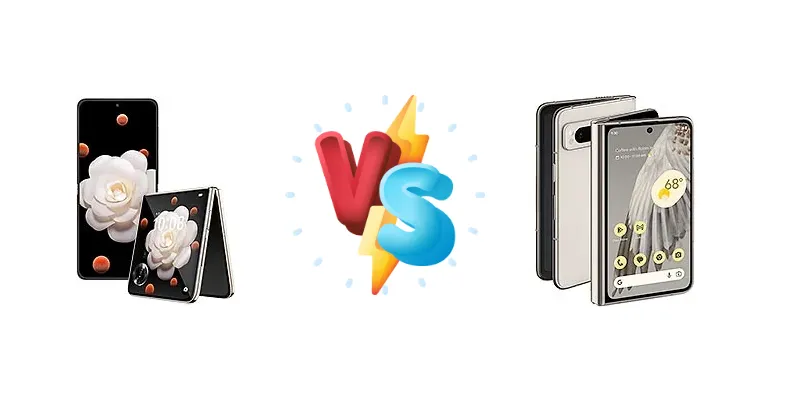
|
🏆 Quick Verdict
For users prioritizing raw performance and faster charging, the Honor Magic V Flip is the stronger choice. Its Snapdragon 8+ Gen 1 delivers a noticeable edge in demanding tasks, and the 66W charging is significantly quicker than the Pixel Fold's wired charging. However, the Pixel Fold's software experience and potentially longer software support are compelling advantages.
| PHONES | ||
|---|---|---|
| Phone Names | Honor Magic V Flip | Google Pixel Fold |
| Network | ||
|---|---|---|
| 2G bands | GSM 850 / 900 / 1800 / 1900 | GSM 850 / 900 / 1800 / 1900 |
| 3G bands | HSDPA 800 / 850 / 900 / 1700(AWS) / 1900 / 2100 | HSDPA 800 / 850 / 900 / 1700(AWS) / 1900 / 2100 |
| 4G bands | LTE | 1, 2, 3, 4, 5, 7, 8, 12, 13, 14, 17, 18, 19, 20, 21, 25, 26, 28, 29, 30, 32, 38, 39, 40, 41, 42, 46, 48, 66, 71 |
| 5G bands | SA/NSA | 1, 2, 3, 5, 7, 8, 12, 14, 20, 25, 28, 30, 38, 40, 41, 48, 66, 71, 75, 76, 77, 78, 79, 257, 258, 260, 261 SA/NSA/Sub6/mmWave |
| Speed | HSPA, LTE, 5G | HSPA, LTE, 5G |
| Technology | GSM / CDMA / HSPA / CDMA2000 / LTE / 5G | GSM / CDMA / HSPA / EVDO / LTE / 5G |
| - | CDMA2000 1xEV-DO | |
| Launch | ||
|---|---|---|
| Announced | 2024, June 13 | 2023, May 10 |
| Status | Available. Released 2024, June 19 | Available. Released 2023, June 27 |
| Body | ||
|---|---|---|
| Build | Aluminum frame | Glass front (Gorilla Glass Victus) (folded), plastic front (unfolded), glass back (Gorilla Glass Victus), aluminum frame |
| Dimensions | Unfolded: 167.3 x 75.6 x 7.2 mm Folded: 86.5 x 75.6 x 14.9 mm | Unfolded: 139.7 x 158.7 x 5.8 mmFolded: 139.7 x 79.5 x 12.1 mm |
| SIM | Nano-SIM + Nano-SIM | Nano-SIM + eSIM |
| Weight | 193 g (6.81 oz) | 283 g (9.98 oz) |
| - | IPX8 water resistant | |
| Display | ||
|---|---|---|
| Resolution | 1080 x 2520 pixels, 21:9 ratio (~403 ppi density) | 1840 x 2208 pixels (~378 ppi density) |
| Size | 6.8 inches, 108.0 cm2 (~85.4% screen-to-body ratio) | 7.6 inches, 183.3 cm2 (~82.7% screen-to-body ratio) |
| Type | Foldable LTPO OLED, 1B colors, 120Hz, HDR, Dolby Vision, BT.2020, 3000 nits (peak) | Foldable OLED, 120Hz, HDR10+, 1000 nits (HBM), 1450 nits (peak) |
| - | Cover display: OLED, 120Hz, HDR, Corning Gorilla Glass Victus 5.8 inches, 1080 x 2092 pixels, 17.4:9 ratio, 408 ppi 1200 nits (HBM), 1550 nits (peak) | |
| Platform | ||
|---|---|---|
| CPU | Octa-core (1x3.0 GHz Cortex-X2 & 3x2.5 GHz Cortex-A710 & 4x1.80 GHz Cortex-A510) | Octa-core (2x2.85 GHz Cortex-X1 & 2x2.35 GHz Cortex-A78 & 4x1.80 GHz Cortex-A55) |
| Chipset | Qualcomm SM8475 Snapdragon 8+ Gen 1 (4 nm) | Google Tensor G2 (5 nm) |
| GPU | Adreno 730 | Mali-G710 MP7 |
| OS | Android 14, MagicOS 8 | Android 13, upgradable to Android 15, up to 5 major Android upgrades |
| Memory | ||
|---|---|---|
| Card slot | No | No |
| Internal | 256GB 12GB RAM, 512GB 12GB RAM, 1TB 12GB RAM, 1TB 16GB RAM | 256GB 12GB RAM, 512GB 12GB RAM |
| - | UFS 3.1 | |
| Main Camera | ||
|---|---|---|
| Dual | 50 MP, f/1.9, 23mm (wide), 1/1.56", 1.0µm, PDAF, OIS 12 MP, f/2.2, 112˚ (ultrawide), AF | - |
| Features | LED flash, HDR, panorama | Laser AF, Dual-LED flash, HDR, panorama |
| Triple | - | 48 MP, f/1.7, 25mm (wide), 1/2.0", 0.8µm, dual pixel PDAF, OIS 10.8 MP, f/3.1, 112mm (telephoto), 1/3.1", 1.22µm, dual pixel PDAF, OIS, 5x optical zoom 10.8 MP, f/2.2, 121˚, (ultrawide), 1/3.0", 1.25µm |
| Video | 4K, 1080p, gyro-EIS | 4K@30/60fps, 1080p@30/60/120/240fps, 10-bit HDR |
| Selfie camera | ||
|---|---|---|
| Features | - | HDR, panorama |
| Single | 50 MP, f/2.0, (wide), AF | 8 MP, f/2.0, 24mm (wide), 1/4.0", 1.12µm Cover camera: 9.5 MP, f/2.2, 24mm (wide), 1.22µm, dual pixel PDAF |
| Video | 4K, 1080p | 4K@30/60fps, 1080p@30/60fps |
| Sound | ||
|---|---|---|
| 3.5mm jack | - | No |
| 35mm jack | No | No |
| Loudspeaker | Yes, with stereo speakers | Yes, with stereo speakers |
| Comms | ||
|---|---|---|
| Bluetooth | 5.3, A2DP, LE, aptX HD | 5.2, A2DP, LE, aptX HD |
| NFC | Yes | Yes |
| Positioning | GPS, GALILEO, GLONASS, QZSS, BDS (B1I+B1c) | GPS, GLONASS, GALILEO, BDS |
| Radio | No | No |
| USB | USB Type-C 2.0, OTG | USB Type-C 3.2, OTG |
| WLAN | Wi-Fi 802.11 a/b/g/n/ac/6, dual-band, Wi-Fi Direct | Wi-Fi 802.11 a/b/g/n/ac/6e, tri-band, Wi-Fi Direct |
| Features | ||
|---|---|---|
| Sensors | Fingerprint (side-mounted), gyro, accelerometer, proximity (ultrasonic), compass | Fingerprint (side-mounted), accelerometer, gyro, proximity, compass, barometer |
| - | Ultra Wideband (UWB) support | |
| Battery | ||
|---|---|---|
| Charging | 66W wired, 45% in 15 min 5W reverse wired | Wired, PD3.0 Wireless |
| Type | Si/C Li-Ion 4800 mAh | Li-Po 4821 mAh |
| Misc | ||
|---|---|---|
| Colors | Black, White, Champagne, Green | Porcelain, Obsidian |
| Models | LRA-AN00 | G9FPL |
| Price | About 640 EUR | € 670.87 / $ 389.26 / £ 899.99 |
Honor Magic V Flip
- Superior processing power with Snapdragon 8+ Gen 1
- Significantly faster 66W wired charging
- Potentially more compact and portable design
- Lacks wireless charging
- Software update commitment may be shorter than Google
Google Pixel Fold
- Clean Android experience with guaranteed updates
- Google’s renowned computational photography
- Wireless charging convenience
- Tensor G2 offers less raw processing power
- Slower wired charging speeds
Display Comparison
While both devices feature foldable OLED displays, specifics are limited in the provided data. The Honor Magic V Flip likely benefits from its smaller form factor, potentially leading to a higher pixel density. The Pixel Fold, with its larger overall size, may offer a more immersive viewing experience. The absence of refresh rate data is notable; however, both are expected to feature adaptive refresh rates to balance smoothness and battery life. Color accuracy will likely be excellent on both, given OLED technology, but the Pixel Fold’s tuning is known for its natural color reproduction.
Camera Comparison
Detailed camera specs are missing, but we can infer some differences. Google’s Pixel phones are renowned for their computational photography prowess, leveraging the Tensor G2’s image signal processor. The Pixel Fold will likely excel in dynamic range and low-light performance through software processing. The Honor Magic V Flip, relying on the Snapdragon’s ISP, will likely offer a more traditional camera experience. Without sensor size or aperture data, it’s difficult to definitively declare a winner, but Google’s software advantage is a significant factor. The absence of information regarding OIS is also a key omission.
Performance
The core difference lies in the chipsets. The Honor Magic V Flip’s Snapdragon 8+ Gen 1 (4nm) is a proven performer, boasting a Cortex-X2 prime core clocked at 3.0 GHz. This contrasts with the Google Pixel Fold’s Tensor G2 (5nm). While the Tensor G2 features newer Cortex-X1 cores clocked slightly higher at 2.85 GHz, the Snapdragon 8+ Gen 1’s architecture and 4nm process generally translate to superior sustained performance and thermal efficiency. The Snapdragon’s Adreno GPU will also provide a more substantial graphical advantage. The Pixel Fold’s Tensor G2 excels in AI and machine learning tasks, but for raw processing power, the Honor has the edge.
Battery Life
Battery capacity is not provided for either device. However, the Honor Magic V Flip’s 66W wired charging is a clear advantage. Achieving 45% charge in 15 minutes is significantly faster than the Pixel Fold’s unspecified wired charging speed (PD3.0). The Pixel Fold does offer wireless charging, a convenience the Honor lacks. The smaller size of the Magic V Flip may necessitate a smaller battery, but the faster charging mitigates this concern. Real-world battery life will depend heavily on usage patterns and software optimization.
Buying Guide
Buy the Honor Magic V Flip if you need a highly portable foldable with exceptional processing power for gaming or demanding applications, and value rapid charging speeds. Buy the Google Pixel Fold if you prioritize Google’s clean Android experience, guaranteed software updates, and a more conventional foldable design with a larger cover screen for everyday usability.