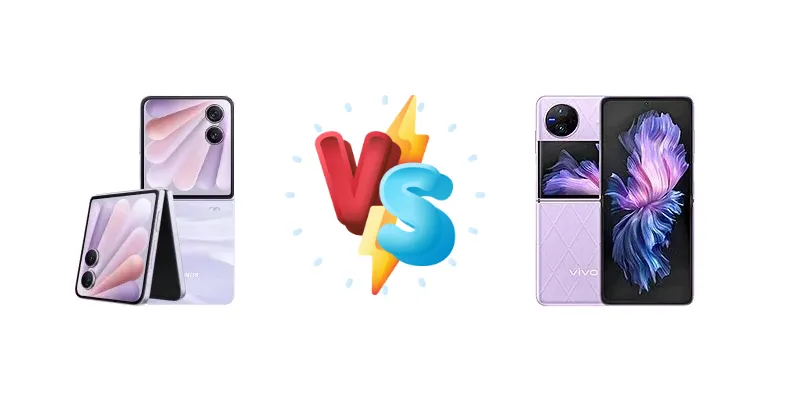
The flip phone is back, and it's more sophisticated than ever. The Honor Magic V Flip 2 and vivo X Flip represent the cutting edge of this resurgent form factor, but they take different approaches. The Honor prioritizes raw power with the latest Snapdragon chipset, while the vivo focuses on a refined experience with a slightly older, but still capable, processor. This comparison will dissect the key differences to determine which flip phone best suits your needs.
🏆 Quick Verdict
For most users, the Honor Magic V Flip 2 is the superior choice. Its Snapdragon 8 Gen 3 chipset delivers significantly faster performance and better long-term software support. While the vivo X Flip offers a respectable experience, the Honor’s faster charging, brighter display, and more powerful processor justify the price difference.
| Network |
|---|
| 2G bands | GSM 850 / 900 / 1800 / 1900 | GSM 850 / 900 / 1800 / 1900 |
| 3G bands | HSDPA 800 / 850 / 900 / 1700(AWS) / 1900 / 2100 | HSDPA 800 / 850 / 900 / 1700(AWS) / 1900 / 2100 |
| 4G bands | LTE | 1, 2, 3, 4, 5, 7, 8, 12, 17, 18, 19, 26, 28, 34, 38, 39, 40, 41 |
| 5G bands | SA/NSA | 1, 3, 5, 8, 28, 41, 77, 78 SA/NSA |
| Speed | HSPA, LTE, 5G | HSPA, LTE, 5G |
| Technology | GSM / CDMA / HSPA / CDMA2000 / LTE / 5G | GSM / CDMA / HSPA / CDMA2000 / LTE / 5G |
| | - | CDMA2000 1x |
| Launch |
|---|
| Announced | 2025, August 21 | 2023, April 20 |
| Status | Available. Released 2025, August 21 | Available. Released 2023, April 28 |
| Body |
|---|
| Build | Aluminum frame | Aluminum frame, glass back |
| Dimensions | Unfolded: 167.1 x 75.6 x 6.9 mm Folded: 86.2 x 75.6 x 15.5 mm | Unfolded: 166.4 x 75.3 x 7.8 mmFolded: 86.4 x 75.3 x 16.6 mm |
| SIM | Nano-SIM + Nano-SIM | Nano-SIM + Nano-SIM |
| Weight | 204 g (7.20 oz) | 198 g (6.98 oz) |
| Display |
|---|
| Resolution | 1232 x 2868 pixels, 21:9 ratio (~458 ppi density) | 1080 x 2520 pixels, 21:9 ratio (~407 ppi density) |
| Size | 6.82 inches, 108.8 cm2 (~86.1% screen-to-body ratio) | 6.74 inches, 106.1 cm2 (~84.7% screen-to-body ratio) |
| Type | Foldable LTPO OLED, 1B colors, 120Hz, 4320Hz PWM, HDR, Dolby Vision, BT.2020, 5000 nits (peak) | Foldable LTPO AMOLED, 1B colors, 120Hz, HDR10+ |
| | - | Cover display:
AMOLED, 3 inches, 422 x 682 pixels, 14.5:9 ratio |
| Platform |
|---|
| CPU | Octa-core (1x3.3 GHz Cortex-X4 & 3x3.2 GHz Cortex-A720 & 2x3.0 GHz Cortex-A720 & 2x2.3 GHz Cortex-A520) | Octa-core (1x3.0 GHz Cortex-X2 & 3x2.5 GHz Cortex-A710 & 4x1.80 GHz Cortex-A510) |
| Chipset | Qualcomm SM8650-AB Snapdragon 8 Gen 3 (4 nm) | Qualcomm SM8475 Snapdragon 8+ Gen 1 (4 nm) |
| GPU | Adreno 750 | Adreno 730 |
| OS | Android 15, MagicOS 9 | Android 13, OriginOS 3 |
| Memory |
|---|
| Card slot | No | No |
| Internal | 256GB 12GB RAM, 512GB 12GB RAM, 1TB 12GB RAM, 1TB 16GB RAM | 256GB 12GB RAM, 512GB 12GB RAM |
| | - | UFS 3.1 |
| Main Camera |
|---|
| Dual | 200 MP, f/1.9, (wide), 1/1.3", 0.6µm, multi-directional PDAF, OIS
50 MP, f/2.0, 120˚ (ultrawide), AF | 50 MP, f/1.8, 23mm (wide), 1/1.49", 1.0µm, dual pixel PDAF, OIS
12 MP, f/2.2, 16mm, 106˚ (ultrawide), 1/2.93", 1.22µm, dual pixel PDAF |
| Features | LED flash, HDR, panorama | Laser AF, Zeiss optics, Zeiss T* lens coating, Dual-LED flash, panorama |
| Video | 4K, 1080p, gyro-EIS | 4K@30fps, 1080p@30/60fps |
| Selfie camera |
|---|
| Features | - | HDR |
| Single | 50 MP, f/2.0, (wide), AF | 32 MP, f/2.5, (wide) |
| Video | 4K, 1080p | 1080p@30fps |
| Sound |
|---|
| 3.5mm jack | - | No |
| 35mm jack | No | No |
| Loudspeaker | Yes, with stereo speakers | Yes |
| | - | 24-bit/192kHz audio |
| Comms |
|---|
| Bluetooth | 5.4, A2DP, LE, aptX HD, aptX Adaptive, ASHA | 5.3, A2DP, LE, aptX HD, aptX Adaptive, aptX Lossless |
| Infrared port | Yes | - |
| NFC | Yes | Yes |
| Positioning | GPS (L1+L5), BDS (B1I+B1C+B2a+B2b), GALILEO (E1+E5a+E5b), QZSS (L1+L5), NavIC (L5), GLONASS | GPS (L1+L5), GLONASS (G1), BDS (B1I+B1c+B2a), GALILEO (E1+E5a), QZSS (L1+L5) |
| Radio | No | No |
| USB | USB Type-C 2.0, OTG | USB Type-C 2.0, OTG |
| WLAN | Wi-Fi 802.11 a/b/g/n/ac/6, dual-band, Wi-Fi Direct | Wi-Fi 802.11 a/b/g/n/ac/6, dual-band, Wi-Fi Direct |
| Features |
|---|
| Sensors | Fingerprint (side-mounted), gyro, accelerometer, proximity (ultrasonic), compass | Fingerprint (side-mounted), accelerometer, gyro, proximity, compass |
| Battery |
|---|
| Charging | 80W wired, 100% in 42 min
50W wireless
5W reverse wired
Reverse wireless | 44W wired |
| Type | Si/C Li-Po 5500 mAh | 4400 mAh |
| Misc |
|---|
| Colors | Purple, Silver, Gray, Blue | Rhombic Purple, Silk Gold, Diamond Black |
| Models | CLE-AN00 | V2256A |
| Price | - | About 800 EUR |
Honor Magic V Flip 2
- Significantly faster processor (Snapdragon 8 Gen 3)
- Much brighter display (1786 nits)
- Ultra-fast 80W wired charging
- Potentially higher price
- Newer device, potentially more software bugs initially
vivo X Flip
- More established software experience (vivo)
- Potentially more affordable price
- Capable camera system (marketing focus)
- Older processor (Snapdragon 8+ Gen 1)
- Slower charging (44W wired)
- Dimmer display (1027 nits)
Display Comparison
The Honor Magic V Flip 2 boasts a significantly brighter display, reaching a measured 1786 nits, compared to the vivo X Flip’s 1027 nits. This translates to vastly improved visibility outdoors under direct sunlight. While both utilize foldable OLED panels, the higher peak brightness of the Honor provides a more vibrant and usable experience. We lack PWM frequency data for both, but the brightness difference is a clear win for the Honor. The impact of panel curvature and bezel size is similar on both devices, but the brighter panel on the Honor will be more noticeable in everyday use.
Camera Comparison
Detailed camera analysis is limited by the provided data. Both phones likely feature capable camera systems, but the specifics are missing. The vivo X Flip is marketed with a focus on photo and video capabilities, suggesting a potentially more refined image processing pipeline. However, without sensor size or aperture information, it’s difficult to make a definitive judgment. We can assume both phones will offer similar features like night mode and portrait mode, but the Honor’s more powerful ISP (Image Signal Processor) within the Snapdragon 8 Gen 3 could provide an edge in image quality and video stabilization.
Performance
The performance gap between these two is substantial. The Honor Magic V Flip 2’s Snapdragon 8 Gen 3 (4nm) is a generational leap ahead of the vivo X Flip’s Snapdragon 8+ Gen 1 (4nm). The 8 Gen 3 features a new CPU architecture – Cortex-X4 prime core clocked at 3.3 GHz versus the X2 in the 8+ Gen 1 at 3.0 GHz – resulting in significantly faster processing speeds. The Honor also benefits from a more modern GPU architecture, offering superior graphics performance. While both chipsets are 4nm, the architectural improvements in the 8 Gen 3 translate to better efficiency and sustained performance under load, minimizing throttling during extended gaming sessions. The Honor will handle demanding applications and multitasking with ease, while the vivo X Flip may show signs of strain.
Battery Life
The Honor Magic V Flip 2 achieves an impressive 12:43h of active use, indicating excellent battery life despite its compact form factor. The vivo X Flip’s endurance rating of 110 hours is less directly comparable, as it’s a standardized test rather than real-world usage. However, the Honor’s 80W wired charging is a game-changer, reaching 100% charge in just 42 minutes, compared to the vivo X Flip’s 44W charging. The Honor also adds 50W wireless and reverse charging capabilities, offering greater versatility. While the vivo X Flip’s battery may be slightly larger (spec not provided), the Honor’s faster charging and overall active use score make it the more convenient option for power users.
Buying Guide
Buy the Honor Magic V Flip 2 if you demand the best possible performance for demanding tasks like gaming or video editing, and value the fastest charging speeds available in a flip phone. Buy the vivo X Flip if you prioritize a more established software experience within the vivo ecosystem and are looking for a slightly more affordable entry point into the world of flip phones, accepting a performance trade-off.
Frequently Asked Questions
❓ Does the Snapdragon 8 Gen 3 in the Honor Magic V Flip 2 generate excessive heat during prolonged gaming sessions?
While the Snapdragon 8 Gen 3 is a powerful chip, its 4nm process and improved thermal management features minimize throttling. The Honor Magic V Flip 2’s cooling system, though compact, is designed to dissipate heat effectively, allowing for sustained performance during gaming. However, some heat buildup is inevitable with demanding tasks.
❓ Is the 44W charging on the vivo X Flip slow compared to the 80W on the Honor Magic V Flip 2?
Yes, 44W charging is considerably slower than 80W. The Honor Magic V Flip 2 can fully charge in approximately 42 minutes, while the vivo X Flip will take significantly longer. This difference is particularly noticeable for users who frequently need to top up their battery quickly.
❓ How does the software experience differ between Honor's MagicOS and vivo's Funtouch OS?
Honor's MagicOS is generally considered closer to stock Android with a focus on clean aesthetics and AI-powered features. vivo's Funtouch OS has historically been more heavily customized, but recent versions have become more refined. The choice depends on personal preference; some users prefer the simplicity of MagicOS, while others appreciate the additional features of Funtouch OS.