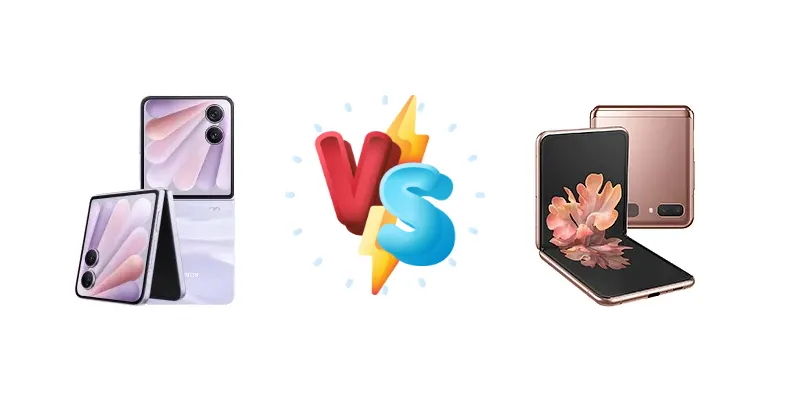
The foldable phone market is maturing, with options ranging from ultra-premium to more accessible. The Samsung Galaxy Z Flip 5G established a strong baseline for compact foldables, but the Honor Magic V Flip 2 arrives with a significantly newer chipset and faster charging. This comparison dissects the key differences to determine which flip phone best suits your needs.
🏆 Quick Verdict
For users prioritizing performance and future-proofing, the Honor Magic V Flip 2 is the clear winner. Its Snapdragon 8 Gen 3 chipset offers a substantial upgrade over the Galaxy Z Flip 5G’s Snapdragon 865. However, the Z Flip 5G remains a viable option for those seeking a more established foldable experience with a lower price point.
| Network |
|---|
| 2G bands | GSM 850 / 900 / 1800 / 1900 | GSM 850 / 900 / 1800 / 1900 |
| 3G bands | HSDPA 800 / 850 / 900 / 1700(AWS) / 1900 / 2100 | HSDPA 850 / 900 / 1700(AWS) / 1900 / 2100 - International, Canada |
| 4G bands | LTE | 1, 2, 3, 4, 5, 7, 8, 12, 13, 14, 18, 19, 20, 25, 26, 28, 29, 30, 38, 39, 40, 41, 66, 71 - International |
| 5G bands | SA/NSA | 1, 41, 77, 78, 79 Sub6 - China, Hong Kong |
| Speed | HSPA, LTE, 5G | HSPA 42.2/5.76 Mbps, LTE (6CA) Cat20 2000/200 Mbps, 5G |
| Technology | GSM / CDMA / HSPA / CDMA2000 / LTE / 5G | GSM / CDMA / HSPA / EVDO / LTE / 5G |
| | - | 41, 66, 71 Sub6 - Canada |
| Launch |
|---|
| Announced | 2025, August 21 | 2020, July 22 |
| Status | Available. Released 2025, August 21 | Available. Released 2020, August 07 |
| Body |
|---|
| Build | Aluminum frame | Plastic front, glass back (Gorilla Glass 6), aluminum frame |
| Dimensions | Unfolded: 167.1 x 75.6 x 6.9 mm Folded: 86.2 x 75.6 x 15.5 mm | Unfolded: 167.3 x 73.6 x 7.2 mm Folded: 87.4 x 73.6 x 17.3 mm |
| SIM | Nano-SIM + Nano-SIM | Nano-SIM + eSIM |
| Weight | 204 g (7.20 oz) | 183 g (6.46 oz) |
| Display |
|---|
| Resolution | 1232 x 2868 pixels, 21:9 ratio (~458 ppi density) | 1080 x 2636 pixels (~425 ppi density) |
| Size | 6.82 inches, 108.8 cm2 (~86.1% screen-to-body ratio) | 6.7 inches, 101.6 cm2 (~82.5% screen-to-body ratio) |
| Type | Foldable LTPO OLED, 1B colors, 120Hz, 4320Hz PWM, HDR, Dolby Vision, BT.2020, 5000 nits (peak) | Foldable Dynamic AMOLED, HDR10+ |
| | - | Cover display:
Super AMOLED, 1.1 inches, 112 x 300 pixels |
| Platform |
|---|
| CPU | Octa-core (1x3.3 GHz Cortex-X4 & 3x3.2 GHz Cortex-A720 & 2x3.0 GHz Cortex-A720 & 2x2.3 GHz Cortex-A520) | Octa-core (1x3.09 GHz Cortex-A77 & 3x2.40 GHz Cortex-A77 & 4x1.80 GHz Cortex-A55) |
| Chipset | Qualcomm SM8650-AB Snapdragon 8 Gen 3 (4 nm) | Qualcomm SM8250 Snapdragon 865 5G+ (7 nm+) |
| GPU | Adreno 750 | Adreno 650 |
| OS | Android 15, MagicOS 9 | Android 10, upgradable to Android 13, One UI 5 |
| Memory |
|---|
| Card slot | No | No |
| Internal | 256GB 12GB RAM, 512GB 12GB RAM, 1TB 12GB RAM, 1TB 16GB RAM | 256GB 8GB RAM |
| | - | UFS 3.0 |
| Main Camera |
|---|
| Dual | 200 MP, f/1.9, (wide), 1/1.3", 0.6µm, multi-directional PDAF, OIS
50 MP, f/2.0, 120˚ (ultrawide), AF | 12 MP, f/1.8, 27mm (wide), 1/2.55", 1.4µm, dual pixel PDAF, OIS
12 MP, f/2.2, 123˚ (ultrawide), 1.12µm |
| Features | LED flash, HDR, panorama | LED flash, HDR, panorama |
| Video | 4K, 1080p, gyro-EIS | 4K@30/60fps, 1080p@60/240fps, 720p@960fps, HDR10+ |
| Selfie camera |
|---|
| Features | - | HDR |
| Single | 50 MP, f/2.0, (wide), AF | 10 MP, f/2.4, 26mm (wide), 1.22µm |
| Video | 4K, 1080p | 4K@30fps |
| Sound |
|---|
| 3.5mm jack | - | No |
| 35mm jack | No | No |
| Loudspeaker | Yes, with stereo speakers | Yes |
| | - | 32-bit/384kHz audio
Tuned by AKG |
| Comms |
|---|
| Bluetooth | 5.4, A2DP, LE, aptX HD, aptX Adaptive, ASHA | 5.0, A2DP, LE |
| Infrared port | Yes | - |
| NFC | Yes | Yes |
| Positioning | GPS (L1+L5), BDS (B1I+B1C+B2a+B2b), GALILEO (E1+E5a+E5b), QZSS (L1+L5), NavIC (L5), GLONASS | GPS, GLONASS, GALILEO, BDS |
| Radio | No | No |
| USB | USB Type-C 2.0, OTG | USB Type-C 2.0, OTG |
| WLAN | Wi-Fi 802.11 a/b/g/n/ac/6, dual-band, Wi-Fi Direct | Wi-Fi 802.11 a/b/g/n/ac/6, dual-band, Wi-Fi Direct |
| Features |
|---|
| Sensors | Fingerprint (side-mounted), gyro, accelerometer, proximity (ultrasonic), compass | Fingerprint (side-mounted), accelerometer, gyro, proximity, compass, barometer |
| | - | Samsung Pay (Visa, MasterCard certified) |
| Battery |
|---|
| Charging | 80W wired, 100% in 42 min
50W wireless
5W reverse wired
Reverse wireless | 15W wired
9W wireless |
| Type | Si/C Li-Po 5500 mAh | Li-Po 3300 mAh |
| Misc |
|---|
| Colors | Purple, Silver, Gray, Blue | Mystic Grey, Mystic Bronze, Mystic White |
| Models | CLE-AN00 | SM-F707B, SM-F707N, SM-F7070, SM-F707U, SM-F707U1, SM-F707W |
| Price | - | About 800 EUR |
| SAR | - | 0.80 W/kg (head) 1.01 W/kg (body) |
| SAR EU | - | 0.80 W/kg (head) 1.45 W/kg (body) |
Honor Magic V Flip 2
- Significantly faster processor (Snapdragon 8 Gen 3)
- Much faster charging (80W wired, 50W wireless)
- Higher peak display brightness (1786 nits)
- Potential software quirks due to newer release
- Long-term software support remains to be seen
Samsung Galaxy Z Flip 5G
- Established software and ecosystem
- More affordable price point (likely)
- Compact and durable design
- Outdated processor (Snapdragon 865)
- Slow charging speeds (15W wired, 9W wireless)
- Lower peak display brightness
Display Comparison
The Honor Magic V Flip 2 boasts a measured peak brightness of 1786 nits, significantly exceeding what’s typically found in the Galaxy Z Flip 5G. While Samsung’s display technology is excellent, the higher brightness of the Honor model translates to better visibility in direct sunlight. Both devices utilize foldable OLED panels, but the Honor’s superior brightness is a tangible advantage. Details regarding refresh rate and panel type (LTPO) are missing for the Honor, but given its positioning, a high refresh rate is expected.
Camera Comparison
Context data lacks detailed camera specifications for both devices. However, given the market positioning, it’s reasonable to assume the Honor Magic V Flip 2 will feature a more advanced camera system. The Snapdragon 8 Gen 3’s improved ISP (Image Signal Processor) will also contribute to better image quality, particularly in low-light conditions. The Galaxy Z Flip 5G’s camera is adequate, but likely won’t match the capabilities of a newer flagship chipset.
Performance
The core difference lies in the chipsets. The Honor Magic V Flip 2’s Snapdragon 8 Gen 3 (4nm) represents a massive leap over the Galaxy Z Flip 5G’s Snapdragon 865 5G+ (7nm+). The 8 Gen 3 features a new CPU architecture – Octa-core (1x3.3 GHz Cortex-X4 & 3x3.2 GHz Cortex-A720 & 2x3.0 GHz Cortex-A720 & 2x2.3 GHz Cortex-A520) – offering substantial gains in both single-core and multi-core performance. The 7nm+ process of the 865 is less efficient, leading to more heat generation under sustained load. This translates to smoother multitasking, faster app loading times, and a more responsive overall experience on the Honor.
Battery Life
The Honor Magic V Flip 2 delivers a compelling battery and charging experience. Its active use score of 12:43h suggests excellent battery life, and the 80W wired charging allows for a full charge in just 42 minutes. The addition of 50W wireless and reverse wireless charging further enhances its versatility. In contrast, the Galaxy Z Flip 5G’s 15W wired and 9W wireless charging are comparatively slow. While battery capacity isn’t specified, the faster charging of the Honor mitigates any potential capacity disadvantage.
Buying Guide
Buy the Honor Magic V Flip 2 if you demand the fastest possible performance for gaming, multitasking, and demanding applications, and value significantly faster charging speeds. Buy the Samsung Galaxy Z Flip 5G if you prioritize a more refined software experience, a well-established ecosystem, and are comfortable with a less powerful, but still capable, chipset at a potentially lower cost.
Frequently Asked Questions
❓ Will the Snapdragon 8 Gen 3 in the Honor Magic V Flip 2 handle demanding games like Genshin Impact at max settings?
Yes, the Snapdragon 8 Gen 3 is a flagship-level chipset designed for demanding games. Its Adreno 750 GPU and advanced thermal management should allow for sustained high frame rates even in graphically intensive titles like Genshin Impact, likely at maximum settings.
❓ Is the 15W charging on the Galaxy Z Flip 5G slow enough to be a major inconvenience?
For casual users, 15W charging is adequate for overnight charging. However, if you frequently find yourself needing a quick top-up, the slow charging speed will be noticeable and potentially frustrating compared to the Honor Magic V Flip 2’s 80W charging.
❓ How does the software experience differ between Honor's MagicOS and Samsung's One UI?
Samsung's One UI is a mature and feature-rich software experience with a large user base. Honor's MagicOS is newer and aims for a cleaner, more streamlined interface. One UI offers more customization options, while MagicOS prioritizes simplicity and speed. Software updates and long-term support are generally more reliable with Samsung.