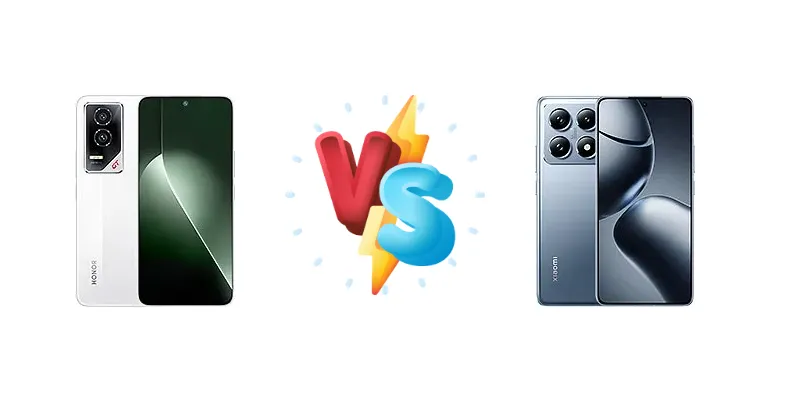
The Honor GT and Xiaomi 14T Pro represent compelling options in the increasingly competitive flagship space. The Honor GT leverages Qualcomm’s latest Snapdragon 8 Gen 3, while the Xiaomi 14T Pro opts for MediaTek’s Dimensity 9300+. This comparison dissects the key differences, focusing on performance, charging capabilities, and real-world usability to determine which device delivers the best overall experience.
🏆 Quick Verdict
For users prioritizing raw processing power and gaming, the Honor GT with its Snapdragon 8 Gen 3 is the superior choice. However, the Xiaomi 14T Pro counters with significantly faster charging – reaching 100% in just 19 minutes – and a longer active use battery score, making it ideal for those constantly on the move.
| Network |
|---|
| 2G bands | GSM 850 / 900 / 1800 / 1900 | GSM 850 / 900 / 1800 / 1900 |
| 3G bands | HSDPA 850 / 900 / 1900 / 2100 | HSDPA 800 / 850 / 900 / 1700(AWS) / 1900 / 2100 |
| 4G bands | LTE | 1, 2, 3, 4, 5, 7, 8, 12, 13, 17, 18, 19, 20, 25, 26, 28, 32, 38, 39, 40, 41, 42, 48, 66 |
| 5G bands | SA/NSA | 1, 2, 3, 5, 7, 8, 12, 20, 25, 26, 28, 38, 40, 41, 48, 66, 75, 77, 78 SA/NSA |
| Speed | HSPA, LTE, 5G | HSPA, LTE, 5G |
| Technology | GSM / HSPA / LTE / 5G | GSM / HSPA / LTE / 5G |
| Launch |
|---|
| Announced | 2024, December 17 | 2024, September 26 |
| Status | Available. Released 2024, December 17 | Available. Released 2024, September 26 |
| Body |
|---|
| Build | - | Glass front (Gorilla Glass 5), aluminum frame, glass back (Panda X) |
| Dimensions | 161 x 74.2 x 7.7 mm (6.34 x 2.92 x 0.30 in) | 160.4 x 75.1 x 8.4 mm (6.31 x 2.96 x 0.33 in) |
| SIM | Nano-SIM + Nano-SIM | · Nano-SIM + eSIM· eSIM + eSIM· Nano-SIM + Nano-SIM |
| Weight | 196 g (6.91 oz) | 209 g (7.37 oz) |
| Display |
|---|
| Protection | - | Corning Gorilla Glass 5 |
| Resolution | 1200 x 2664 pixels (~436 ppi density) | 1220 x 2712 pixels, 20:9 ratio (~446 ppi density) |
| Size | 6.7 inches, 108.5 cm2 (~90.8% screen-to-body ratio) | 6.67 inches, 107.4 cm2 (~89.1% screen-to-body ratio) |
| Type | AMOLED, 1B colors, 120Hz, HDR, 1200 nits (HBM), 4000 nits (peak) | AMOLED, 68B colors, 144Hz, 3840Hz PWM, Dolby Vision, HDR10+, 1600 nits (HBM), 4000 nits (peak) |
| Platform |
|---|
| CPU | 8-core (1x3.3GHz Cortex-X4 & 3x3.2GHz Cortex-A720 & 2x3.0GHz Cortex-A720 & 2x2.3GHz Cortex-A520) | Octa-core (1x3.4 GHz Cortex-X4 & 3x2.85 GHz Cortex-X4 & 4x2.0 GHz Cortex-A720) |
| Chipset | Qualcomm SM8650-AB Snapdragon 8 Gen 3 (4 nm) | Mediatek Dimensity 9300+ (4 nm) |
| GPU | Adreno 750 | Immortalis-G720 MC12 |
| OS | Android 15, MagicOS 9 | Android 14, HyperOS |
| Memory |
|---|
| Card slot | No | No |
| Internal | 256GB 12GB RAM, 256GB 16GB RAM, 512GB 12GB RAM, 512GB 16GB RAM, 1TB 16GB RAM | 256GB 12GB RAM, 512GB 12GB RAM, 512GB 16GB RAM, 1TB 12GB RAM |
| Main Camera |
|---|
| Dual | 50 MP, f/2.0, (wide), 1/1.56", 1.0µm, PDAF, OIS
12 MP, f/2.2, 112˚ (ultrawide), AF | - |
| Features | LED flash, HDR, panorama | Leica lens, Ultra HDR, LED flash, HDR, panorama |
| Triple | - | 50 MP, f/1.6, 23mm (wide), 1/1.31", 1.2µm, PDAF, OIS
50 MP, f/2.0, 60mm (telephoto), 1/2.88", 0.61µm, PDAF, 2.6x optical zoom
12 MP, f/2.2, 15mm (ultrawide), 1/3.06", 1.12µm |
| Video | 4K, 1080p, gyro-EIS, OIS | 8K@24/30fps, 4K@24/30/60fps, 1080p@30/60/120/240/960fps, gyro-EIS, 10-bit Rec. 2020, HDR10+ |
| Selfie camera |
|---|
| Features | HDR | HDR |
| Single | 16 MP, f/2.5, (wide) | 32 MP, f/2.0, 25mm (wide), 1/3.44", 0.64µm |
| Video | 1080p, gyro-EIS | 4K@30fps, 1080p@30/60fps, HDR10+ |
| Sound |
|---|
| 35mm jack | No | No |
| Loudspeaker | Yes, with stereo speakers | Yes, with stereo speakers |
| Comms |
|---|
| Bluetooth | 5.3, A2DP, LE, aptX HD | 5.4, A2DP, LE, LHDC |
| Infrared port | Yes | Yes |
| NFC | Yes | Yes (market/region dependent) |
| Positioning | GPS, GALILEO, GLONASS, BDS (B1I+B1c) | GPS (L1+L5), BDS (B1I+B1C+B2a+B2b), GALILEO (E1+E5a+E5b), QZSS (L1+L5), NavIC (L5), GLONASS |
| Radio | No | No |
| USB | USB Type-C 2.0, OTG | USB Type-C 2.0, OTG |
| WLAN | Wi-Fi 802.11 a/b/g/n/ac/6/7, dual-band, Wi-Fi Direct | Wi-Fi 802.11 a/b/g/n/ac/6e/7, dual-band, Wi-Fi Direct |
| Features |
|---|
| Sensors | Fingerprint (under display, optical), accelerometer, gyro, compass, ultrasound proximity | Fingerprint (under display, optical), accelerometer, gyro, proximity, compass |
| Battery |
|---|
| Charging | 100W wired, 60% in 15 min
5W reverse wired | 120W wired, PD3.0, QC4, 100% in 19 min
50W wireless, 100% in 45 min |
| Type | Si/C Li-Ion 5300 mAh | Li-Po 5000 mAh |
| Misc |
|---|
| Colors | Black, White, Green | Titan Gray, Titan Blue, Titan Black |
| Models | AMG-AN00 | 2407FPN8EG |
| Price | About 290 EUR | $ 550.00 / £ 498.00 / € 539.99 |
| SAR EU | - | 0.99 W/kg (head) 1.00 W/kg (body) |
Honor GT
- Potentially superior single-core performance with Snapdragon 8 Gen 3
- Likely better GPU performance for gaming
- Qualcomm’s established gaming optimizations
- Slower charging speed compared to Xiaomi 14T Pro
- No wireless charging support
- Battery life potentially lower than Xiaomi 14T Pro
Xiaomi 14T Pro
- Incredibly fast 120W wired charging (19 minutes to full)
- 50W wireless charging support
- Excellent battery life (12:32h active use)
- Dimensity 9300+ may trail Snapdragon 8 Gen 3 in peak gaming performance
- Potentially less refined image processing compared to Snapdragon
- Display brightness is a key advantage, but other display specs are unknown
Display Comparison
The Xiaomi 14T Pro boasts a measured peak brightness of 1228 nits, exceeding what we’d expect and providing excellent visibility outdoors. While the Honor GT’s display specs are currently unavailable, the Xiaomi’s high brightness is a clear advantage for sunlight readability. Both devices utilize a 4nm chipset, suggesting similar power efficiency in display operation. The Xiaomi 14T Pro’s brightness is a key differentiator for users who frequently consume content outdoors.
Camera Comparison
Without detailed camera specifications for the Honor GT, a direct comparison is limited. However, the Xiaomi 14T Pro’s camera system likely focuses on computational photography leveraging the Dimensity 9300+'s ISP. The absence of information regarding sensor sizes and OIS on the Honor GT makes it difficult to assess its photographic capabilities. We anticipate both phones will offer capable main cameras, but the Xiaomi’s image processing pipeline will likely be more refined given MediaTek’s recent advancements in this area.
Performance
The core of the difference lies in the chipsets. The Honor GT’s Snapdragon 8 Gen 3 (4nm) features a 1x3.3GHz Cortex-X4 prime core, complemented by 3x3.2GHz Cortex-A720 cores and 2x2.3GHz Cortex-A520 cores. The Xiaomi 14T Pro’s Dimensity 9300+ (also 4nm) employs a 1x3.4 GHz Cortex-X4, but notably includes *three* 2.85 GHz Cortex-X4 cores, alongside 4x2.0 GHz Cortex-A720 cores. This configuration suggests the Dimensity 9300+ may excel in multi-threaded workloads, while the Snapdragon 8 Gen 3’s architecture is optimized for single-core performance and gaming. The Snapdragon’s Adreno GPU is generally considered superior for graphics-intensive tasks. Both utilize LPDDR5x RAM, but thermal management will be crucial in sustaining peak performance.
Battery Life
The Xiaomi 14T Pro shines in battery and charging. Its active use score of 12:32h demonstrates excellent endurance. The 120W wired charging, capable of a full charge in just 19 minutes, is a significant advantage over the Honor GT’s 100W charging (60% in 15 minutes). Furthermore, the Xiaomi 14T Pro adds 50W wireless charging, a feature absent on the Honor GT. While the Honor GT’s battery capacity is unknown, the Xiaomi’s combination of endurance and charging speed makes it the clear winner for users prioritizing these aspects.
Buying Guide
Buy the Honor GT if you demand the absolute best CPU and GPU performance for demanding games and applications, and are willing to trade some charging speed for that power. Buy the Xiaomi 14T Pro if you prioritize all-day battery life, incredibly fast charging (including wireless), and a consistently bright display, even if it means a slight performance compromise.
Frequently Asked Questions
❓ Does the Dimensity 9300+ in the Xiaomi 14T Pro overheat during prolonged gaming sessions?
While the Dimensity 9300+ is a powerful chip, thermal throttling is always a concern. MediaTek has made significant strides in thermal management with this generation, and the Xiaomi 14T Pro likely incorporates advanced cooling solutions. However, sustained peak performance may result in some heat buildup, potentially leading to slight frame rate drops over extended gaming periods. Real-world testing is needed to fully assess its thermal performance.
❓ How does the 100W charging on the Honor GT compare to the 120W on the Xiaomi 14T Pro in terms of actual charging time?
The Xiaomi 14T Pro’s 120W charging is significantly faster, achieving a full charge in just 19 minutes. The Honor GT’s 100W charging reaches 60% in 15 minutes, but takes longer to complete the full cycle. This difference is substantial for users who frequently need to quickly top up their battery.
❓ Is the Xiaomi 14T Pro’s 50W wireless charging compatible with all Qi wireless chargers?
The Xiaomi 14T Pro supports the Qi wireless charging standard, but for optimal performance and to achieve the full 50W charging speed, it’s recommended to use a charger specifically designed for this wattage. Standard Qi chargers may deliver slower charging speeds.