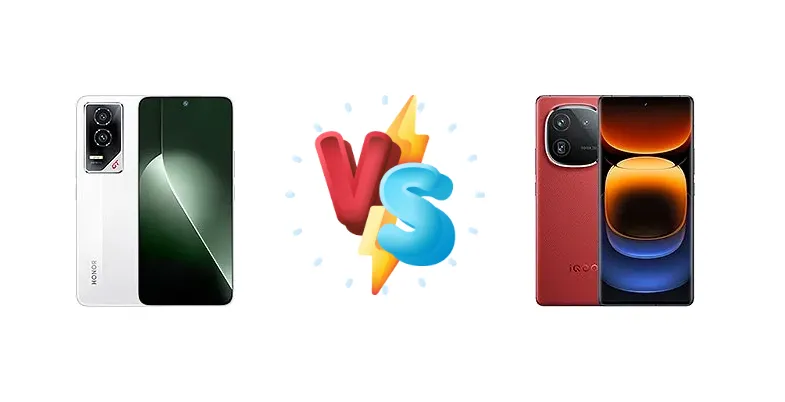
The Honor GT and vivo iQOO 12 Pro represent the cutting edge of Android performance, both powered by Qualcomm’s Snapdragon 8 Gen 3. However, these devices aren’t simply clones; they diverge significantly in charging technology and wireless features, creating a clear choice for users prioritizing speed versus convenience.
🏆 Quick Verdict
For the average user, the vivo iQOO 12 Pro emerges as the stronger contender. While both phones share the same processor, the iQOO 12 Pro’s 120W wired charging and inclusion of 50W wireless charging offer a substantial advantage in daily usability and convenience, justifying its potential price premium.
| Network |
|---|
| 2G bands | GSM 850 / 900 / 1800 / 1900 | GSM 850 / 900 / 1800 / 1900 |
| 3G bands | HSDPA 850 / 900 / 1900 / 2100 | HSDPA 800 / 850 / 900 / 1700(AWS) / 1900 / 2100 |
| 4G bands | LTE | 1, 2, 3, 4, 5, 7, 8, 12, 17, 18, 19, 20, 25, 26, 28, 34, 38, 39, 40, 41, 42, 66 |
| 5G bands | SA/NSA | 1, 2, 3, 5, 7, 8, 12, 20, 25, 26, 28, 66, 38, 40, 41, 77, 78 SA/NSA |
| Speed | HSPA, LTE, 5G | HSPA, LTE, 5G |
| Technology | GSM / HSPA / LTE / 5G | GSM / CDMA / HSPA / CDMA2000 / LTE / 5G |
| Launch |
|---|
| Announced | 2024, December 17 | 2023, November 07 |
| Status | Available. Released 2024, December 17 | Available. Released 2023, November 14 |
| Body |
|---|
| Dimensions | 161 x 74.2 x 7.7 mm (6.34 x 2.92 x 0.30 in) | 164.6 x 75.4 x 8.6 mm or 8.8 mm |
| SIM | Nano-SIM + Nano-SIM | Nano-SIM + Nano-SIM |
| Weight | 196 g (6.91 oz) | 205 g or 210 g (7.23 oz) |
| Display |
|---|
| Resolution | 1200 x 2664 pixels (~436 ppi density) | 1440 x 3200 pixels, 20:9 ratio (~518 ppi density) |
| Size | 6.7 inches, 108.5 cm2 (~90.8% screen-to-body ratio) | 6.78 inches, 111.0 cm2 (~89.4% screen-to-body ratio) |
| Type | AMOLED, 1B colors, 120Hz, HDR, 1200 nits (HBM), 4000 nits (peak) | LTPO AMOLED, 1B colors, 144Hz, HDR10+, 1600 nits (HBM), 3000 nits (peak) |
| Platform |
|---|
| CPU | 8-core (1x3.3GHz Cortex-X4 & 3x3.2GHz Cortex-A720 & 2x3.0GHz Cortex-A720 & 2x2.3GHz Cortex-A520) | Octa-core (1x3.3 GHz Cortex-X4 & 3x3.2 GHz Cortex-A720 & 2x3.0 GHz Cortex-A720 & 2x2.3 GHz Cortex-A520) |
| Chipset | Qualcomm SM8650-AB Snapdragon 8 Gen 3 (4 nm) | Qualcomm SM8650-AB Snapdragon 8 Gen 3 (4 nm) |
| GPU | Adreno 750 | Adreno 750 |
| OS | Android 15, MagicOS 9 | Android 14, up to 2 major Android upgrades, Funtouch 14 (International), OriginOS 4 (China) |
| Memory |
|---|
| Card slot | No | No |
| Internal | 256GB 12GB RAM, 256GB 16GB RAM, 512GB 12GB RAM, 512GB 16GB RAM, 1TB 16GB RAM | 256GB 16GB RAM, 512GB 16GB RAM, 1TB 16GB RAM |
| Main Camera |
|---|
| Dual | 50 MP, f/2.0, (wide), 1/1.56", 1.0µm, PDAF, OIS
12 MP, f/2.2, 112˚ (ultrawide), AF | - |
| Features | LED flash, HDR, panorama | Color spectrum sensor, Dual-LED flash, HDR, panorama |
| Triple | - | 50 MP, f/1.7, 23mm (wide), 1/1.3", 1.2µm, ulti-directional PDAF, OIS
64 MP, f/2.6, 70mm (periscope telephoto), 1/2.0", PDAF, OIS, 3x optical zoom
50 MP, f/2.0, 15mm, 119˚ (ultrawide), AF |
| Video | 4K, 1080p, gyro-EIS, OIS | 8K@30fps, 4K@24/30/60fps, 1080p@30/60/120/240fps, gyro-EIS |
| Selfie camera |
|---|
| Features | HDR | HDR |
| Single | 16 MP, f/2.5, (wide) | 16 MP, f/2.5, (wide) |
| Video | 1080p, gyro-EIS | 1080p@30fps, gyro-EIS |
| Sound |
|---|
| 35mm jack | No | No |
| Loudspeaker | Yes, with stereo speakers | Yes, with stereo speakers |
| Comms |
|---|
| Bluetooth | 5.3, A2DP, LE, aptX HD | 5.4, A2DP, LE, aptX HD, aptX Adaptive, aptX Lossless |
| Infrared port | Yes | Yes |
| NFC | Yes | Yes |
| Positioning | GPS, GALILEO, GLONASS, BDS (B1I+B1c) | GPS (L1+L5), GLONASS (G1), BDS (B1I+B1c+B2a), GALILEO (E1+E5a), QZSS (L1+L5) |
| Radio | No | No |
| USB | USB Type-C 2.0, OTG | USB Type-C 2.0, OTG |
| WLAN | Wi-Fi 802.11 a/b/g/n/ac/6/7, dual-band, Wi-Fi Direct | Wi-Fi 802.11 a/b/g/n/ac/6/7, tri-band, Wi-Fi Direct |
| Features |
|---|
| Sensors | Fingerprint (under display, optical), accelerometer, gyro, compass, ultrasound proximity | Fingerprint (under display, ultrasonic), accelerometer, gyro, proximity, compass |
| Battery |
|---|
| Charging | 100W wired, 60% in 15 min
5W reverse wired | 120W wired
50W wireless
10W reverse wireless |
| Type | Si/C Li-Ion 5300 mAh | 5100 mAh |
| Misc |
|---|
| Colors | Black, White, Green | Black, Red, White (BMW M branding) |
| Models | AMG-AN00 | V2329A |
| Price | About 290 EUR | About 650 EUR |
Honor GT
- Potentially lower price point
- Fast 100W wired charging
- Snapdragon 8 Gen 3 performance
- No wireless charging
- Slower charging than iQOO 12 Pro
vivo iQOO 12 Pro
- Industry-leading 120W wired charging
- Convenient 50W wireless charging
- Snapdragon 8 Gen 3 performance
- Likely higher price
- Potential for faster battery degradation with extreme fast charging
Display Comparison
Both devices utilize the Snapdragon 8 Gen 3, meaning display performance will be largely similar, assuming comparable panel quality. However, specifics like peak brightness and PWM dimming frequency (not provided) will be crucial differentiators. The absence of LTPO information suggests both may not dynamically adjust refresh rates for optimal power efficiency, potentially impacting battery life during static content viewing. Bezels are likely similar given the focus on maximizing screen real estate in this segment.
Camera Comparison
Without detailed camera specifications, a direct comparison is limited. However, the market positioning of both brands suggests a focus on computational photography. The iQOO series often emphasizes image processing algorithms for vibrant, social media-ready photos, while Honor tends towards a more natural color profile. Sensor size and OIS implementation (not specified) will be key determinants of low-light performance. The absence of information regarding lens apertures makes it difficult to assess depth of field capabilities.
Performance
The core performance is virtually identical, as both the Honor GT and vivo iQOO 12 Pro are equipped with the Qualcomm SM8650-AB Snapdragon 8 Gen 3 (4nm). The CPU configuration – 1x3.3GHz Cortex-X4, 3x3.2GHz Cortex-A720, 2x3.0GHz Cortex-A720, and 2x2.3GHz Cortex-A520 – is mirrored across both devices. The 4nm process node ensures excellent thermal efficiency, but sustained performance will depend heavily on the cooling solutions employed by each manufacturer (data not provided). RAM speed (likely LPDDR5x) is also expected to be comparable, minimizing performance bottlenecks.
Battery Life
The iQOO 12 Pro’s 120W wired charging significantly outpaces the Honor GT’s 100W, promising a faster 0-100% charge time. The iQOO 12 Pro also introduces 50W wireless charging, a feature absent in the Honor GT. While battery capacity isn’t specified, the faster charging speeds of the iQOO 12 Pro effectively mitigate the impact of a potentially smaller battery, offering more flexibility for users who frequently top up their devices. The 5W/10W reverse wired charging on both devices is primarily for accessories, not substantial power delivery to other phones.
Buying Guide
Buy the Honor GT if you prioritize a potentially lower price point and are comfortable relying solely on fast wired charging. It’s a solid choice for gamers who primarily charge overnight. Buy the vivo iQOO 12 Pro if you value the flexibility of both incredibly fast wired charging *and* convenient wireless charging, and are willing to pay a bit more for the added functionality. This phone caters to users constantly on the move.
Frequently Asked Questions
❓ Will the 120W charging of the iQOO 12 Pro significantly degrade the battery health over time?
While extremely fast charging can theoretically accelerate battery degradation, modern smartphones employ sophisticated charging management systems to mitigate this effect. The iQOO 12 Pro likely utilizes adaptive charging algorithms that slow down the charging rate as the battery nears full capacity, minimizing heat and stress on the battery cells. However, long-term battery health will inevitably be affected by any charging method.
❓ Does either phone support 8K video recording, and if so, at what frame rate?
The Snapdragon 8 Gen 3 is capable of 8K video recording, but whether either the Honor GT or iQOO 12 Pro fully supports this feature, and at what frame rate (24/30fps), is not specified in the provided data. This would depend on the camera software and hardware implementation by each manufacturer.
❓ How does the thermal management differ between the Honor GT and iQOO 12 Pro during extended gaming sessions?
Without specific details on the cooling systems (vapor chamber size, heat pipe configuration, etc.), it's difficult to definitively say which phone manages thermals better. However, iQOO phones are often marketed with a strong focus on gaming performance, suggesting a potentially more robust cooling solution. Both phones benefit from the 4nm Snapdragon 8 Gen 3, which is more efficient than previous generations.