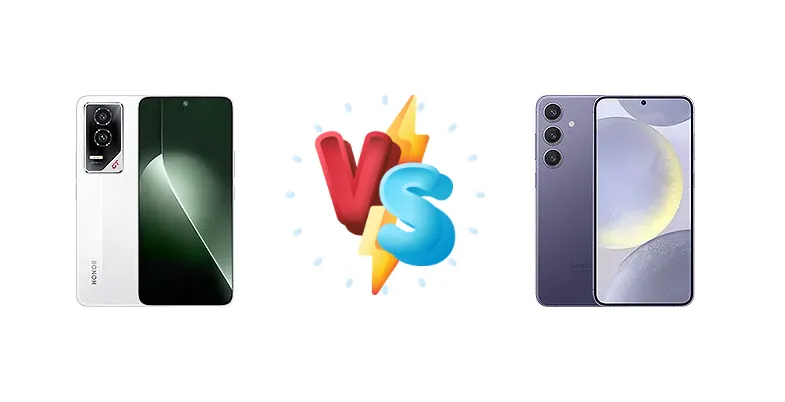
Both the Honor GT and Samsung Galaxy S24+ represent the pinnacle of Android flagship performance, powered by the latest Snapdragon 8 Gen 3. However, they diverge significantly in their approach to battery technology, charging speeds, and overall user experience. This comparison dissects these differences to determine which device delivers the best value for demanding users.
🏆 Quick Verdict
For users prioritizing raw speed and incredibly fast charging, the Honor GT emerges as the winner. Its 100W charging dramatically reduces downtime. However, the Galaxy S24+ offers a more refined software experience and demonstrably longer battery life in active use, making it the better choice for all-day productivity.
| Network |
|---|
| 2G bands | GSM 850 / 900 / 1800 / 1900 | GSM 850 / 900 / 1800 / 1900 |
| 3G bands | HSDPA 850 / 900 / 1900 / 2100 | HSDPA 850 / 900 / 1700(AWS) / 1900 / 2100 |
| 4G bands | LTE | 1, 2, 3, 4, 5, 7, 8, 12, 13, 17, 18, 19, 20, 25, 26, 28, 32, 38, 39, 40, 41, 66 - International |
| 5G bands | SA/NSA | 1, 2, 3, 5, 7, 8, 12, 20, 25, 26, 28, 38, 40, 41, 66, 75, 77, 78 SA/NSA/Sub6 - International |
| Speed | HSPA, LTE, 5G | HSPA, LTE (up to 7CA), 5G |
| Technology | GSM / HSPA / LTE / 5G | GSM / CDMA / HSPA / EVDO / LTE / 5G |
| Launch |
|---|
| Announced | 2024, December 17 | 2024, January 17 |
| Status | Available. Released 2024, December 17 | Available. Released 2024, January 24 |
| Body |
|---|
| Build | - | Glass front (Gorilla Glass Victus 2), glass back (Gorilla Glass Victus 2), aluminum frame |
| Dimensions | 161 x 74.2 x 7.7 mm (6.34 x 2.92 x 0.30 in) | 158.5 x 75.9 x 7.7 mm (6.24 x 2.99 x 0.30 in) |
| SIM | Nano-SIM + Nano-SIM | · Nano-SIM + Nano-SIM + eSIM + eSIM (max 2 at a time) - INT· Nano-SIM + eSIM + eSIM (max 2 at a time) - USA· Nano-SIM + Nano-SIM - CN |
| Weight | 196 g (6.91 oz) | 196 g or 197 g (6.91 oz) |
| Display |
|---|
| Protection | - | Corning Gorilla Glass Victus 2 |
| Resolution | 1200 x 2664 pixels (~436 ppi density) | 1440 x 3120 pixels, 19.5:9 ratio (~513 ppi density) |
| Size | 6.7 inches, 108.5 cm2 (~90.8% screen-to-body ratio) | 6.7 inches, 110.2 cm2 (~91.6% screen-to-body ratio) |
| Type | AMOLED, 1B colors, 120Hz, HDR, 1200 nits (HBM), 4000 nits (peak) | Dynamic LTPO AMOLED 2X, 120Hz, HDR10+, 2600 nits (peak) |
| Platform |
|---|
| CPU | 8-core (1x3.3GHz Cortex-X4 & 3x3.2GHz Cortex-A720 & 2x3.0GHz Cortex-A720 & 2x2.3GHz Cortex-A520) | 8-core (1x3.39GHz Cortex-X4 & 3x3.1GHz Cortex-A720 & 2x2.9GHz Cortex-A720 & 2x2.2GHz Cortex-A520)10-core (1x3.2GHz Cortex-X4 & 2x2.9GHz Cortex-A720 & 3x2.6GHz Cortex-A720 & 4x1.95GHz Cortex-A520) |
| Chipset | Qualcomm SM8650-AB Snapdragon 8 Gen 3 (4 nm) | Qualcomm SM8650-AC Snapdragon 8 Gen 3 (4 nm) - USA/Canada/ChinaExynos 2400 (4 nm) - International |
| GPU | Adreno 750 | Adreno 750 (1 GHz) - USA/Canada/ChinaXclipse 940 - International |
| OS | Android 15, MagicOS 9 | Android 14, up to 7 major Android upgrades, One UI 8.0 |
| Memory |
|---|
| Card slot | No | No |
| Internal | 256GB 12GB RAM, 256GB 16GB RAM, 512GB 12GB RAM, 512GB 16GB RAM, 1TB 16GB RAM | 256GB 12GB RAM, 512GB 12GB RAM |
| Main Camera |
|---|
| Dual | 50 MP, f/2.0, (wide), 1/1.56", 1.0µm, PDAF, OIS
12 MP, f/2.2, 112˚ (ultrawide), AF | - |
| Features | LED flash, HDR, panorama | LED flash, auto-HDR, panorama |
| Triple | - | 50 MP, f/1.8, 24mm (wide), 1/1.56", 1.0µm, dual pixel PDAF, OIS
10 MP, f/2.4, 67mm (telephoto), 1/3.94", 1.0µm, PDAF, OIS, 3x optical zoom
12 MP, f/2.2, 13mm, 120˚ (ultrawide), 1/2.55" 1.4µm, Super Steady video |
| Video | 4K, 1080p, gyro-EIS, OIS | 8K@24/30fps, 4K@30/60fps, 1080p@30/60/120/240fps, HDR10+, stereo sound rec., gyro-EIS |
| Selfie camera |
|---|
| Features | HDR | HDR, HDR10+ |
| Single | 16 MP, f/2.5, (wide) | 12 MP, f/2.2, 26mm (wide), 1/3.2", 1.12µm, dual pixel PDAF |
| Video | 1080p, gyro-EIS | 4K@30/60fps, 1080p@30fps |
| Sound |
|---|
| 35mm jack | No | No |
| Loudspeaker | Yes, with stereo speakers | Yes, with stereo speakers |
| Comms |
|---|
| Bluetooth | 5.3, A2DP, LE, aptX HD | 5.3, A2DP, LE |
| Infrared port | Yes | - |
| NFC | Yes | Yes |
| Positioning | GPS, GALILEO, GLONASS, BDS (B1I+B1c) | GPS, GLONASS, BDS, GALILEO, QZSS |
| Radio | No | No |
| USB | USB Type-C 2.0, OTG | USB Type-C 3.2, DisplayPort 1.2, OTG |
| WLAN | Wi-Fi 802.11 a/b/g/n/ac/6/7, dual-band, Wi-Fi Direct | Wi-Fi 802.11 a/b/g/n/ac/6e, tri-band, Wi-Fi Direct |
| Features |
|---|
| Sensors | Fingerprint (under display, optical), accelerometer, gyro, compass, ultrasound proximity | Fingerprint (under display, ultrasonic), accelerometer, gyro, proximity, compass, barometer |
| Battery |
|---|
| Charging | 100W wired, 60% in 15 min
5W reverse wired | 45W wired, PD3.0, 65% in 30 min
15W wireless (Qi)
4.5W reverse wireless |
| Type | Si/C Li-Ion 5300 mAh | Li-Ion 4900 mAh |
| Misc |
|---|
| Colors | Black, White, Green | Onyx Black, Marble Grey, Cobalt Violet, Amber Yellow, Jade Green, Sandstone Orange, Sapphire Blue |
| Models | AMG-AN00 | SM-S926B, SM-S926B/DS, SM-S926U, SM-S926U1, SM-S926W, SM-S926N, SM-S9260, SM-S926E, SM-S926E/DS |
| Price | About 290 EUR | $ 429.50 / € 549.00 / £ 445.98 |
| SAR | - | 1.16 W/kg (head) 0.84 W/kg (body) |
| SAR EU | - | 0.74 W/kg (head) 1.25 W/kg (body) |
Honor GT
- Incredibly fast 100W wired charging
- Consistent Snapdragon 8 Gen 3 performance globally
- Potentially more aggressive pricing (based on brand history)
- Missing detailed camera specifications
- Unknown battery capacity
- Software experience may be less refined than Samsung
Samsung Galaxy S24+
- Excellent 12:30h battery life in active use
- Bright and vibrant display with likely LTPO support
- Mature and feature-rich One UI software
- Slower 45W charging compared to Honor GT
- Regional variations with Exynos 2400 chip
- Potentially higher price point
Display Comparison
The Samsung Galaxy S24+ boasts a significantly brighter display, reaching a measured 1452 nits, crucial for outdoor visibility. While the Honor GT’s display specs are not provided, Samsung’s panel likely utilizes LTPO technology for adaptive refresh rates, conserving battery life. The S24+'s brightness advantage will be noticeable in direct sunlight, while the Honor GT's display quality remains unknown without further data. The S24+'s panel is also likely to have superior color accuracy and calibration.
Camera Comparison
Detailed camera specs for the Honor GT are missing, making a direct comparison difficult. The Galaxy S24+’s camera system is expected to deliver excellent photo and video quality, leveraging Samsung’s image processing expertise. Without knowing the sensor sizes and lens apertures of the Honor GT, it’s difficult to assess its capabilities. The S24+'s OIS (Optical Image Stabilization) will be crucial for stable video recording and low-light photography. We can assume the S24+ will offer a more versatile and refined camera experience.
Performance
Both phones utilize the Qualcomm SM8650-AB Snapdragon 8 Gen 3 (4nm) in select regions, promising similar CPU performance. The S24+’s CPU clocks are slightly higher (3.39GHz vs 3.3GHz Cortex-X4), but the real-world impact will be minimal. However, the S24+ also ships with the Exynos 2400 in international markets. The Exynos variant’s 10-core architecture, while seemingly more complex, doesn’t necessarily translate to superior performance and may introduce thermal throttling concerns. The Honor GT’s consistent Snapdragon 8 Gen 3 across all regions provides a more predictable performance profile. Both devices benefit from LPDDR5x RAM, ensuring fast data access.
Battery Life
The Samsung Galaxy S24+ achieves an impressive 12:30h active use score, indicating strong battery endurance. The Honor GT’s battery capacity is not specified, but its 100W wired charging is a game-changer, achieving 60% charge in just 15 minutes. The S24+’s 45W charging, taking 30 minutes for 65% charge, is considerably slower. While the Honor GT may have a smaller battery, its rapid charging mitigates this, offering quicker top-ups. The S24+ also supports 15W wireless charging and 4.5W reverse wireless charging, features the Honor GT matches with 5W reverse wired.
Buying Guide
Buy the Honor GT if you need blistering fast charging, prioritize peak gaming performance, and are comfortable with a potentially less polished software experience. Buy the Samsung Galaxy S24+ if you prefer a longer-lasting battery, a more mature and feature-rich software ecosystem, and a brighter, more visible display in direct sunlight.
Frequently Asked Questions
❓ Does the Exynos 2400 chip in the international Galaxy S24+ overheat during prolonged gaming sessions?
Early reports suggest the Exynos 2400 can exhibit thermal throttling under sustained load, potentially leading to reduced performance during extended gaming. The Snapdragon 8 Gen 3 variant is generally considered more thermally efficient, making it the preferred choice for gamers.
❓ How much faster is the Honor GT's 100W charging in real-world scenarios compared to the Galaxy S24+'s 45W charging?
The Honor GT can gain 60% charge in 15 minutes, while the Galaxy S24+ requires 30 minutes for 65%. This translates to a significantly faster top-up for the Honor GT, ideal for users who frequently need a quick power boost.
❓ Is the lack of detailed camera specs for the Honor GT a major concern?
Yes, the absence of information regarding sensor size, lens aperture, and image processing capabilities makes it difficult to assess the Honor GT's camera performance. The Galaxy S24+ benefits from Samsung's well-regarded camera technology and provides a more predictable photographic experience.
❓ Will the Honor GT receive the same level of software updates and support as the Samsung Galaxy S24+?
Samsung typically provides longer software support and more frequent updates for its flagship devices. Honor's update schedule is less consistent, so users should expect a potentially shorter lifespan of software support compared to the Galaxy S24+.