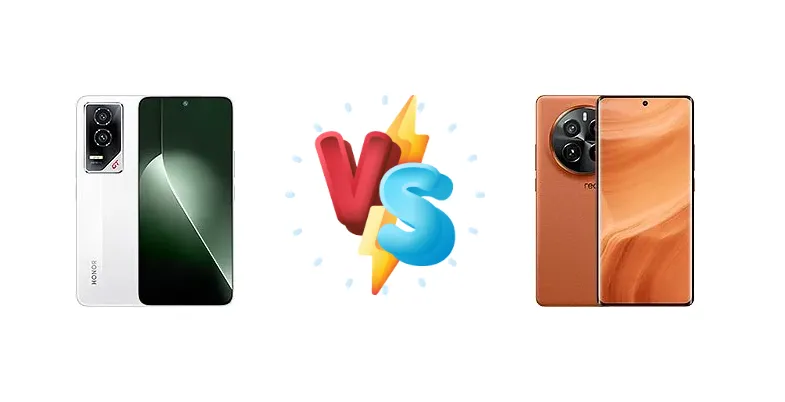
Both the Honor GT and Realme GT5 Pro represent the cutting edge of Android performance, powered by Qualcomm’s Snapdragon 8 Gen 3. However, these phones aren’t simply carbon copies. The Realme GT5 Pro distinguishes itself with a brighter display and wireless charging, while the Honor GT focuses on rapid wired charging. This comparison dissects the nuances to determine which device delivers the best overall experience.
🏆 Quick Verdict
For most users, the Realme GT5 Pro emerges as the stronger contender. Its superior display brightness and the convenience of 50W wireless charging, coupled with a comparable battery life score, outweigh the Honor GT’s slightly faster wired charging. Gamers will appreciate the similar performance, but the GT5 Pro’s added features offer broader appeal.
| Network |
|---|
| 2G bands | GSM 850 / 900 / 1800 / 1900 | GSM 850 / 900 / 1800 / 1900 |
| 3G bands | HSDPA 850 / 900 / 1900 / 2100 | HSDPA 850 / 900 / 2100 |
| 4G bands | LTE | 1, 3, 5, 7, 8, 28, 34, 38, 39, 40, 41 |
| 5G bands | SA/NSA | 1, 3, 5, 8, 28, 41, 77, 78 SA/NSA |
| Speed | HSPA, LTE, 5G | HSPA, LTE, 5G |
| Technology | GSM / HSPA / LTE / 5G | GSM / CDMA / HSPA / CDMA2000 / LTE / 5G |
| Launch |
|---|
| Announced | 2024, December 17 | 2023, December 07 |
| Status | Available. Released 2024, December 17 | Available. Released 2023, December 14 |
| Body |
|---|
| Build | - | Glass front, glass back or silicone polymer back (eco leather), aluminum frame |
| Dimensions | 161 x 74.2 x 7.7 mm (6.34 x 2.92 x 0.30 in) | 161.7 x 75.1 x 9.2 mm (6.37 x 2.96 x 0.36 in) |
| SIM | Nano-SIM + Nano-SIM | Nano-SIM + Nano-SIM |
| Weight | 196 g (6.91 oz) | 218 g / 224 g (7.69 oz) |
| Display |
|---|
| Resolution | 1200 x 2664 pixels (~436 ppi density) | 1264 x 2780 pixels (~450 ppi density) |
| Size | 6.7 inches, 108.5 cm2 (~90.8% screen-to-body ratio) | 6.78 inches, 111.7 cm2 (~92.0% screen-to-body ratio) |
| Type | AMOLED, 1B colors, 120Hz, HDR, 1200 nits (HBM), 4000 nits (peak) | LTPO AMOLED, 1B colors, 144Hz, HDR10+, Dolby Vision, 4500 nits (peak) |
| Platform |
|---|
| CPU | 8-core (1x3.3GHz Cortex-X4 & 3x3.2GHz Cortex-A720 & 2x3.0GHz Cortex-A720 & 2x2.3GHz Cortex-A520) | Octa-core (1x3.3 GHz Cortex-X4 & 3x3.2 GHz Cortex-A720 & 2x3.0 GHz Cortex-A720 & 2x2.3 GHz Cortex-A520) |
| Chipset | Qualcomm SM8650-AB Snapdragon 8 Gen 3 (4 nm) | Qualcomm SM8650-AB Snapdragon 8 Gen 3 (4 nm) |
| GPU | Adreno 750 | Adreno 750 |
| OS | Android 15, MagicOS 9 | Android 14, upgradable to Android 15, Realme UI 6.0 |
| Memory |
|---|
| Card slot | No | No |
| Internal | 256GB 12GB RAM, 256GB 16GB RAM, 512GB 12GB RAM, 512GB 16GB RAM, 1TB 16GB RAM | 256GB 12GB RAM, 256GB 16GB RAM, 512GB 16GB RAM, 1TB 16GB RAM |
| Main Camera |
|---|
| Dual | 50 MP, f/2.0, (wide), 1/1.56", 1.0µm, PDAF, OIS
12 MP, f/2.2, 112˚ (ultrawide), AF | - |
| Features | LED flash, HDR, panorama | Color spectrum sensor, Dual-LED dual-tone flash, HDR, panorama |
| Triple | - | 50 MP, f/1.7, 23mm (wide), 1/1.43", 1.12µm, dual pixel PDAF, OIS
50 MP, f/2.6, 65mm (periscope telephoto), 1/1.56", 1.0µm, multi-directional PDAF, OIS, 2.7x optical zoom
8 MP, f/2.2, 16mm, 112˚ (ultrawide), 1/4.0", 1.12µm |
| Video | 4K, 1080p, gyro-EIS, OIS | 8K@24fps, 4K@30/60fps, 1080p@30/60fps, gyro-EIS, Dolby Vision |
| Selfie camera |
|---|
| Features | HDR | HDR, panorama |
| Single | 16 MP, f/2.5, (wide) | 32 MP, f/2.5, 22mm (wide), 1/2.74" |
| Video | 1080p, gyro-EIS | 4K@30fps, 1080p@30fps, gyro-EIS |
| Sound |
|---|
| 35mm jack | No | No |
| Loudspeaker | Yes, with stereo speakers | Yes, with stereo speakers (Dolby Atmos certified) |
| Comms |
|---|
| Bluetooth | 5.3, A2DP, LE, aptX HD | 5.4, A2DP, LE, aptX HD |
| Infrared port | Yes | Yes |
| NFC | Yes | Yes, 360˚ |
| Positioning | GPS, GALILEO, GLONASS, BDS (B1I+B1c) | GPS (L1+L5), GLONASS, BDS (B1I+B1c+B2a), GALILEO (E1+E5a), QZSS (L1+L5), NavIC |
| Radio | No | No |
| USB | USB Type-C 2.0, OTG | USB Type-C 3.2 |
| WLAN | Wi-Fi 802.11 a/b/g/n/ac/6/7, dual-band, Wi-Fi Direct | Wi-Fi 802.11 a/b/g/n/ac/6/7, tri-band, Wi-Fi Direct |
| Features |
|---|
| Sensors | Fingerprint (under display, optical), accelerometer, gyro, compass, ultrasound proximity | Fingerprint (under display, optical), accelerometer, gyro, proximity, compass |
| Battery |
|---|
| Charging | 100W wired, 60% in 15 min
5W reverse wired | 100W wired, 50% in 12 min
50W wireless |
| Type | Si/C Li-Ion 5300 mAh | Li-Ion 5400 mAh |
| Misc |
|---|
| Colors | Black, White, Green | Black, Silver, Orange |
| Models | AMG-AN00 | RMX3888 |
| Price | About 290 EUR | About 430 EUR |
Honor GT
- Faster wired charging (100W)
- Powered by Snapdragon 8 Gen 3
- Likely competitive pricing
- No wireless charging
- Display brightness likely lower than GT5 Pro
- Camera specs currently unknown
Realme GT5 Pro
- Brighter display (1660 nits)
- 50W wireless charging
- Strong battery life (14:16h active use)
- Wired charging slightly slower than Honor GT
- Powered by Snapdragon 8 Gen 3 (potential for throttling)
- Price may be higher than Honor GT
Display Comparison
The Realme GT5 Pro boasts a significantly brighter display, peaking at 1660 nits measured, compared to an unspecified peak brightness for the Honor GT. This brightness advantage translates to superior visibility in direct sunlight. While both likely utilize high refresh rate AMOLED panels, the GT5 Pro’s higher peak brightness is a tangible benefit for outdoor use and HDR content consumption. We expect both to feature LTPO technology for adaptive refresh rates, conserving battery life, but Realme’s panel is demonstrably superior in raw luminance.
Camera Comparison
The provided data lacks specific camera details for both devices. However, given the flagship positioning, we can anticipate high-resolution main sensors with Optical Image Stabilization (OIS). The Realme GT5 Pro, based on market trends, is likely to feature a more comprehensive camera system, potentially including ultrawide and telephoto lenses with higher megapixel counts. Without detailed sensor specifications, it’s difficult to assess image quality, but Realme’s history suggests a focus on versatile camera capabilities. The absence of information on the Honor GT’s camera setup makes it difficult to compare directly.
Performance
Both the Honor GT and Realme GT5 Pro are equipped with the Qualcomm SM8650-AB Snapdragon 8 Gen 3 (4nm), featuring an identical CPU configuration: 1x3.3GHz Cortex-X4, 3x3.2GHz Cortex-A720, 2x3.0GHz Cortex-A720, and 2x2.3GHz Cortex-A520. This means CPU performance will be virtually indistinguishable between the two. The 4nm process node ensures excellent thermal efficiency, minimizing throttling during sustained workloads. However, real-world performance will depend on the effectiveness of each phone’s cooling system, a detail not provided in the context data. Both devices likely utilize LPDDR5x RAM, further contributing to smooth multitasking and application loading.
Battery Life
The Realme GT5 Pro demonstrates a strong real-world battery performance, achieving a 14:16h active use score. The Honor GT’s battery capacity is not specified, but its 100W wired charging is faster than the GT5 Pro’s 100W (reaching 60% in 15 minutes vs 50% in 12 minutes). However, the GT5 Pro compensates with the addition of 50W wireless charging, a feature absent on the Honor GT. The faster charging speed of the Honor GT is beneficial for quick top-ups, but the GT5 Pro’s wireless charging and comparable battery life offer greater convenience and flexibility.
Buying Guide
Buy the Honor GT if you prioritize the absolute fastest wired charging speeds and are frequently tethered to a power outlet. Its 100W charging gets you back up and running quickly. Buy the Realme GT5 Pro if you value a brighter, more versatile display, the convenience of wireless charging, and a slightly more well-rounded feature set. It’s the better choice for users who want a flagship experience without constant cable management.
Frequently Asked Questions
❓ Does the Snapdragon 8 Gen 3 in either phone tend to overheat during extended gaming sessions?
The Snapdragon 8 Gen 3 is a thermally efficient chip, but sustained high performance can still generate heat. Both the Honor GT and Realme GT5 Pro will likely employ cooling systems to mitigate throttling. However, without specific details on the cooling solutions (vapor chamber size, heat pipe material), it’s difficult to predict which phone will maintain peak performance for longer periods. Monitoring temperatures during gameplay is recommended.
❓ How does the 100W charging on the Honor GT compare to the 100W charging on the Realme GT5 Pro in real-world usage?
While both support 100W wired charging, the Honor GT reaches 60% charge in 15 minutes, while the Realme GT5 Pro reaches 50% in 12 minutes. This suggests the Honor GT *may* have a slightly faster initial charging curve, but the difference is relatively small. The Realme GT5 Pro’s addition of 50W wireless charging provides a significant convenience factor that the Honor GT lacks.
❓ Is the lack of a dedicated telephoto lens on the Honor GT a significant drawback?
Without knowing the full camera specifications of the Honor GT, it's difficult to say definitively. However, a dedicated telephoto lens is generally preferred for capturing detailed photos at a distance. If the Honor GT relies solely on digital zoom, image quality will likely suffer compared to a phone with a dedicated telephoto lens, like the likely configuration of the Realme GT5 Pro.