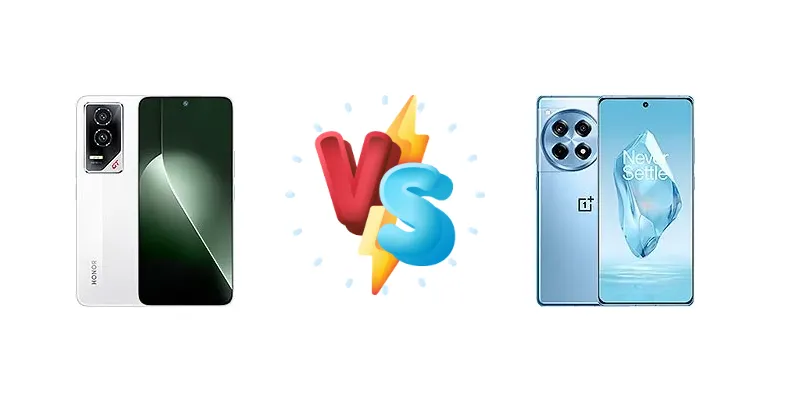
The Honor GT and OnePlus 12R represent compelling options in a crowded mid-to-high-end smartphone market. The Honor GT arrives with the latest Snapdragon 8 Gen 3, promising top-tier performance, while the OnePlus 12R focuses on delivering a balanced experience with the previous-generation Snapdragon 8 Gen 2 and a focus on long-lasting battery life. This comparison dissects their key differences to determine which device best suits your needs.
🏆 Quick Verdict
For users prioritizing raw power and demanding gaming, the Honor GT is the clear winner thanks to its Snapdragon 8 Gen 3. However, the OnePlus 12R offers exceptional value with its impressive 14:32 hour active use battery life and 100W charging, making it ideal for everyday users who prioritize endurance.
| Network |
|---|
| 2G bands | GSM 850 / 900 / 1800 / 1900 | GSM 850 / 900 / 1800 / 1900 |
| 3G bands | HSDPA 850 / 900 / 1900 / 2100 | HSDPA 850 / 900 / 1700(AWS) / 1900 / 2100 |
| 4G bands | LTE | 1, 2, 3, 4, 5, 7, 8, 12, 17, 18, 19, 20, 26, 28, 32, 38, 39, 40, 41, 66 |
| 5G bands | SA/NSA | 1, 2, 3, 5, 7, 8, 12, 20, 28, 38, 40, 41, 66, 77, 78 SA/NSA |
| Speed | HSPA, LTE, 5G | HSPA, LTE, 5G |
| Technology | GSM / HSPA / LTE / 5G | GSM / CDMA / HSPA / LTE / 5G |
| Launch |
|---|
| Announced | 2024, December 17 | 2024, January 23 |
| Status | Available. Released 2024, December 17 | Available. Released 2024, February 06 |
| Body |
|---|
| Build | - | Glass front (Gorilla Glass Victus 2), aluminum frame, glass back |
| Dimensions | 161 x 74.2 x 7.7 mm (6.34 x 2.92 x 0.30 in) | 163.3 x 75.3 x 8.8 mm (6.43 x 2.96 x 0.35 in) |
| SIM | Nano-SIM + Nano-SIM | · Nano-SIM + Nano-SIM + eSIM (max 2 at a time)· Nano-SIM + Nano-SIM |
| Weight | 196 g (6.91 oz) | 207 g (7.30 oz) |
| Display |
|---|
| Protection | - | Corning Gorilla Glass Victus 2 |
| Resolution | 1200 x 2664 pixels (~436 ppi density) | 1264 x 2780 pixels (~450 ppi density) |
| Size | 6.7 inches, 108.5 cm2 (~90.8% screen-to-body ratio) | 6.78 inches, 111.7 cm2 (~90.9% screen-to-body ratio) |
| Type | AMOLED, 1B colors, 120Hz, HDR, 1200 nits (HBM), 4000 nits (peak) | LTPO4 AMOLED, 1B colors, 120Hz, HDR10+, Dolby Vision, 1600 nits (HBM), 4500 nits (peak) |
| Platform |
|---|
| CPU | 8-core (1x3.3GHz Cortex-X4 & 3x3.2GHz Cortex-A720 & 2x3.0GHz Cortex-A720 & 2x2.3GHz Cortex-A520) | Octa-core (1x3.2 GHz Cortex-X3 & 2x2.8 GHz Cortex-A715 & 2x2.8 GHz Cortex-A710 & 3x2.0 GHz Cortex-A510) |
| Chipset | Qualcomm SM8650-AB Snapdragon 8 Gen 3 (4 nm) | Qualcomm SM8550-AB Snapdragon 8 Gen 2 (4 nm) |
| GPU | Adreno 750 | Adreno 740 |
| OS | Android 15, MagicOS 9 | Android 14, up to 3 major Android upgrades, OxygenOS 15 |
| Memory |
|---|
| Card slot | No | No |
| Internal | 256GB 12GB RAM, 256GB 16GB RAM, 512GB 12GB RAM, 512GB 16GB RAM, 1TB 16GB RAM | 128GB 8GB RAM, 256GB 8GB RAM, 256GB 12GB RAM, 256GB 16GB RAM |
| Main Camera |
|---|
| Dual | 50 MP, f/2.0, (wide), 1/1.56", 1.0µm, PDAF, OIS
12 MP, f/2.2, 112˚ (ultrawide), AF | - |
| Features | LED flash, HDR, panorama | Laser AF, color spectrum sensor, LED flash, HDR, panorama |
| Triple | - | 50 MP, f/1.8, 24mm (wide), 1/1.56", 1.0µm, multi-directional PDAF, OIS
8 MP, f/2.2, 16mm, 112˚ (ultrawide), 1/4.0", 1.12µm
2 MP (macro) |
| Video | 4K, 1080p, gyro-EIS, OIS | 4K@30/60fps, 1080p@30/60/120/240fps, gyro-EIS, OIS |
| Selfie camera |
|---|
| Features | HDR | HDR, panorama |
| Single | 16 MP, f/2.5, (wide) | 16 MP, f/2.4, 26mm (wide), 1/3", 1.0µm |
| Video | 1080p, gyro-EIS | 1080p@30fps, gyro-EIS |
| Sound |
|---|
| 35mm jack | No | No |
| Loudspeaker | Yes, with stereo speakers | Yes, with stereo speakers |
| Comms |
|---|
| Bluetooth | 5.3, A2DP, LE, aptX HD | 5.3, A2DP, LE, aptX HD |
| Infrared port | Yes | Yes |
| NFC | Yes | Yes |
| Positioning | GPS, GALILEO, GLONASS, BDS (B1I+B1c) | GPS, GALILEO, GLONASS, BDS, QZSS |
| Radio | No | No |
| USB | USB Type-C 2.0, OTG | USB Type-C 2.0 |
| WLAN | Wi-Fi 802.11 a/b/g/n/ac/6/7, dual-band, Wi-Fi Direct | Wi-Fi 802.11 a/b/g/n/ac/6/7, dual-band |
| Features |
|---|
| Sensors | Fingerprint (under display, optical), accelerometer, gyro, compass, ultrasound proximity | Fingerprint (under display, optical), accelerometer, gyro, proximity, compass |
| Battery |
|---|
| Charging | 100W wired, 60% in 15 min
5W reverse wired | 100W wired, 100% in 26 min |
| Type | Si/C Li-Ion 5300 mAh | Li-Ion 5500 mAh |
| Misc |
|---|
| Colors | Black, White, Green | Iron Gray, Cool Blue, Electric Violet, Sunset Dune |
| Models | AMG-AN00 | CPH2609, CPH2585, CPH2611 |
| Price | About 290 EUR | € 410.84 / $ 399.95 / £ 649.00 |
| SAR | - | 1.19 W/kg (head) 0.82 W/kg (body) |
Honor GT
- Latest Snapdragon 8 Gen 3 for top-tier performance
- Potentially superior camera system (speculation)
- Faster CPU clock speeds for improved responsiveness
- Battery life is unknown, potentially lower than OnePlus 12R
- Charging speed may taper off before reaching 100%
OnePlus 12R
- Excellent 14:32h active use battery life
- Fast 100W charging (full charge in 26 minutes)
- Bright 1181 nit display for outdoor visibility
- Older Snapdragon 8 Gen 2 chipset
- May not match the Honor GT’s peak performance
Display Comparison
The OnePlus 12R boasts a bright display, peaking at 1181 nits, ensuring excellent visibility even in direct sunlight. While the Honor GT’s display specifications aren’t provided, it’s reasonable to expect a comparable brightness level given its flagship positioning. The OnePlus 12R’s panel likely utilizes LTPO technology, enabling variable refresh rates for improved power efficiency. Without knowing the Honor GT’s panel type, it’s difficult to assess its efficiency, but the OnePlus 12R’s adaptive refresh rate is a clear advantage for battery conservation.
Camera Comparison
Without detailed camera specifications for the Honor GT, a direct comparison is limited. However, the OnePlus 12R’s camera system is expected to be solid, focusing on delivering consistent image quality in various conditions. The absence of information regarding sensor sizes and OIS on the Honor GT makes it difficult to assess its photographic capabilities. It’s likely the Honor GT will feature a more advanced camera system to justify its higher price point, but this remains speculative without further details. We can assume both phones will offer capable main sensors, but the Honor GT may have an advantage in low-light performance and dynamic range.
Performance
The Honor GT’s Snapdragon 8 Gen 3 (4nm) represents a substantial leap over the OnePlus 12R’s Snapdragon 8 Gen 2 (4nm). The Gen 3 features a new CPU architecture with the Cortex-X4 prime core clocked at 3.3GHz, compared to the Gen 2’s Cortex-X3 at 3.2GHz. This translates to faster single-core performance and improved responsiveness. The Honor GT’s CPU configuration (1+3+2+2) also differs from the OnePlus 12R’s (1+2+2+3), potentially impacting multi-core performance. While both chips are built on a 4nm process, the architectural improvements in the Gen 3 should result in better overall performance and efficiency, especially during sustained workloads. The Honor GT will likely exhibit less thermal throttling during extended gaming sessions.
Battery Life
The OnePlus 12R shines in battery life, achieving an impressive 14 hours and 32 minutes of active use. While the Honor GT’s battery capacity is unknown, the Snapdragon 8 Gen 3’s improved efficiency may help offset any capacity difference. Both devices support 100W wired charging, but the OnePlus 12R achieves a full charge in 26 minutes, while the Honor GT reaches 60% in 15 minutes. This suggests the Honor GT’s charging curve may taper off more quickly, potentially taking longer to reach 100%. The OnePlus 12R’s longer sustained battery life and relatively fast charging make it a strong contender for users prioritizing endurance.
Buying Guide
Buy the Honor GT if you need uncompromising performance for gaming, content creation, or demanding applications. Its Snapdragon 8 Gen 3 chipset provides a significant edge. Buy the OnePlus 12R if you prefer a phone that can comfortably last a full day and charges incredibly quickly, offering a more balanced experience without sacrificing significant performance.
Frequently Asked Questions
❓ Will the Snapdragon 8 Gen 2 in the OnePlus 12R struggle with demanding games like Genshin Impact?
While not the absolute latest, the Snapdragon 8 Gen 2 is still a very capable chipset. The OnePlus 12R should handle Genshin Impact at high settings, though you might experience some frame drops during intense scenes. The phone's thermal management will be key to maintaining consistent performance over extended gaming sessions.
❓ How does the 100W charging on both phones compare in real-world usage?
Both phones offer incredibly fast 100W charging, but the OnePlus 12R achieves a full charge in 26 minutes, while the Honor GT only reaches 60% in 15 minutes. This suggests the Honor GT’s charging speed slows down significantly after the initial boost, potentially taking longer to fully charge.
❓ Is the difference in CPU architecture between the Snapdragon 8 Gen 2 and 8 Gen 3 noticeable in everyday tasks?
For basic tasks like browsing, social media, and email, the difference will be minimal. However, the Snapdragon 8 Gen 3’s newer Cortex-X4 core and improved architecture will provide a more responsive experience when multitasking, editing videos, or running demanding applications.
❓ Does the OnePlus 12R support any form of wireless charging?
No, the OnePlus 12R does not support wireless charging. It relies solely on its fast 100W wired charging capabilities.