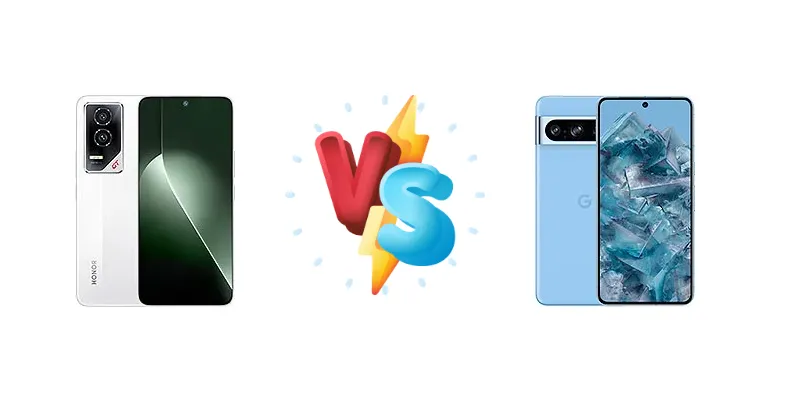
The Honor GT and Google Pixel 8 Pro represent distinct philosophies in the Android flagship space. The Honor GT prioritizes raw performance with the latest Snapdragon silicon and blazing-fast charging, while the Pixel 8 Pro focuses on a refined software experience, computational photography, and AI-driven features powered by Google’s Tensor G3 chip. This comparison dissects these differences to determine which phone best suits your needs.
🏆 Quick Verdict
For users prioritizing unadulterated speed and gaming prowess, the Honor GT emerges as the winner. Its Snapdragon 8 Gen 3 chipset delivers superior performance, and 100W charging is significantly faster than the Pixel 8 Pro’s 30W. However, the Pixel 8 Pro’s exceptional camera and AI capabilities make it the better choice for photography enthusiasts and those deeply integrated into the Google ecosystem.
| Network |
|---|
| 2G bands | GSM 850 / 900 / 1800 / 1900 | GSM 850 / 900 / 1800 / 1900 |
| 3G bands | HSDPA 850 / 900 / 1900 / 2100 | HSDPA 800 / 850 / 900 / 1700(AWS) / 1900 / 2100 |
| 4G bands | LTE | 1, 2, 3, 4, 5, 7, 8, 12, 13, 14, 17, 18, 19, 20, 25, 26, 28, 29, 30, 38, 39, 40, 41, 46, 48, 66, 71 - G1MNW |
| 5G bands | SA/NSA | 1, 2, 3, 5, 7, 8, 12, 20, 25, 26, 28, 29, 30, 38, 40, 41, 48, 66, 70, 71, 77, 78, 257, 258, 260, 261 SA/NSA/Sub6/mmWave - G1MNW |
| Speed | HSPA, LTE, 5G | HSPA, LTE, 5G |
| Technology | GSM / HSPA / LTE / 5G | GSM / HSPA / LTE / 5G |
| Launch |
|---|
| Announced | 2024, December 17 | 2023, October 04 |
| Status | Available. Released 2024, December 17 | Available. Released 2023, October 12 |
| Body |
|---|
| Build | - | Glass front (Gorilla Glass Victus 2), glass back (Gorilla Glass Victus 2), aluminum frame |
| Dimensions | 161 x 74.2 x 7.7 mm (6.34 x 2.92 x 0.30 in) | 162.6 x 76.5 x 8.8 mm (6.40 x 3.01 x 0.35 in) |
| SIM | Nano-SIM + Nano-SIM | Nano-SIM + eSIM |
| Weight | 196 g (6.91 oz) | 213 g (7.51 oz) |
| Display |
|---|
| Protection | - | Corning Gorilla Glass Victus 2 |
| Resolution | 1200 x 2664 pixels (~436 ppi density) | 1344 x 2992 pixels, 20:9 ratio (~489 ppi density) |
| Size | 6.7 inches, 108.5 cm2 (~90.8% screen-to-body ratio) | 6.7 inches, 108.7 cm2 (~87.4% screen-to-body ratio) |
| Type | AMOLED, 1B colors, 120Hz, HDR, 1200 nits (HBM), 4000 nits (peak) | LTPO OLED, 120Hz, HDR10+, 1600 nits (HBM), 2400 nits (peak) |
| Platform |
|---|
| CPU | 8-core (1x3.3GHz Cortex-X4 & 3x3.2GHz Cortex-A720 & 2x3.0GHz Cortex-A720 & 2x2.3GHz Cortex-A520) | Nona-core (1x3.0 GHz Cortex-X3 & 4x2.45 GHz Cortex-A715 & 4x2.15 GHz Cortex-A510) |
| Chipset | Qualcomm SM8650-AB Snapdragon 8 Gen 3 (4 nm) | Google Tensor G3 (4 nm) |
| GPU | Adreno 750 | Immortalis-G715s MC10 |
| OS | Android 15, MagicOS 9 | Android 14, upgradable to Android 16, up to 7 major Android upgrades |
| Memory |
|---|
| Card slot | No | No |
| Internal | 256GB 12GB RAM, 256GB 16GB RAM, 512GB 12GB RAM, 512GB 16GB RAM, 1TB 16GB RAM | 128GB 12GB RAM, 256GB 12GB RAM, 512GB 12GB RAM, 1TB 12GB RAM |
| Main Camera |
|---|
| Dual | 50 MP, f/2.0, (wide), 1/1.56", 1.0µm, PDAF, OIS
12 MP, f/2.2, 112˚ (ultrawide), AF | - |
| Features | LED flash, HDR, panorama | Multi-zone Laser AF, Dual-LED flash, Pixel Shift, Ultra-HDR, panorama, Best Take, Zoom Enhance |
| Triple | - | 50 MP, f/1.7, 25mm (wide), 1/1.31", 1.2µm, dual pixel PDAF, OIS
48 MP, f/2.8, 113mm (periscope telephoto), 1/2.55", 0.7µm, dual pixel PDAF, OIS, 5x optical zoom
48 MP, f/2.0, 126˚ (ultrawide), 1/2.0", 0.8µm, dual pixel PDAF |
| Video | 4K, 1080p, gyro-EIS, OIS | 4K@30/60fps, 1080p@24/30/60/120/240fps; gyro-EIS, OIS, 10-bit HDR |
| Selfie camera |
|---|
| Features | HDR | HDR, panorama |
| Single | 16 MP, f/2.5, (wide) | 10.5 MP, f/2.2, 20mm (ultrawide), 1/3.1", 1.22µm, PDAF |
| Video | 1080p, gyro-EIS | 4K@24/30/60fps, 1080p@30/60fps |
| Sound |
|---|
| 35mm jack | No | No |
| Loudspeaker | Yes, with stereo speakers | Yes, with stereo speakers |
| Comms |
|---|
| Bluetooth | 5.3, A2DP, LE, aptX HD | 5.3, A2DP, LE, aptX HD |
| Infrared port | Yes | - |
| NFC | Yes | Yes |
| Positioning | GPS, GALILEO, GLONASS, BDS (B1I+B1c) | GPS (L1+L5), GLONASS (G1), GALILEO (E1+E5a), QZSS (L1+L5) |
| Radio | No | No |
| USB | USB Type-C 2.0, OTG | USB Type-C 3.2 |
| WLAN | Wi-Fi 802.11 a/b/g/n/ac/6/7, dual-band, Wi-Fi Direct | Wi-Fi 802.11 a/b/g/n/ac/6e/7, tri-band, Wi-Fi Direct |
| Features |
|---|
| Sensors | Fingerprint (under display, optical), accelerometer, gyro, compass, ultrasound proximity | Fingerprint (under display, optical), accelerometer, gyro, proximity, compass, barometer, thermometer (skin temperature) |
| Battery |
|---|
| Charging | 100W wired, 60% in 15 min
5W reverse wired | 30W wired, PD3.0, PPS, 50% in 30 min
23W wireless
Reverse wireless
Bypass charging |
| Type | Si/C Li-Ion 5300 mAh | Li-Ion 5050 mAh |
| Misc |
|---|
| Colors | Black, White, Green | Obsidian, Porcelain, Bay, Mint |
| Models | AMG-AN00 | GC3VE, G1MNW |
| Price | About 290 EUR | € 362.00 / $ 289.97 / £ 329.95 / ₹ 54,999 |
Honor GT
- Significantly faster 100W charging
- More powerful Snapdragon 8 Gen 3 processor
- Likely superior gaming performance
- Camera likely lacks Pixel 8 Pro’s computational photography
- Software support may not match Pixel 8 Pro’s longevity
Google Pixel 8 Pro
- Exceptional camera with advanced AI features
- Long-term software support and updates
- Excellent battery life and wireless charging
- Slower 30W charging
- Tensor G3 processor is less powerful than Snapdragon 8 Gen 3
Display Comparison
The Pixel 8 Pro boasts a measured peak brightness of 1600 nits, ensuring excellent visibility even in direct sunlight. While the Honor GT’s display specs aren’t provided, Honor typically utilizes high-quality panels. The Pixel 8 Pro’s LTPO technology allows for a variable refresh rate, optimizing battery life by dynamically adjusting the refresh rate based on content. The Pixel 8 Pro’s display is likely to offer superior color accuracy and calibration, benefiting content creators and those who demand accurate visuals. The Honor GT’s display, while likely vibrant, may not match the Pixel 8 Pro’s refinement.
Camera Comparison
The Pixel 8 Pro is renowned for its computational photography prowess. While specific sensor details aren’t provided, Google’s image processing algorithms are a significant differentiator. The Pixel 8 Pro excels in dynamic range, low-light performance, and portrait mode. The Honor GT’s camera specs are not detailed, but Honor often focuses on high megapixel counts. However, megapixel count isn’t everything; the Pixel 8 Pro’s software optimization and features like Magic Eraser and Best Take provide a more compelling overall photography experience. The Pixel 8 Pro’s video capabilities are also likely to be superior, benefiting from Google’s advanced video processing.
Performance
The Honor GT’s Qualcomm Snapdragon 8 Gen 3 (4nm) is a powerhouse, featuring a nona-core CPU configuration with a prime Cortex-X4 core clocked at 3.3GHz. This architecture is designed for peak performance in demanding tasks. In contrast, the Pixel 8 Pro utilizes Google’s Tensor G3 (4nm) chip, a nona-core processor with a Cortex-X3 prime core at 3.0GHz. While the Tensor G3 excels in AI and machine learning tasks, the Snapdragon 8 Gen 3 demonstrably outperforms it in raw CPU and GPU benchmarks. The Honor GT’s likely use of LPDDR5x RAM further enhances its performance advantage. The Pixel 8 Pro’s thermal management will be crucial to prevent throttling during sustained workloads, a potential area where the Snapdragon 8 Gen 3’s efficiency could shine.
Battery Life
The Pixel 8 Pro achieves an impressive 11:14h active use score, indicating excellent battery life. Its endurance rating of 90 hours further reinforces this. The Honor GT’s battery capacity is not specified, but its 100W wired charging is a game-changer, achieving 60% charge in just 15 minutes. The Pixel 8 Pro’s 30W charging, while supporting PD3.0 and PPS, takes 30 minutes to reach 50%. The Honor GT’s faster charging is ideal for users who frequently need to top up their battery quickly. The Pixel 8 Pro’s wireless charging (23W) and reverse wireless charging offer added convenience, while the Honor GT provides 5W reverse wired charging.
Buying Guide
Buy the Honor GT if you need a phone for demanding mobile gaming, frequent multitasking, and value incredibly fast charging speeds. You’ll benefit from the Snapdragon 8 Gen 3’s raw power and the ability to quickly top up your battery. Buy the Google Pixel 8 Pro if you prefer a seamless software experience, prioritize computational photography and AI features, and value long-term software support and a consistently excellent camera experience.
Frequently Asked Questions
❓ Does the Honor GT’s Snapdragon 8 Gen 3 chipset get excessively hot during prolonged gaming sessions?
The Snapdragon 8 Gen 3 is built on a 4nm process, offering improved thermal efficiency compared to previous generations. While some heat generation is inevitable during intense gaming, the Honor GT likely incorporates advanced cooling solutions to mitigate throttling and maintain consistent performance. However, sustained peak performance will still generate heat.
❓ How does the Google Tensor G3’s AI capabilities translate into real-world benefits for Pixel 8 Pro users?
The Tensor G3 powers features like Magic Eraser, Photo Unblur, and Best Take, significantly enhancing the photography experience. It also enables faster and more accurate voice typing, live translation, and improved Assistant features. These AI-driven capabilities are deeply integrated into the Pixel 8 Pro’s software, providing a more intelligent and intuitive user experience.
❓ Can the Pixel 8 Pro’s ‘Bypass Charging’ feature extend battery lifespan?
Yes, the Pixel 8 Pro’s Bypass Charging feature allows the phone to draw power directly from the charger, reducing stress on the battery during overnight charging. This can help to slow down battery degradation over time, potentially extending the overall lifespan of the battery.