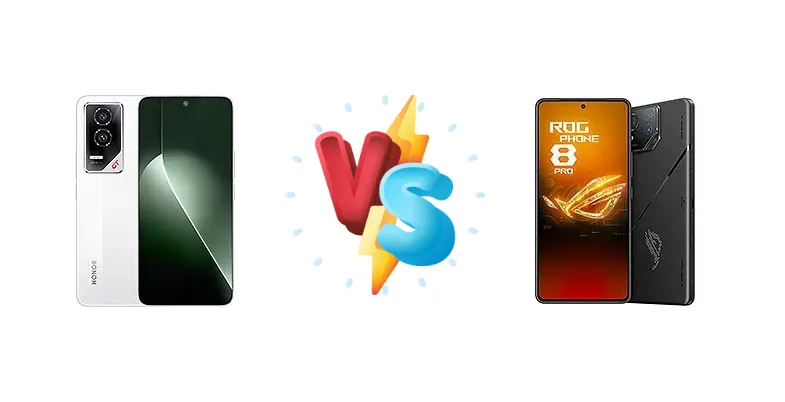
Both the Honor GT and Asus ROG Phone 8 Pro represent the pinnacle of Android performance, powered by the latest Qualcomm Snapdragon 8 Gen 3. However, they cater to slightly different audiences. The Honor GT aims for a balance of power and mainstream appeal, while the ROG Phone 8 Pro is unapologetically geared towards hardcore mobile gamers. This comparison dissects their strengths and weaknesses to determine which device reigns supreme.
🏆 Quick Verdict
For the average user prioritizing raw speed and incredibly fast charging, the Honor GT emerges as the winner. Its 100W charging significantly outperforms the ROG Phone 8 Pro's 65W (International) or 30W (India) capabilities. However, gamers who value sustained performance and a brighter display will find the ROG Phone 8 Pro a more compelling choice.
| Network |
|---|
| 2G bands | GSM 850 / 900 / 1800 / 1900 | GSM 850 / 900 / 1800 / 1900 |
| 3G bands | HSDPA 850 / 900 / 1900 / 2100 | HSDPA 850 / 900 / 1700(AWS) / 1800 / 1900 / 2100 - International |
| 4G bands | LTE | 1, 2, 3, 4, 5, 7, 8, 12, 17, 18, 19, 20, 25, 26, 28, 32, 34, 38, 39, 40, 41, 42, 43, 48, 66 - International |
| 5G bands | SA/NSA | 1, 2, 3, 5, 7, 8, 12, 18, 20, 25, 26, 28, 38, 40, 41, 48, 66, 77, 78, 79 SA/NSA/Sub6 - International |
| Speed | HSPA, LTE, 5G | HSPA, LTE (Up to 7CA), 5G |
| Technology | GSM / HSPA / LTE / 5G | GSM / CDMA / HSPA / LTE / 5G |
| Launch |
|---|
| Announced | 2024, December 17 | 2024, January 08 |
| Status | Available. Released 2024, December 17 | Available. Released 2024, January 18 |
| Body |
|---|
| Build | - | Glass front (Gorilla Glass Victus 2), glass back (Gorilla Glass), aluminum frame |
| Dimensions | 161 x 74.2 x 7.7 mm (6.34 x 2.92 x 0.30 in) | 163.8 x 76.8 x 8.9 mm (6.45 x 3.02 x 0.35 in) |
| SIM | Nano-SIM + Nano-SIM | Nano-SIM + Nano-SIM |
| Weight | 196 g (6.91 oz) | 225 g (7.94 oz) |
| Display |
|---|
| Protection | - | Corning Gorilla Glass Victus 2 |
| Resolution | 1200 x 2664 pixels (~436 ppi density) | 1080 x 2400 pixels, 20:9 ratio (~388 ppi density) |
| Size | 6.7 inches, 108.5 cm2 (~90.8% screen-to-body ratio) | 6.78 inches, 111.0 cm2 (~88.2% screen-to-body ratio) |
| Type | AMOLED, 1B colors, 120Hz, HDR, 1200 nits (HBM), 4000 nits (peak) | LTPO AMOLED, 1B colors, 165Hz, HDR10, 1600 nits (HBM), 2500 nits (peak) |
| Platform |
|---|
| CPU | 8-core (1x3.3GHz Cortex-X4 & 3x3.2GHz Cortex-A720 & 2x3.0GHz Cortex-A720 & 2x2.3GHz Cortex-A520) | Octa-core (1x3.3 GHz Cortex-X4 & 3x3.2 GHz Cortex-A720 & 2x3.0 GHz Cortex-A720 & 2x2.3 GHz Cortex-A520) |
| Chipset | Qualcomm SM8650-AB Snapdragon 8 Gen 3 (4 nm) | Qualcomm SM8650-AB Snapdragon 8 Gen 3 (4 nm) |
| GPU | Adreno 750 | Adreno 750 |
| OS | Android 15, MagicOS 9 | Android 14, up to 2 major Android upgrades |
| Memory |
|---|
| Card slot | No | No |
| Internal | 256GB 12GB RAM, 256GB 16GB RAM, 512GB 12GB RAM, 512GB 16GB RAM, 1TB 16GB RAM | 512GB 16GB RAM, 1TB 24GB RAM |
| Main Camera |
|---|
| Dual | 50 MP, f/2.0, (wide), 1/1.56", 1.0µm, PDAF, OIS
12 MP, f/2.2, 112˚ (ultrawide), AF | - |
| Features | LED flash, HDR, panorama | LED flash, HDR, panorama |
| Triple | - | 50 MP, f/1.9, 24mm (wide), 1/1.56", 1.0µm, PDAF, gimbal OIS
32 MP, f/2.4, (telephoto), 1/3.2", 0.7µm, PDAF, OIS, 3x optical zoom
13 MP, f/2.2, 13mm, 120˚ (ultrawide) |
| Video | 4K, 1080p, gyro-EIS, OIS | 8K@24fps, 4K@30/60fps, 1080p@30/60/120/240fps, 720p@480fps; gyro-EIS, HDR10+ |
| Selfie camera |
|---|
| Features | HDR | Panorama, HDR |
| Single | 16 MP, f/2.5, (wide) | 32 MP, f/2.5, 22mm (wide), 1/3.2", 0.7µm |
| Video | 1080p, gyro-EIS | 1080p@30fps |
| Sound |
|---|
| 35mm jack | No | Yes |
| Loudspeaker | Yes, with stereo speakers | Yes, with stereo speakers |
| Comms |
|---|
| Bluetooth | 5.3, A2DP, LE, aptX HD | 5.4, A2DP, LE, aptX HD, aptX Adaptive, aptX Lossless |
| Infrared port | Yes | - |
| NFC | Yes | Yes |
| Positioning | GPS, GALILEO, GLONASS, BDS (B1I+B1c) | GPS (L1+L5), BDS (B1I+B1c+B2a), GALILEO (E1+E5a), QZSS (L1+L5), NavIC (L5), GLONASS |
| Radio | No | No |
| USB | USB Type-C 2.0, OTG | USB Type-C (side), DisplayPort 1.4; USB Type-C (bottom), OTG |
| WLAN | Wi-Fi 802.11 a/b/g/n/ac/6/7, dual-band, Wi-Fi Direct | Wi-Fi 802.11 a/b/g/n/ac/6e/7, tri-band, Wi-Fi Direct |
| Features |
|---|
| Sensors | Fingerprint (under display, optical), accelerometer, gyro, compass, ultrasound proximity | Fingerprint (under display, optical), accelerometer, gyro, proximity, compass |
| Battery |
|---|
| Charging | 100W wired, 60% in 15 min
5W reverse wired | 65W wired, PD3.0, PPS, QC5, 100% in 39 min - International
30W wired, PD3.0, PPS - India
15W wireless (Qi)
10W reverse wired |
| Type | Si/C Li-Ion 5300 mAh | 5500 mAh |
| Misc |
|---|
| Colors | Black, White, Green | Phantom Black |
| Models | AMG-AN00 | AI2401, AI2401_A, AI2401_D |
| Price | About 290 EUR | $ 1,157.98 / £ 1,693.75 / € 632.66 |
Honor GT
- Incredibly fast 100W charging
- Potentially more affordable price point
- Sleek and mainstream design
- Potential for thermal throttling under sustained load
- Camera specs currently unknown
Asus ROG Phone 8 Pro
- Exceptional battery life (14:43h active use)
- Brighter display (1765 nits)
- Advanced cooling system for sustained performance
- Slower charging speed (65W/30W)
- Higher price tag
Display Comparison
The Asus ROG Phone 8 Pro boasts a significantly brighter display, reaching a measured 1765 nits. This is crucial for outdoor visibility and HDR content consumption. While the Honor GT’s display specs aren’t provided, the ROG Phone’s brightness advantage is substantial. Both devices likely utilize high refresh rate panels, but the ROG Phone’s brightness gives it a clear edge for users who frequently use their phones in bright environments. The ROG Phone 8 Pro’s display is also likely to have a more sophisticated color calibration for accurate gaming visuals.
Camera Comparison
Camera details for the Honor GT are absent, making a direct comparison difficult. The Asus ROG Phone 8 Pro’s camera is described as capable for both photo and video, but lacks specific sensor details. Given the ROG Phone’s gaming focus, it’s reasonable to assume the camera system is good, but not a primary selling point. Without knowing the Honor GT’s sensor size, aperture, or image processing capabilities, it’s impossible to definitively declare a winner. However, ROG phones historically prioritize functionality over photographic excellence.
Performance
Both the Honor GT and Asus ROG Phone 8 Pro are equipped with the Qualcomm SM8650-AB Snapdragon 8 Gen 3 (4 nm) chipset, featuring an identical CPU configuration: 1x3.3GHz Cortex-X4, 3x3.2GHz Cortex-A720, 2x3.0GHz Cortex-A720, and 2x2.3GHz Cortex-A520. This means theoretical processing power is nearly identical. However, the ROG Phone 8 Pro’s advanced cooling system – a staple of the ROG line – is likely to allow for sustained peak performance for longer durations, mitigating thermal throttling during extended gaming sessions. The Honor GT, while powerful, may experience more throttling under heavy load. RAM configurations are not specified, but faster LPDDR5x RAM would benefit both devices.
Battery Life
The Asus ROG Phone 8 Pro demonstrates impressive battery life, achieving 14 hours and 43 minutes of active use. The Honor GT’s battery capacity is not specified, but its 100W wired charging is a significant advantage. It can reach 60% charge in just 15 minutes, while the ROG Phone 8 Pro takes 39 minutes for a full charge (International) or longer in India (30W). This difference in charging speed is substantial for users who frequently need to top up their battery quickly. The ROG Phone’s longer active use time suggests a larger battery capacity, but the Honor GT’s faster charging could offset this difference for many users.
Buying Guide
Buy the Honor GT if you need blazing-fast charging, a sleek design, and top-tier performance for everyday tasks and casual gaming. It's the ideal choice for users who want a powerful phone that doesn't scream 'gamer.' Buy the Asus ROG Phone 8 Pro if you prioritize extended gaming sessions, a brighter, more vibrant display, and features specifically tailored for competitive mobile gaming, even if it means sacrificing some charging speed.
Frequently Asked Questions
❓ How much faster is the Honor GT's charging compared to the ROG Phone 8 Pro in a real-world scenario?
The Honor GT's 100W charging can add 60% battery in 15 minutes, while the ROG Phone 8 Pro (International) takes approximately 20-25 minutes to reach the same level. In India, with the 30W charging, the ROG Phone 8 Pro will take significantly longer – over an hour to reach 60%.
❓ Will the Snapdragon 8 Gen 3 in the Honor GT overheat during prolonged gaming sessions?
While the Snapdragon 8 Gen 3 is a powerful chip, it can generate significant heat. The Honor GT may experience some thermal throttling during extended gaming, potentially leading to reduced performance. The ROG Phone 8 Pro, with its dedicated cooling system, is better equipped to handle sustained workloads.
❓ Does the Asus ROG Phone 8 Pro support external accessories like gamepads or cooling fans?
Yes, the ROG Phone 8 Pro is renowned for its extensive ecosystem of accessories. It supports a wide range of ROG accessories, including external gamepads, cooling fans, and even a second screen attachment, enhancing the gaming experience.
❓ What kind of reverse wireless charging capabilities does each phone offer?
The Honor GT offers 5W reverse wired charging, suitable for topping up small accessories. The ROG Phone 8 Pro provides 10W reverse wired charging and 15W wireless (Qi) reverse charging, offering more versatile options for charging other devices.