
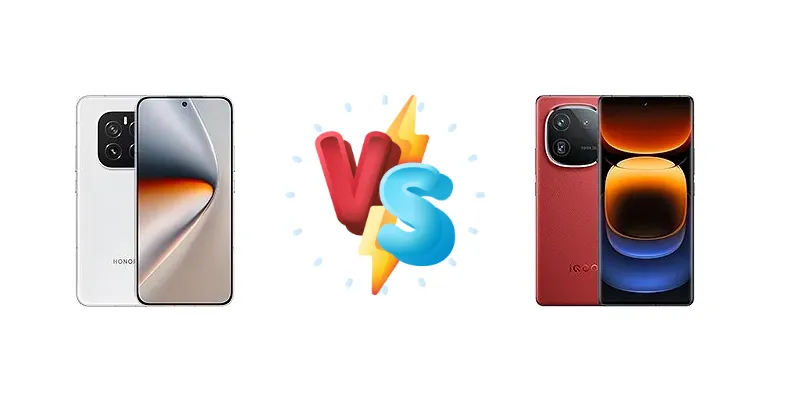
Honor GT Pro vs vivo iQOO 12 Pro: A Head-to-Head Performance and Charging Showdown
| Phones Images | |||||
|---|---|---|---|---|---|
|
🏆 Quick Verdict
For users prioritizing peak CPU performance and a potentially more responsive experience, the Honor GT Pro edges out the iQOO 12 Pro. However, the iQOO 12 Pro’s significantly faster 120W wired and 50W wireless charging, coupled with the Snapdragon 8 Gen 3’s efficiency, make it the more practical choice for most users.
| PHONES | ||
|---|---|---|
| Phone Names | Honor GT Pro | vivo iQOO 12 Pro |
| Network | ||
|---|---|---|
| 2G bands | GSM 850 / 900 / 1800 / 1900 | GSM 850 / 900 / 1800 / 1900 |
| 3G bands | HSDPA 800 / 850 / 900 / 1700(AWS) / 1900 / 2100 | HSDPA 800 / 850 / 900 / 1700(AWS) / 1900 / 2100 |
| 4G bands | LTE | 1, 2, 3, 4, 5, 7, 8, 12, 17, 18, 19, 20, 25, 26, 28, 34, 38, 39, 40, 41, 42, 66 |
| 5G bands | SA/NSA | 1, 2, 3, 5, 7, 8, 12, 20, 25, 26, 28, 66, 38, 40, 41, 77, 78 SA/NSA |
| Speed | HSPA, LTE, 5G | HSPA, LTE, 5G |
| Technology | GSM / HSPA / LTE / 5G | GSM / CDMA / HSPA / CDMA2000 / LTE / 5G |
| Launch | ||
|---|---|---|
| Announced | 2025, April 23 | 2023, November 07 |
| Status | Available. Released 2025, April 23 | Available. Released 2023, November 14 |
| Body | ||
|---|---|---|
| Build | Glass front (Giant rhino glass), aluminum frame, fiber-reinforced plastic back | - |
| Dimensions | 162.1 x 75.7 x 8.6 mm (6.38 x 2.98 x 0.34 in) | 164.6 x 75.4 x 8.6 mm or 8.8 mm |
| SIM | Nano-SIM + Nano-SIM | Nano-SIM + Nano-SIM |
| Weight | 212 g (7.48 oz) | 205 g or 210 g (7.23 oz) |
| Display | ||
|---|---|---|
| Protection | Giant rhino glass | - |
| Resolution | 1224 x 2800 pixels (~453 ppi density) | 1440 x 3200 pixels, 20:9 ratio (~518 ppi density) |
| Size | 6.78 inches, 107.9 cm2 (~87.9% screen-to-body ratio) | 6.78 inches, 111.0 cm2 (~89.4% screen-to-body ratio) |
| Type | LTPO AMOLED, 1B colors, 144Hz, 4320Hz PWM, HDR Vivid, 1600 nits (HBM), 6000 nits (peak) | LTPO AMOLED, 1B colors, 144Hz, HDR10+, 1600 nits (HBM), 3000 nits (peak) |
| Platform | ||
|---|---|---|
| CPU | Octa-core (2x4.47 GHz Oryon V2 Phoenix L + 6x3.53 GHz Oryon V2 Phoenix M) | Octa-core (1x3.3 GHz Cortex-X4 & 3x3.2 GHz Cortex-A720 & 2x3.0 GHz Cortex-A720 & 2x2.3 GHz Cortex-A520) |
| Chipset | Qualcomm SM8750-AB Snapdragon 8 Elite (3 nm) | Qualcomm SM8650-AB Snapdragon 8 Gen 3 (4 nm) |
| GPU | Adreno 830 | Adreno 750 |
| OS | Android 15, MagicOS 9 | Android 14, up to 2 major Android upgrades, Funtouch 14 (International), OriginOS 4 (China) |
| Memory | ||
|---|---|---|
| Card slot | No | No |
| Internal | 256GB 12GB RAM, 512GB 12GB RAM, 512GB 16GB RAM, 1TB 16GB RAM | 256GB 16GB RAM, 512GB 16GB RAM, 1TB 16GB RAM |
| Main Camera | ||
|---|---|---|
| Features | LED flash, HDR, panorama | Color spectrum sensor, Dual-LED flash, HDR, panorama |
| Triple | 50 MP, f/2.0, (wide), 1/1.56", 1.0µm, PDAF, OIS 50 MP, f/2.4, (telephoto), 1/2.0", 0.8µm, PDAF, OIS, 3x optical zoom 50 MP, f/2.0, 122˚ (ultrawide), AF | 50 MP, f/1.7, 23mm (wide), 1/1.3", 1.2µm, ulti-directional PDAF, OIS 64 MP, f/2.6, 70mm (periscope telephoto), 1/2.0", PDAF, OIS, 3x optical zoom 50 MP, f/2.0, 15mm, 119˚ (ultrawide), AF |
| Video | 4K@24/30/60fps, 1080p@30/60/120/240fps, gyro-EIS, OIS, HDR Vivid | 8K@30fps, 4K@24/30/60fps, 1080p@30/60/120/240fps, gyro-EIS |
| Selfie camera | ||
|---|---|---|
| Features | HDR | HDR |
| Single | 50 MP, f/2.0, 22mm (wide) | 16 MP, f/2.5, (wide) |
| Video | 4K@30/60fps, 1080p@30/60fps, gyro-EIS | 1080p@30fps, gyro-EIS |
| Sound | ||
|---|---|---|
| 35mm jack | No | No |
| Loudspeaker | Yes, with stereo speakers | Yes, with stereo speakers |
| Comms | ||
|---|---|---|
| Bluetooth | 5.4, A2DP, LE, aptX HD, aptX Adaptive | 5.4, A2DP, LE, aptX HD, aptX Adaptive, aptX Lossless |
| Infrared port | Yes | Yes |
| NFC | Yes | Yes |
| Positioning | GPS (L1+L5), BDS (B1I+B1c+B2a), GALILEO (E5a+E5b), QZSS (L1+L5), NavIC (L1+L5), GLONASS | GPS (L1+L5), GLONASS (G1), BDS (B1I+B1c+B2a), GALILEO (E1+E5a), QZSS (L1+L5) |
| Radio | No | No |
| USB | USB Type-C, OTG | USB Type-C 2.0, OTG |
| WLAN | Wi-Fi 802.11 a/b/g/n/ac/6/7, dual-band, Wi-Fi Direct | Wi-Fi 802.11 a/b/g/n/ac/6/7, tri-band, Wi-Fi Direct |
| Features | ||
|---|---|---|
| Sensors | Fingerprint (under display, ultrasonic), accelerometer, proximity, gyro, compass | Fingerprint (under display, ultrasonic), accelerometer, gyro, proximity, compass |
| Battery | ||
|---|---|---|
| Charging | 90W wired 5W reverse wired | 120W wired 50W wireless 10W reverse wireless |
| Type | Si/C Li-Ion 7200 mAh | 5100 mAh |
| Misc | ||
|---|---|---|
| Colors | Black, White, Gold | Black, Red, White (BMW M branding) |
| Models | PPG-AN00 | V2329A |
| Price | About 440 EUR | About 650 EUR |
Honor GT Pro
- Potentially faster CPU performance due to Oryon cores.
- 3nm Snapdragon 8 Elite offers cutting-edge technology.
- 90W wired charging is still very fast.
- Likely lower battery efficiency compared to the iQOO 12 Pro.
- No wireless charging support.
- Reverse charging is limited to 5W.
vivo iQOO 12 Pro
- 120W wired charging for incredibly fast top-ups.
- 50W wireless charging provides convenient power options.
- Snapdragon 8 Gen 3 offers excellent performance and efficiency.
- CPU clock speeds are lower than the Honor GT Pro.
- May not match the GT Pro in peak single-core performance.
- Image processing style may not appeal to all users.
Display Comparison
While display specs are absent from the provided data, both phones likely feature high-refresh-rate AMOLED panels typical of their price bracket. The key difference will likely be peak brightness and color calibration. Given vivo’s history with display technology, the iQOO 12 Pro may offer a slightly more color-accurate panel. However, without specific data, this remains speculative. Both will likely support HDR10+.
Camera Comparison
Without camera specifications, a direct comparison is impossible. However, both brands typically equip their flagships with high-resolution sensors and optical image stabilization (OIS). The iQOO series often leans towards vibrant, saturated colors, while Honor tends to aim for more natural image processing. The absence of details like sensor size and aperture makes it difficult to assess which phone will excel in low-light photography. We can assume both will offer capable camera systems, but the specifics will determine the winner.
Performance
The core battle lies in the chipsets. The Honor GT Pro’s Snapdragon 8 Elite, featuring Oryon V2 Phoenix cores, boasts higher clock speeds (up to 4.47 GHz) than the iQOO 12 Pro’s Snapdragon 8 Gen 3 (3.3 GHz). The Oryon architecture, designed by Nuvia, prioritizes single-core performance, potentially giving the GT Pro an edge in responsiveness and tasks that aren’t heavily multi-threaded. However, the Snapdragon 8 Gen 3, built on a 4nm process, is more power-efficient. The GT Pro’s 3nm process *should* also be efficient, but the higher clock speeds may negate some of those gains. The iQOO 12 Pro’s Cortex-X4 prime core is a strong performer, and its overall architecture is optimized for sustained performance. The GT Pro’s advantage is likely to be most noticeable in short bursts of intense activity.
Battery Life
The iQOO 12 Pro’s charging capabilities are a clear advantage. 120W wired charging will significantly reduce charging times compared to the Honor GT Pro’s 90W. Furthermore, the iQOO 12 Pro adds 50W wireless charging, a feature absent on the GT Pro. While battery capacity isn’t specified, the faster charging speeds of the iQOO 12 Pro mitigate the impact of a potentially smaller battery. The 10W reverse wireless charging on the GT Pro is a minor addition, while the iQOO 12 Pro offers a more substantial 5W reverse wired option.
Buying Guide
Buy the Honor GT Pro if you are a power user demanding the absolute fastest CPU performance for tasks like video editing, emulation, or demanding mobile games, and are willing to trade some battery efficiency for it. Buy the vivo iQOO 12 Pro if you prioritize all-day battery life, incredibly fast charging (both wired and wireless), and a more balanced overall experience with the Snapdragon 8 Gen 3’s optimized performance.