
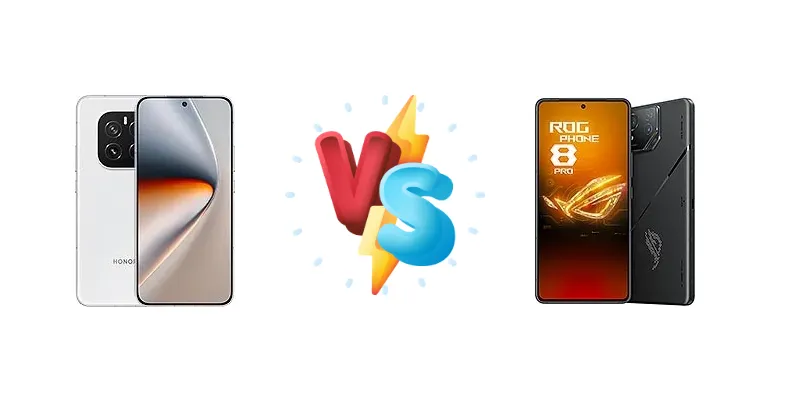
Honor GT Pro vs. Asus ROG Phone 8 Pro: A Battle of Snapdragon Titans
| Phones Images | |||||
|---|---|---|---|---|---|
|
🏆 Quick Verdict
For the average user prioritizing raw speed and charging convenience, the Honor GT Pro takes a slight edge thanks to its Snapdragon 8 Elite and 90W charging. However, gamers and those valuing sustained performance and battery life will find the Asus ROG Phone 8 Pro’s optimized thermal management and 14:43h active use score more compelling.
| PHONES | ||
|---|---|---|
| Phone Names | Honor GT Pro | Asus ROG Phone 8 Pro |
| Network | ||
|---|---|---|
| 2G bands | GSM 850 / 900 / 1800 / 1900 | GSM 850 / 900 / 1800 / 1900 |
| 3G bands | HSDPA 800 / 850 / 900 / 1700(AWS) / 1900 / 2100 | HSDPA 850 / 900 / 1700(AWS) / 1800 / 1900 / 2100 - International |
| 4G bands | LTE | 1, 2, 3, 4, 5, 7, 8, 12, 17, 18, 19, 20, 25, 26, 28, 32, 34, 38, 39, 40, 41, 42, 43, 48, 66 - International |
| 5G bands | SA/NSA | 1, 2, 3, 5, 7, 8, 12, 18, 20, 25, 26, 28, 38, 40, 41, 48, 66, 77, 78, 79 SA/NSA/Sub6 - International |
| Speed | HSPA, LTE, 5G | HSPA, LTE (Up to 7CA), 5G |
| Technology | GSM / HSPA / LTE / 5G | GSM / CDMA / HSPA / LTE / 5G |
| Launch | ||
|---|---|---|
| Announced | 2025, April 23 | 2024, January 08 |
| Status | Available. Released 2025, April 23 | Available. Released 2024, January 18 |
| Body | ||
|---|---|---|
| Build | Glass front (Giant rhino glass), aluminum frame, fiber-reinforced plastic back | Glass front (Gorilla Glass Victus 2), glass back (Gorilla Glass), aluminum frame |
| Dimensions | 162.1 x 75.7 x 8.6 mm (6.38 x 2.98 x 0.34 in) | 163.8 x 76.8 x 8.9 mm (6.45 x 3.02 x 0.35 in) |
| SIM | Nano-SIM + Nano-SIM | Nano-SIM + Nano-SIM |
| Weight | 212 g (7.48 oz) | 225 g (7.94 oz) |
| Display | ||
|---|---|---|
| Protection | Giant rhino glass | Corning Gorilla Glass Victus 2 |
| Resolution | 1224 x 2800 pixels (~453 ppi density) | 1080 x 2400 pixels, 20:9 ratio (~388 ppi density) |
| Size | 6.78 inches, 107.9 cm2 (~87.9% screen-to-body ratio) | 6.78 inches, 111.0 cm2 (~88.2% screen-to-body ratio) |
| Type | LTPO AMOLED, 1B colors, 144Hz, 4320Hz PWM, HDR Vivid, 1600 nits (HBM), 6000 nits (peak) | LTPO AMOLED, 1B colors, 165Hz, HDR10, 1600 nits (HBM), 2500 nits (peak) |
| Platform | ||
|---|---|---|
| CPU | Octa-core (2x4.47 GHz Oryon V2 Phoenix L + 6x3.53 GHz Oryon V2 Phoenix M) | Octa-core (1x3.3 GHz Cortex-X4 & 3x3.2 GHz Cortex-A720 & 2x3.0 GHz Cortex-A720 & 2x2.3 GHz Cortex-A520) |
| Chipset | Qualcomm SM8750-AB Snapdragon 8 Elite (3 nm) | Qualcomm SM8650-AB Snapdragon 8 Gen 3 (4 nm) |
| GPU | Adreno 830 | Adreno 750 |
| OS | Android 15, MagicOS 9 | Android 14, up to 2 major Android upgrades |
| Memory | ||
|---|---|---|
| Card slot | No | No |
| Internal | 256GB 12GB RAM, 512GB 12GB RAM, 512GB 16GB RAM, 1TB 16GB RAM | 512GB 16GB RAM, 1TB 24GB RAM |
| Main Camera | ||
|---|---|---|
| Features | LED flash, HDR, panorama | LED flash, HDR, panorama |
| Triple | 50 MP, f/2.0, (wide), 1/1.56", 1.0µm, PDAF, OIS 50 MP, f/2.4, (telephoto), 1/2.0", 0.8µm, PDAF, OIS, 3x optical zoom 50 MP, f/2.0, 122˚ (ultrawide), AF | 50 MP, f/1.9, 24mm (wide), 1/1.56", 1.0µm, PDAF, gimbal OIS 32 MP, f/2.4, (telephoto), 1/3.2", 0.7µm, PDAF, OIS, 3x optical zoom 13 MP, f/2.2, 13mm, 120˚ (ultrawide) |
| Video | 4K@24/30/60fps, 1080p@30/60/120/240fps, gyro-EIS, OIS, HDR Vivid | 8K@24fps, 4K@30/60fps, 1080p@30/60/120/240fps, 720p@480fps; gyro-EIS, HDR10+ |
| Selfie camera | ||
|---|---|---|
| Features | HDR | Panorama, HDR |
| Single | 50 MP, f/2.0, 22mm (wide) | 32 MP, f/2.5, 22mm (wide), 1/3.2", 0.7µm |
| Video | 4K@30/60fps, 1080p@30/60fps, gyro-EIS | 1080p@30fps |
| Sound | ||
|---|---|---|
| 35mm jack | No | Yes |
| Loudspeaker | Yes, with stereo speakers | Yes, with stereo speakers |
| Comms | ||
|---|---|---|
| Bluetooth | 5.4, A2DP, LE, aptX HD, aptX Adaptive | 5.4, A2DP, LE, aptX HD, aptX Adaptive, aptX Lossless |
| Infrared port | Yes | - |
| NFC | Yes | Yes |
| Positioning | GPS (L1+L5), BDS (B1I+B1c+B2a), GALILEO (E5a+E5b), QZSS (L1+L5), NavIC (L1+L5), GLONASS | GPS (L1+L5), BDS (B1I+B1c+B2a), GALILEO (E1+E5a), QZSS (L1+L5), NavIC (L5), GLONASS |
| Radio | No | No |
| USB | USB Type-C, OTG | USB Type-C (side), DisplayPort 1.4; USB Type-C (bottom), OTG |
| WLAN | Wi-Fi 802.11 a/b/g/n/ac/6/7, dual-band, Wi-Fi Direct | Wi-Fi 802.11 a/b/g/n/ac/6e/7, tri-band, Wi-Fi Direct |
| Features | ||
|---|---|---|
| Sensors | Fingerprint (under display, ultrasonic), accelerometer, proximity, gyro, compass | Fingerprint (under display, optical), accelerometer, gyro, proximity, compass |
| Battery | ||
|---|---|---|
| Charging | 90W wired 5W reverse wired | 65W wired, PD3.0, PPS, QC5, 100% in 39 min - International 30W wired, PD3.0, PPS - India 15W wireless (Qi) 10W reverse wired |
| Type | Si/C Li-Ion 7200 mAh | 5500 mAh |
| Misc | ||
|---|---|---|
| Colors | Black, White, Gold | Phantom Black |
| Models | PPG-AN00 | AI2401, AI2401_A, AI2401_D |
| Price | About 440 EUR | $ 1,157.98 / £ 1,693.75 / € 632.66 |
Honor GT Pro
- Potentially faster CPU performance with Snapdragon 8 Elite
- Ultra-fast 90W wired charging
- Likely more affordable price point (based on Honor's positioning)
- Battery life likely inferior to ROG Phone 8 Pro
- Camera specs unknown, potential for weaker performance
- Thermal management could be a concern under sustained load
Asus ROG Phone 8 Pro
- Exceptional battery life (14:43h active use)
- Brighter display (1765 nits)
- Optimized thermal management for sustained gaming
- Slower charging speeds (65W/30W)
- Higher price point (typical for ROG Phone)
- CPU performance may be slightly lower than Honor GT Pro
Display Comparison
The Asus ROG Phone 8 Pro boasts a significantly brighter display, reaching a measured 1765 nits, ensuring excellent visibility even in direct sunlight. While the Honor GT Pro’s display specs are not provided, the ROG Phone’s brightness advantage is substantial. Both likely employ high refresh rate panels, but the ROG Phone’s brightness and potential for LTPO technology (implied by its ROG lineage) suggest a more visually immersive experience. Bezels are likely comparable, given both phones target a premium aesthetic.
Camera Comparison
The provided data is limited regarding camera capabilities. The Asus ROG Phone 8 Pro is listed as having 'Photo / Video' capabilities, suggesting a versatile camera system, but details are absent. The Honor GT Pro’s camera specs are also missing. Given the ROG Phone’s history, it likely features a multi-camera setup with OIS on the main sensor. Without specific sensor sizes or apertures, it’s difficult to definitively compare image quality. We can assume both phones will offer competent camera performance, but the ROG Phone’s brand positioning suggests a greater emphasis on overall camera versatility.
Performance
This is where the core battle lies. The Honor GT Pro’s Snapdragon 8 Elite, built on a 3nm process, features a unique Oryon V2 Phoenix CPU architecture (2x4.47 GHz + 6x3.53 GHz) designed for peak performance. The Asus ROG Phone 8 Pro utilizes the Snapdragon 8 Gen 3 (4nm) with a more traditional core configuration (1x3.3 GHz Cortex-X4 + 3x3.2 GHz Cortex-A720 + 2x3.0 GHz Cortex-A720 + 2x2.3 GHz Cortex-A520). While the 8 Gen 3 is a proven performer, the 3nm node and Oryon architecture of the 8 Elite *should* deliver superior single-core and multi-core performance. However, the ROG Phone 8 Pro’s thermal design and software optimizations are crucial; the 4nm process offers better thermal efficiency, potentially mitigating throttling during prolonged gaming. The ROG Phone’s LPDDR5x RAM is standard for flagships, and the Honor GT Pro is expected to have similar RAM specifications.
Battery Life
The Asus ROG Phone 8 Pro clearly wins in battery endurance, achieving an impressive 14:43h of active use. The Honor GT Pro’s battery capacity is unknown, but its 90W wired charging is significantly faster than the ROG Phone’s 65W (International) or 30W (India) charging. The ROG Phone also offers 15W wireless charging and 10W reverse wireless charging, features absent in the Honor GT Pro. While the Honor GT Pro’s faster charging is convenient, the ROG Phone’s longer battery life is more valuable for users who spend extended periods away from a power source.
Buying Guide
Buy the Honor GT Pro if you need the absolute fastest CPU performance for demanding tasks and appreciate incredibly rapid charging. It’s ideal for power users who frequently edit videos, play graphically intensive games in short bursts, and want a phone that recharges in under an hour. Buy the Asus ROG Phone 8 Pro if you prefer extended gaming sessions, prioritize battery longevity, and value a more refined software experience tailored for mobile gaming, even if it means slightly slower peak CPU speeds.